More than 80% of the ocean is yet to be charted, explored – or even seen – by human beings. What lies in the deepest places of the world remains unknown; about 230,000 marine species have been recorded, but it’s estimated that there are over two million. Here, we present the work of artists previously featured in Aesthetica Magazine who are inspired by the delicate ecosystems of our seas and the urgency of our changing climate. Through their lenses, we navigate the boundary between meditative calm and ecological crisis, uncovering a fluid visual language that challenges us to rethink our fragile connection to water.


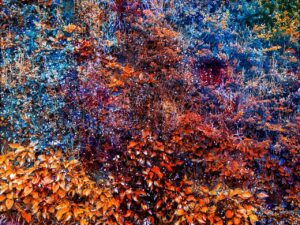
Brazilian image-maker Gleeson Paulino (b. 1988) brings us a rich and evocative collection of photographs. The series Batismo is an ode to his native country, offering a dreamlike chronicle of its inhabitants and biodiverse ecosystems. Water is a constant here, as figures make ripples in turquoise pools and emerge from deep rivers. Elsewhere, shimmering droplets cascade down close-up faces and leaves bob atop dark blue lakes. Paulino’s wider body of work brings together elements from across the creative spectrum: fashion collides with fine art, documentary and still life. The command of colour is striking, with canary yellow popping out from deep navy hues, indigoes and olive greens.

Jane Fulton Alt (b. 1951) has spent 40 years visiting a northern Wisconsin lake, capturing the fleeting beauty of water lilies at daybreak. “Their geometric forms and musical rhythms astonish me,” she explains. These vibrant, painterly images lead into her book, Still Life: A Photographer’s Journey Through Grief and Gardening. Created after the death of her husband, Howard, the work documents a garden he planted in response to climate change. Spanning abstraction to Dutch still life, Alt’s photographs offer a powerful reflection on stewardship, ecological crisis, and the cycle of growth and loss within a changing ecosystem.
janefultonalt.com | @janefultonalt


Alexej Sachov (b. 1972) is a passionate diver. In Hotel Guests Underwater (2022), the Ukrainian-German artist documents an emerging species of aquatic creature: the result of chance collisions between plastic pollutants in the deep. Yellow polythene bags, rainbow fishing nets and transparent bottles drift together and pull apart, echoing shapes and colours of familiar living creatures. Viewers can pick out silhouettes of jellyfish, seahorses and other animals from the debris. Each detailed shot is made whilst submerged beneath the waves, then selected from hundreds of outtakes. Sachov’s underwater worlds, with twinkling night skies, are a stark reminder of an omnipresent climate emergency.
sachov-art.com | @alexej.sachov

Insula is the Latin word for island. In the brain, the insular cortex is believed to be involved in consciousness and our awareness of emotions, including empathy and compassion. It’s from this etymology that Alexis Pichot’s (b. 1980) contemplative images of archipelagos emerge. Pichot is a French photographer known for producing work in the dead of night. In his work moonlight bounces off the ocean, creating a milk-white sheen on its surface. “I lived by the water – or was surrounded by water – for three years,” Pichot recalls.
alexispichot.com | @alexis_pichot
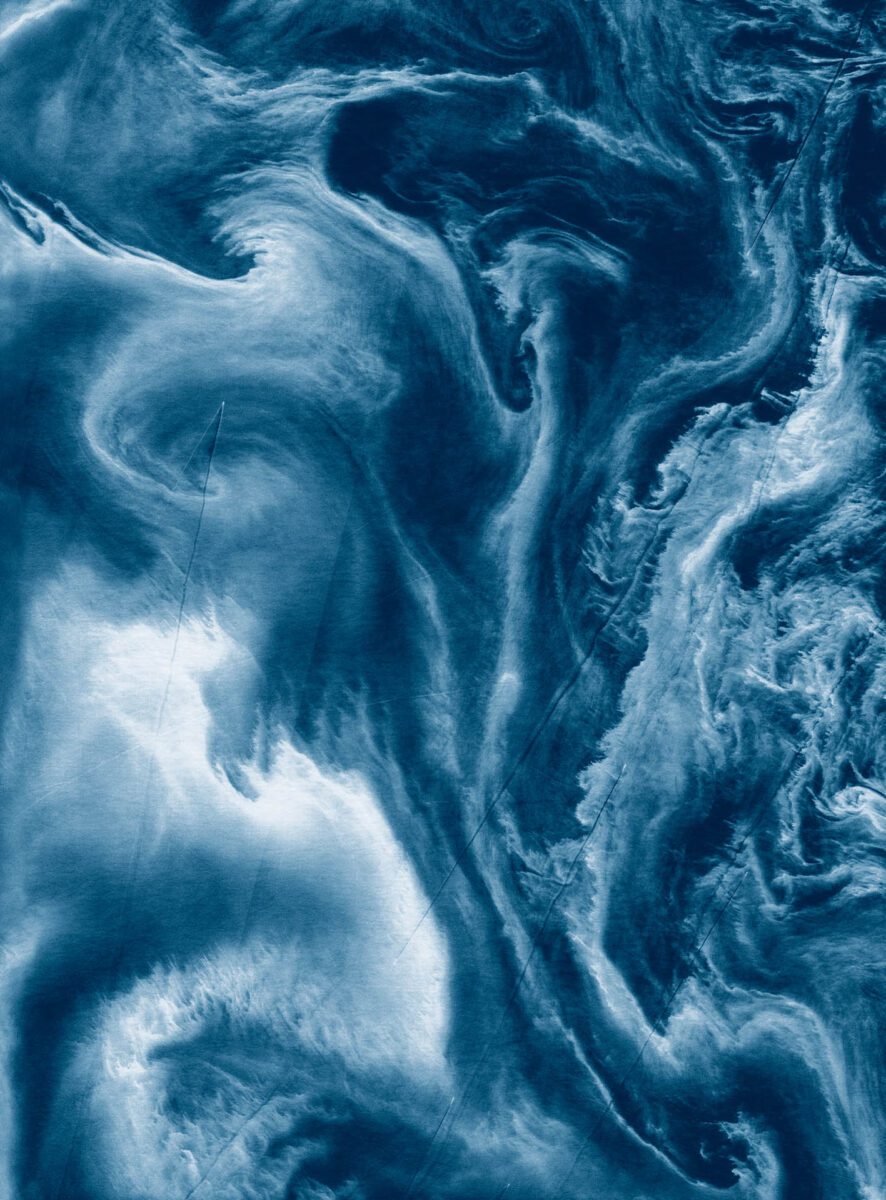
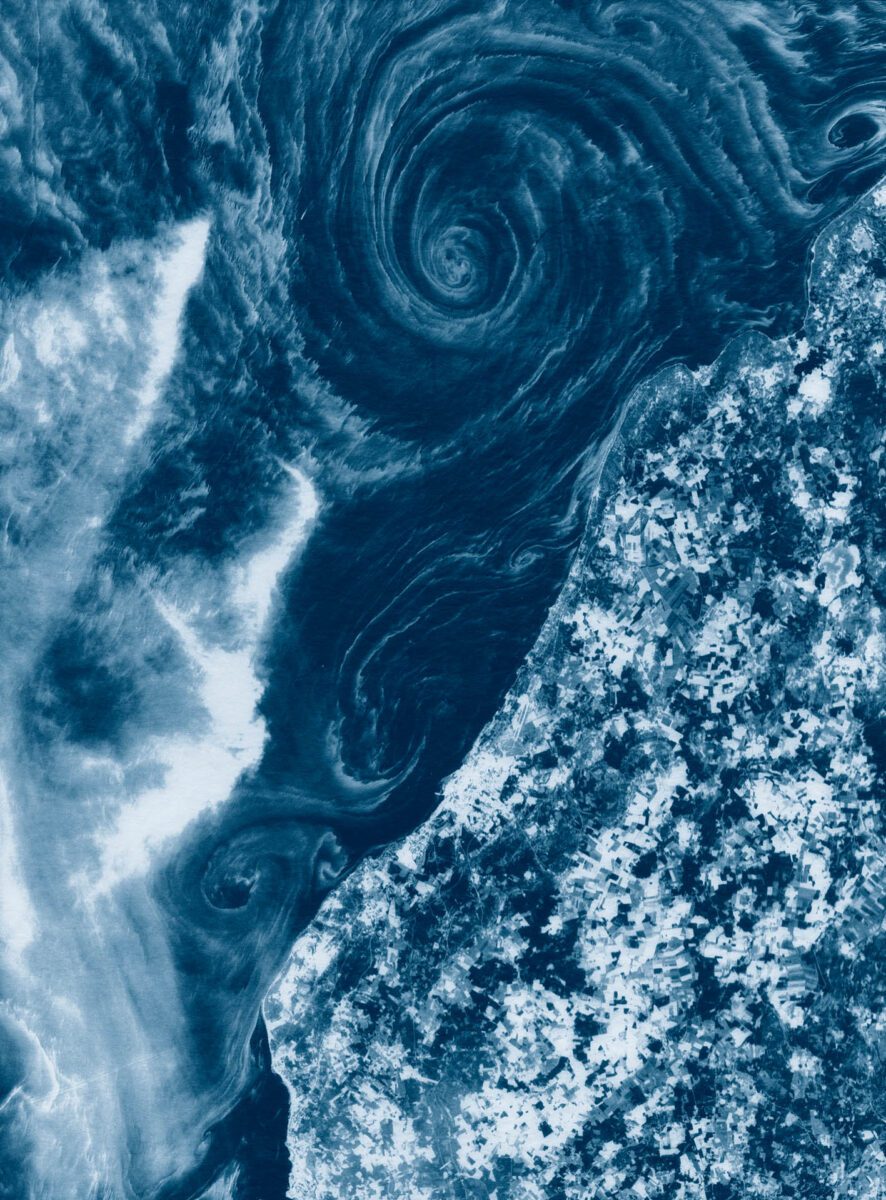
The Baltic Sea faces unprecedented oxygen loss due to human-induced pollution. This depletion threatens marine biodiversity and fish mortality. In the publication viridescent, afire (Blow Up Press, 2025), artist Małgorzata Stankiewicz (b. 1986) presents algal bloom formations – indicators of hypoxic waters – drifting across the sea. Stankiewicz translated NASA and ESA remote-sensed data into digital negatives, hand-printing them as cyanotypes. This revives a photographic process dating back to Anna Atkins. What appear as painterly waves are sinister heralds of dead zones beneath the surface. Beautiful yet alarming, these images invite viewers to look twice at the fragile Baltic ecosystem.

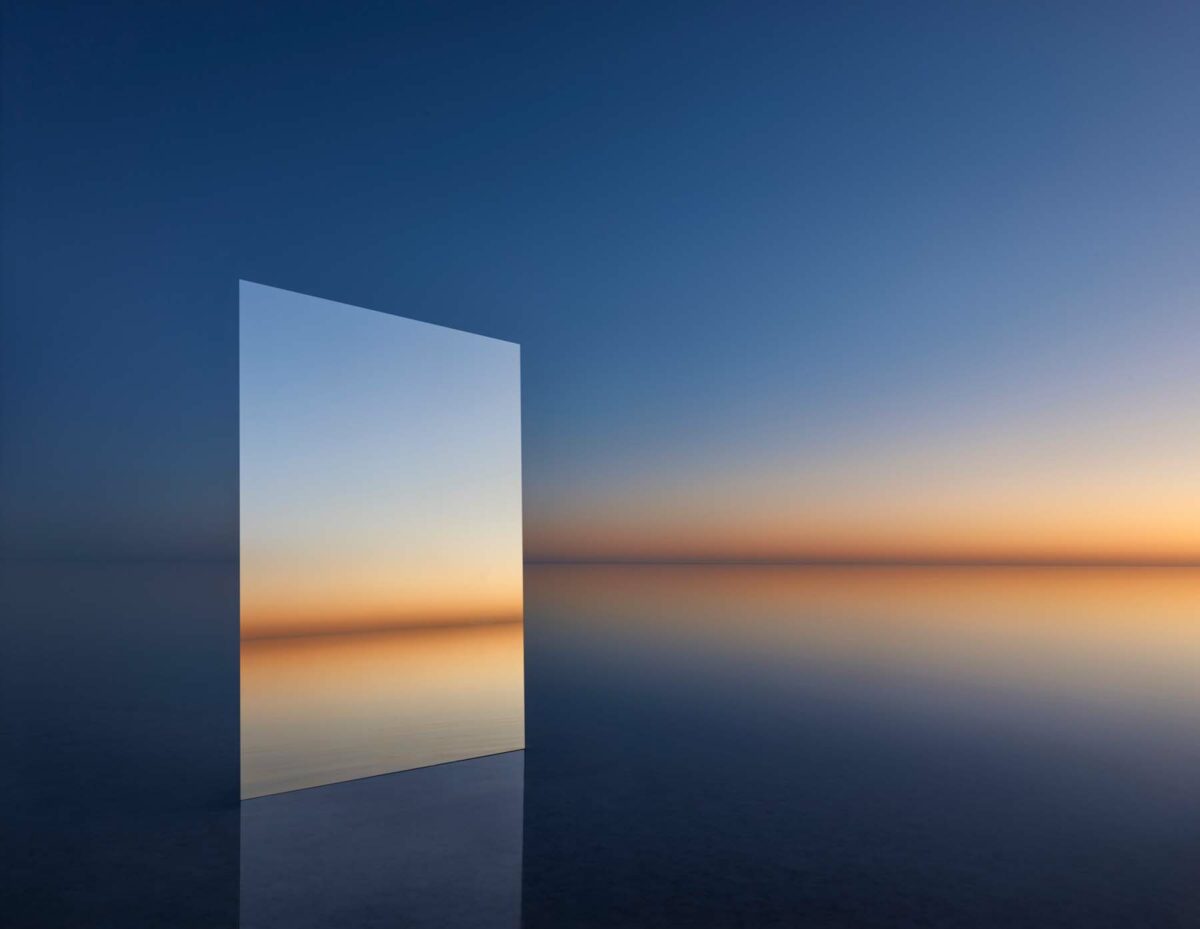
In the Vanity series, Murray Fredericks (b. 1970) captures ethereal horizons and seemingly immeasurable distances. Wading out into Kati Thanda-Lake Eyre, a 9,500 km2 endorheic salt lake 700 km north of Adelaide, Australia, Fredericks sets up multiple mirrors to picture the glass-like surfaces, offering a “dual experience” as the sky is reflected in the water and all sense of time and place washes away, immersed in “pure space.” The images are mesmeric, a counterpoint to today’s information age, as all sense of human presence disappears, giving way to the phenomena of light, colour and space on a deeply visceral level.
murrayfredericks.com.au | @murrayfredericks
Subscribe to Aesthetica & Save 70% in November | 12 Months for £12 | Click Here to Shop All Issues.
Words: Sophie Bullivant
Image Credits:
1. Murray Fredericks, Mirror 8 (2017). Digital pigment print on cotton rag, edition of 7, 7/7, 120cm x 155cm.
2. Image courtesy Gleeson Paulino.
3. Image courtesy Gleeson Paulino.
4. Jane Fulton Alt, Composition No 7, from Water Works. Image courtesy of the artist.
5. Alexej Sachov, Guard, from Hotel Guests Underwater (2022).
6. Alexej Sachov, Bobby, from Hotel Guests Underwater (2022).
7. Image courtesy Alexis Pichot. From the series Insula (2021-2022).
8. Baltic Algal Bloom D1 – detail, (2020-2021). Unique cyanotype print on tengujo kōzo paper from a satellite image captured by Copernicus Sentinel (2019) processed by ESA, ca. 30 x 40.5 cm © Małgorzata Stankiewicz.
9. Baltic Algal Bloom A2, (2020-2021). Unique cyanotype print on tengujo kōzo paper from a satellite image captured by Copernicus Sentinel (2019) processed by ESA, ca. 30 x 40.5 cm © Małgorzata Stankiewicz.
10. Murray Fredericks, Mirror 11 (2017). Digital pigment print on cotton rag, edition of 7, A/P, 120 x 155cm.