teamLab is a phenomenon. The international art collective, founded in 2001, welcomed over 4.2 million visitors to its two Tokyo locations last year, after setting the Guinness World Record for the world’s most attended museum dedicated to a single group or artist back in 2024. It has further permanent installations across Abu Dhabi, Jeddah, Kyoto, Osaka and Singapore, with works held in the collections of major institutions across the globe. teamLab is a leader in contemporary multisensory art, transforming traditional exhibition spaces into immersive digital forests, interactive ponds and floral-scented labyrinths. It does so through a confluence of creativity, science and technology, amassing an interdisciplinary team of artists, architects, CG animators, engineers, mathematicians and programmers. Each member brings a unique set of skills to projects that use algorithms, projections and sensors to inspire wonder and awe.
Beyond gallery shows, another key part of teamLab’s mission involves animating historic locations, including UNESCO World Heritage sites and cultural monuments. This winter, it turns attention to the ruins of Fukuoka Castle, which was the largest castle in Kyushu during the Edo Period (1603-1868). Built over seven years from 1601 and often referred to as the “stone castle”, it was destroyed following the Meiji Restoration in 1868. Today, only its walls and turrets remain. From 30 October, these ruins will provide the canvas for teamLab’s digital artworks. The collective is returning to the site for the first time since 2019.
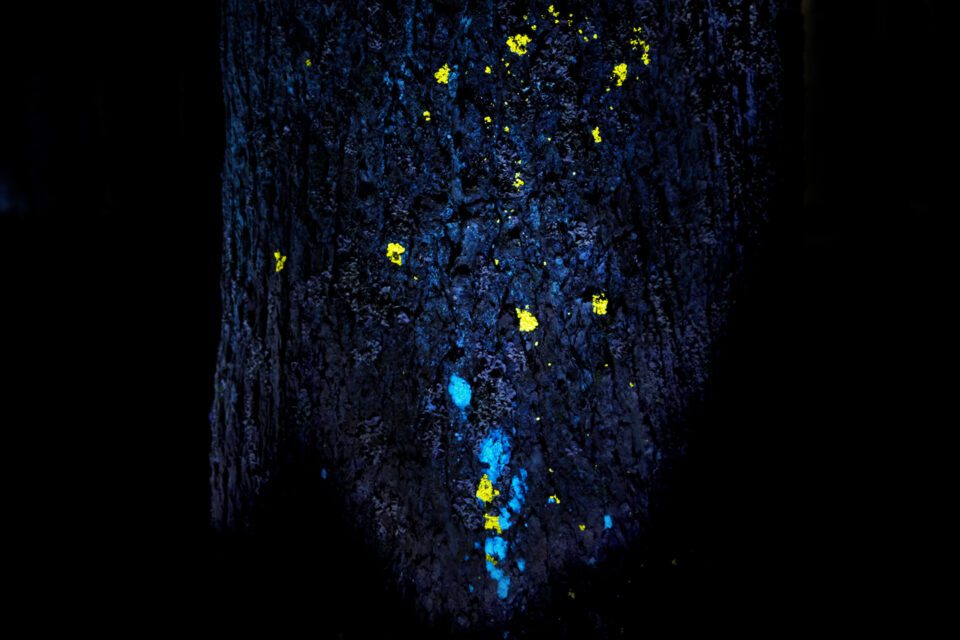
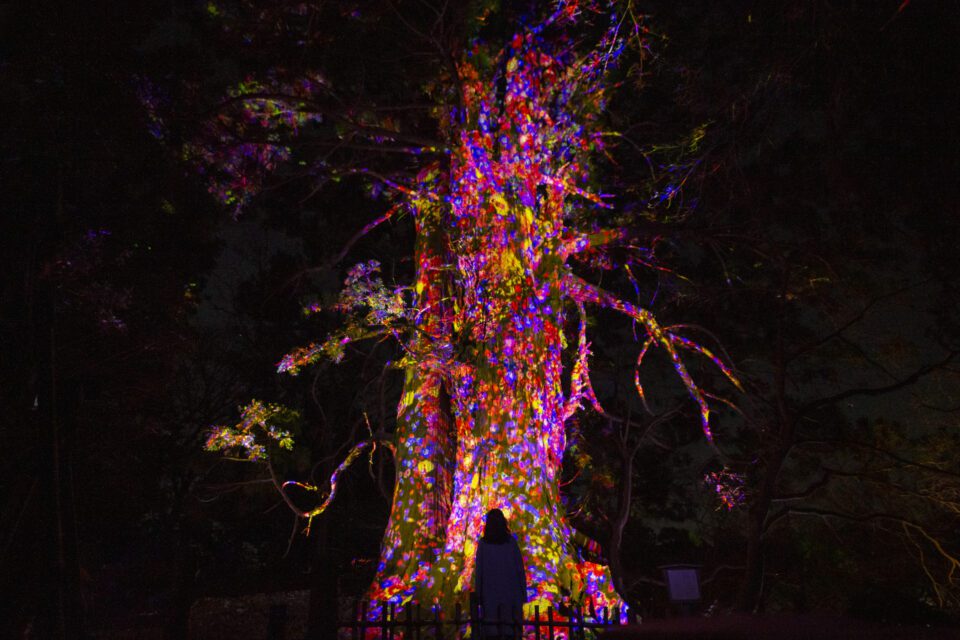
Featured projects include Pillar of Constant Flux, a collection of flexible, glowing fronds – resembling a tree – that move and change shape based on the wind, rain and humidity. Nature takes centre stage in Ever Blossoming Life Tree, through which audiences will watch as a year’s worth of local seasonal flowers are projected onto a giant trunk. They grow, bud, bloom, scatter, wither and disappear over the course of an hour, in “a continuous cycle of life and death.” The Materialization of Time likewise engages with organic life, this time with the lichen (umenokigoke) that grows on bark. These organisms glow yellow and blue in the presence of ultraviolet light – a spectacle that is not visible during the day. At night, however, when under UV, they flicker, reflecting “the trail of life that the forest has painted over decades and centuries.”
Several of the pieces respond to Fukuoka Castle itself. In Walk, Walk, Walk, for example, a group of anonymous figures – including frogs and rabbits – marches along the ruined stone walls in a procession. When people interact with the figures, they react, sometimes stop, change directions or choose a different path. Further engaging with the architecture is Enso on Ancient Stone Wall, in which large-scale black calligraphy appears on the Fushimi Yagura turret, an historic three-tiered defensive tower. Enso is the Zen practice of drawing a circle with a single brushstroke, symbolising the concepts of enlightenment, truth, the universe and equality. Elsewhere, Stone Steps of Oblivion illuminates a staircase, shining brightly and then fading as if breathing slowly. When visitors approach the steps, it glows particularly intensely.
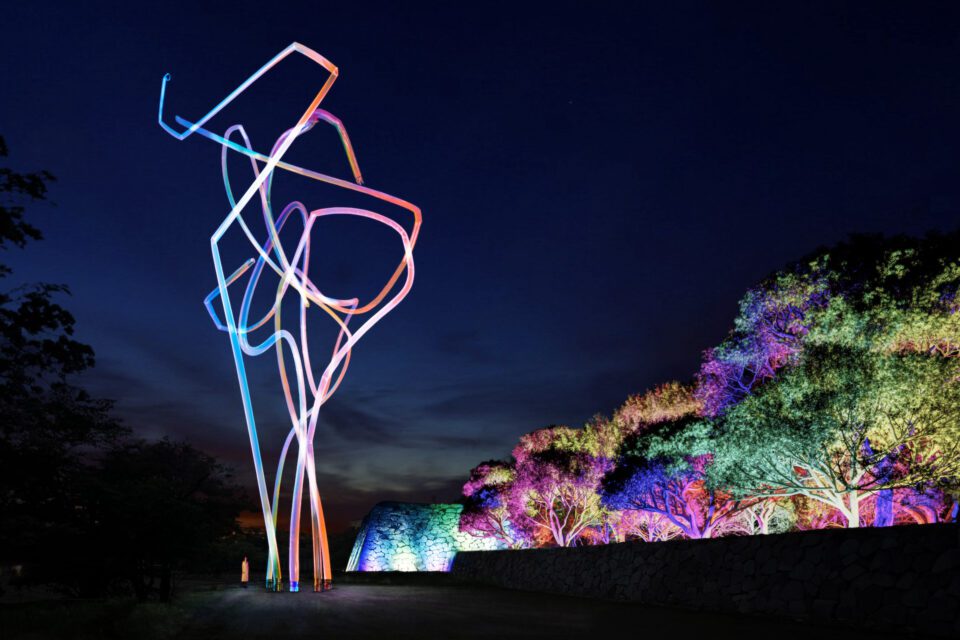
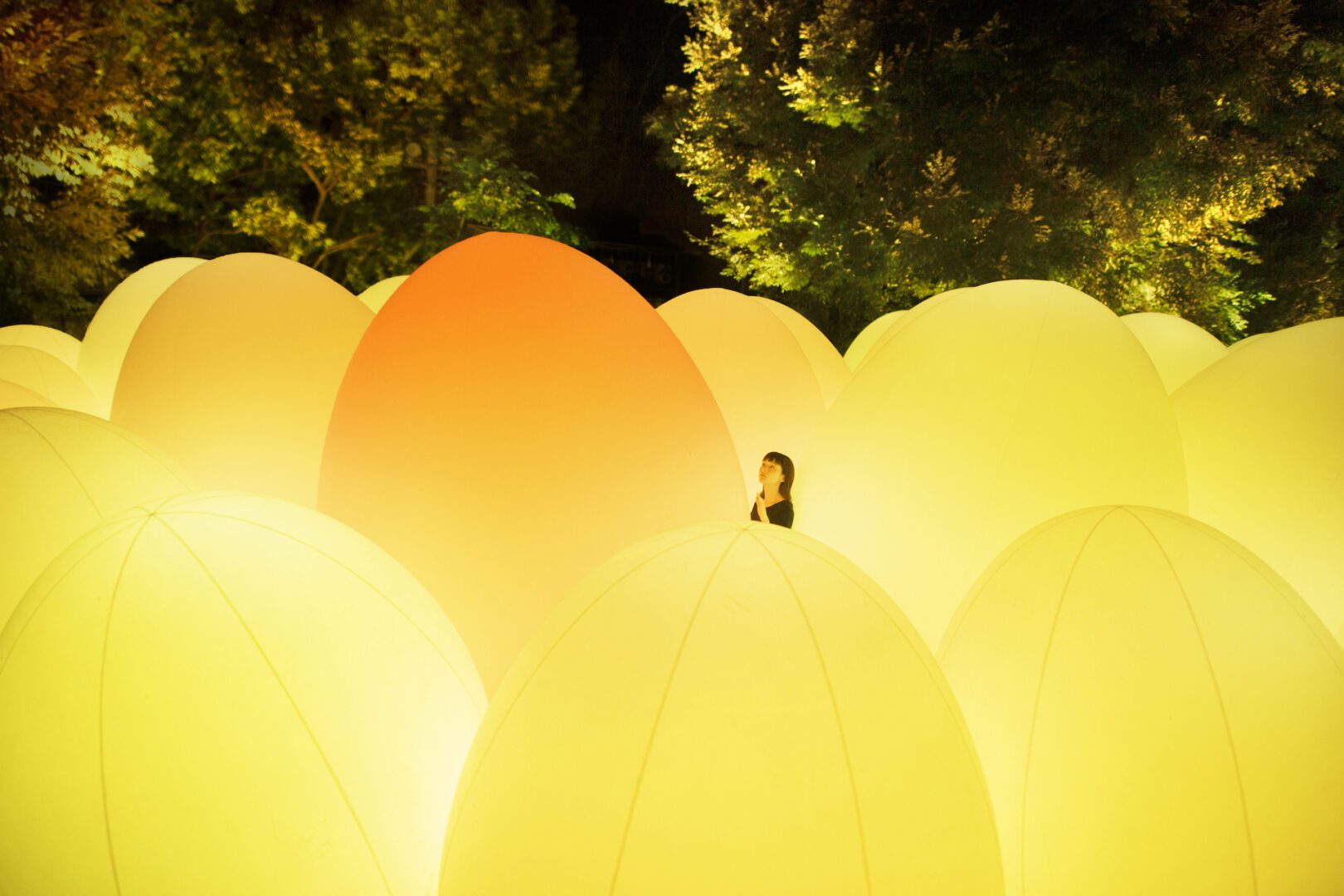
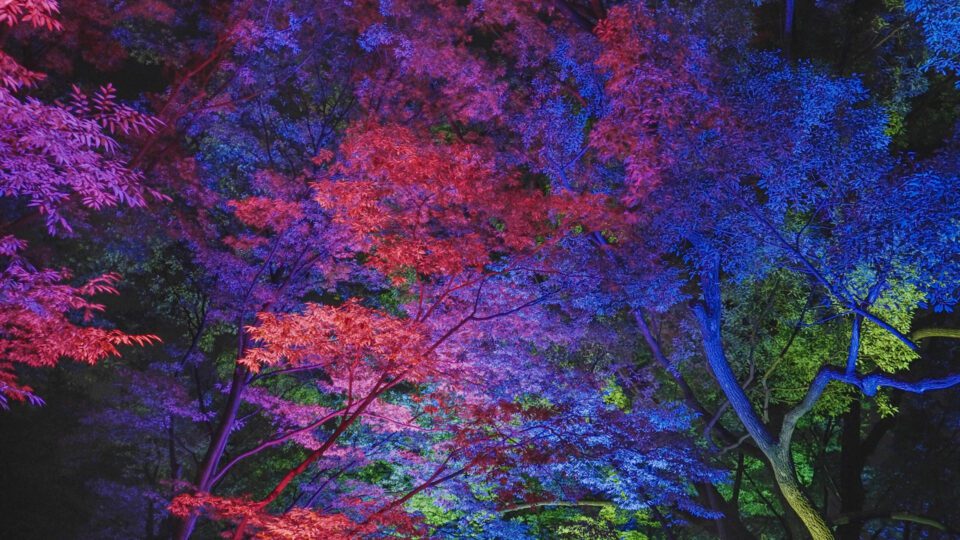
One of the standout works is Autonomous Resonating Life, an outdoor space filled with teamLab’s signature Ovoids – egg-shaped forms that radiate coloured light. When pushed over by a person, they illuminate, sound a tone and rise back up on their own. The surrounding Ovoids then resonate one after another, continuously transmitting the same hue and noise in a chain reaction. This piece has a direct influence on the nearby Resonating Trees, a collection of overhead branches that change appearance based on what is happening down below. Seen from a distance, the piece functions as a beacon of activity across the site.
teamLab’s projects are, at their core, about the connection between humans and the wider world. Digitized Fukuoka Castle Ruins is a distillation of that aim. It responds to history, the weather and audience behaviour, inviting us to engage not only with 400 years of heritage, but with nature and, ultimately, each other.
teamLab: Digitized Fukuoka Castle Ruins runs 30 October – 11 January.
Words: Eleanor Sutherland
Image Credits:
1. teamLab, Autonomous Resonating Life, 2017-, Interactive Installation, Endless, Sound: Hideaki Takahashi © teamLab
2. teamLab, Resonating Trees, 2014-, Installation, Sound: Hideaki Takahashi, teamLab © teamLab
3. teamLab, The Materialization of Time, 2026, Installation, Sound: teamLab © teamLab
4. teamLab, Ever Blossoming Life Tree, 2021, Installation, Sound: Hideaki Takahashi © teamLab
5. teamLab, Pillars of Constant Flux, 2026, from the series Pillars that Dance with the Wind, 2023-, Installation, Sound: Hideaki Takahashi © teamLab, Rendering