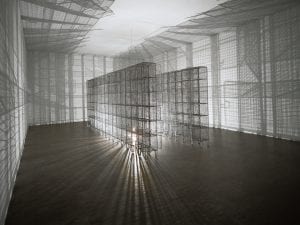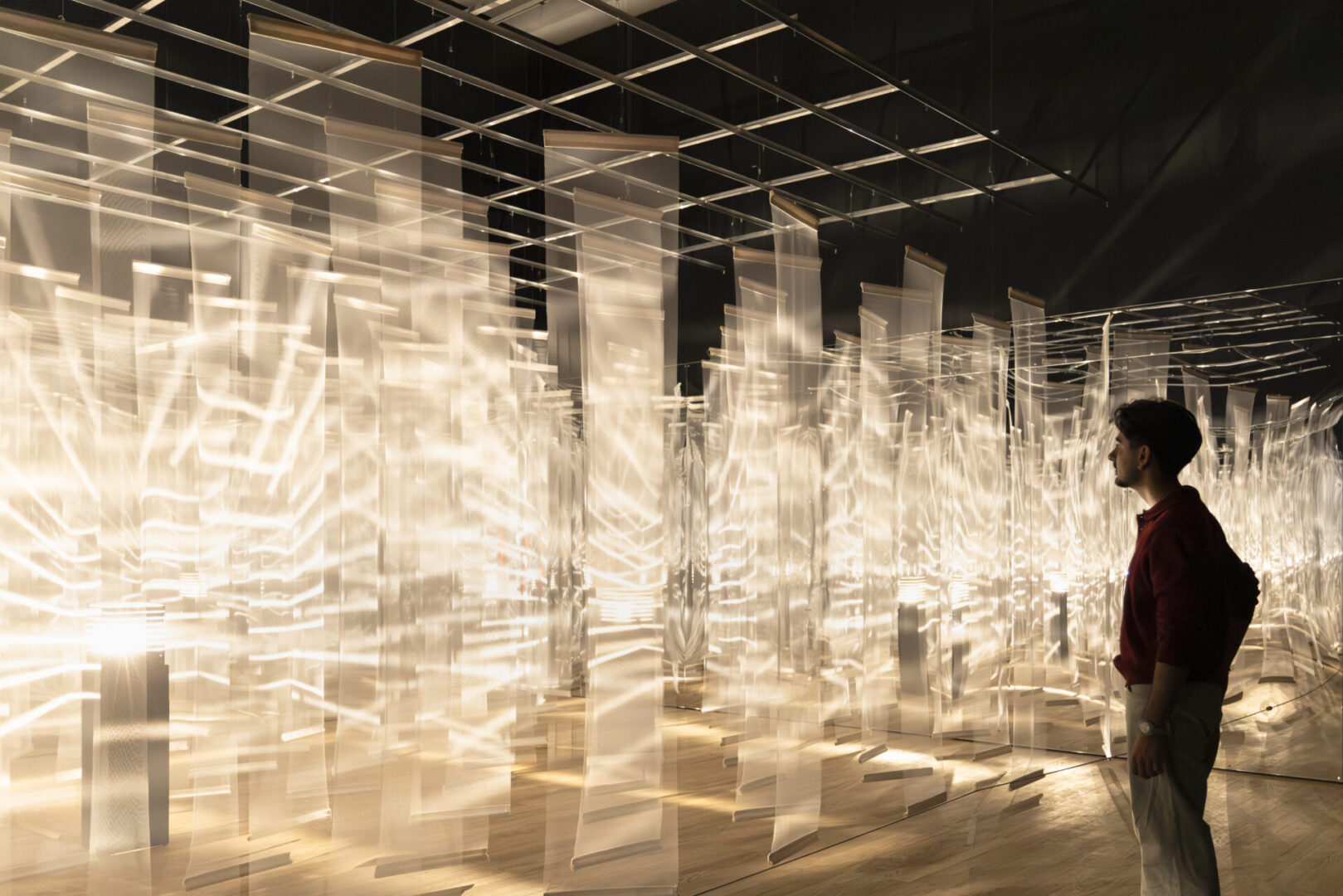
Installation art is about experience. The focus is on how the viewer interacts with the work, providing an intense or lasting impression. As artist Ilya Kabakov said: “The main actor in the total installation, the main centre towards with everything is addressed, for which everything is intended, is the viewer.” These five exhibitions, on display around the world this season, are major contributions to the artform. Tate hosts two landmark figures, with Aleksandra Kasuba’s cavernous light sculptures transforming their St Ives gallery, whilst Julio Le Parc’s kaleidoscopic pieces shift and transform in front of visitors to the Tate Modern. Es Devlin’s expansive practice is celebrated at The Design Museum, whilst Cecilia Fiona receives her first UK retrospective at Towner Eastbourne. Finally, Saatchi Gallery allows audiences to walk through an entire day, with creatives like teamLab exploring humanity’s relationship to the cosmic.
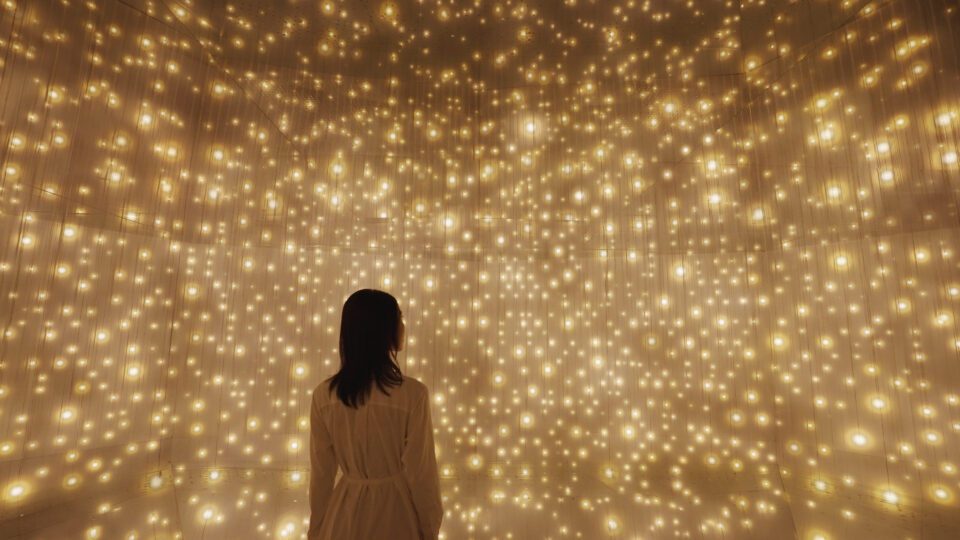
The Sun and The Moon: Art Inspired by the Celestial
Saatchi Gallery, London | Until 8 September
For as long as humans have been making art, they have looked to the sky for inspiration. Across centuries, artists have used the sun and the moon to explore power, divinity and emotion, from Egyptian recreations of the sun as the god Ra, to medieval Christians using sunlight to represent divine order. Now, this rich strand of art history is the subject of a new show at Saatchi Gallery. The Sun and the Moon is a major exhibition exploring how the two most powerful and enduring phenomena in the sky have inspired creativity curiosity and belief throughout human history and across different cultures. The show is truly impressive in scale, occupying two floors and nine spaces in the gallery, each one representing a period of the day. The experience unfolds like a 24-hour cycle, moving from dawn into the depths of the night.
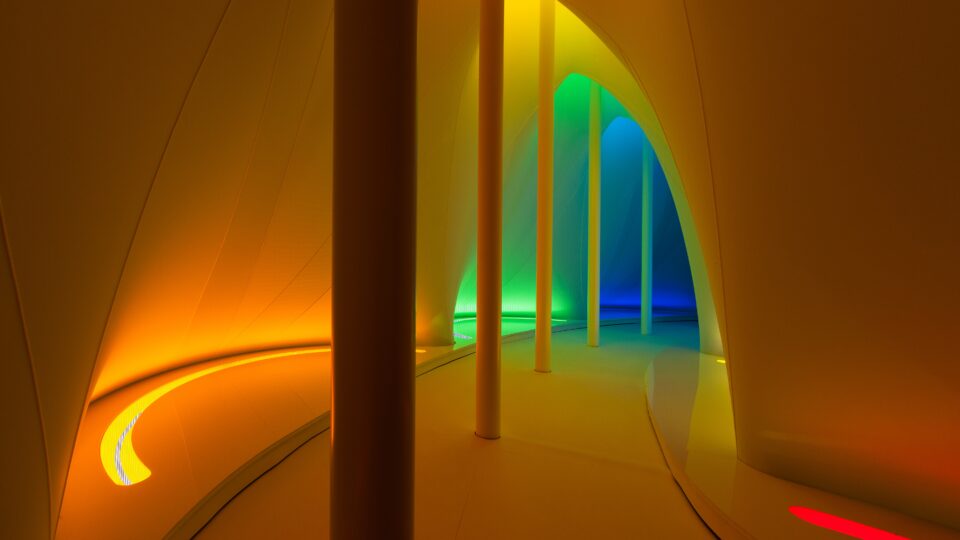
Aleksandra Kasuba: Shelters for the Senses
Tate St. Ives | Until 4 October
In 1944, because of successive occupations by the Soviet Union and Nazi Germany, visionary artist Aleksandra Kasuba fled Lithuania. Three years later, she emigrated to the USA, where she settled in New York and, later, New Mexico. Tate St. Ives considers how the artist was driven by a desire to forge a deeper connection between humanity and nature, and to imagine alternative ways of living. The exhibition spans seven decades of work, from early paintings and mosaics to later sculptures and architectural designs. Her love of the natural world is clear throughout, with pieces often inspired by the shapes and forms of nature, such as shells, rocks, vegetation and marine life. The artist famously told The New Yorker in 1971, that she wanted to “kill the square. Conventional rooms with four walls dictate too much to the people in them.”
Spiritual Gathering, Time Breathing
Towner Eastbourne | Until 1 November
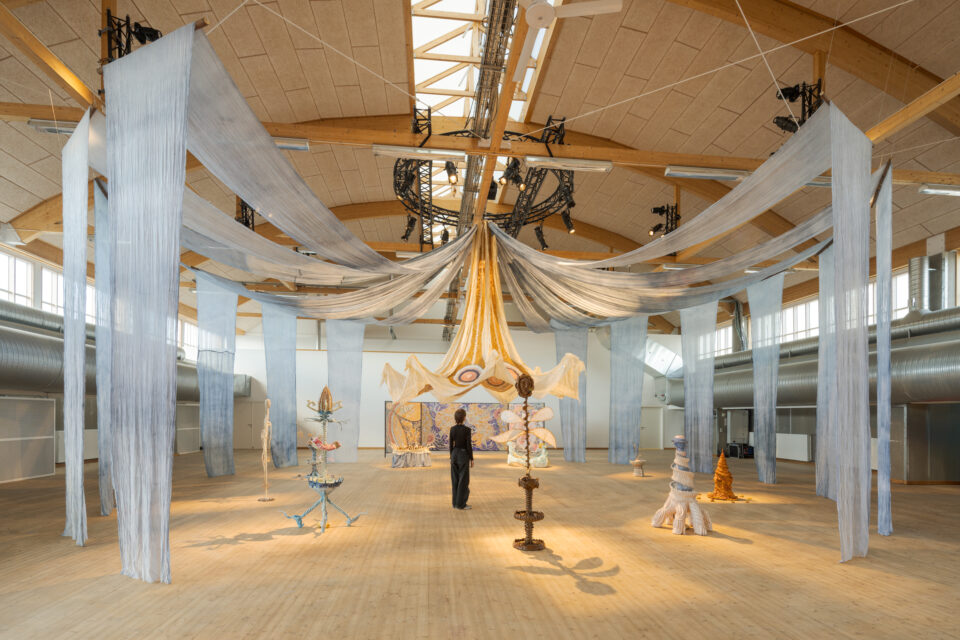
Danish artist Cecilia Fiona is concerned with imagining and exploring the interconnected relationship between the body, the earth and the cosmos. From the microscopic realm of atoms and cells to the vast cosmic scale of the universe, Fiona envisages the movement and flow of energy, picturing the universe as one vast living organism. Spiritual Gathering, Time Breathing is the artist’s first institutional solo exhibition in the UK, featuring new paintings, sculptural installations and a sound piece made in collaboration with Lucie Cure. In this new body of work, Fiona creates extraordinary dreamlike imagery: bodies dissolve into ribbons, roots and tendrils, looping and weaving in cycles of creation and destruction. The piece draws inspiration from human and plant biology, Norse mythology and quantum physics.
The Design Museum, London | Opens 2 October
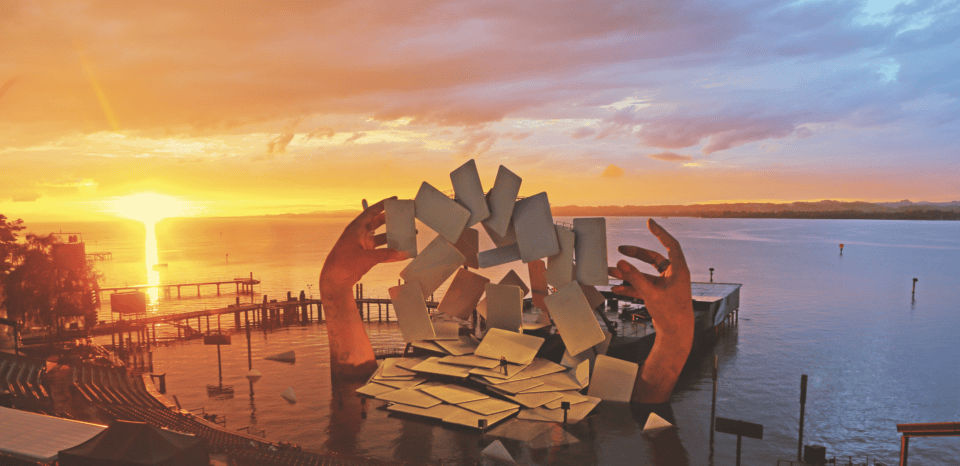
Es Devlin’s practice is difficult to define – spanning sculpture, stage design, music, language and light. The Design Museum presents the first major retrospective of this expansive career, looking back at an extraordinary 30 years. The exhibition explores Devlin’s genre-defying practice and the vast range of projects she has brought to life around the world. The aim is simple: immerse viewers in her imaginative world. The artist invites visitors into a collective experience that goes beyond a traditional exhibition setting and which invites new perspectives. Tim Marlow, Director of the Design Museum, says: “Es Devlin shares [The Design Museum’s] ethos. Her remarkable boundary-blurring work across art, activism, poetry, sculpture, music and architecture is the embodiment of enlightened design thinking.”
Julio Le Parc: Light. Colour. Action.
Tate Modern, London | Until 3 May 2027
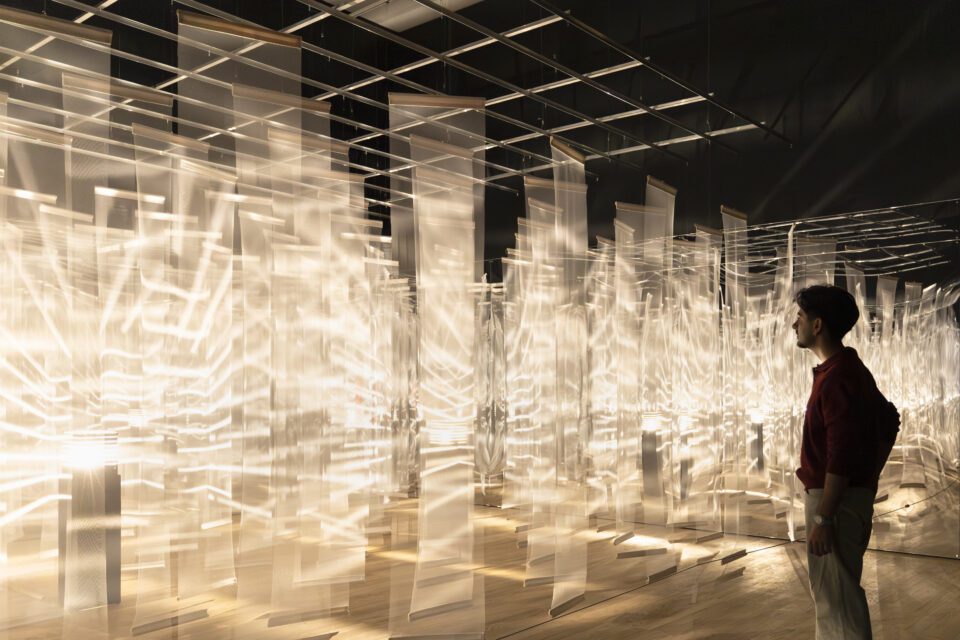
Julio Le Parc dedicated 70 years of artistic practice to interactive installations, striking light sculptures and geometric abstract paintings. Tate’s exhibition features over 60 works, arranged in a winding, maze-like manner to follow Le Parc’s career-long mission to activate the viewer, making audiences aware of the role they can play in bringing art to life. A particular highlight is the artist’s innovative luminokinetic pieces. Initially emerging in 1959 as a series of Light Boxes – sculptures containing sheets of transparent acrylic plastic and light sources to create mesmerising sequences – these installations quickly evolved into Le Parc’s key body of work, the Continual Light Mobiles, debuted in 1960. Spotlights in combination with reflective or transparent elements create kaleidoscopic visuals, which transform in front of the spectator.
Words: Emma Jacob
Image Credits:
1&6. Julio Le Parc at Tate Modern. Photo © Tate Photography (Kathleen Arundell).
2. teamLab, Massless Suns and Dark Suns. Installation image courtesy of teamLab.
3. Aleksandra Kasuba Spectrum, An Afterthought, 1975/2014. Tate St Ives, 2026. Photo © Tate (Kathleen Arundell).
4. Cecilia Fiona, ‘Ghost Flower Ritual’, Installation view at Copenhagen Contemporary, 2025. Commissioned by Copenhagen Contemporary. Photo: David Stjernholm.
5. ‘Carmen’ at Bregenz Festival, design by EsDevlin Photo by Es Devlin.