“Experience does not produce nostalgia. It gives us an extraordinary impulse toward the future.” Paulo Mendes de la Rocha’s architectural legacy was one of innovation, with a forward-looking spirit that transcended simple construction to serve as poetic instruments of civic transformation. Born in Espírito Santo and rooted in São Paolo, de la Rocha became a towering figure of the Paulista School, an architectural movement celebrated for its expressive use of exposed reinforced concrete and structural honesty. His Pritzker Prize-winning work ranged from intimate private dwellings that doubled as infrastructural manifestos to monumental civic landmarks that hover over public plazas. Regardless of the design, one thing remained constant: his structures always challenge our perception of space and material.
Now, gestalten publishes Paulo Mendes de la Rocha: The Architecture of Possibility. The book positions the architect’s career as an antidote to today’s major questions. It asks: how do we build a future when the present feels increasingly fragile? In an era of rapid urbanisation, climate crises and a search for meaningful public space, how do we prioritise considered design? Readers are taken through his major institutional commissions, looking at how his output shaped the urban landscape of Brazil. Audiences then are drawn into the more intimate, domestic spaces that defined a significant portion of de la Rocha’s practice. Here, parallels are drawn between the architectural field and the wider sociopolitical landscape of Brazil.
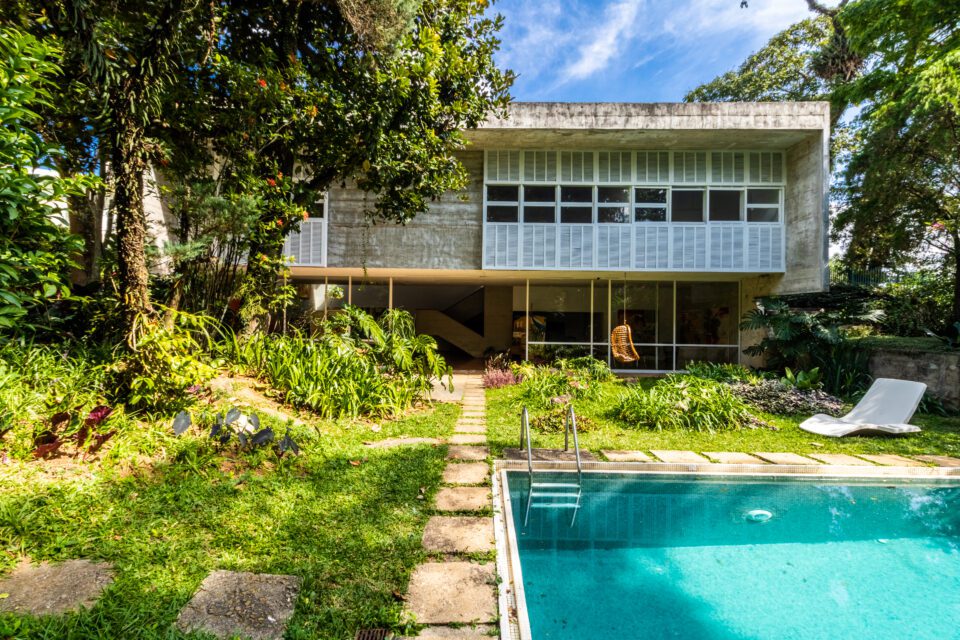
In 1964, the Brazilian president João Goulart was overthrown by a miliary coup, marking the beginning of the Brazilian military dictatorship that would last 21 years. The regime dismantled democratic institutions, censored the press, persecuted political opponents and often employed state violence to maintain control. The result for de la Rocha, and many of his contemporaries, was a reduction in creative freedom and the eradication of funding for public buildings. Instead, progressive architects found themselves working on houses for the intellectual middle class. As the book explains: “It was within these private residences, however, that they continues to rehearse their vision of the country: one grounded in collective rather than individual values, and more committed to the ideals of public space than to the sentimental and bourgeois comforts traditionally associated with domestic life.” These buildings bridge the gap between how a private and a public space could look, revealing the sociopolitical backdrop of housing.
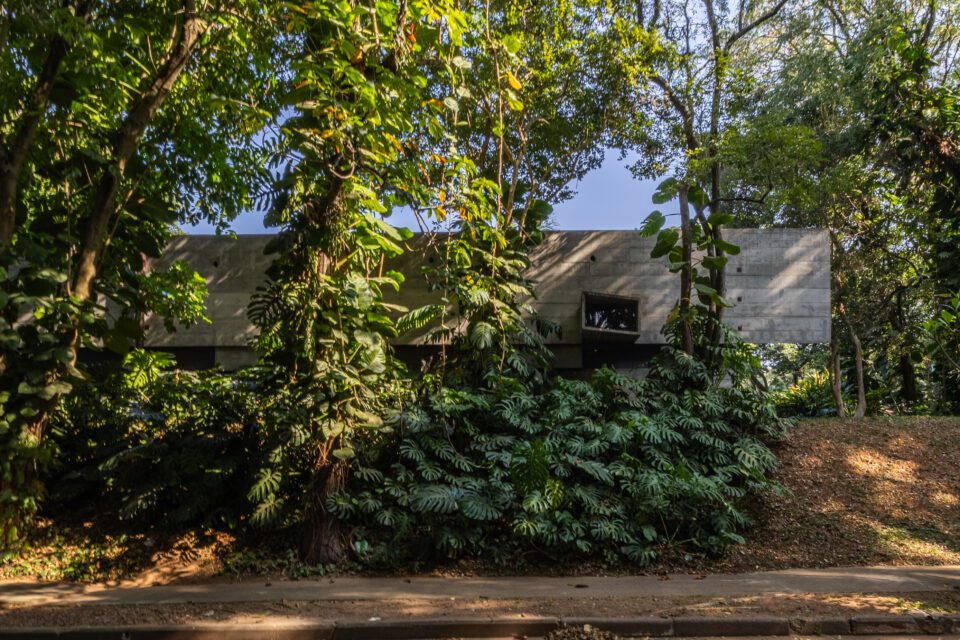
Many consider de la Rocha’s magnum opus to be the Brazilian Museum of Sculpture and Ecology, completed in São Paulo in 1986. The architect described it as a kind of “Stonehenge for the age of prestressed concrete.” The introduction of this book positions the building as a major moment in both de la Rocha’s career and in the field of design, “It is an immense structure with almost no practical function, whose significance is fundamentally symbolic rather than utilitarian. Rather than sheltering activities, it defines a place; rather than solving a technical problem, it transforms the site into a civic landmark.” Once again, this book blends the political with the individual, weaving de la Rocha’s career into the history of Brazil. There’s a clear parallel, each one influencing the other. De la Rocha was wildly influential throughout his life, but much of his trajectory was influenced by wider forces.
This single architect’s career is emblematic of something much wider. The design world does not sit in isolation from the rest of reality. It is constantly shaped by political forces, social factors and economic shifts. The buildings we look at do not stand alone. They tell a story of the unique moment they were built, and the unique figure behind it, revealing a fascinating legacy.
Paulo Mendes da Rocha: The Architecture of Possibility is published by gestalten: uk.gestalten.com
Words: Emma Jacob
Image Credits:
1. Photo Leonardo Finotti, Paulo Mendes da Rocha, gestalten 2026.
2. Photo Leonardo Finotti, Paulo Mendes da Rocha, gestalten 2026.
3. Photo Leonardo Finotti, Paulo Mendes da Rocha, gestalten 2026.
4. Photo Leonardo Finotti, Paulo Mendes da Rocha, gestalten 2026.