

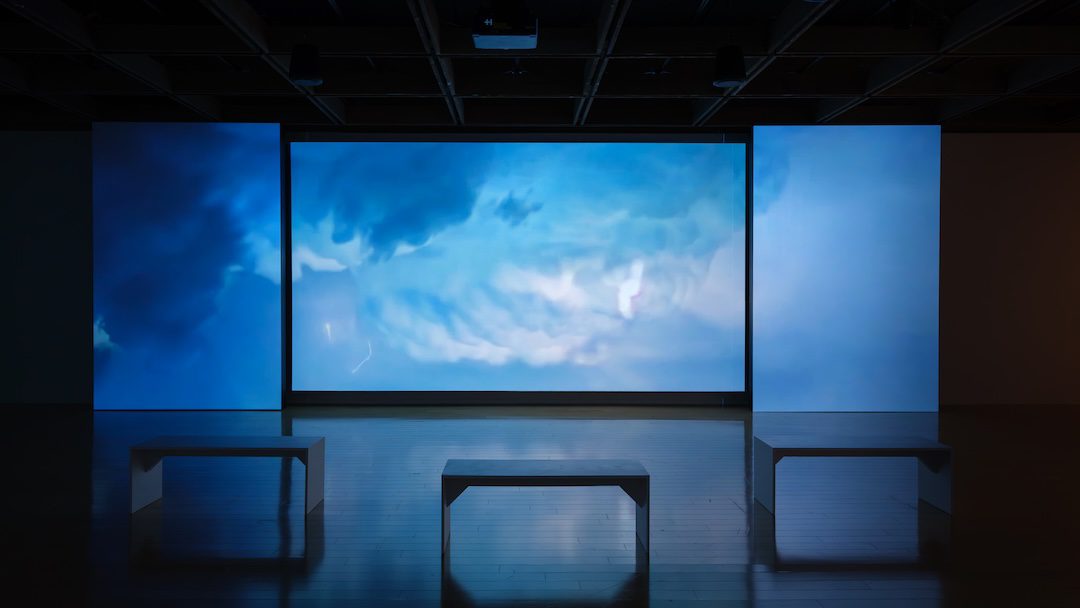
From the expanses of the California desert to the movement of distant stars, Lita Albuquerque’s (b. 1946) practice explores the shifting boundaries between earthly existence and cosmic space. At Palm Springs Art Museum, Cosmic Land, a major exhibition spanning nearly six decades’ work, brings together sculpture, painting, film and installation, examining humanity’s relationship with the natural world.
How might art make the immensity of the universe tangible while keeping sight of the planet on which human life depends? This question runs through contemporary debates around ecology, perception and the limits of human knowledge, challenging established distinctions between nature as a resource and the individual as its observer. For Lita Albuquerque, the Earth is a site of accumulated histories, geological processes and invisible energies, its relationship with the cosmos extending far beyond the limits of immediate experience. Across nearly sixty years, the California artist has developed a practice that connects landscape with celestial phenomena, ancient cosmologies and the structures of human consciousness. Now, Cosmic Land brings these investigations together, revealing a body of work in which the physical world is continually considered against the vastness of space.
Organised across four galleries, the exhibition traces Albuquerque’s sustained engagement with light, matter, water and the cosmos, bringing together works that span sculpture, painting, photography, film and installation. Its breadth makes visible the continuities within a practice that has moved between intimate observations of natural phenomena and interventions on an expansive environmental scale. Light, in particular, is treated as something with physical and conceptual agency, carrying information between the visible world and what lies beyond immediate perception. Albuquerque has described this directly: “light carries information”. The phrase offers a point of entry into the show, where illumination is both a material presence and a way of considering the relationship between the human body, the Earth and the universe.
Albuquerque’s artistic development is closely connected to the landscape of Southern California, where the intensity of desert light has shaped generations of artists’ investigations into perception. Her work shares an important history with the Light and Space movement, whose practitioners explored the effects of illumination, colour and atmosphere on the viewer’s experience. However, Albuquerque’s interest extends beyond the perceptual conditions of a gallery or architectural environment, drawing on cosmology, mythology and the symbolism of ancient cultures. The distinction is particularly apparent when considered alongside James Turrell, whose monumental Roden Crater project transforms an extinct volcanic formation in Arizona into an observatory for experiencing celestial light. Both artists invite viewers to reconsider their position in relation to the sky, although Albuquerque’s work places greater emphasis on the body as a point of connection between terrestrial and cosmic histories.
That emphasis also informs Albuquerque’s relationship with the natural forces that shape her materials. In NAJMA Returns and the Wind Paintings, movement through the landscape becomes part of the work’s making, with wind acting as an active participant in the distribution and transformation of pigment. Such processes complicate conventional ideas of artistic authorship, allowing environmental conditions to influence the finished composition. The resulting works register an encounter with forces that cannot be fully controlled or predicted, while retaining the artist’s attention to structure and intention. Their surfaces hold traces of an event, making visible the passage of air, time and matter. Albuquerque’s approach suggests an understanding of landscape as an active presence, with its own rhythms and agency.
This interest in site-specific experience has a significant precedent in the work of Nancy Holt, whose Sun Tunnels (1973–1976) established a direct relationship between sculpture, landscape and astronomical observation. Situated in Utah’s Great Basin Desert, Holt’s four concrete cylinders align with the positions of the rising and setting sun during the solstices, while openings in their surfaces frame particular constellations. Albuquerque shares Holt’s interest in the ways human-made structures can bring celestial movement into perceptible relation with a specific place. Both artists ask viewers to attend to the Earth through the changing positions of the sun and stars, giving astronomical time a physical presence. Their work also challenges the idea that landscape is a passive backdrop, proposing instead that a place can be understood through its relationship with events unfolding far beyond it.
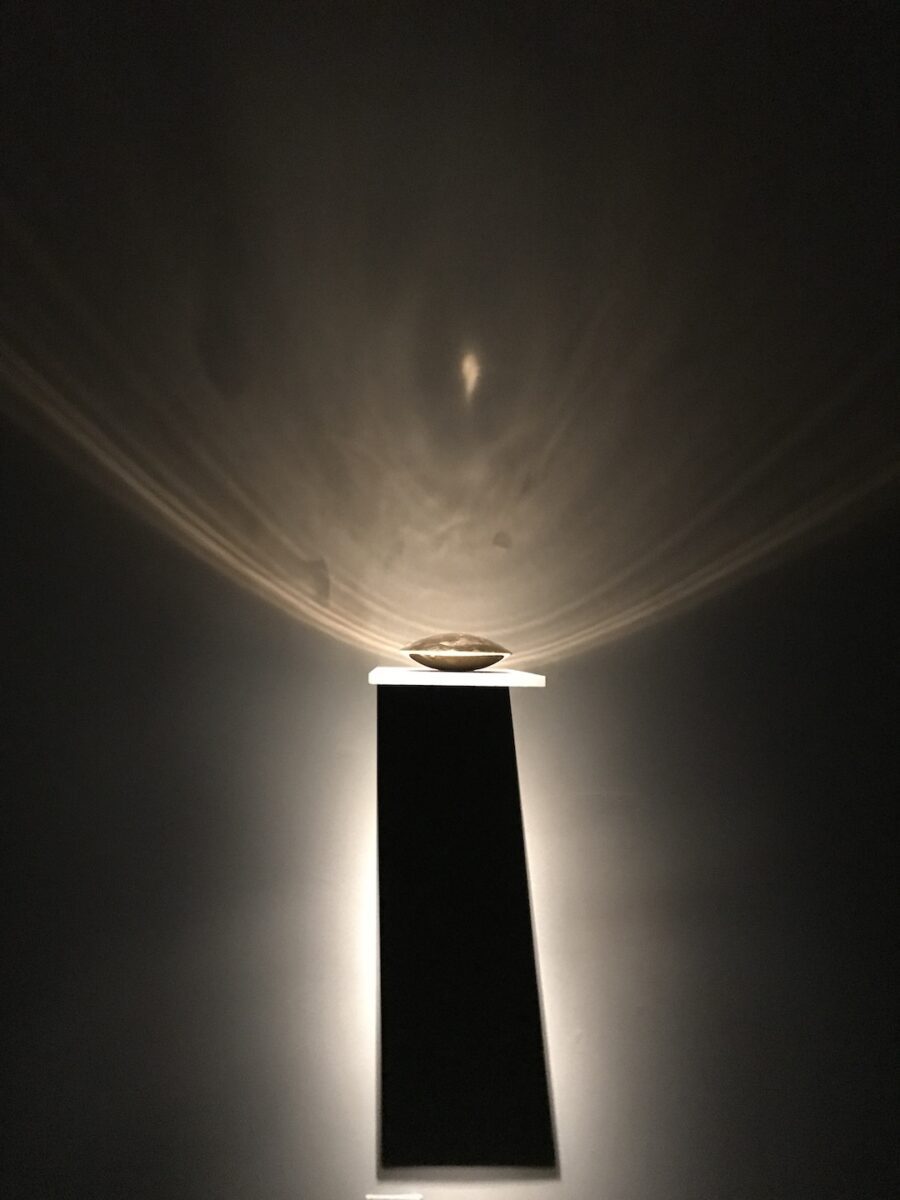
These questions of scale and authorship are particularly evident in Spine of the Earth (1980/2024/2026), one of Albuquerque’s seminal works. Originally realised on a Mojave Desert lakebed, the earthwork employed powdered pigment and sacred geometry to create a vast configuration across the Earth’s surface, extending more than 600 feet in diameter. Its subsequent documentation, performance and reconstruction have allowed the work to persist across different moments, although its relationship with the original site remains fundamental to its significance. For Cosmic Land, Albuquerque has reinterpreted the work as a 40-by-40-foot installation, translating the original desert intervention into a museum setting, as reported by the Los Angeles Times in October 2026. This transformation raises questions about what happens when an ephemeral artwork enters the institutional space, where its relationship with a particular landscape must be reconsidered. Nearby, Emanation (2022), with its reflective gold leaf, continues the investigation into light as both material presence and an agent of transformation.
The history of Land Art provides an important framework for understanding these interventions, while also revealing the exclusions that shaped its early canon. Large-scale works in remote environments have often been discussed through ideas of monumentality, mastery and the heroic individual artist, with women’s contributions receiving less sustained attention. Albuquerque’s practice offers a different account of the relationship between body and terrain, one in which the artist’s presence is connected to the environment without claiming possession of it. A productive comparison can be made with Ana Mendieta’s Silueta series, in which the artist used her own body, or its outline, to create temporary forms in earth, grass, water and other natural materials. Mendieta’s works engage questions of identity, displacement and belonging, bringing personal history into direct contact with the landscape. Although their artistic languages differ, both practices resist the treatment of land as an empty surface, attending instead to the histories and experiences held within it.
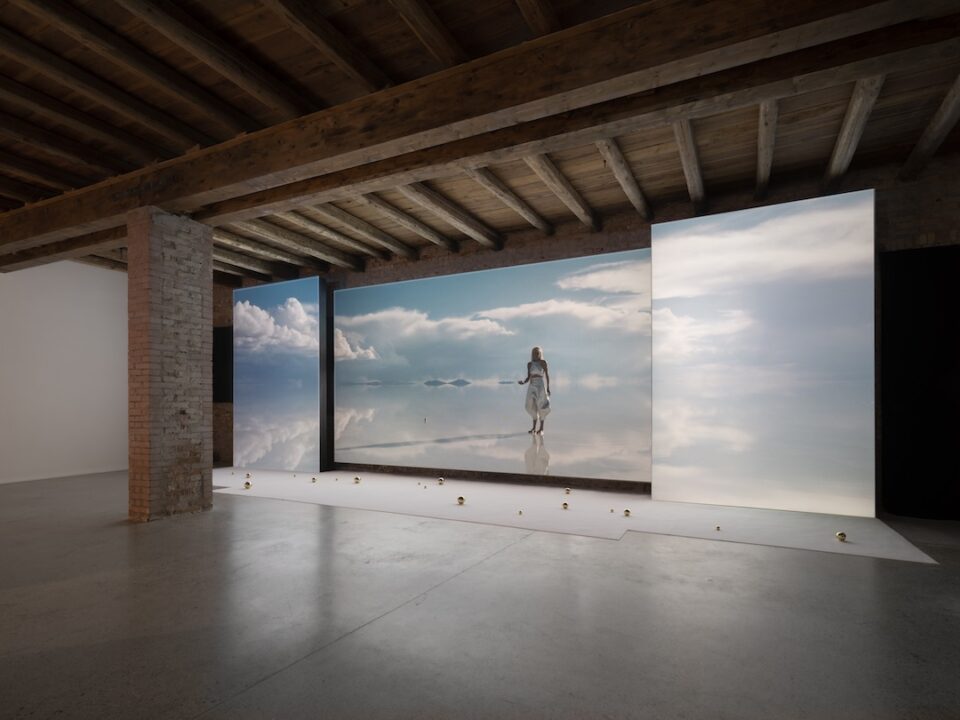
Albuquerque’s engagement with ancient cultures and astronomical systems extends these concerns beyond the immediate landscape. Solar Disc 6,000 BC, Mali draws on the symbolic significance of celestial forms, while the films 20/20: Accelerando and Liquid Light explore the movement and transformation of light through time and space. Across these works, scientific observation and spiritual reflection occupy a shared field of enquiry. The artist’s interest in cosmology does not depend on presenting the universe as a distant abstraction; it asks how knowledge of celestial processes might alter the way people understand their place on Earth. This approach also brings an ecological dimension to the exhibition, since the same systems that connect the planet to the wider universe determine the conditions under which life can exist. The cosmic perspective therefore carries an immediate implication: human activity takes place within an environment whose complexity exceeds the limits of human control.
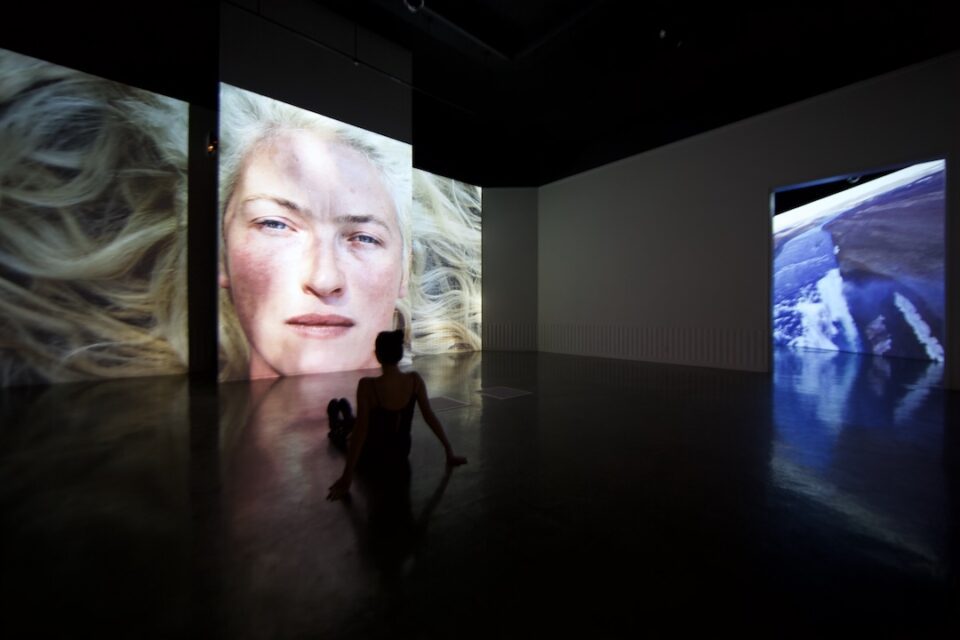
In Particle Horizon (2014), Albuquerque brings this relationship into particularly direct focus. A cast of the artist’s body is projected with images of stars observed from the North Pole, the South Pole and the Equator, placing an individual physical presence against the scale of astronomical space. The work unsettles the assumption that the body and the universe belong to separate orders, allowing the viewer to consider the human figure as both material and cosmic. Spoken passages from GENIUS REMEMBERED add another dimension, introducing language and memory into an installation concerned with the limits of perception. The body here is neither an isolated subject nor a measure of the universe; it is a point from which relationships between scale, location and time can be considered. Such an approach gives Albuquerque’s imagery an intimate dimension, grounded in the experience of being physically present.
The curatorial framework developed by Christine Vendredi brings these strands into conversation, allowing works from different periods and media to reveal the persistence of Albuquerque’s concerns. Vendredi observes that “Southern California has long inspired artists to consider perception, consciousness, and our place within something larger than ourselves.” The exhibition draws on that regional history whilst showing how Albuquerque has developed a distinctive vocabulary through which to explore it. Its movement between large-scale interventions, intimate objects and moving image resists a single chronological account, foregrounding instead the connections that run across the artist’s practice. The juxtaposition of works also makes clear how her thinking has shifted in response to different materials, locations and cultural references. Cosmic Land offers an opportunity to consider not only the development of an individual career, but also the changing terms through which artists have approached the landscape.
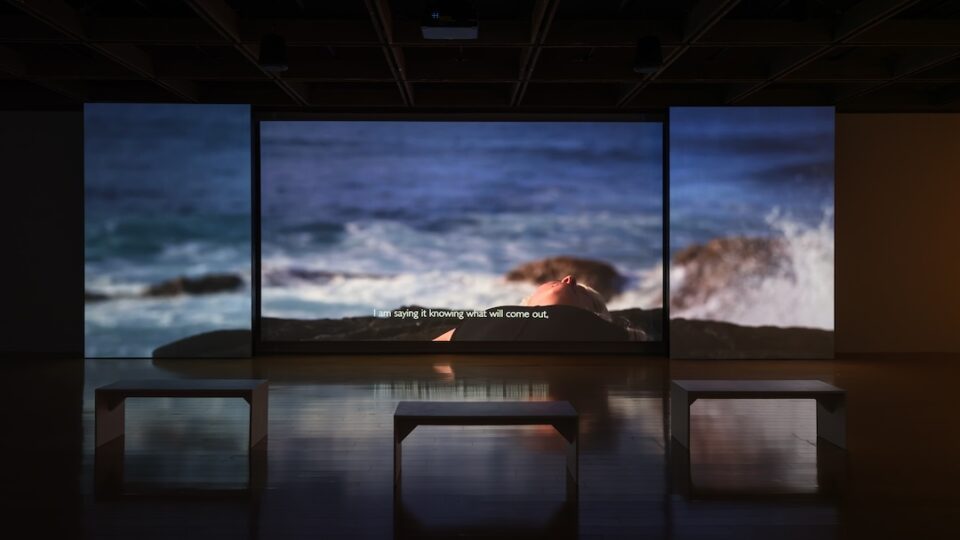
There is, however, a tension. The immensity of the universe can encourage a sense of humility, but it can also risk making the specific conditions of life on Earth appear distant or inconsequential. At a moment of accelerating climate disruption, environmental degradation and unequal access to natural resources, Albuquerque’s attention to planetary interdependence carries urgency. Her work invites viewers to recognise the Earth as a physical place, shaped by geological time and sustaining fragile forms of life, rather than as an abstract symbol of universal harmony. The comparisons with Turrell, Holt and Mendieta also reveal how varied artistic practices can make relationship between body, land and sky available to experience. Cosmic Land asks what it means to inhabit a planet whose boundaries are both materially immediate and cosmically expansive. Its answer lies in the act of looking closely – at the ground beneath us, the light around us and the distant forces that place human existence within a much wider field.
Lita Albuquerque: Cosmic Land is at Palm Springs Art Museum until 3 May.
Words: Anna Müller
Image Credits: Lita Albuquerque: Cosmic Land, October 17, 2026 – May 3, 2027. Palm Springs Art Museum. Installation photography by Oscar Flink.


