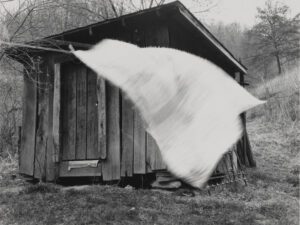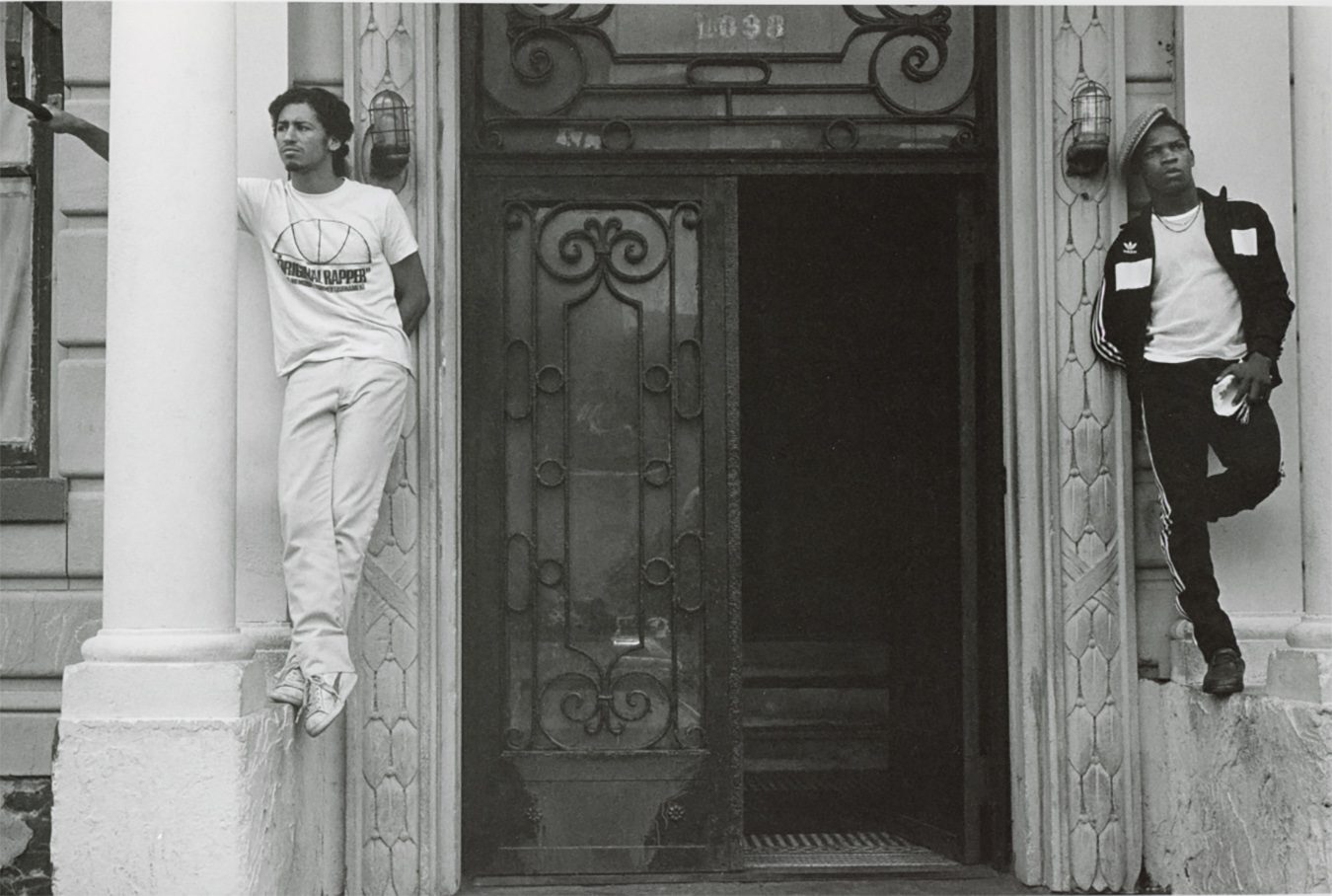
A city is more than a collection of buildings and streets; it is a choreography of bodies, gestures and fleeting acts of invention. Helen Levitt – City at Play, opening at Fotomuseum Winterthur, considers photography as a form of attentive looking, asking what can be revealed when the everyday becomes the subject of sustained observation. Across more than 200 photographs, alongside film, colour slides, contact prints and archival material, the retrospective expands Levitt’s reputation beyond the familiar image of the New York street photographer. Her pictures attend to play, humour, social inequality and urban transformation without resolving them into straightforward documentary narratives. What emerges is a practice grounded in ambiguity – one that understands the street as both social space and improvised stage.
Levitt’s photographs resist the conventional authority of documentary photography, particularly the assumption that the camera simply records what is already there. Her own description of the process is telling: “I never had a ‘project.’ I would go out and shoot, follow my eyes – what they noticed, I tried to capture with my camera, for others to see.” This intuitive method suggests a practice built less around predetermined subjects than around receptivity, where significance is discovered rather than imposed. Such an approach complicates the idea of the photographer as authorial interpreter, replacing certainty with curiosity and allowing coincidence to become a compositional principle. The resulting images feel precise without appearing controlled, as though the city itself has momentarily arranged its actors.
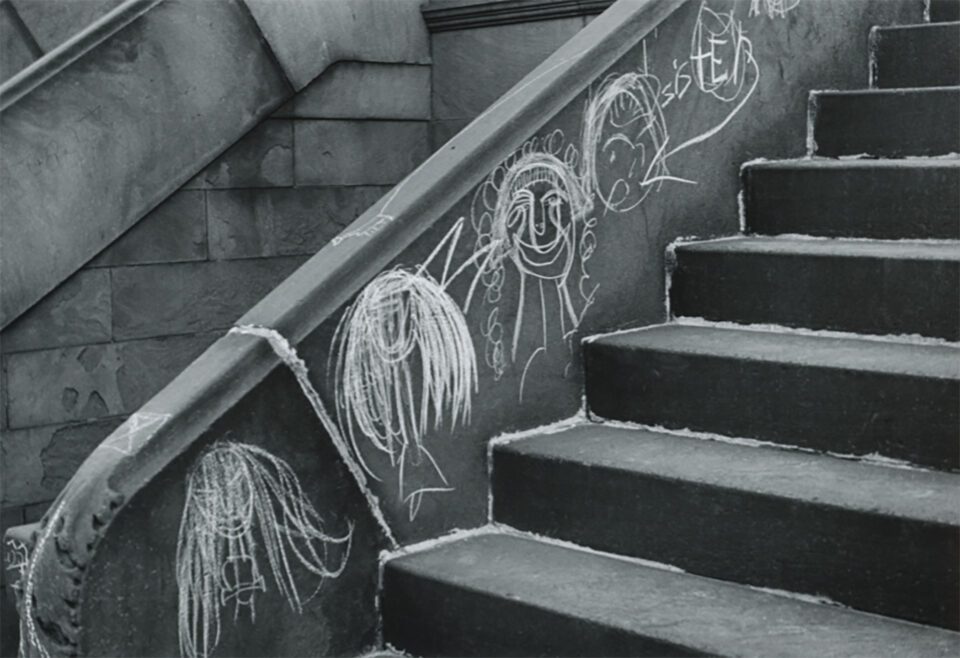
Much of that visual language developed in New York from the late 1930s onwards, particularly across East Harlem, the Lower East Side and the Bronx. Children recur throughout Levitt’s work not because she constructed an idealised portrait of childhood, but because, as she put it with characteristic bluntness, “People think I love children, but I don’t. Not more than the next person. It was just that children were out in the street.” Their presence makes visible a wider question about public space – who occupies it, how freely they move through it, and what kinds of behaviour are permitted. Chalk drawings, games, theatrical poses and spontaneous performances transform pavements into temporary arenas, while Levitt’s camera registers the social world surrounding these acts without reducing it to sociological evidence.
Here, play becomes more than a recurring motif; it becomes a way of grasping Levitt’s photographic intelligence. A child leaping between shadows, a group clustering around an unseen event, or a figure caught in an awkward gesture can produce an image whose meaning stays deliberately unstable. Levitt was drawn to comedy as well as melancholy, observing that “these days, I tend to look for comedy more and more.” Here, it is not decorative but analytical – a way of exposing the strange structures and incongruities embedded in ordinary life. Her images recognise that public existence is innately performative, yet they also suggest that it cannot entirely hide the inequalities, aspirations and tensions of the city.
This tension between intimacy and distance is key to the exhibition’s curatorial proposition. Curated by Joshua Chuang as a partnership between Fotomuseum Winterthur and Fundación Mapfre, the retrospective brings Levitt’s archive into dialogue with the images that have shaped her reputation, using recently accessible material to widen the narrative around her work. The inclusion of approximately 115 items of ephemera and archival objects, with previously unpublished contact prints, shifts attention from the iconic finished image to the processes of selection, experimentation and repetition behind it. Instead of presenting Levitt as a singular genius of the decisive moment, the exhibition shows an expansive and exploratory practice. Alessandra Nappo’s role as collection curator, with Chuang’s curatorial approach, further situates the work within questions of photographic history, preservation and institutional memory.
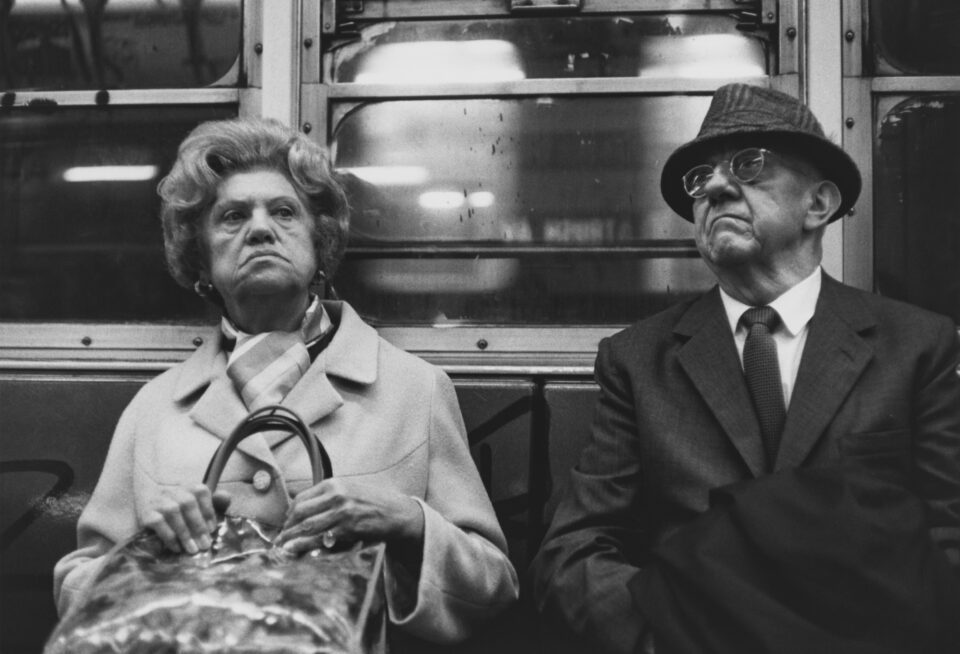
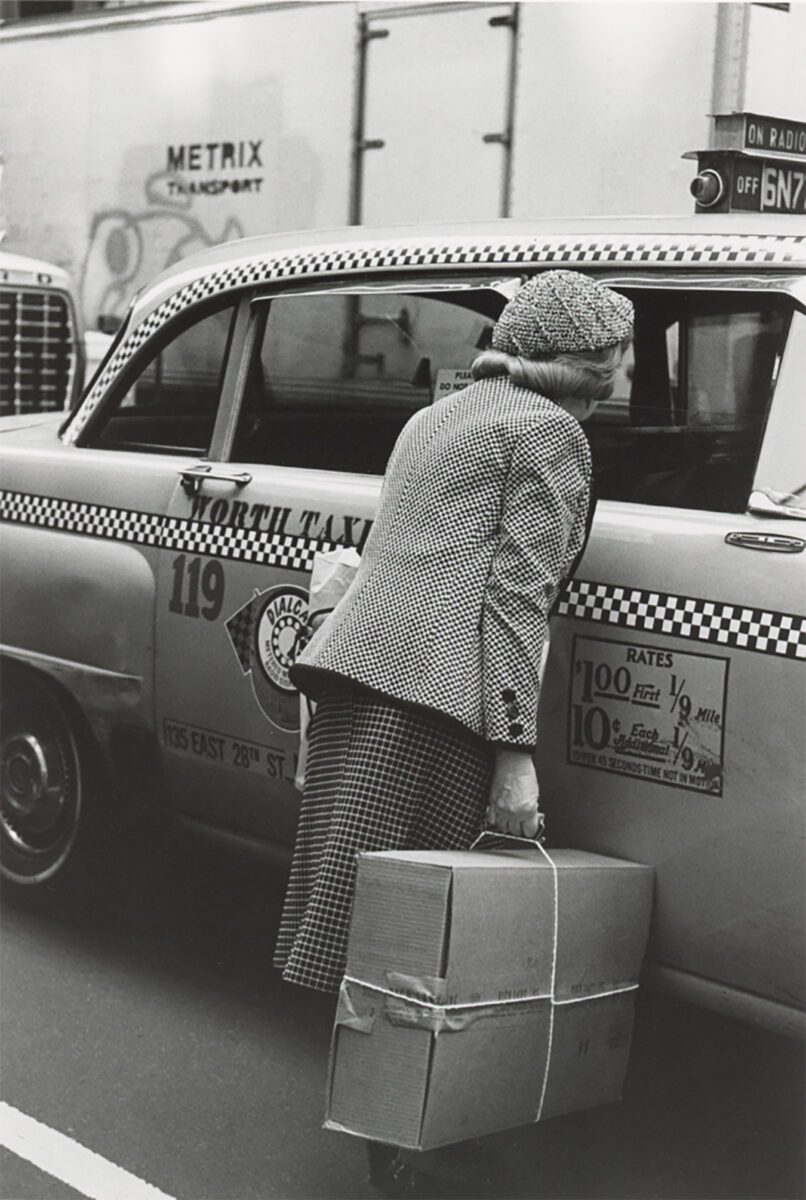
Looking at Levitt with her contemporaries also shows the particularity of her approach. Diane Arbus, Berenice Abbott and Levitt were working within a period when American photography was increasingly turning to the street as a site of social observation, but each developed a markedly different relationship to the people and environments in front of the lens. Abbott’s New York photographs foregrounded the city’s architecture and infrastructure, documenting the physical transformations of modern urban life, while Arbus became known for portraits that confronted the viewer with individuals who sat outside conventional ideas of normality. Levitt occupied a more elusive position between these approaches, finding neither monumental cityscape nor psychologically charged portrait, but rather the fleeting encounter – a gesture, game or glance that could reveal something about how urban life was lived. Placed in this wider generation of photographers, her work emerges not simply as an example of street photography, but as a distinctive form of social observation grounded in movement, humour and coincidence.
Arbus offers a particularly useful counterpoint because her work makes the ethics of looking unusually visible. Where Arbus often confronted her subjects directly, producing portraits charged with psychological tension, Levitt is better known to remain at the edge of the scene, allowing her subjects to continue their respective activities without apparent interruption. Both approaches complicate the idea of the camera as a neutral observer, since each depends upon choices about proximity, attention and representation. Levitt’s distance, however, creates a different kind of ambiguity: her photographs can feel intimate without claiming to explain the people within them. That tension becomes especially significant when considering her images of working-class neighbourhoods shaped by racial inequality, where observation carries an unavoidable question of who is looking and who is being looked at.
Abbott provides a different route into Levitt’s New York. Both photographers were intensely attentive to the city as it changed around them, yet their cameras located modernity in opposing places. Abbott’s celebrated images emphasised buildings, streets and infrastructure, turning the expanding metropolis into a monumental record of architectural transformation; Levitt looked instead at what happened between those structures, where people gathered, played, performed and passed one another. Here, her New York is less a fixed urban portrait than a constantly shifting social space. The comparison also helps to clarify why Levitt’s images remain so distinctive: rather than treating the street as backdrop or subject alone, she understood it as a stage on which the city continually produced new and unpredictable compositions.
Vivian Maier, working several decades later, provides another productive comparison, particularly in relation to the accidental encounter. Like Levitt, Maier transformed the street into a space of discovery, finding expressive possibilities in various strangers, reflections, children and passing gestures. Both photographers cultivated an apparently unobtrusive mode of looking, although Maier’s recurring self-portraits and reflections make the presence of the photographer more explicit. Levitt, by contrast, often disappears into the rhythm of the scene, allowing her subjects to completely dominate the frame while retaining an acute sense of timing. The comparison demonstrates how a seemingly casual street photograph can become an intricate negotiation between observation, authorship and opportunity.
Levitt’s 1948 film In the Street, made with James Agee and Janice Loeb, extends this particular interest in movement beyond the still image. Filmed in Spanish Harlem, the short work observes everyday activity without imposing an explanatory voice, allowing gestures, pauses and fragments of urban life to accumulate into a distinctive rhythm of their own. Its experimental structure occupies an important position in the history of observational cinema, anticipating aspects of the cinéma vérité that would become influential in the 1960s. Photography and film consequently appear not as separate practices but as complementary methods for understanding duration and attention. A still photograph arrests a gesture; film permits that gesture to exist within the continuous flow from which it initially emerged.
Mexico, too, complicates the idea of Levitt as exclusively a New York photographer. Her 1941 journey to Mexico City produced images that continued her interest in street life while introducing the perspective of the outsider into the work. Instead of pursuing the more overtly surreal imagery associated with some of her European influences, Levitt focused on human interaction and fragments of urban experience, maintaining the same alertness to coincidence that characterised her American images. The exhibition’s inclusion of 13 finished prints with more than 100 work prints from this period is particularly valuable, since it shows the breadth of her visual experimentation. These materials suggest that her photographic language was never tied to a single geography, even if New York remained its most enduring space.
Colour presents another rupture in the conventional story of Levitt’s career. Starting her experiments in the late 1950s, she became an early practitioner of colour imagery at a time when the medium was still frequently associated with advertising and commercial imagery not serious artistic practice. Her Guggenheim Fellowship in 1959 recognised this experimentation with what were then described as “the newest techniques of colour photography”. Returning to familiar neighbourhoods, Levitt began to see the street differently, attending to chromatic relationships as carefully as she had once seen gesture and form. The loss of many early colour slides through theft in the 1970s adds a materialism to this history, stressing how photographic archives are prone to disappearance even as images acquire cultural significance.
Urban photography has long carried a complicated relationship with power, particularly when it turns its lens towards communities experiencing economic and racial marginalisation. Levitt’s work belongs to a tradition that includes documentary photography, social realism and the politically engaged practices emerging from the New York Film and Photo League, yet it refuses the didactic certainty sometimes associated with those movements. Her subjects are neither presented as symbols of deprivation nor transformed into picturesque emblems of urban authenticity. Instead, comedy, awkwardness and beauty coexist with the knowledge that these streets were shaped by inequality. This balance makes the photographs particularly resonant now, when debates around surveillance, representation and the ownership of public images have transformed the meaning of photographing strangers.
Fotomuseum Winterthur’s broader interest in photography’s cultural, social and political effects provides a fitting context for such questions. The institution’s approach positions photography not merely as an art object but as a technology that influences how individuals understand themselves, one another and the environments they inhabit. City at Play benefits from this expanded conception because Levitt’s images are simultaneously aesthetic constructions, historical records and acts of looking. Their apparent spontaneity is underpinned by extraordinary formal sensitivity – cropping, timing, spatial tension and the geometry of bodies within the frame. Curatorial attention to archive and process hence allows viewers to encounter not just the famous street photographs, but the intellectual and material conditions that produced them.
Levitt is set apart by her refusal to make everyday life appear ordinary. Her images find visual complexity in chalk on pavement, a child’s pose, an exchanged glance or a figure briefly isolated against a wall, showing how little separates documentary evidence from poetic invention. The city becomes a revised composition in which no participant remains fixed for long, and photography becomes an act of following not possessing. Helen Levitt – City at Play proposes a history of street photography rooted not only in decisive moments, but in attentiveness, uncertainty and the ethics of looking. Across decades, Levitt teaches us that the most revealing image may be the one that does not tell us what to see, but makes us look again.
Helen Levitt – City at Play is at Fotomuseum Winterthur from 24 October – 31 January: fotomuseum.ch
Words: Simon Cartwright
Image Credits:
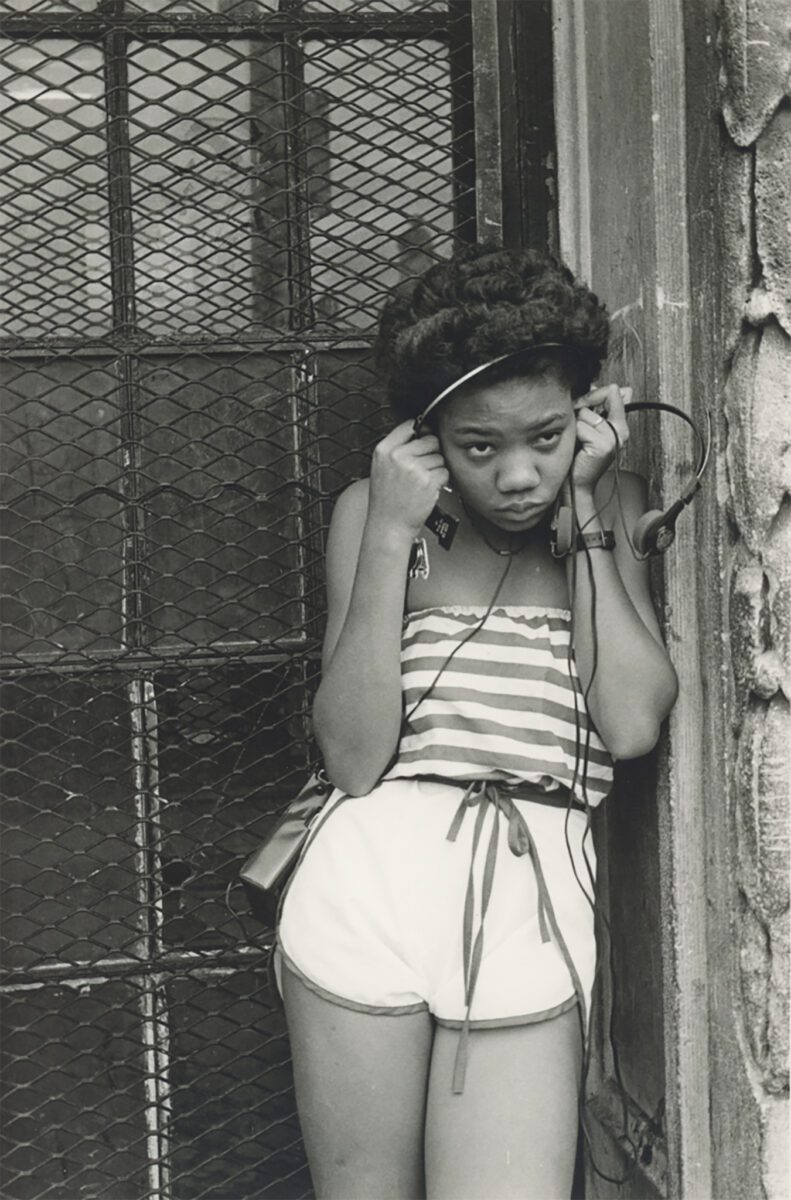
1. Helen Levitt, New York, 1985 © Film Documents LLC, courtesy Zander Galerie, Cologne
2.Helen Levitt, New York, 1982 © Film Documents LLC, courtesy Zander Galerie, Cologne
3.Helen Levitt, New York (Subway), 1975 © Film Documents LLC, courtesy Zander Galerie, Cologne.
4.Helen Levitt, Brooklyn, New York, 1982 © Film Documents LLC, courtesy Zander Galerie, Cologne
5.Helen Levitt, New York, 1937 © Film Documents LLC, courtesy Zander Galerie, Cologne