
Digital technology has fundamentally altered the conditions in which art is produced, experienced and understood. Its influence, however, extends far beyond questions of medium or technique. Artificial intelligence, algorithmic systems and computational processes increasingly shape how societies construct knowledge, distribute power and negotiate collective memory. For artists, these developments offer new creative possibilities while raising urgent questions about the structures underpinning technological progress. What matters now is what technology reveals about the world in which it operates.
This tension runs through the 2026 Lumen Prize, whose winners explore technology as both an artistic material and a subject of critical investigation. Selected from more than 2,200 submissions across 82 countries, the artists address historical erasure, ecological instability, automation and identity. Founded in 2012, the Prize has developed into an international platform for creative practices at the intersection of art and technology, connecting artists with museums, cultural institutions, collaborators and audiences. Its fifteenth anniversary offers an opportunity to reflect on how considerably this field has evolved. Digital art is no longer a peripheral category defined by its tools; it has become an important site for examining the political, cultural and social conditions of contemporary life.
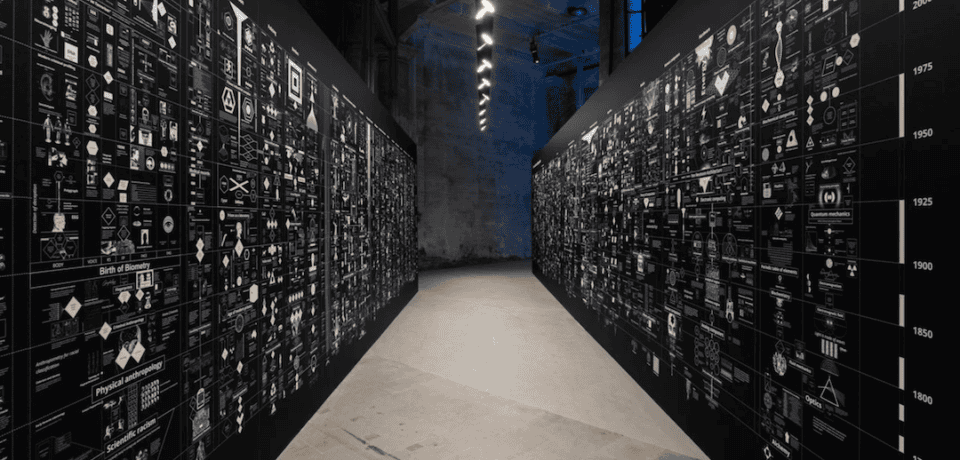
At the centre of this year’s selection is Calculating Empires: A Genealogy of Power and Technology Since 1500, by Kate Crawford and Vladan Joler, recipients of the Gold Award. Spanning more than 24 metres in its physical installation, the work traces five centuries of technological development through systems of communication, computation, classification and social control. Rather than presenting artificial intelligence as an unprecedented rupture, Crawford and Joler locate its emergence within longer histories of imperialism, administration and extraction. Thousands of connections reveal how contemporary technologies inherit structures of power that have shaped political and economic life for generations. By challenging the idea that technological progress is a clean break with the past, the installation asks viewers to consider which historical relationships remain embedded in the systems shaping their present.
The politics of visibility takes a more personal and historically specific form in Mimi Ọnụọha’s Ground Truths, recipient of the Legacy Futures Award. Following the discovery of 95 bodies in a mass grave close to her childhood home in Sugar Land, Texas, the artist spent four years developing a machine-learning model to identify other possible convict-leasing burial sites. The resulting docufiction film considers how computational systems might help uncover histories that have been deliberately or institutionally neglected. Yet the work also raises questions about the authority we give to data and the limitations of technological evidence. By bringing machine learning into conversation with collective memory, Ọnụọha exposes a central contradiction of the digital age: information may be abundant, but visibility and acknowledgement remain profoundly unequal.
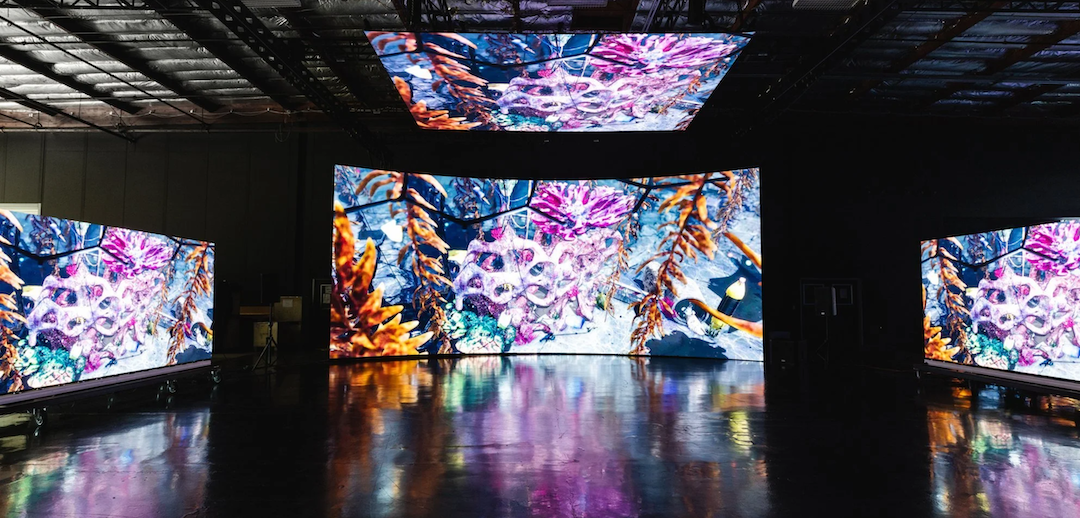
Technology’s relationship with the natural world is equally complex. In Drift Lattice, recipient of the Systems & Structures Award, Theo Triantafyllidis simulates a marine environment populated by aquatic life, synthetic debris and autonomous cleaning drones. Influenced by real-time climate and ocean data, the installation brings biological and artificial systems into an evolving relationship, making the precarious condition of marine ecosystems visible. Rather than positioning technology as an uncomplicated solution to ecological crisis, the work considers the interdependence of human intervention, automation and natural processes. A different form of environmental reflection emerges in Throat of the Wind by Aiwen Ding and Zhi Geng. Their Student Award-winning installation transforms a decommissioned wind turbine blade into a sound-producing instrument, incorporating wind and electromagnetic signals to evoke the environmental and historical memory of Anguli Nao in northern China.
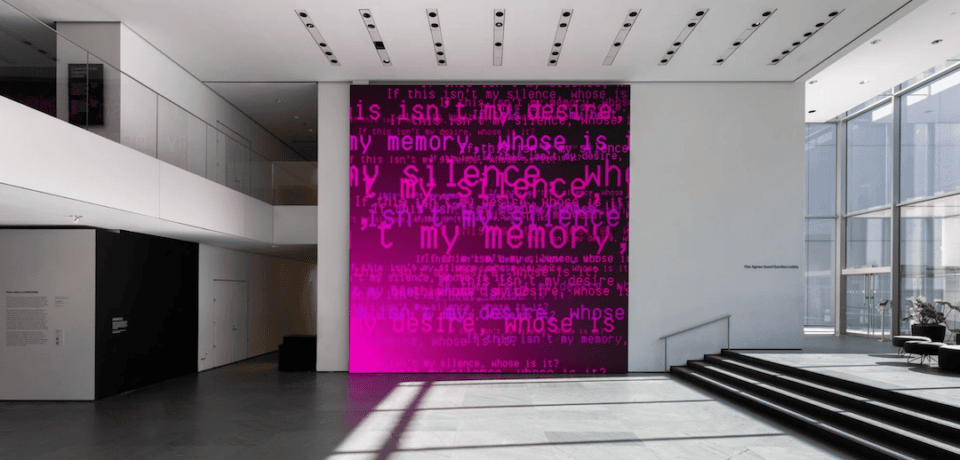
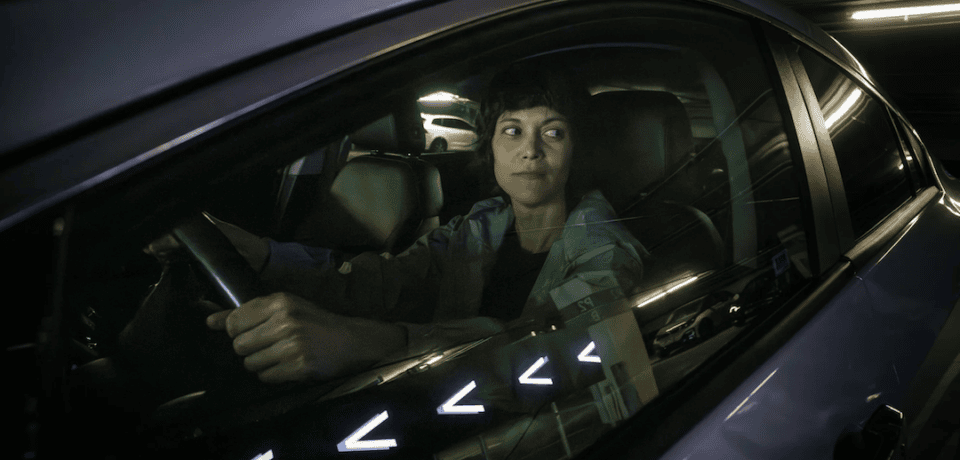
Questions of agency extend into the relationship between people and the systems they create. Lauren Lee McCarthy’s AUTO, winner of the Experiential Innovation Award, centres on an autonomous vehicle driven through collective singing. Passengers learn its words as they leave their mouths, gradually discovering that participation is inseparable from the mechanism itself. Playful in construction, the experience raises serious questions about automation, surveillance, infrastructure and collective control. Sasha Stiles explores a different aspect of human and machine interaction in A LIVING POEM, a generative environment combining poetry, voice, visual imagery, code and artificial intelligence. Developed alongside her AI alter ego, Technelegy, the work proposes a form of poetic intelligence in which emotional expression and algorithmic processes contribute to the creation of meaning. Both practices resist the assumption that human creativity and technological systems must exist in opposition.
The relationship between innovation and inherited knowledge is particularly apparent in Pattern Language, created by Matt DesLauriers, Kjetil Golid and Andreas Rau, recipients of the Nordic Award. Bringing Western Norwegian textile traditions into dialogue with computational aesthetics, the installation draws on historic Åkle weaving patterns and the visual language of early computer interfaces. Visitors can manipulate a generative system to produce virtual tapestries, some of which are subsequently translated into jacquard-woven textiles. The process connects centuries-old techniques with contemporary methods of production, challenging the idea that technological innovation requires the abandonment of traditional knowledge. Historical continuity also informs Robin Kane’s 1864, recipient of the Carla Rapoport Award. Using AI-assisted moving and still images, the work considers the Circassian Genocide and the displacement that followed, focusing on inherited grief, cultural survival and the persistence of identity. Here, technology becomes a means of approaching histories that resist straightforward representation.

Taken together, the works raise questions about how digital art should be understood and presented within contemporary institutions. Their significance cannot be reduced to the technologies employed or the novelty of their visual languages. Instead, the curatorial framework of the 2026 awards establishes connections through shared concerns, allowing distinct practices to speak to one another across installation, moving image, sound, generative systems and participatory experience. The different award strands – from Legacy Futures and Systems & Structures to Experiential Innovation and the Nordic Award – reflect the breadth of a field that increasingly resists conventional categorisation. The continuing partnership with Kunstsilo in Kristiansand provides an institutional setting for this exchange, bringing digital experimentation into dialogue with a museum whose Tangen Collection is dedicated to Nordic modernism. Under director Maria Mediaas Jørstad, the museum has developed an international programme that connects artistic practice with wider cultural debate, while its collaboration with Lumen brings together artists, curators, researchers and cultural leaders.
Recognition also raises a broader question about how artists establish lasting positions within the contemporary art world. Prizes such as the Turner Prize, Prix Ars Electronica and Aesthetica Art Prize help determine which practices enter wider cultural conversations, creating opportunities to reach curators, collectors, galleries and international audiences. Their value, however, extends beyond financial reward or immediate visibility. At their best, awards provide professional networks, institutional relationships and platforms through which challenging, or less familiar practices can find an audience. The Aesthetica Art Prize, for example, supports artists across disciplines through exhibition opportunities, editorial coverage and professional exposure, recognising work that engages with the social, political and environmental conditions of contemporary life. Such initiatives contribute to the cultural infrastructure that enables artists to develop their practices and sustain their careers.

The trajectories of previous Lumen recipients illustrate the possibilities that can emerge from this kind of recognition. Refik Anadol, recipient of the 2019 Gold Award, has gone on to present Unsupervised at the Museum of Modern Art in New York, using artificial intelligence to reinterpret the institution’s collection, and Echoes of the Earth: Living Archive at London’s Serpentine Galleries. Sougwen Chung, whose Drawing Operations (Duet) received the 2019 Still Image Award, has developed an influential practice exploring collaboration between human gestures and robotic systems. Their work has entered the permanent collections of the Victoria and Albert Museum and EMMA – Espoo Museum of Modern Art. Casey Reas, recognised in 2020 alongside Jan St. Werner for Compressed Cinema, has continued to shape computational art through his work as an artist and educator, co-founding the Processing Foundation and digital art platform Feral File. These developments demonstrate how recognition can connect individual practices with institutions, research communities and new forms of cultural exchange.
The 2026 winners suggest that the future of technological art will be shaped less by the novelty of its tools than by the questions artists bring to them. Across histories of imperial power, ecological uncertainty, collective memory and machine intelligence, these practices examine the structures that shape contemporary experience and challenge assumptions about who controls them. They also unsettle familiar divisions between the natural and artificial, the historical and contemporary, the material and virtual. Prizes cannot resolve the ethical and cultural tensions accompanying technological change, but they can create the conditions in which artists interrogate them with greater visibility and reach. Fifteen years after its foundation, the Lumen Prize demonstrates the importance of recognising not simply what technology makes possible, but the artists who help us understand its consequences.
Words: Simon Cartwright
Image Credits:
1. © Theo Triantafyllidis, Drift Lattice.
2. © Sasha Stiles, A LIVING POEM.
3. © Lauren Lee McCarthy, AUTO.
4. © Kate Crawford and Vladan Joler, Calculating Empires, A Genealogy of Power and Technology Since 1500.
5. © Aiwen Ding and Zhi Geng, 风喉 Throat of the Wind.
6. © Mimi Ọnụọha, Ground Truths.


