

Photographer Arpita Shah spent the earlier part of her life living between India, Ireland and the Middle East, before settling in the UK. This migratory experience is reflected in her practice, which often focuses on the notion of home, belonging and shifting cultural identities. Her latest exhibition, hosted at Firstsite, Colchester, follows this artistic inquiry. Arpita Shah: Nalini is a thoughtful and personal journey through motherhood, heritage, belonging and the connections that exist across generations and continents. The series was developed across India, East Africa and the UK, exploring the connected histories of the artist, her mother and grandmother. The process of creating the series uncovered forgotten family photographs. Through this, she reconnects with her maternal lineage and explores how migration, distance and loss have shaped their lives. Shah caught up with Aesthetica to discuss this deeply personal project.
A: How did you begin working behind the lens? Where did you get your first camera?
AS: My first encounter with photography began in childhood, watching my father photograph my mother in vibrant saris beneath dusty, blossoming trees in India and Saudi Arabia, reflected in mirrors or sitting by the sea. She was his muse, and those images shaped the way I see and photograph her. The Firstsite exhibition includes some archival photographs taken by my father, including one of me standing amongst the roses in our garden, wearing a dress the same shade as the petals. As a teenager in the 1990s, my walls were covered with cut-outs from I-D, Dazed, Fruits and Vogue, alongside Polaroids of friends and family. At 16, my father gave me his Canon A-1. The first person I documented was my mother. I studied photography at college, and then at university in Edinburgh and, now aged 42, I am still photographing my mum.

A: This exhibition explores the connected histories of you, your mother and grandmother. What is it like to work on such a personal project?
AS: For over 18 years, I’ve collaborated with South Asian women exploring diaspora, womanhood, cultural displacement and ancestral histories, particularly mother-daughter relationships. So, turning the camera onto my own family felt very organic, particularly following my grandmother’s illness. The project began during a visit to India in 2015, when my grandmother fell into a coma for almost three weeks. We thought we were going to lose her, and during that time, I felt that deep sadness, regret and longing that many of us experience, especially when our elders are scattered across different lands. I felt a strong urgency to document her life and preserve her stories. Making the work was precious, emotional and difficult at times. I was both granddaughter and artist, so navigating when to dig deeper, when to photograph, when to be respectful and give her space while she was ill, was tough to balance. But the project also led to beautiful, tender moments, conversations, discovering old family photographs, heirlooms, and travelling to places such as Kenya with my mother, things that would have never have happened if the project hadn’t begun. Exhibiting the work still feels vulnerable, yet I’m always moved by how deeply it resonates with visitors. Conversations emerge around their own family histories, memories, and relationships with their mothers and grandmothers. These exchanges have become one of the most meaningful parts of the work for me.
A: Did you discover anything about your family in the making of the series?
AS: There were so many gems unearthed in the attics of family members’ homes in India, Kenya and the UK, secrets, tales and keepsakes preserved across generations. One of the most exciting discoveries was learning more about my family’s time in Nairobi, Kenya. I had grown up hearing stories that had almost become family myth, until I discovered a collection of photographs from the 1920s and 1930s in my late great-grandmother’s attic in India. Amongst them was a crumbling photograph of the Krishna Milk Depot, my family’s business, with five-year-old Nalini at its centre. I had never seen an image of my grandmother that young, and this photograph became a starting point for the project. In the exhibition, it is presented with a magnifying glass, inviting viewers to look closer, as I did.
A: Tell us about the name of the show. Where does that come from?
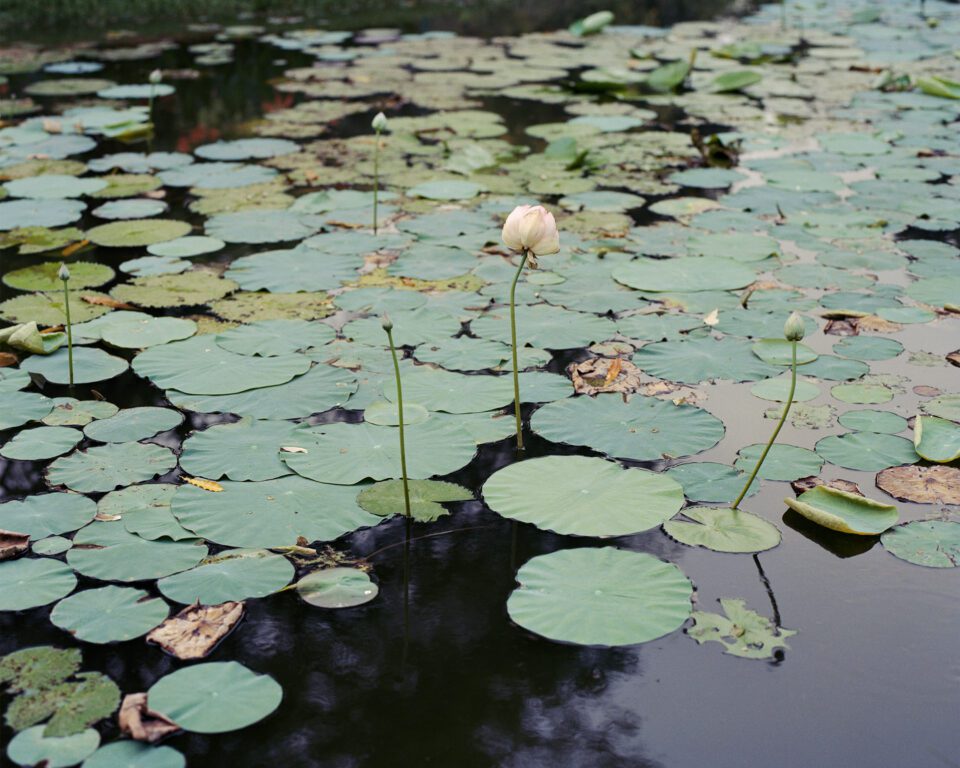
AS: Nalini is my grandmother’s name, and, like in many of my projects, the title has a double meaning. In Sanskrit, Nalini translates to lotus flower, which in Hindu mythology symbolises fertility, the womb and rebirth. My work often draws from flora in Indian culture and mythology to explore displacement, uprootedness and the different stages of the female life cycle, such as in my earlier works Vasant Ritu and Nymphaeaceae. When my grandmother woke from her coma, the first thing she said was that she had dreamt she was floating in the ocean between Africa and India. This very poetic imagery became a key motif for the series. I wanted to evoke this sensation in the exhibition, particularly in the triptych of my grandmother and mother lying at the centre of a lotus pond, with a white lotus emerging between them.
A: What role do flowers play in the exhibition?
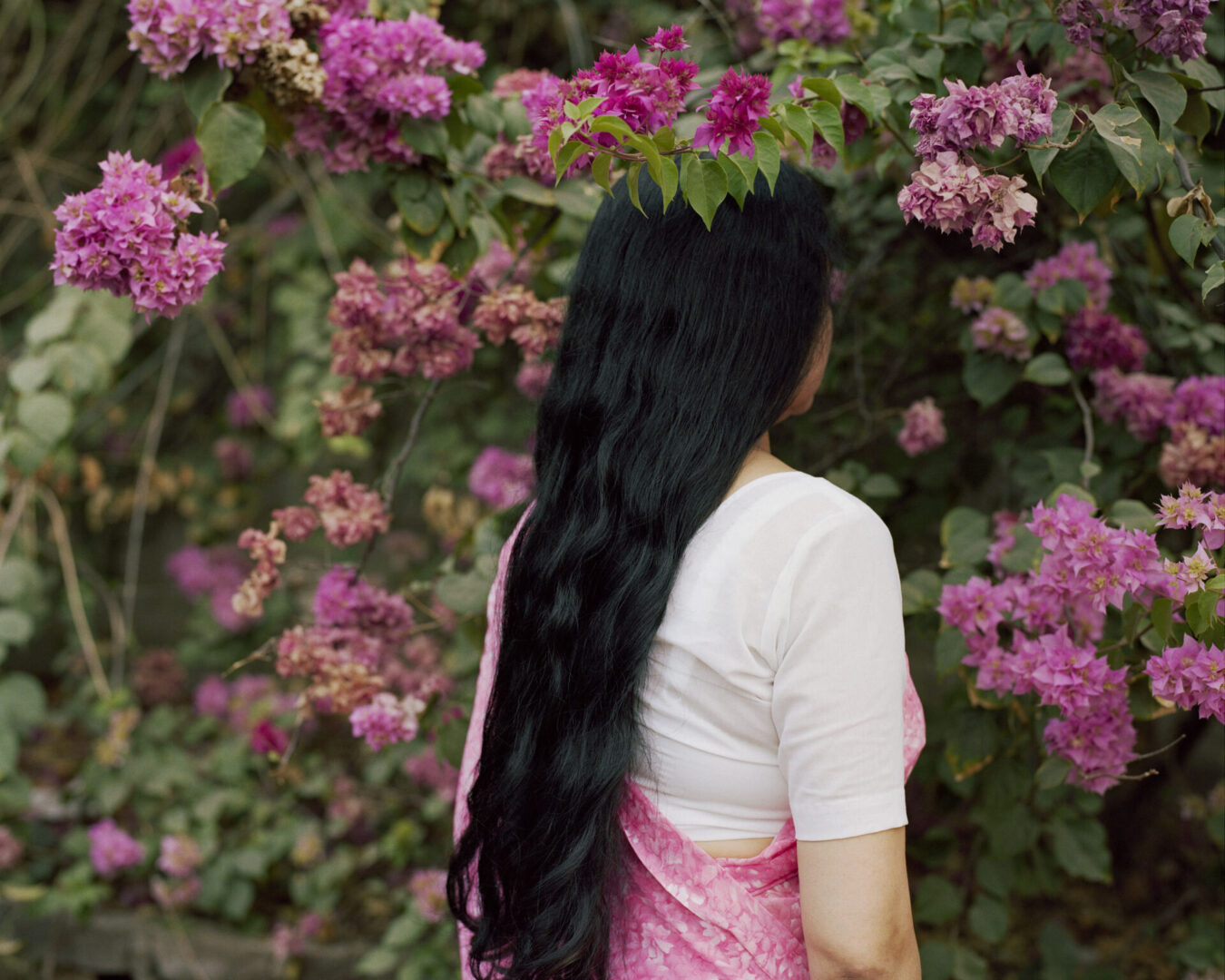
AS: Flowers have long been associated with women across cultures, particularly in Indian mythology, art and culture. Growing up in a Hindu home, I was surrounded by images of goddesses floating on large lotus flowers. On particular occasions, I’d watch the women in my family decorate photographs of our ancestors with fresh flowers as a way of honouring and remembering them, and this ritual of remembrance is woven throughout Nalini. In the exhibition, flowers become metaphors for femininity, uprootedness, memory, touch, longing and the passing of time. Wilting petals sit alongside ageing skin and crumbling family albums. The lotus is central, but the series also features roses and bougainvillea. One image features my great-grandmother Narmanda’s open passport with a bougainvillea I hand-picked at my family’s former dairy farm in Nairobi. Originally from Brazil, this flower was introduced to India and East Africa during British colonial rule, making it a symbol of migration, displacement and colonial history.
A: Why did you choose to focus your lens on the female figures in your family?
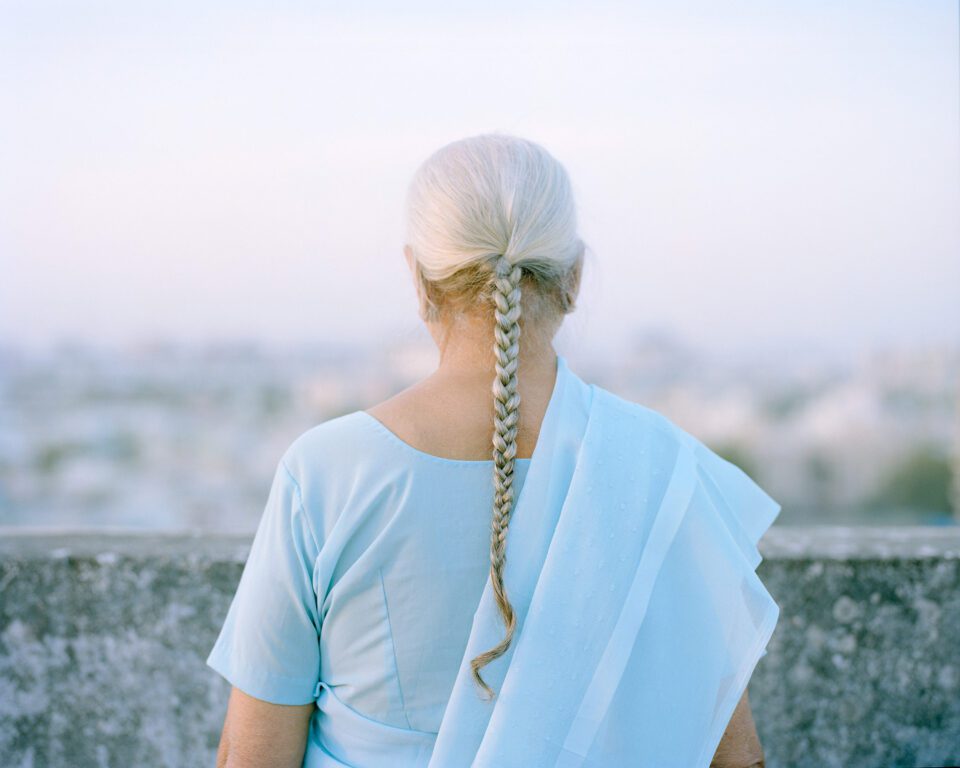
AS: As an artist, I’ve always been interested in making the presence and narratives of women of colour more visible, particularly within galleries and museums in the UK. Growing up, I rarely saw women like my mum or grandmother being celebrated in these spaces. For almost two decades, I’ve collaborated with South Asian women because they are often the keepers of ancestral knowledge. It’s often women who pass down the traditions and rituals that shape our identities. Much of my work is inspired by my mother, her childhood stories and her experiences of growing up in India and migrating to the UK. As a woman of the Indian diaspora, I’ve learned so much about my culture from those who came before me, through recipes, rituals, braiding and oiling hair, learning how to drape a sari, and all the small, intimate acts through which culture and care is passed down. These are the things you hold onto so dearly when you are displaced from your homeland and longing for your ancestors. In Nalini, I wanted to piece these fragments together, honour those who came before me and explore the connections that carry us across generations.
A: You spent the earlier part of your life living between India, Ireland and the Middle East. How does that experience shape your artistic practice?
AS: Central themes to my artistic practice are questions of home and belonging and this definitely stems from my own experiences of growing up across different countries. I think this sense of displacement and searching for home has always been a really meaningful way of connecting to the people I collaborate with. In my images, I’m forever returning to memories of my time in these countries: shrines of Hindu goddesses, intricate Islamic architecture, the shifting hues of sky and sea, dusty, sun-bleached wildflowers. These images come back to me so vividly that I sometimes dream of them. I wonder whether it is because my father photographed them so often, because my mother carries them with such nostalgia, or because I have held on to them so tightly myself. Perhaps it is all three?

A: Has making the project changed your relationship to your mother and grandmother?
AS: Yes, it deepened the connection immensely, and the most significant change was my relationship with my grandmother. My Gujarati is very limited, so we’ve always struggled to communicate. As I made Nalini, we would spend hours together, sometimes trying to understand each other, her performing to the camera, and other times simply sitting in silence as I observed her. For me, that silence and the slow process of photographing her became much more meaningful than language had ever been. This project created an intimacy and bond between us that I had never experienced before, and I’m forever grateful.
A: Do you have a particular image in the exhibition that feels like a standout moment?
AS: There is a new piece in the exhibition titled Nalini & Narmada, presented as a lightbox. It is the most recent image I’ve made, and the first since Nalini passed away in 2023. The image shows flowers from her funeral scattered across the Narmada at dusk, a sacred river in Gujarat. Narmada was also the name of Nalini’s mother, my great grandmother, and so this image feels like the final frame of a decade-long journey. A love letter to her and all my female ancestors. In the exhibition at Firstsite, it appears like a floating portal into the afterlife, but also as a farewell. It feels like a passage between life and death, past and present.
Arpita Shah: Nalini is at Firstsite, Colchester until 4 October: firstsite.uk
Nalini is a Street Level Photoworks touring exhibition.
Words: Emma Jacob & Arpita Shah
Image Credits:
1. Bougainvillaea Mahara from the series Nalini © Arpita Shah.
2. Nalini & Narmada from the series Nalini © Arpita Shah.
3. English Blue from the series Nalini © Arpita Shah.
4. Parminal Gardens from the series Nalini © Arpita Shah.
5. Mombassa from the series Nalini © Arpita Shah.


