

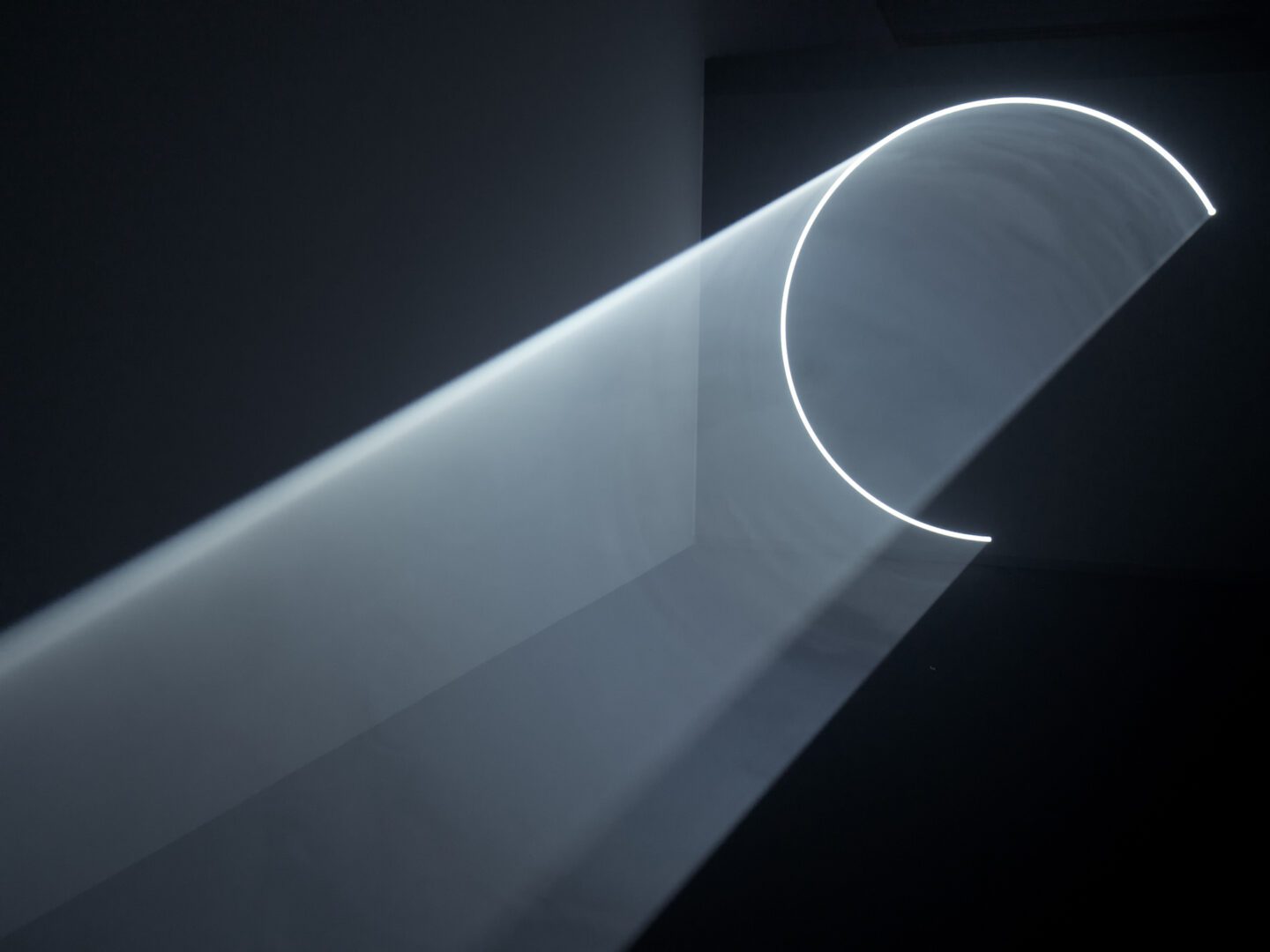
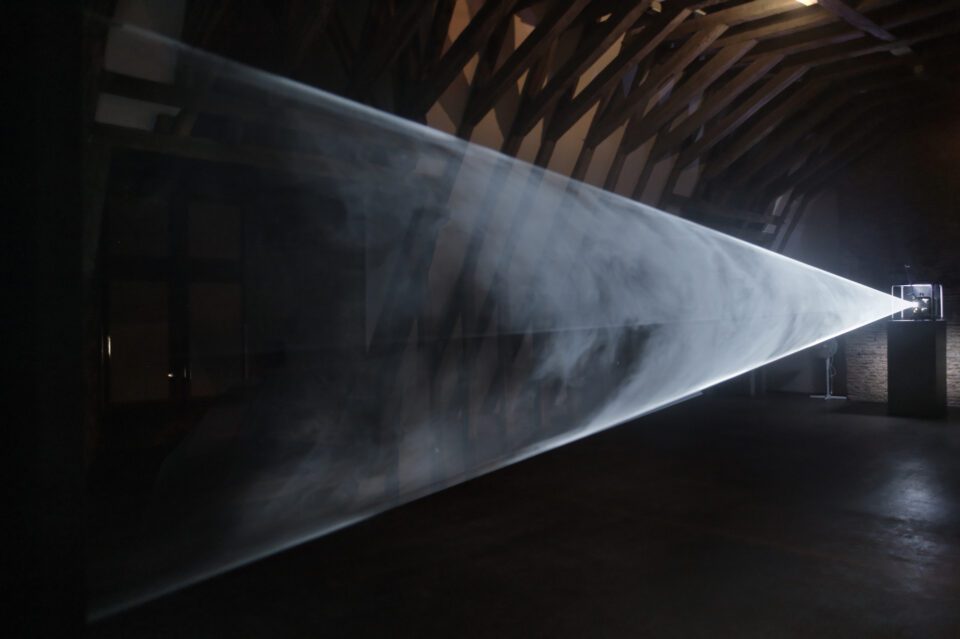
In 1973, Anthony McCall (b. 1946) broke new artistic ground with Line Describing a Cone, an installation in which a single projected line of light slowly traced the outline of a circle within a haze-filled room. Gradually, over the course of 30 minutes, it formed a luminous cone. The piece was revolutionary for several reasons, most of all because it transformed light into sculpture. It was a new blueprint for what a three-dimensional artwork could look like, and went on to inspire other landmark ideas, like Gordon Matta-Clark’s Conical Intersect (1975), which made circular “cuts” into two derelict Paris buildings.
McCall emerged from the avant-garde film communities of London and New York during the late 1960s and early 1970s. He rejected the conventions of narrative cinema in favour of an investigation into the essential properties of the moving-image: light and space. It was from this that his seminal “solid light” installations were born. He concluded: “If you want to make a film that’s really a film, and not anything else, you need to discard the image.” Line Describing a Cone was the first iteration of this idea. Rather than watching a projected scene on a screen, viewers entered the beam of light itself – walking through, around and inside something that appeared to simultaneously exist and not exist. The piece was initially shown in lofts across New York City, where it sliced through the dust and cigarette smoke circulating in the air.
Towards the end of the 1970s, McCall began a 20-year hiatus, stepping away from art-making to focus on graphic design. He returned at the turn of the millennium to a landscape transformed. Technological advancements since the 1990s – including the advent of digital projectors, the commercialisation of haze machines and the development of computer scripts and animation software – now offered different ways of manipulating light and space. These technologies have since enabled McCall to craft increasingly complex pieces, yet his practice remains rooted in the same fundamentals as always: perception, time and the relationship between the body and its surroundings. Today, McCall is widely regarded as one of the most influential names in his field. He has been the subject of major solo exhibitions at leading institutions worldwide, including recent retrospectives at Tate Modern, London, and Guggenheim Bilbao.
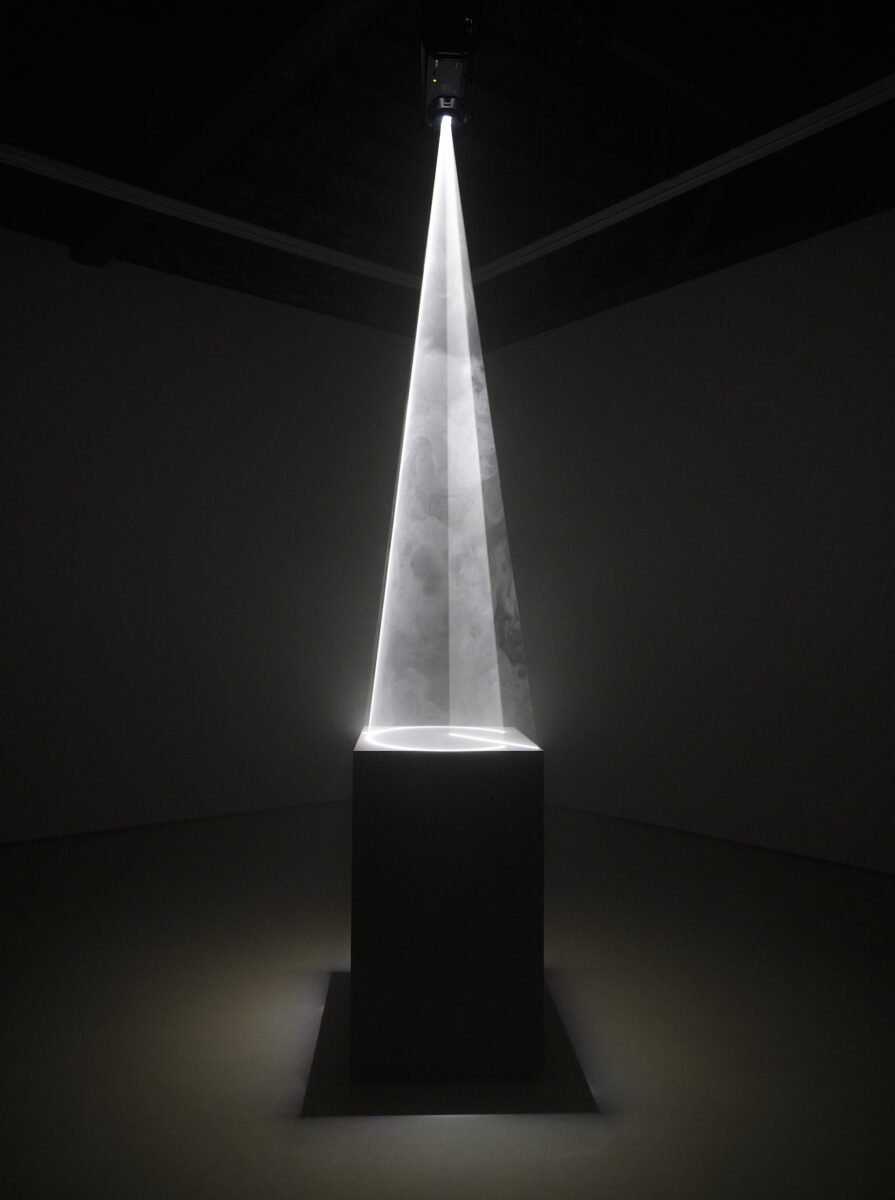
Line Describing a Cone is considered one of the defining examples of 20th century installation art. Now, it is at the heart of Sean Kelly Gallery’s latest exhibition, Solid Light, 1973, 2020, 2026, which brings together three key works spanning 50 years. Audiences will discover Skylight (2020), in which a signature illuminated cone materialises onto a plinth that can be experienced from every angle. It is accompanied by an original score by acclaimed composer David Grubbs, evoking a rumbling thunderstorm with flashes of lightning and steady falling rain. The third piece on view is Swarm (2026), McCall’s most recent offering. It responds to the increased presence of drones in daily life and is composed of two light volumes that rotate in opposite directions over fifteen minutes. Grubbs returns with a soundscape that intensifies over time.
In today’s increasingly digital landscape, where installations are shared online and go viral in an instant, Solid Light, 1973, 2020, 2026 does something special: it presents three works that can only be fully experienced in person. By combining visuals, audio and duration, McCall encourages audiences to participate fully, with all the senses. Moreover, the exhibition traces the artist’s journey from his breakthrough to the present day, highlighting how he has continually pushed the boundaries of his craft, embracing change whilst remaining true to a singular vision where cinema, sculpture and drawing overlap.
Anthony McCall: Solid Light, 1973, 2020, 2026
Sean Kelly, New York, from 11 September – 31 October.
Words: Eleanor Sutherland
Image Credits:
1. Anthony McCall Line Describing a Cone, 1973 16mm projected installation, 30 minutes. © Anthony McCall Courtesy: the artist and Sean Kelly, New York.
2. Anthony McCall Skylight, 2020 vertical, single projection, soundtrack by David Grubbs, media player, digital file, digital projector, audio speakers, haze machine duration: 16 minutes (looped). © Anthony McCall Courtesy: the artist and Sean Kelly, New York.
3. Anthony McCall Line Describing a Cone, 1973 16mm projected installation, 30 minutes.
© Anthony McCall Courtesy: the artist and Sean Kelly, New York

