


Installation art challenges the boundaries of traditional exhibitions, transforming white cube environments and public spaces alike into immersive experiences. From Do Ho Suh’s large-scale fabric homes to Anthony McCall’s light projections, these artworks redefine how we perceive architecture and our surroundings. This feature highlights the thoughts of ten pioneering artists previously featured in Aesthetica Magazine, whose work invites us to consider the relationship between art, audience and the built environment. Be inspired by these quotes, which go behind the scenes of some of the most famous works of our times.

Tara Donovan on her materials-of-choice
“I sought cheap, mass-produced materials specifically because I could source massive amounts quickly, then experiment with them in the studio … I tend to gravitate towards properties like transparency and reflectivity. Light plays such a central role in the perception and comprehension of my works. I think of it as a medium in and of itself.” Read more ›
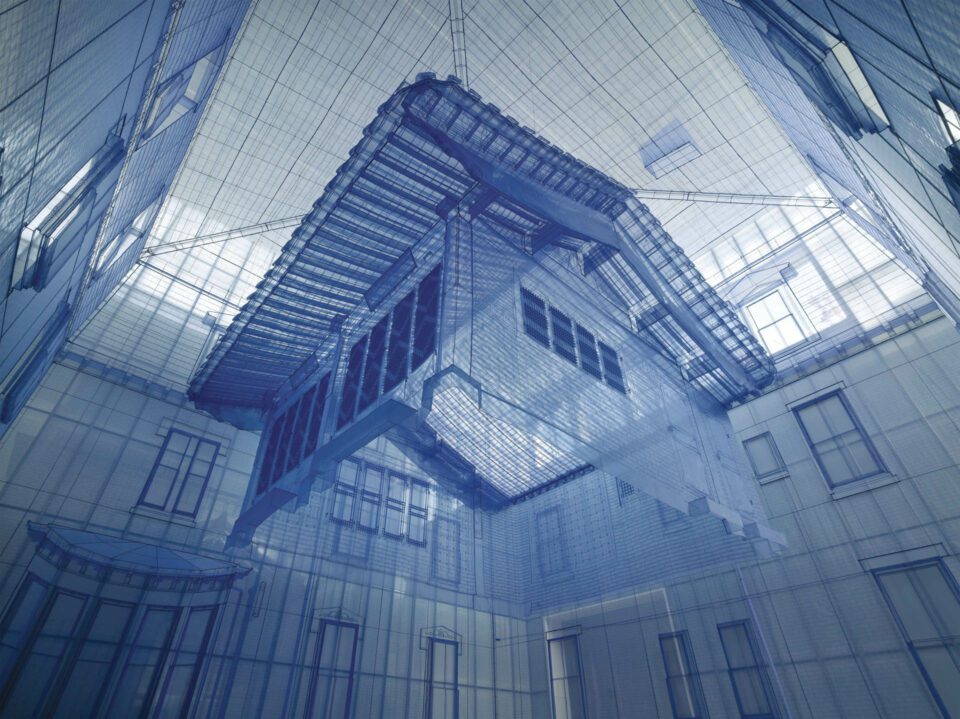
Do Ho Suh on the concept of home
“One of the areas I’m most interested in is what we carry with us. How much of ‘home’ is transportable? How tied to notions of site is it?” Read more ›

Cerith Wyn Evans on describing his work
“I’ve never found it particularly constructive to make a distinction based on medium … I’ve chosen, over the years, to avoid ‘describing’ my work. It seems to undermine the very purpose of making it. For that reason, I’m privileged to afford a changing focus as feels right.” Read more ›

Squidsoup on the creative process
“Most of our works originate from a single idea – an abstract or generic concept – that we then iterate and experiment with until something fully formed emerges … In some senses, the technology and hardware are the canvas, paint and brushes. The artwork is like a painting in space and time, underpinned by a conceptual framework.” Read more ›

Anthony McCall on the realisation that changed his practice
“If you want to make a film that’s really a film, and not anything else, you need to discard the image.” Read more ›

Sarah Meyohas on multidisciplinary practice
“Fluidity is essential to my approach. Each idea dictates its own form, and I want my practice to remain responsive – to evolve alongside new technologies, new contexts, and new ways of seeing. Restricting myself to a single medium would be like trying to tell every story with the same vocabulary.” Read more ›
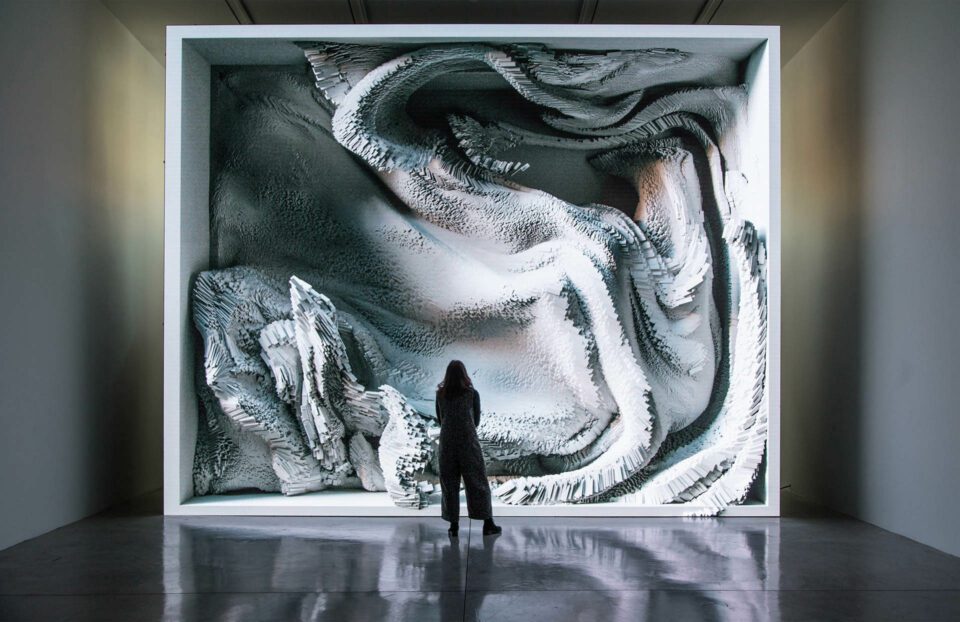
Refik Anadol on working with data
“Data as a medium or as a material is beyond just ones and zeros. Data is more than numbers. I look at them as memories, as the meaningful clusters of important moments transformed into digital entities and stored in the mind of a machine.” Read more ›
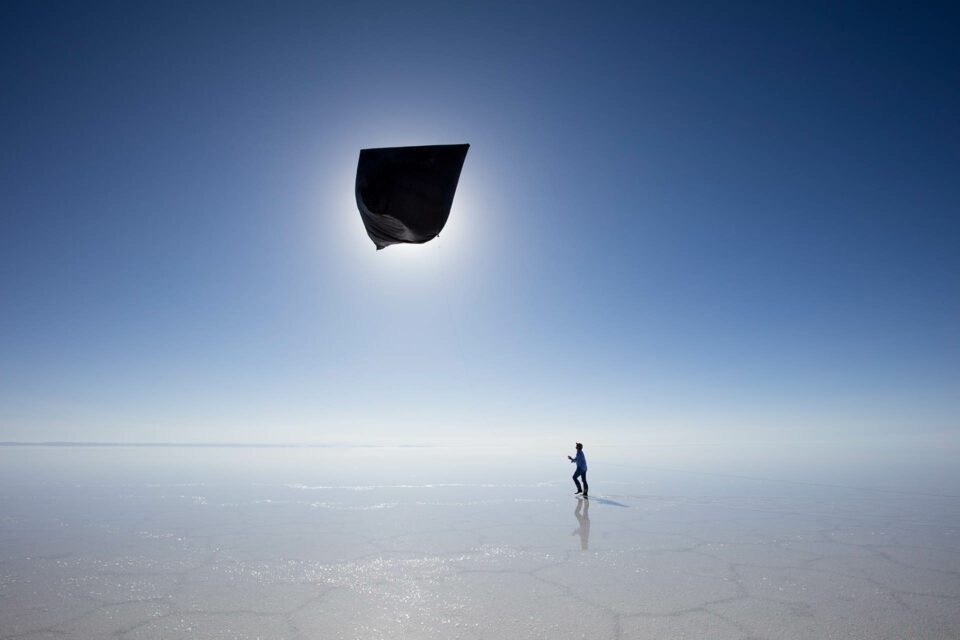
Tomás Saraceno on the visitor experience
“We try not to treat people as an “audience.” It can make them feel alienated. Instead, I ask: how can we involve others more actively? This doesn’t mean visitors can’t be contemplative, but it’s about being present.” Read more ›
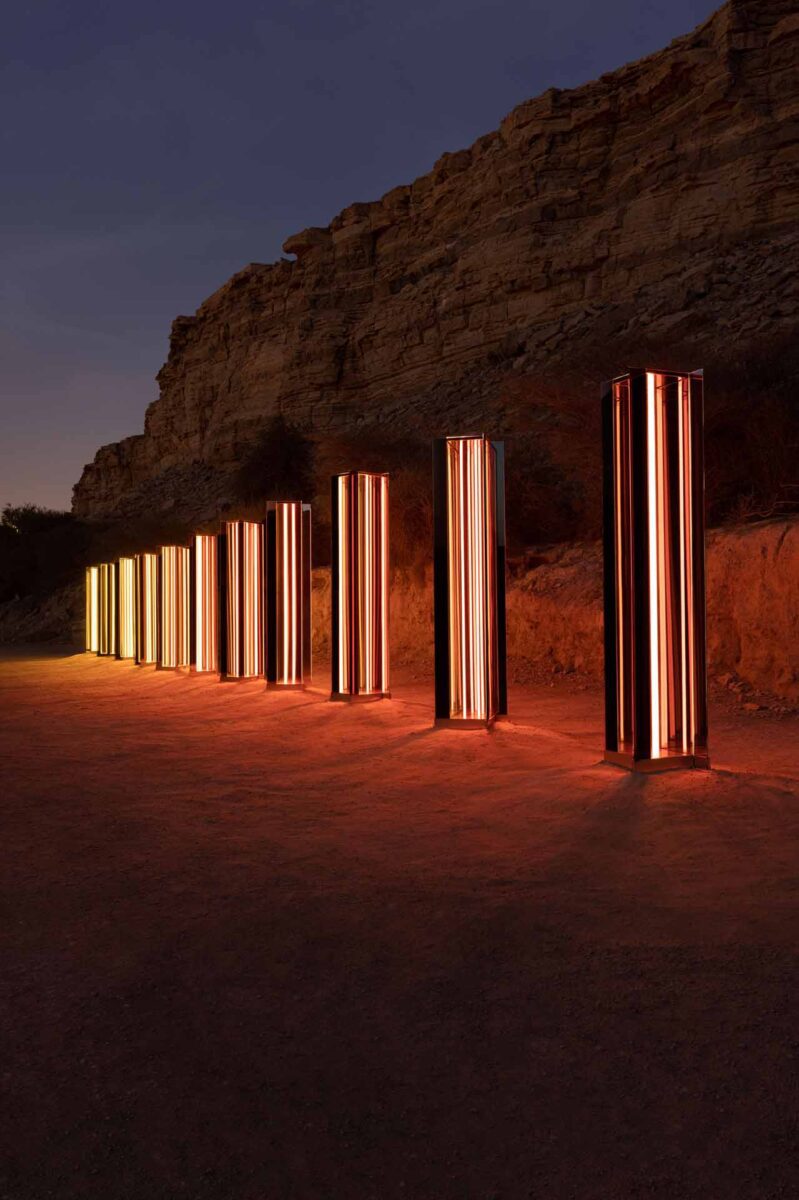
Sabine Marcelis on the power of light
“Light is a catalyst that brings a static object to life. Without it, there is nothing: no colour, no shadow, no reflection. What fascinates me is that it constantly changes things as you move around them. Various combinations can create different atmospheres. I think of colour as something you activate with light. That relationship is at the core of what I do.” Read more ›
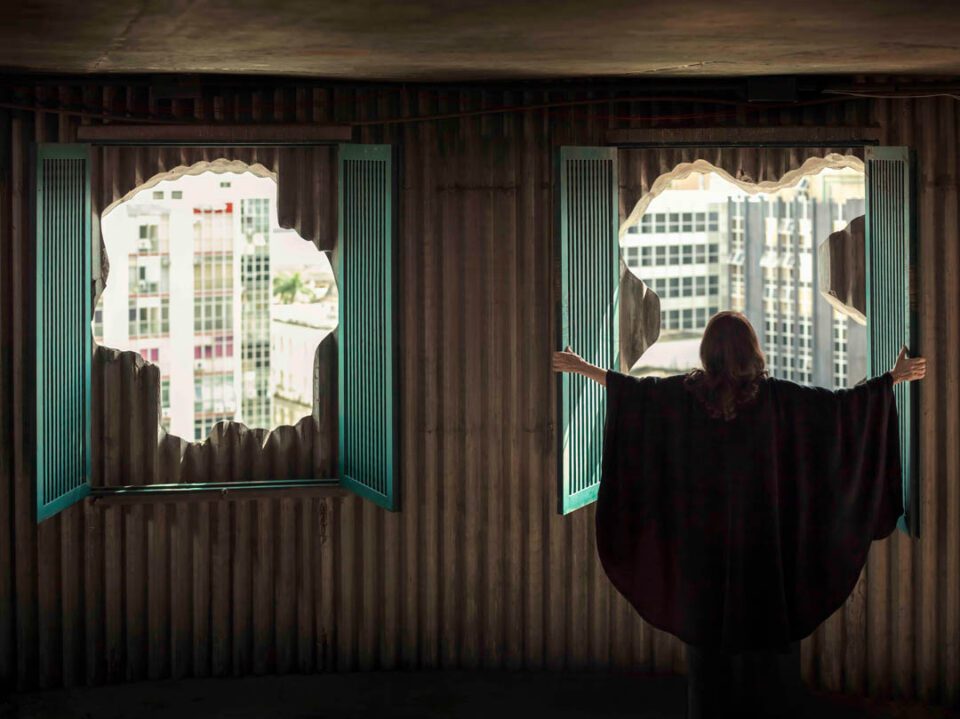
Isaac Julien on defining his practice
“I’m not interested in how I fit between documentary and fiction. Genre expectations are conventions constructed to determine how we think about film. I transgress both these forms. I use the term “political lyricism,” which moves beyond those boundaries of the form … Documentary and fiction meld together. It’s more important to consider how works can test their time. A project must be able to transcend when it was made.” Read more ›
Subscribe to Aesthetica & Save 70% in November | 12 Months for £12 | Click Here to Shop All Issues.
Words: Sophie Bullivant
Image Credits:
1. Cerith Wyn Evans, ….the Illuminating Gas, Pirelli Hangar Bicocca, Milan. 31 October 2019 – 6 July 2020 © Cerith Wyn Evans. Photo © Agostino Osio. Courtesy of the artist; White Cube; Pirelli Hangar Bicocca
2. Untitled (Styrofoam Cups) (detail), (2003/2008). Styrofoam cups and glue. Photograph by Dennis Cowley, courtesy Pace Gallery. © Tara Donovan.
3. Do Ho Suh, Home within Home within Home within Home within Home, (2013). Hanjin Shipping Box Project, MMCA Seoul, 13 November 2013 – 11 May 2014. © Do Ho Suh. Courtesy of the artist, Lehmann Maupin and MMCA Seoul.Photography by Jeon Taeg Su.
4. Cerith Wyn Evans, ….the Illuminating Gas, Pirelli Hangar Bicocca, Milan. 31 October 2019 – 6 July 2020 © Cerith Wyn Evans. Photo © Agostino Osio. Courtesy of the artist; White Cube; Pirelli Hangar Bicocca.
5. Submergence, (2023). City of Light Jyvälskylä, Finland. Image: Michelle Leck / Squidsoup.
6. Anthony McCall, Solid Light Films and Other Works, (1971-2014). Installation view Eye Film Museum, Amsterdam (2014). Courtesy of the artist, Sprüth Magers, and Sean Kelly, New York /Los Angeles. Photo by Hans Wilschut.
7. Sarah Meyohas, from the series Light Speculation (2023). C-Print. Image courtesy the artist and Marianne Boesky Gallery.
8. Refik Anadol, Melting Memories 01, (2018). © Refik Anadol Studio.
9. Tomás Saraceno, Eclipse of the Aerocene Explorer, Bolivia (2016). Courtesy the artist and Aerocene Foundation. Photography by Studio Tomás Saraceno.
10. Sabine Marcelis, Light Horizon, (2022). Image: Rami Mansour.
11. Isaac Julien, Tecnologia pré-histórica / Prehistoric Technology (Lina Bo Bardi – A Marvellous Entanglement) (2019). Endura Ultra photograph facemounted. 180 x 240 x 7.5 cm. 70 7/8 x 94 1/2 x 3 in. Edition of 6 plus 1 artist’s proof. © Isaac Julien. Courtesy the artist and Victoria Miro.


