

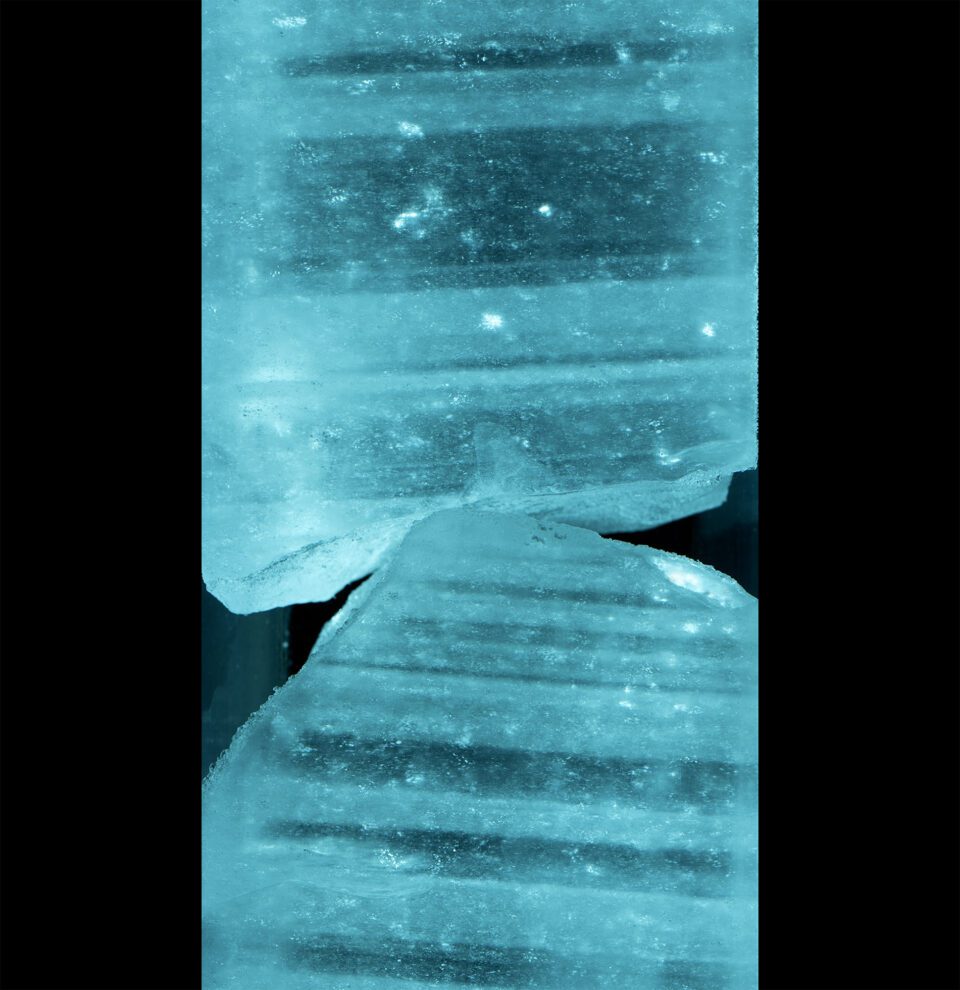
Since 2011, multidisciplinary artist Peggy Weil has been working on what she calls “extended landscapes”: artworks which “visualise the unseen but critical processes of climate change.” This month, two of her video installations, 88 Cores and 18 Cores, are on view at the Museum of Modern Art in New York. Here, Weil reformats scientific archives – including ice and rock cores from the Greenland Ice Sheet and Salton Sea Scientific Drilling projects – into scrolling moving-image portraits that reveal invisible layers “beneath our feet, above our heads, and back in time.” The exhibition, titled Core Memory, takes audiences on a downward journey, showing how climatic and geological events are inscribed into the Earth.
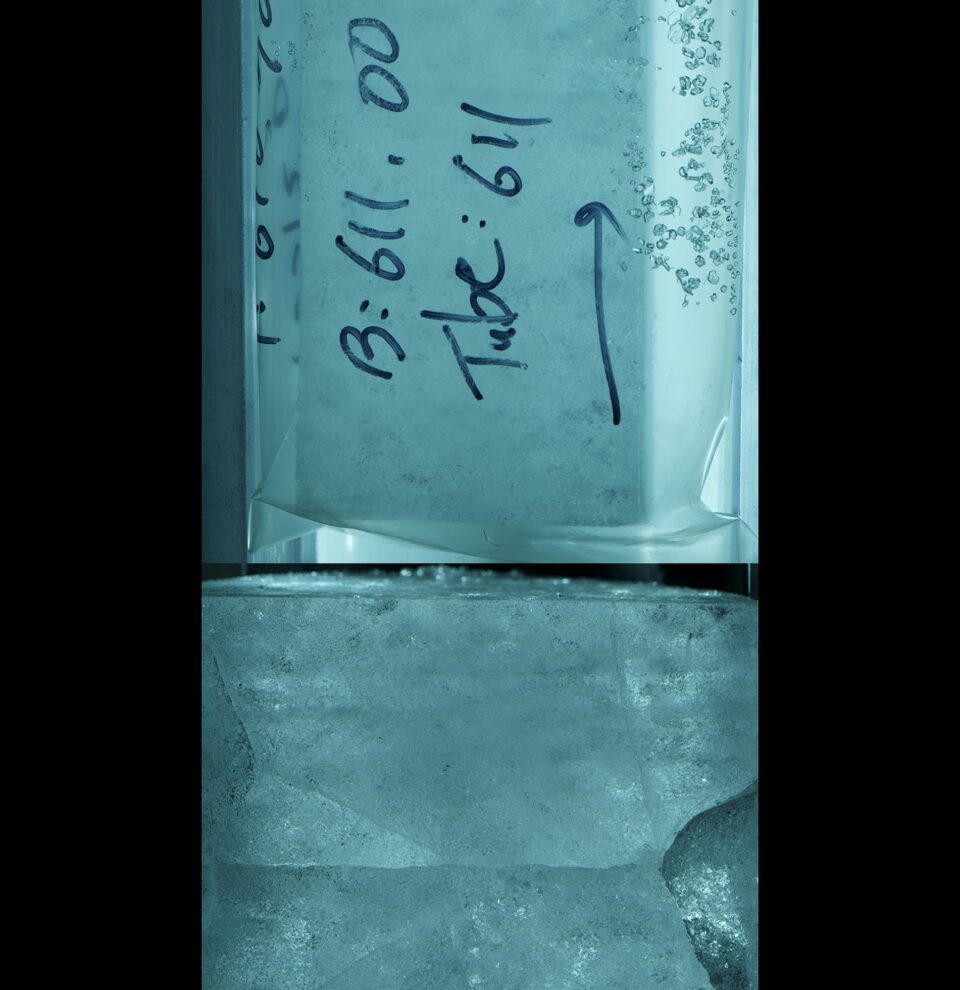
Most of us are familiar with the idea of tree rings, which grow concentrically each year and reveal the plant’s age, as well as past environmental conditions. Ice operates a similar system, preserving time vertically, with each annual layer of compacted snow carrying bubbles of gas and air that record the makeup of the atmosphere at a point in time. Chemical analysis can match these gases to historical events, like volcanic eruptions. Dust and debris are, also, indicators of seasonal variation and regional conditions.
88 Cores is the first of the projects at MoMA. Weil’s visualisation descends two miles and 110,000 years through Greenland’s ice sheet – the largest mass of ice in the Northern Hemisphere, which is melting at rates far surpassing estimates. The experience is hypnotising; as the core descends, audiences come face-to-face with stripes and shapes that resemble abstract colour-field paintings. Some of the images include inscriptions or distinctive shades of blue – testament to the evolution of imaging technologies used to digitise these ice fragments, which were drilled between 1989 and 1993 as part of the Greenland Ice Sheet Project. Also in the show is 18 Cores, in which Weil shifts from polar cold to geothermal heat, assembling images of rock extracted from California’s Salton Sea between 1985 and 1986. The six vertical strands unveil a subterranean landscape of shales, siltstones and sandstones dating to the Pleistocene era.
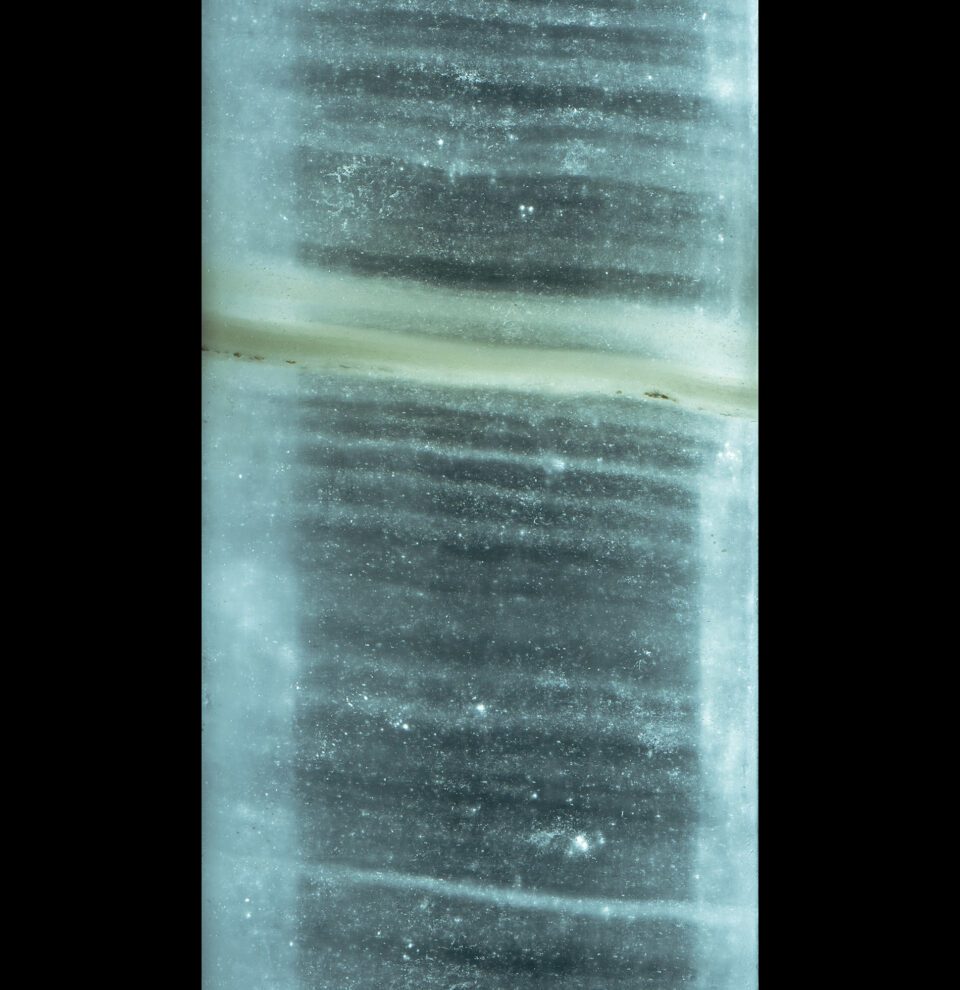
Weil is a part of a growing movement in the art world to make planetary change visible to the masses. In 2018, for example, Olafur Eliasson and Minik Rosing positioned twenty-four blocks of Greenland ice in front of Tate Modern to confront passersby with the reality of glacial melt. Her research-based approach, meanwhile, aligns with that of the rising star Laure Winants, who uses cameraless photography to make colourful abstractions of Arctic ice. Weil’s explorations of deep time echo the work of Noemie Goudal and Ilana Halperin, whose latest exhibition is on view at Edinburgh’s Fruitmarket this season. “The pace of climate change is too slow to apprehend, and its substances – gases like methane and CO2 – are invisible,” the artist observes. Presenting these images on such a scale, at one of the world’s largest institutions, is a powerful way to make the evidence of environmental shifts perceptible – and undeniable.
Peggy Weil: Core Memory is at MoMA, New York, from 7 March – 4 October.
Words: Eleanor Sutherland
Image Credits:
1. Peggy Weil. 88 Cores. 2017. Digital video with score by Celia Hollander. Still featuring cores extracted at depths of -1855m to -1856m. Image courtesy of the artist.
2. Peggy Weil. 88 Cores. 2017. Digital video with score by Celia Hollander. Still featuring cores extracted at depths of -611m to -612m. Image courtesy of the artist.
3. Peggy Weil. 88 Cores. 2017. Digital video with score by Celia Hollander. Still featuring cores extracted at depths of -2545m to -2546m. Image courtesy of the artist


