Sound has become one of the most powerful ways contemporary artists are reconsidering public space. It can summon memory, alter our sense of scale and make familiar environments suddenly strange, turning streets, squares and buildings into sites of collective attention. This November, Aesthetica Film Festival’s Radical Listening, developed with Audible, extends that proposition across York through three ambitious new commissions by Steve Messam, Being Now Here and Squidsoup. Their works place light, sound, architecture and lived experience at the centre of a wider question: what might happen when media art is encountered rather than sought out? Across three sites, the programme proposes that contemporary culture does not need to be contained by galleries, institutions or conventional modes of spectatorship.
That idea carries weight at a moment when public art is growingly being asked to do more than occupy space. It must negotiate history, accessibility, technology and the communities that encounter it, while resisting the temptation to become simply spectacular. Radical Listening approaches this challenge through sound – not as an accompaniment to visual culture, but as a medium capable of reshaping how places are understood. The partnership with Audible is vital in this regard, connecting Aesthetica’s longstanding commitment to film and moving image with a company whose work is rooted in spoken word, narrative and listening. Together, the partners position sound as a cultural language with regional and global reach, while using York as the testing ground for encounters that are deliberately immediate and public.
Curation therefore becomes less about arranging objects than orchestrating experiences. Across 12 new commissions, Aesthetica and Audible bring together three immersive artworks, three documentaries and six new scores for silent cinema, creating a programme that moves between contemporary media art and the earliest forms of film. Such a structure also challenges the hierarchy between image and sound that has shaped much of Western visual culture. The curatorial proposition is clear without being prescriptive: listening can become a method of looking, remembering and understanding. Cherie Federico, Director of Aesthetica, describes the project as an attempt to make ambitious international-quality work part of everyday life, arguing that “the arts should be part of everyday life, not something people have to feel they need permission to enter”. Accessibility therefore is not simply a question of removing a price attached to a ticket; it concerns who gets to encounter ambitious contemporary art, and where.
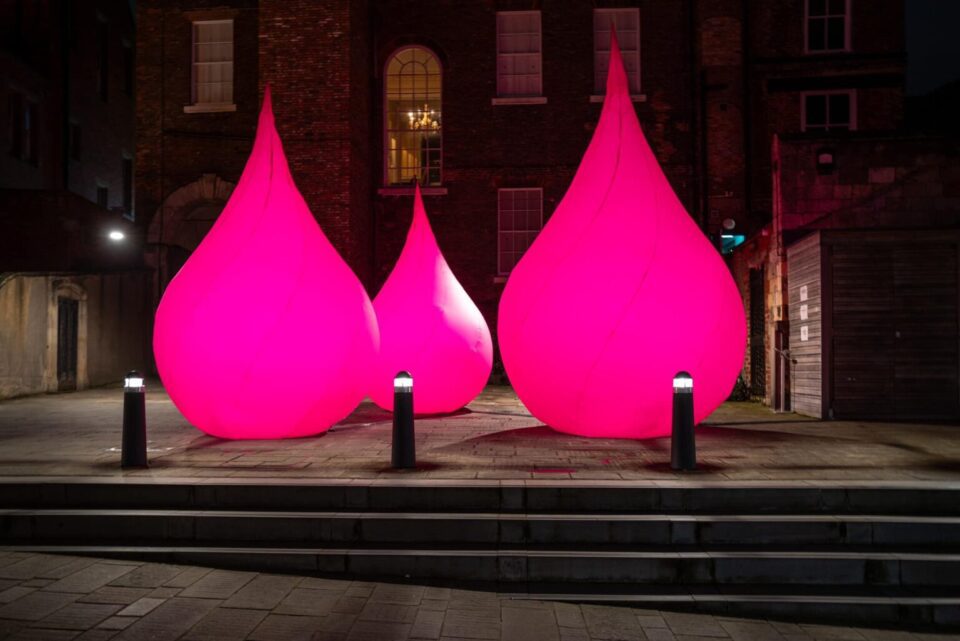
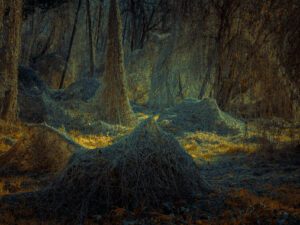
Scale becomes one of the programme’s most visible strategies. At York Theatre Royal, environmental artist Steve Messam creates Fruere Silentio, an inflatable structure reaching approximately the height of the building itself, transforming an already familiar architectural landmark into something temporarily unfamiliar. Yet the work’s ambition is not reducible to monumentality. Inside, visitors encounter a four-minute vocal score recorded across all 20 remaining medieval churches within York’s city walls, alongside York Minster, incorporating voices, footsteps, weather, traffic and other incidental sounds. “The physical scale is enormous, but the experience is intimate,” Messam explains, identifying a productive tension at the heart of the commission. Monumental public art is often dependent upon the spectacle itself, whereas Fruere Silentio makes the distinctive choice to use spectacle as an invitation to become quieter.
That movement between visibility and attention reflects a broader strand of contemporary art concerned with listening as a political and social act. Artists working with field recordings, oral histories and participatory sound have increasingly challenged the assumption that public space is primarily visual, asking whose voices are heard and which histories become audible. Messam’s commission turns York itself into an archive without presenting the city as a static historical object. Medieval churches, contemporary traffic and human voices coexist within the same composition, collapsing distinctions between heritage and the present. The result suggests that place is not something fixed, but something continually produced through movement, memory and sound. Listening becomes a form of orientation – a way of discovering that the environments we inhabit contain more layers than we ordinarily register.
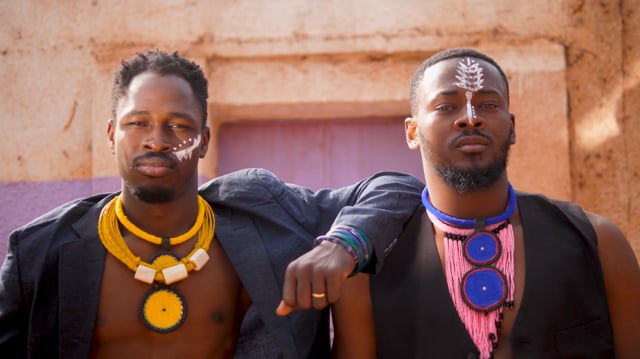
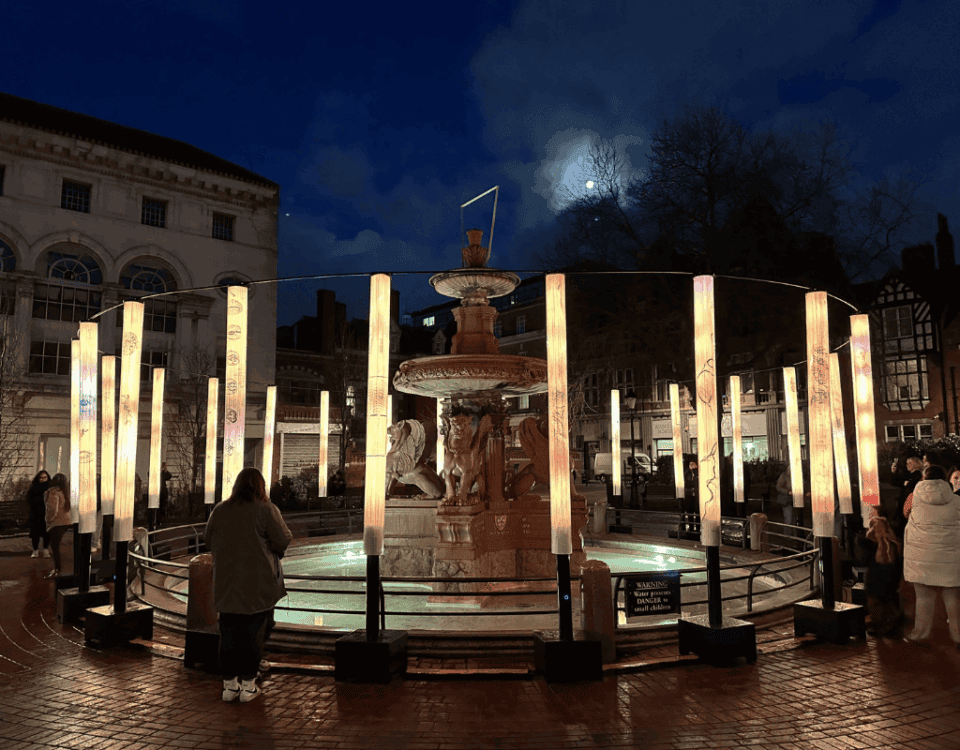
Another relationship between history and technology emerges in Henge: Echoes Through Time, created by Gemma Wood of Being Now Here for King’s Square. Twenty towers, each three metres high, form a changing field of light and sound that draws upon York’s layered histories, from Minster bells and hawks to industrial fires and ironworks. Wood’s approach is less archaeological restoration than temporal collage, allowing fragments from other eras to exist at once. As darkness falls, changing combinations of illumination and audio alter the atmosphere of the square, showing how technology can be used not to display information but to produce a sense of place. “20 three-metre towers in the centre of York is an entirely different level of ambition for my practice,” Wood says, framing the commission as an example of what can happen when artists are given the resources and platform to move beyond scales of production.
Such investment in artistic development is an important part of the programme’s curatorial significance. Large-scale commissions can easily become exercises in institutional branding, particularly when technology and spectacle are involved, but Radical Listening foregrounds the relationship between infrastructure and artistic possibility. Wood’s installation demonstrates how commissioning can create opportunities that would otherwise remain inaccessible to emerging or developing practices. That principle also connects the local to the international: a work made by an artist expanding her practice sits alongside artists with extensive global exhibition histories. Curation here becomes a mechanism for creating parity between different stages of an artist’s career rather than simply assembling established names. The city becomes an environment in which it is both exhibition site and production context.
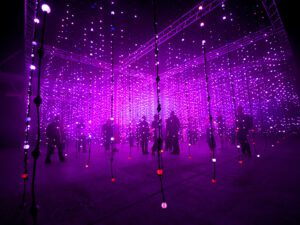
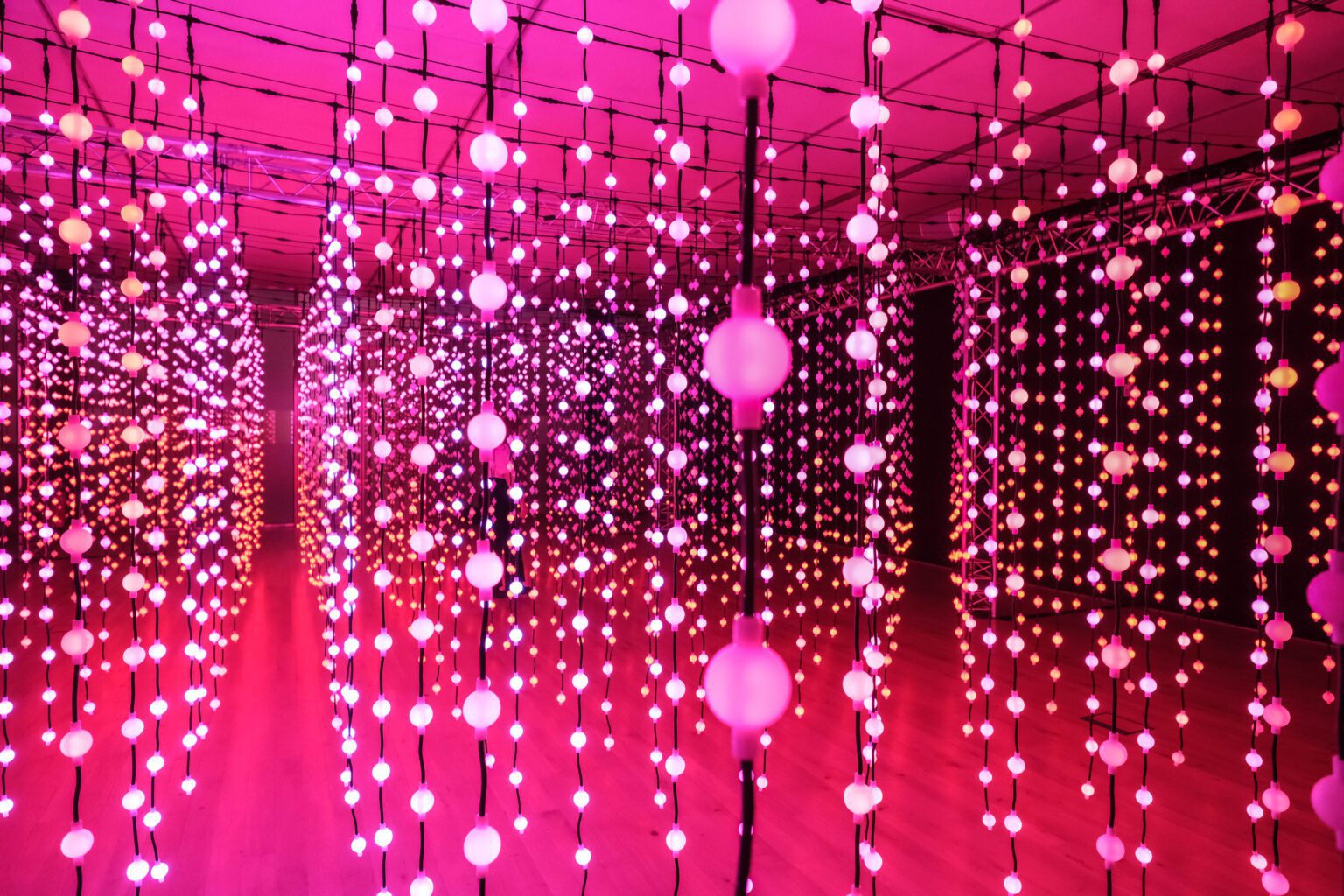
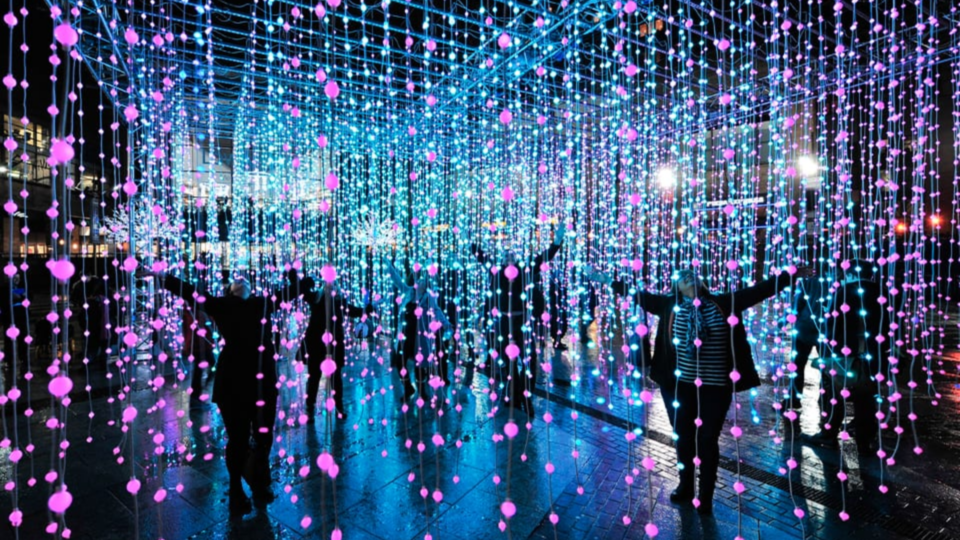
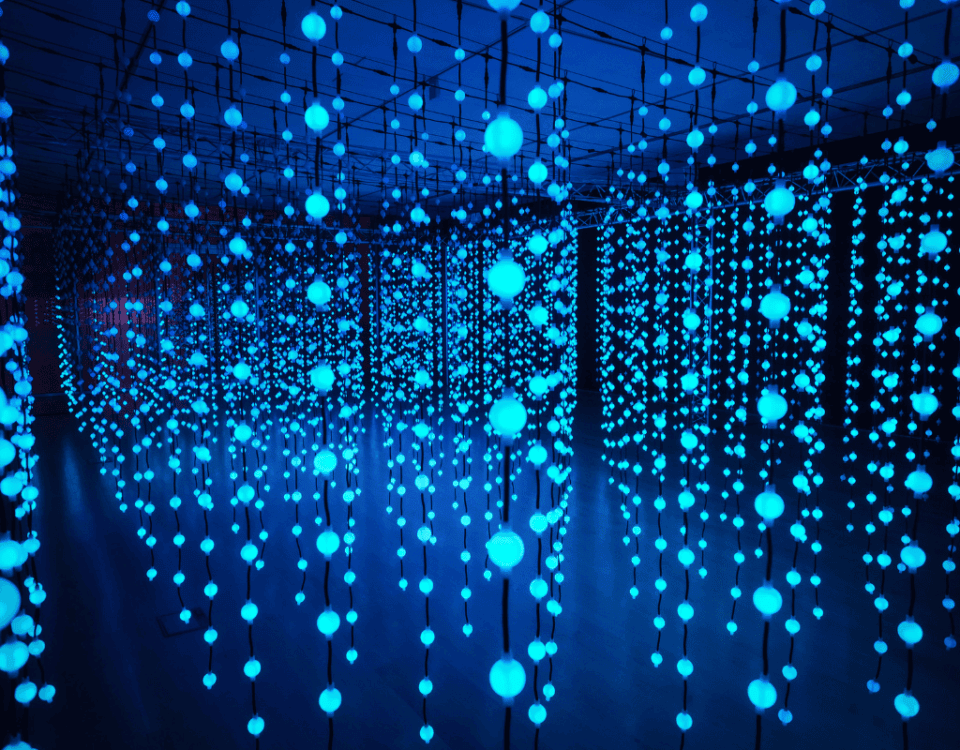
Squidsoup’s contribution brings yet another dimension to this conversation through The Sound of Coming Back to Life at Exhibition Square. Known internationally for immersive installations combining sound with volumetric light, the collective has presented work in more than 70 locations, from Canary Wharf to major cultural institutions and festivals. For York, however, the starting point is intensely personal: the audio derives from founder Anthony Rowe’s experience of cardiac arrest and his recollection of regaining consciousness after several minutes without a heartbeat. That testimony enters a field of light, transforming a medical and bodily experience into an environment shared with strangers. Squidsoup’s Hannah Brady observes that “every place changes the work”, an idea that becomes particularly resonant when an intimate account of survival is relocated into the everyday movement of a city.
Here, immersion raises questions beyond the technological. Contemporary media art often promises to place audiences “inside” an artwork, yet the most compelling immersive practices use that condition to complicate instead of overwhelm perception. Squidsoup’s work turns bodily experience into a collective encounter, asking audiences to consider consciousness, vulnerability and return without requiring a usual narrative structure. The installation also shows why sound is central to the programme: audio can enter the body differently from an image, operating through memory, rhythm, proximity and spatial perception. Instead of treating technology as an end in itself, The Sound of Coming Back to Life uses technology to create conditions for reflection. Immersion becomes less about escape than heightened awareness.
The relationship between contemporary installation and cinema further expands through the six new scores for films made before 1925. Their inclusion makes the programme’s title deliberately recursive: silent cinema was never entirely silent, because audiences historically experienced films alongside live musicians, commentary, ambient noise and the sounds of collective spectatorship. Reintroducing contemporary composition therefore does not simply modernise archival film; it restores something fundamental to its original mode of reception. The three documentaries premiering on Friday 6 November similarly extend the programme’s interest in how sound shapes testimony and narrative, accompanied by Q&As, DJs, drinks and networking. Across these forms, Radical Listening treats cinema not as a fixed medium but as an evolving relationship between image, sound, technology and audience.
That wider ambition places the festival within a global discussion about where contemporary art happens. Museums and galleries remain crucial, but artists are increasingly working across streets, digital platforms, festivals, architecture and civic environments, responding to audiences who may never enter an exhibition space. York’s designation as the UK’s only UNESCO City of Media Arts gives this approach a particular context, but the programme’s significance reaches beyond civic identity. The presence of Squidsoup with Messam and Wood connects local histories to global practices, while Audible’s involvement situates the commissions in a wider culture of audio storytelling. York is as a result less the subject of the programme than its stage – a place through which questions about listening, technology and public life can be tested.
What emerges is a model of media art based on encounter rather than exclusivity. More than 300 films, alongside the VR and Games Lab, Podcasting Lounge, live music, workshops, masterclasses and industry events, create a festival ecology in which moving image is connected to multiple forms of contemporary practice. Radical Listening adds another layer by making the city itself part of that ecology, allowing audiences to move between monumental installation, intimate testimony, historical sound and experimental cinema. For Aesthetica, the approach reflects an established interest in crossing disciplinary boundaries; for Audible, it opens the possibilities of audio beyond the headphone and into shared physical space. From 4–8 November, York becomes a distinct meeting point for these different traditions to encounter one another – but the questions they raise belong to a much broader cultural landscape.
Public art ultimately succeeds not through its size, novelty or technological complexity, but through the quality of attention it creates. Radical Listening begins from that premise, using three very different commissions to ask audiences to reconsider how they hear the places around them and the stories carried within them. Messam makes quietness monumental; Wood turns historical fragments into an evolving sensory environment; Squidsoup translates an experience of survival into light, sound and collective presence. Together, they demonstrate how contemporary art can move beyond the gallery without abandoning intellectual or formal ambition. In doing so, Aesthetica and Audible offer not simply an exhibition that is distributed across the city of York, but a broader proposition for cultural life – that listening, like looking, can completely transfom the way we understand where it is we are.
Aesthetica Film Festival 2026 runs 4-8 November in York, UK. Click here to book your festival pass.
Words: Simon Cartwright
Image Credits:
1. Submergence. Image Courtesy of Squidsoup.
2. Image courtesy of Steve Messam.
3. Submergence. Image Courtesy of Squidsoup.
4. Image courtesy of Being Now Here.
5. Submergence. Image Courtesy of Squidsoup.