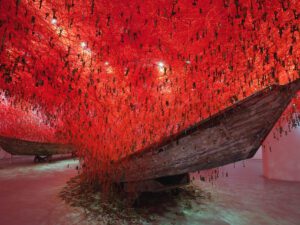
Zineb Sedira has long occupied a singular position within contemporary art – an artist whose practice moves fluidly between film, photography, installation and performance to interrogate the fragile architecture of memory, migration and postcolonial identity. Born in Paris to Algerian parents and later establishing herself in London, Sedira has spent decades tracing the emotional residue left by geopolitical rupture, often focusing on the afterlives of displacement and the silences embedded within official histories. Her installations are marked by a cinematic sensibility that privileges atmosphere as much as narrative, creating spaces where archives become living organisms and spectators become participants in acts of remembrance. From Dreams Have No Titles at the 59th Venice Biennale to her latest commission for Tate Britain, Sedira has demonstrated how cinema can operate as witness and political instrument. Her influence is felt across a generation of artists engaging with diasporic identity, not merely because of the subjects she addresses, but because of the immersive language she has developed to tell them.
At Tate Britain, When Words Fall Silent, Cinema Speaks… transforms the monumental neo-classical Duveen Galleries into a cinematic environment suspended between reconstruction and reverie. The commission draws on the revolutionary energy of African filmmaking in the 1960s and 1970s, centring particularly on Algeria in the years following independence from France in 1962. During this period, Algiers became a vital meeting point for filmmakers, activists and intellectuals from Africa, Asia and Latin America who sought to imagine a new political and cultural future outside colonial frameworks. Sedira revisits this era not through detached historical presentation, but through a sensorial reconstruction that folds together archive, fiction and memory. The result is an installation that feels simultaneously theatrical and deeply intimate – a meditation on how moving images shape collective consciousness and preserve resistance.
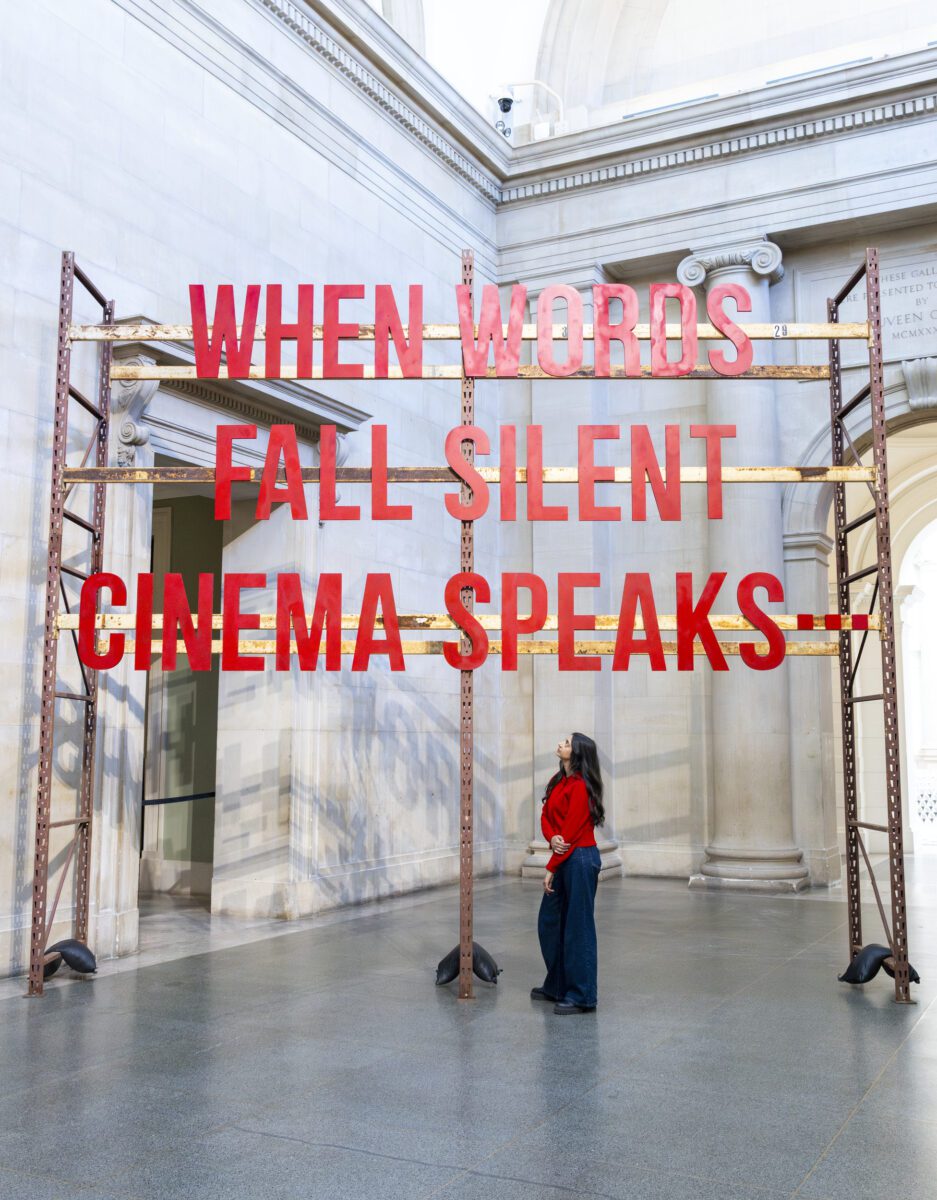
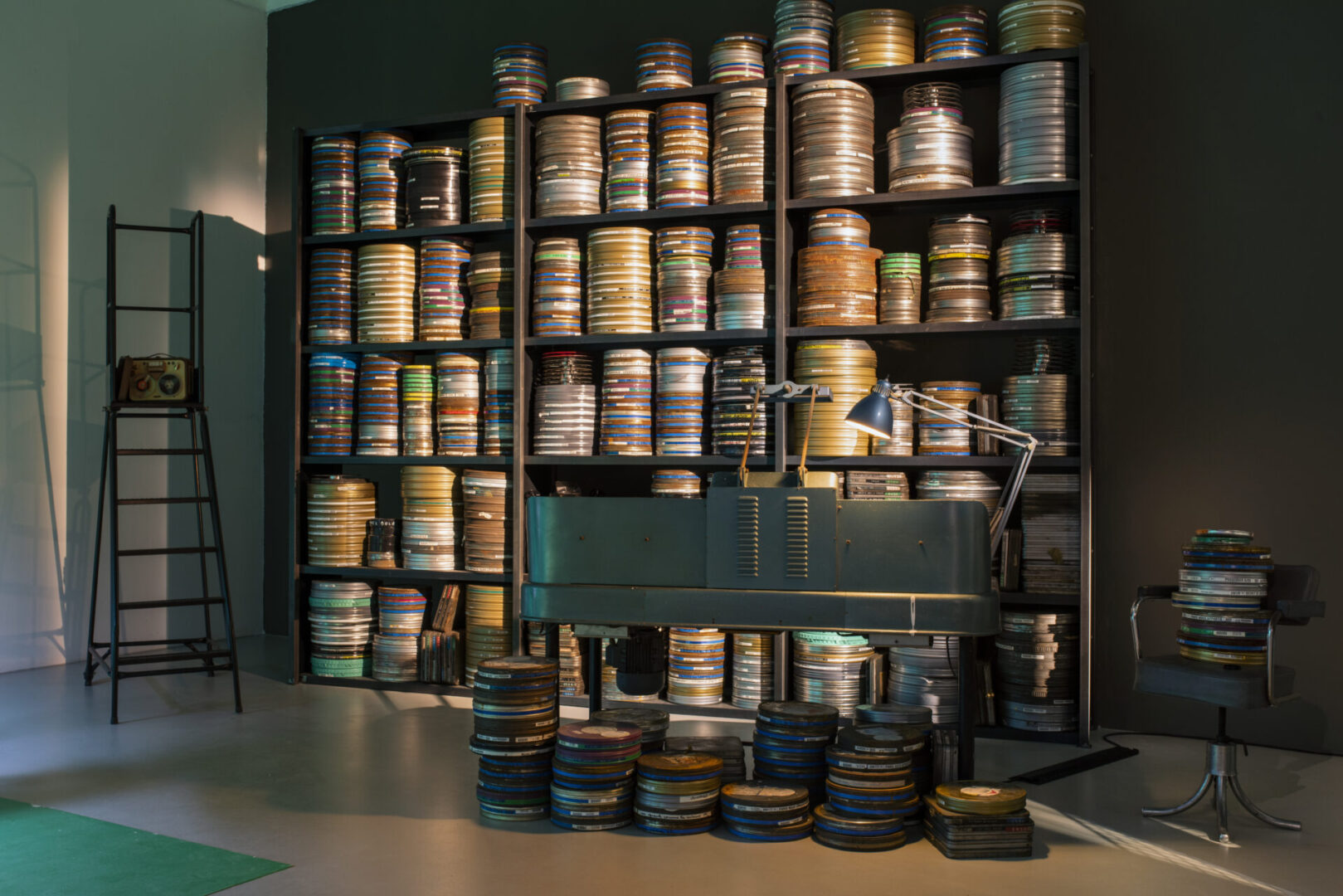
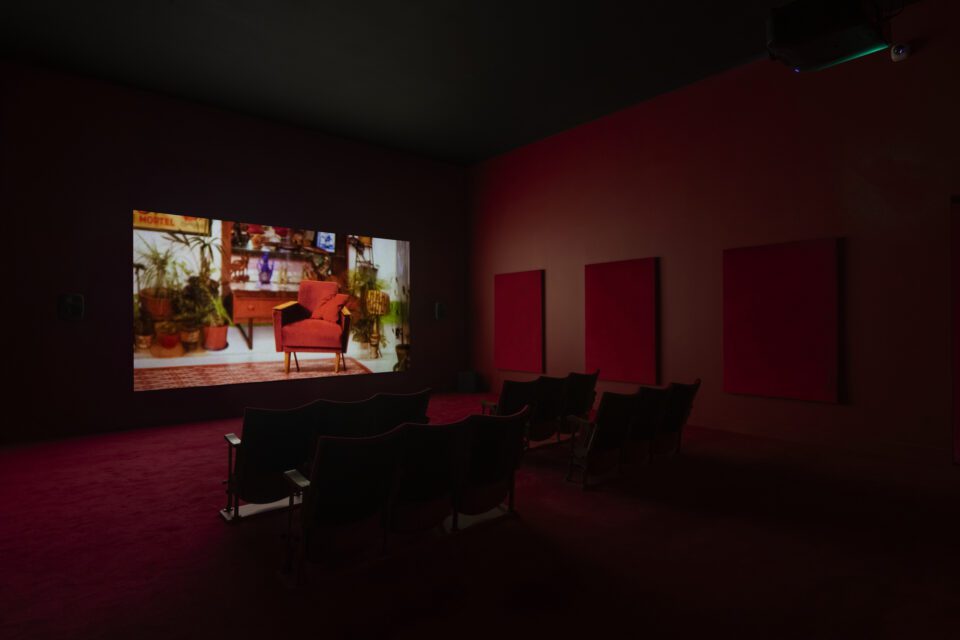
The exhibition opens with the title emblazoned in glowing red lettering reminiscent of mid-century Hollywood marquees, immediately establishing the tension between spectacle and radicalism that underpins the work. Sedira juxtaposes the seductive visual language of Hollywood’s Golden Age with the aesthetics and politics of Third Cinema, the anti-imperialist film movement that emerged during the 1960s as a direct challenge to Western cinematic dominance. Within the galleries, she reconstructs a functioning cinema that screens a newly commissioned film divided into four acts corresponding to the stages of filmmaking – scriptwriting, shooting, editing and projection. The structure itself becomes symbolic, foregrounding cinema not simply as finished product but as collective labour and political process. Interwoven throughout are the recollections of Boudjema Kareche, former director of the Cinémathèque Algérienne, whose memories animate Sedira’s investigation into militant filmmaking.
Sedira’s project belongs to a wider lineage of contemporary artists who have used film and archival material to interrogate the legacies of colonialism and displacement. The immersive quality of the installation recalls the cinematic environments created by Isaac Julien, whose multi-screen works layer choreographed movement, archival imagery and lush cinematography to explore Black identity, migration and historical memory. Like Julien, Sedira treats film as spatial experience rather than passive image, inviting audiences to physically inhabit histories that might otherwise remain distant or abstract. Yet where Julien’s installations often unfold with a dreamlike sensuality, Sedira’s work remains tethered to the collective political energy of revolutionary filmmaking, foregrounding cinema as a site of activism.
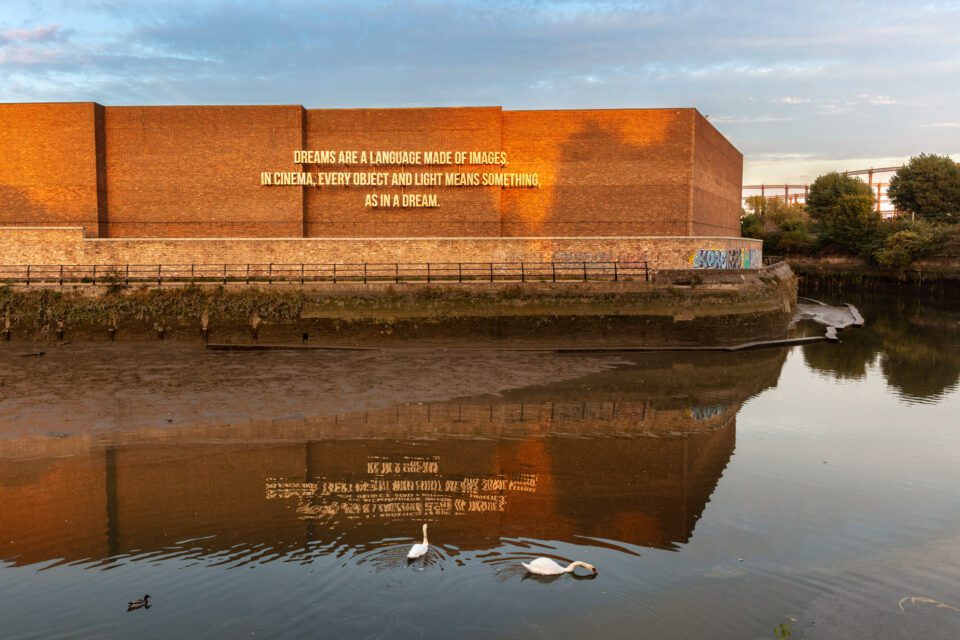
This relationship between archive and atmosphere also resonates with the work of John Akomfrah, particularly in the way both artists transform historical fragments into emotionally charged visual landscapes. Akomfrah’s layered montages frequently move between personal testimony and collective trauma, revealing the lingering psychological effects of empire and migration. Sedira similarly constructs a visual language shaped by fragmentation, memory and absence, though her installation introduces moments of reconstruction and communal gathering that resist pure elegy. The recreated café at Tate Britain, with its books, tables and conversational intimacy, becomes more than a historical reconstruction – it operates as a living social space in which viewers participate in acts of remembrance and exchange.
Sedira’s interest in reconstruction as a political and cinematic device also finds echoes in the practice of Wael Shawky, whose films restage historical narratives through carefully constructed theatrical worlds. Shawky’s Cabaret Crusades series exposed the instability of historical truth by reinterpreting medieval conflicts through marionette performances, revealing how ideology shapes collective memory across generations. Sedira adopts a similarly layered approach to storytelling, collapsing distinctions between documentary, fiction and performance in order to examine how revolutionary histories are circulated and preserved. However, where Shawky’s work often drifts into allegory and myth, Sedira remains grounded in the tactile textures of lived experience – projection rooms, cafés, film reels and communal screening spaces that evoke the material culture surrounding militant cinema during the 1960s and 1970s.
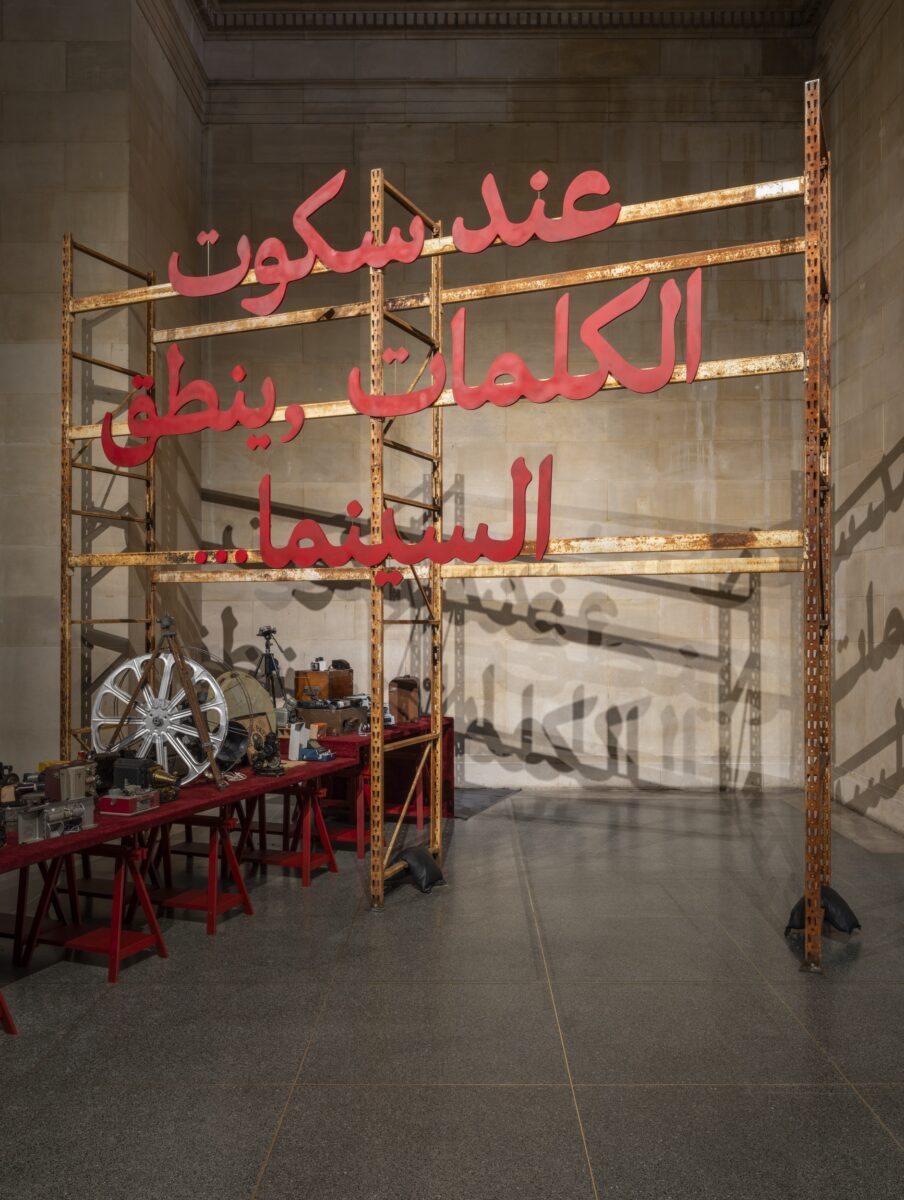
Within Sedira’s installation, one of the most affecting spaces is the recreation of a 1960s Parisian café, complete with books, tables and a functioning bar. The environment evokes the cafés frequented by Algerian communities in exile during the War of Independence, spaces where political debate, solidarity and cultural exchange unfolded away from official scrutiny. Rather than presenting the café as static set design, Sedira activates it as a participatory environment in which visitors are invited to sit, read and inhabit the atmosphere. This attention to social space is central to the commission’s emotional force. The installation resists the passive spectatorship associated with traditional museum display and instead encourages a slower form of engagement rooted in listening and collective reflection.
Nearby, Sedira presents a customised Scopitone – the once-popular video jukebox associated with migrant worker communities during the 1960s. Re-engineered to screen excerpts from Agnès Varda’s Salut les Cubains, the object becomes both archival artefact and sculptural intervention. Varda’s animated still photographs pulse with Afro-Cuban rhythms and scenes of dance, civil society and everyday life, foregrounding joy itself as a form of resistance. Sedira’s inclusion of the Scopitone demonstrates her sophisticated understanding of cinema as a social technology, something encountered not solely within institutional settings but in cafés, bars and communal gathering points. Throughout the exhibition, she repeatedly foregrounds the circulation of images – how films move between people, countries and political movements, carrying with them aspirations for solidarity and liberation.
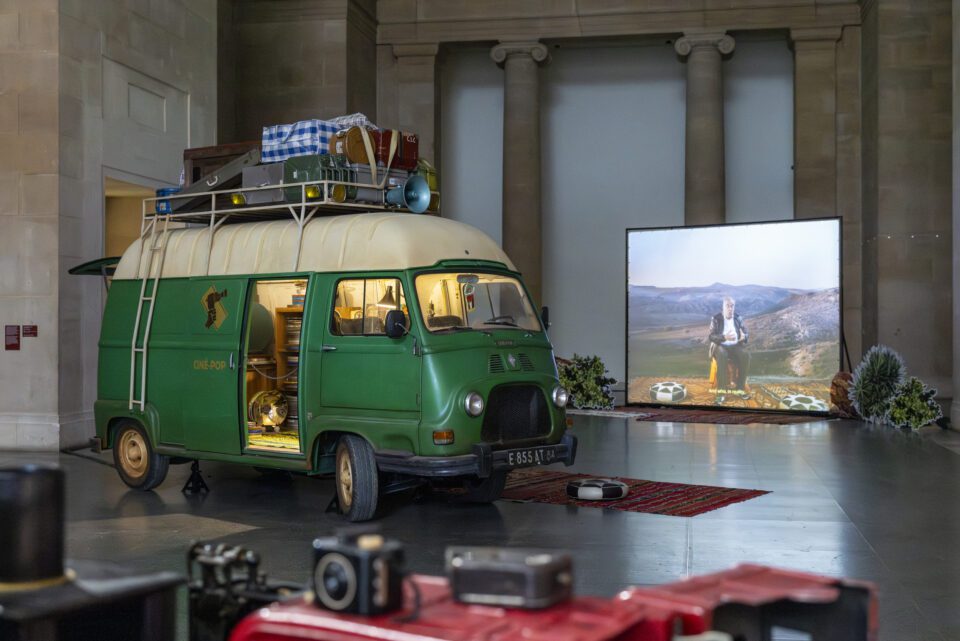
The North Duveen gallery extends these ideas through a sculptural display of vintage camera equipment and a reimagined 1960s French van transformed into a mobile ‘Ciné Pop’. Historically, such projection units were initially used by the French military to disseminate propaganda before later being repurposed by the Algerian state to bring revolutionary cinema to rural communities. Sedira’s treatment of these objects reveals her sensitivity to the political instability of technology itself – tools designed for control becoming instruments of resistance through acts of reclamation. Projected within the van is an interview with film critic and historian Ahmed Bedjaoui, whose reflections situate Algeria as a crucial hub for militant cinema in the decades following independence. The inclusion of oral testimony throughout the exhibition lends the installation a remarkable intimacy, grounding grand political narratives in individual memory.
What distinguishes When Words Fall Silent, Cinema Speaks… from many contemporary installation projects is the clarity with which Sedira balances scholarship and atmosphere. The exhibition is intellectually rigorous, yet never overwhelmed by didacticism. Instead, it unfolds with the pacing of cinema itself – through sequences, transitions and carefully calibrated emotional shifts. Visitors move from glowing marquees to café interiors, from archival footage to sculptural displays, encountering a spatial narrative that mirrors the processes of editing. Sedira understands that memory is never linear. It accumulates through fragments, repetitions and sensory echoes, and her installation embraces precisely this rhythm.
This exhibition stands as one of the most compelling institutional commissions in recent years because it understands history as something active rather than fixed. Sedira does not attempt to monumentalise revolutionary cinema from a safe historical distance. Instead, she asks what it means to revisit these movements now, at a moment when questions surrounding migration, nationalism and cultural memory remain deeply contested. Her installation becomes less an act of preservation than one of reactivation, reviving the radical optimism embedded within the networks of filmmakers, activists and thinkers who once imagined cinema as a tool for liberation. In doing so, Sedira reminds us that film possesses a unique capacity to carry emotion, ideology and collective memory across generations, even when political language begins to fail. The result is an installation of extraordinary emotional and intellectual resonance – one that affirms cinema’s enduring power to reshape how we remember, inhabit and envision the world.
When Words Fall Silent, Cinema Speaks… is at Tate Britain, London until 17 January: tate.org.uk
Words: Shirley Stevenson
Image Credits:
1. Zineb Sedira, Dreams Have No Titles, 2022. Venice Biennial. Photo Thierry Bal.
2. Tate Britain Commission 2026 Zineb Sedira When Words Fall Silent, Cinema Speaks…. Photo © Tate (Lucy Green).
3. Tate Britain Commission Zineb Sedira When Words Fall Silent, Cinema Speaks…. Photo © Tate (Joe Humphrys).
4. Installation photography of Zineb Sedira Dreams Have No Titlesat Tate Britain, 2023 Photo © Tate (Lucy Green).
5. Tate Britain Commission 2026 Zineb Sedira When Words Fall Silent, Cinema Speaks…. Photo © Tate (Lucy Green).
6. Zineb Sedira, Dreams Are a Language Made of Images 2025, The Line © Angus Mill.