Mona Hatoum (b. 1952) is synonymous with artworks that challenge, enthral and disturb in equal measure. She is best known for subverting everyday domestic objects, transforming the familiar into the threatening and the inert into the dangerous. Over the years, her practice has encompassed everything from barbed-wire curtains to beds constructed from steel flooring. In these works, associations of comfort, rest and privacy are denied. Instead, Hatoum confronts viewers with themes of displacement, exclusion, marginalisation and the social and political systems that govern and constrain daily life.
Hatoum was born into a Palestinian family in Beirut, Lebanon. She has lived in London since 1975, when the outbreak of the Lebanese Civil War prevented her from returning home during a short visit to Britain. She first became widely known in the mid-1980s for performance and videos focused on the body. In the 1990s, her work moved towards large-scale installations and sculptures that aim to engage the viewer in conflicting emotions of desire and revulsion, fear and fascination. Fast forward to today, and her most recent shows include Encounters: Giacometti at the Barbican, in which her works were paired with those of the iconic sculptor, as well as a major survey at KAdE, Amersfoort, which ran from January to March 2025.
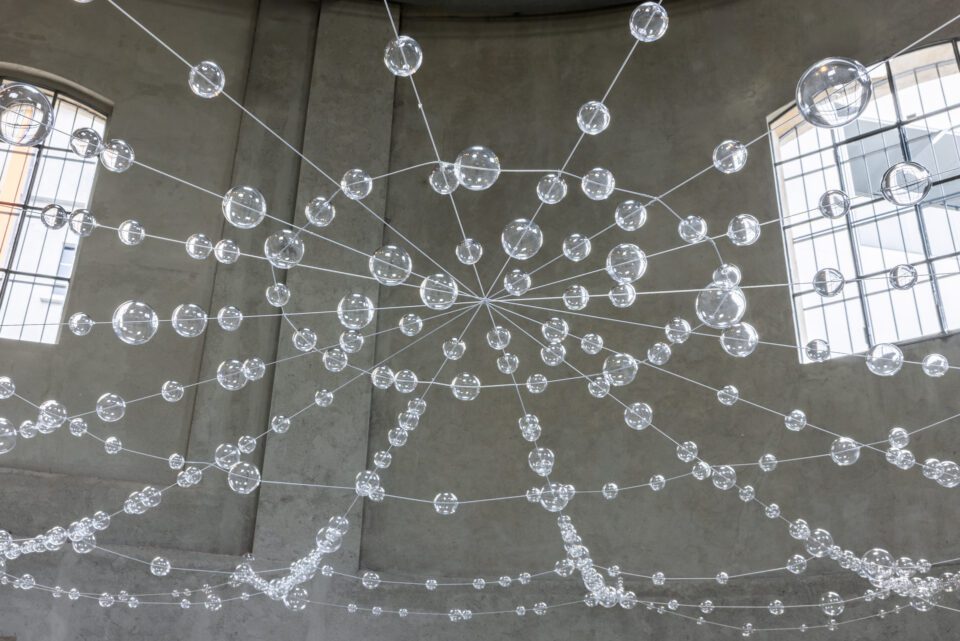
Now, Fondazione Prada, Milan, presents Over, under and in between, a three-part, site-specific project that explores the “archetypal elements” of Hatoum’s practice: the web, the map and the grid. The installations take advantage of the height of the museum’s Cisterna building, which once housed silos and tanks belonging to a former alcohol distillery. First, viewers are confronted with a constellation of delicate, transparent, hand-blown glass spheres, threaded through wires and suspended overheard. In the last few decades, Hatoum has used the web motif in various materials and scales. “A web can be seen as a looming net which suggests oppressive entrapment, while also providing a home or a place of safety,” Hatoum explains. “I personally like to see it as an allusion to the interconnectedness of all things.”
Elsewhere, large areas of the floor are covered with more than thirty thousand translucent red spheres, arranged to form a world map. The work recalls Hot Spot (2006), the glowing globe that is one of Hatoum’s most immediately recognisable installations. In Milan, however, viewers are not met with a fixed cartographic image. Instead, the balls are loose underfoot – creating what the artist describes as an “undefined territory,” vulnerable to disruption by external forces. In constructing this map, Hatoum deliberately rejects the traditional Mercator projection (1569), whose distortions shrink regions of the Global South – such as Africa, South America and Southeast Asia – whilst enlarging those of the Global North. (On a standard Mercator map, Greenland appears roughly the same size as Africa. In reality, Africa is approximately 14 times larger.) As an alternative, Hatoum adopts the Gall-Peters projection, which represents the relative scale of landmasses more accurately. This decision underscores a central concern in Hatoum’s practice: the ways we visualise, chart and understand the world are never neutral.
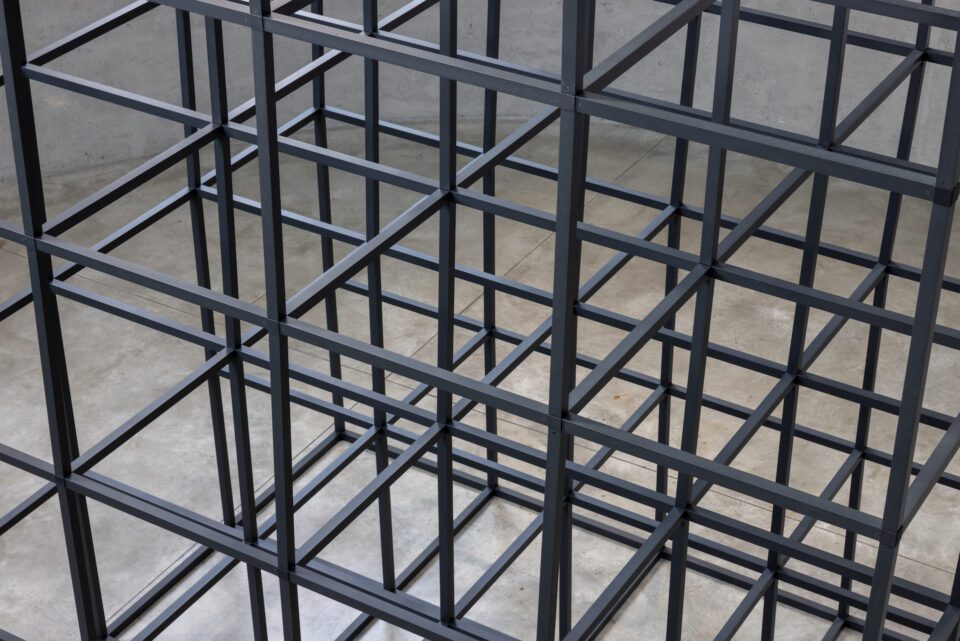
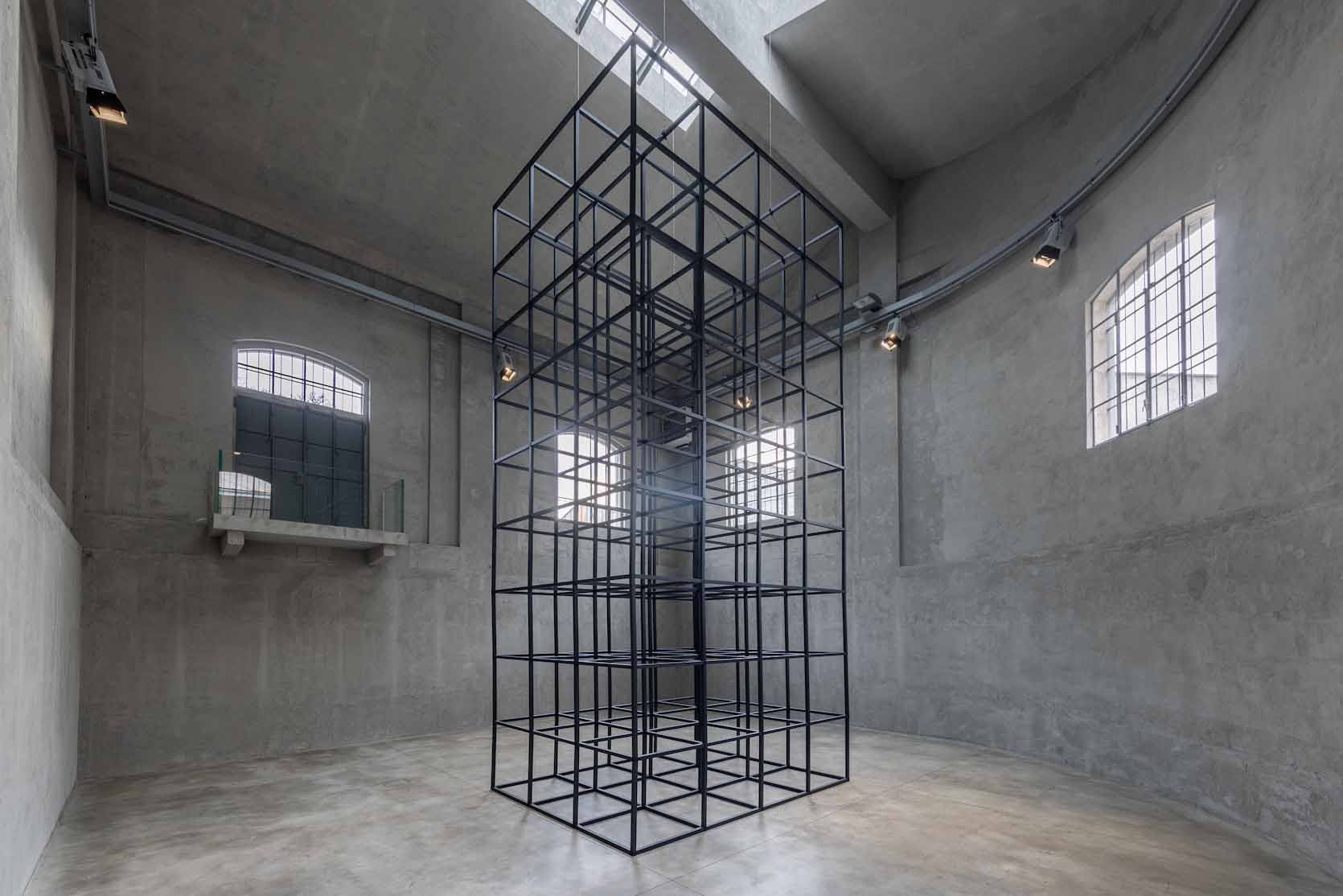
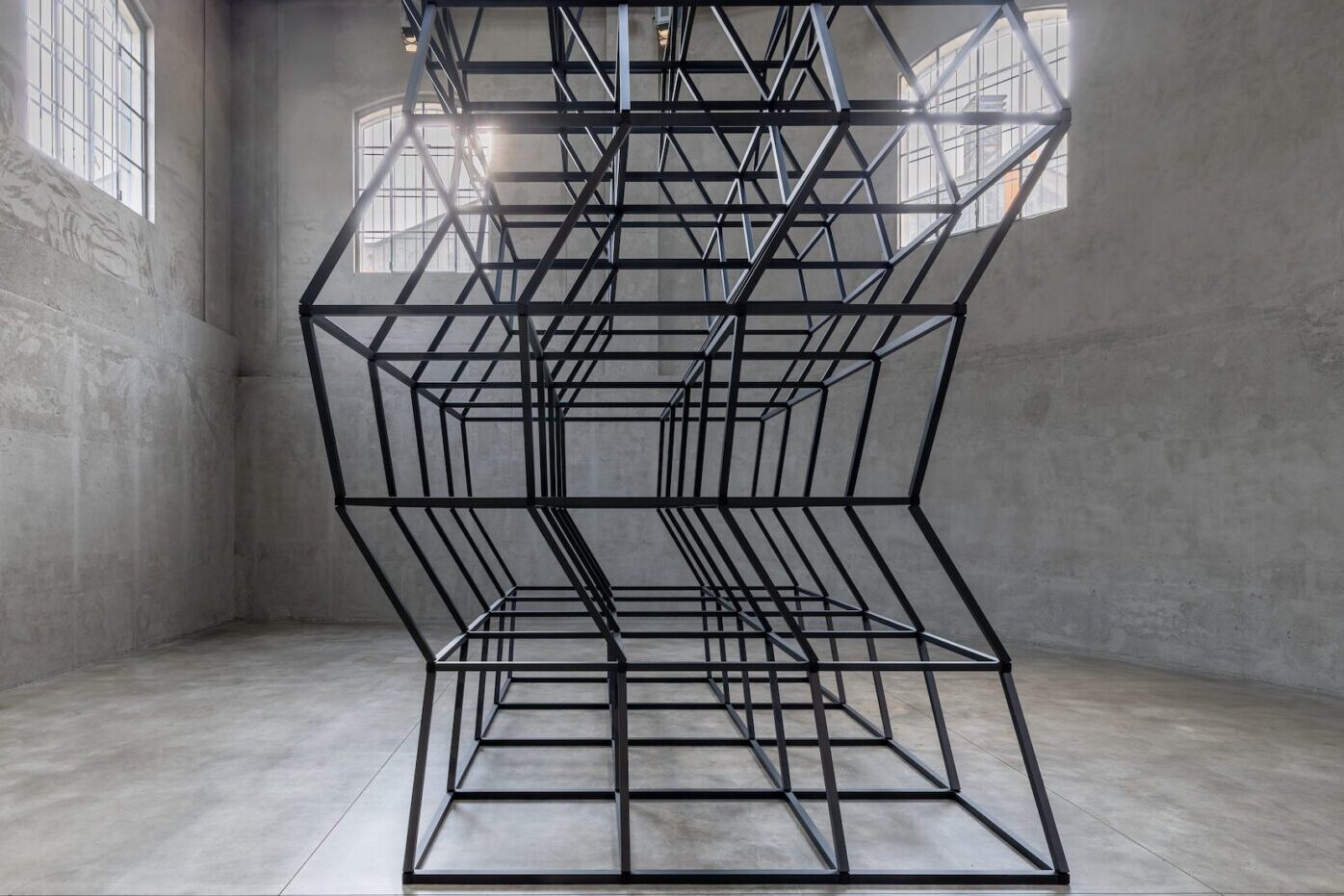
Finally, all of a quiver towers 8.6 metres high. The gridded metallic structure is motorised, slowly moving between collapse and re-construction. Sounds of creaking and clanking fill the room, as the piece sways towards imminent destruction. Once it reaches a certain level, it begins to move upright, before resuming its original height. Here, Hatoum taps into to themes of instability, whilst playing with minimalist aesthetics – another prominent theme in her body of work. As Lebanese architect Lina Ghotmeh writes, the piece “teaches us that to stand is not to conquer instability, but to inhabit it. By demonstrating an openness to change rather than a need to master it, the trembles of all of a quiver are a lesson in humility.”
In Over, under and in between, Hatoum does what she does best: suspending viewers between attraction and unease. Glass spheres hover overhead, the ground threatens to give way and a towering structure shudders – but refuses – to fall. The show offers no stable vantage point. Instead, Hatoum invites us to reconsider what it means to stand, to map, and to belong in a world shaped by forces beyond our control.
Over, under and in between is at Fondazione Prada in Milan, from 29 January – 9 November.
Words: Eleanor Sutherland
Image Credits:
1. Exhibition view of “Over, under and in between” by Mona Hatoum. Photo: Roberto Marossi. Courtesy Fondazione Prada. Mona Hatoum, all of a quiver, 2022. Aluminum square tubes, steel hinges, electric motor, cable.
2. Exhibition view of “Over, under and in between” by Mona Hatoum. Photo: Roberto Marossi. Courtesy Fondazione Prada. Mona Hatoum, all of a quiver, 2022. Aluminum square tubes, steel hinges, electric motor, cable.
3. Exhibition view of “Over, under and in between” by Mona Hatoum. Photo: Roberto Marossi. Courtesy Fondazione Prada. Mona Hatoum, Web, 2026. Hand blown clear glass spheres, stainless steel cable.
4. Exhibition view of “Over, under and in between” by Mona Hatoum. Photo: Roberto Marossi. Courtesy Fondazione Prada. Mona Hatoum, all of a quiver, 2022. Aluminum square tubes, steel hinges, electric motor, cable.