
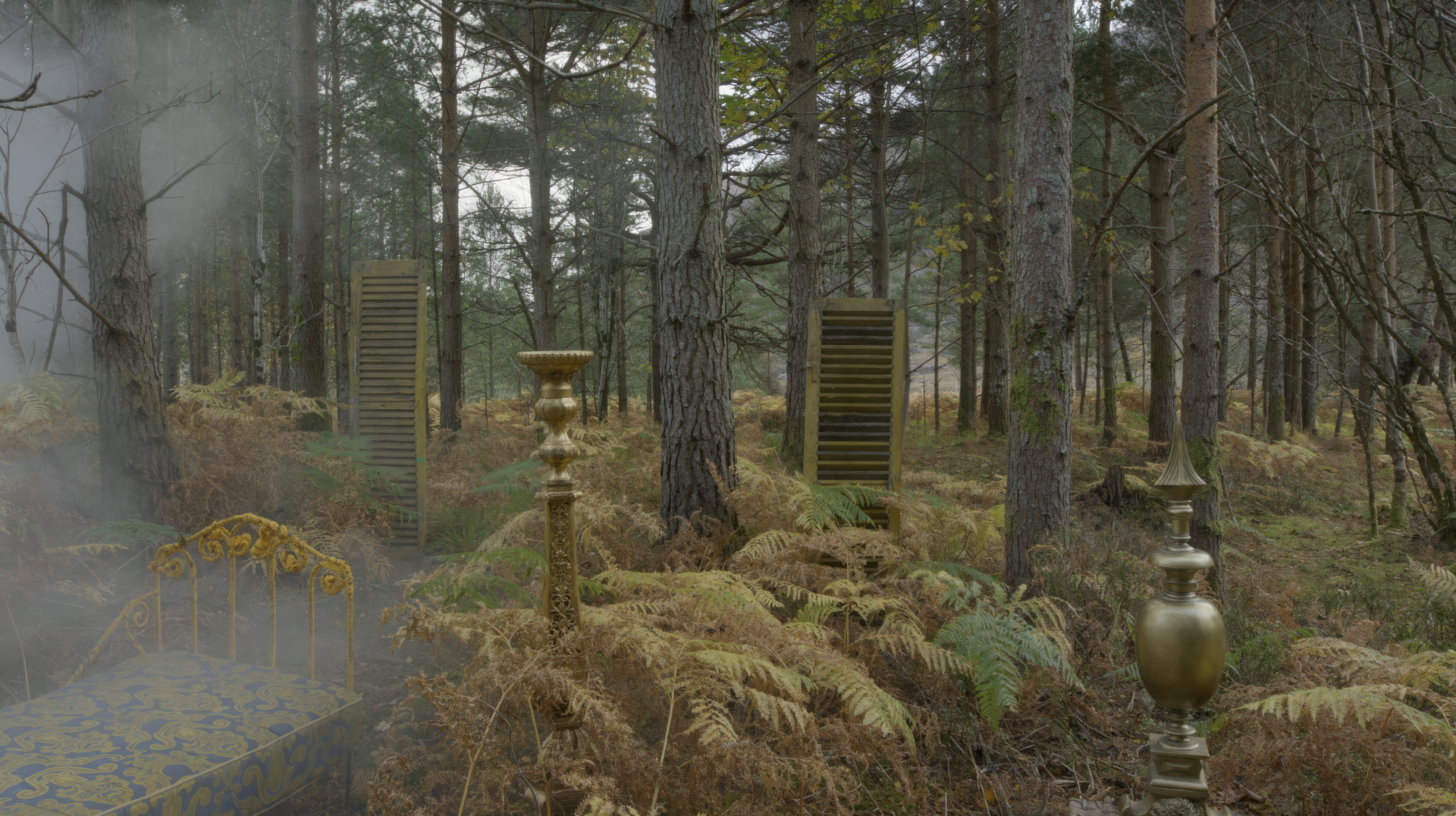
Colonial expansion transformed the natural world on an unprecedented scale. The movement of people, plants, animals, commodities and diseases across continents disrupted ecosystems, reshaped economies and established new structures of global power. These consequences provide the starting point for Arcadia (2023), a five-screen film installation by British artist and filmmaker John Akomfrah, making its London debut at the Natural History Museum. Examining the Columbian Exchange following European arrival in the Americas in 1492, the work considers how imperial ambition and global trade altered relationships between human societies and their environments. Rather than treating ecological change as an isolated phenomenon, Akomfrah situates it within the systems that have shaped the modern world.
The term Columbian Exchange was popularised by historian Alfred W. Crosby in his 1972 study of the biological and cultural consequences of European colonisation. It describes the movement of plants, animals, microorganisms, populations, technologies and ideas between the Americas and Afro-Eurasia following the establishment of sustained transatlantic contact. Indigenous societies already possessed sophisticated systems of exchange and trade, making the encounter considerably more complex than a straightforward transfer between two previously disconnected worlds. European colonisation nevertheless introduced profound inequalities, accelerating resource extraction, expanding plantation economies and displacing Indigenous populations. Epidemics associated with European colonisation also caused catastrophic demographic losses across the Americas. Arcadia approaches these developments through a visual language that connects biological exchange with the structures of empire, recognising that the consequences of these encounters were neither evenly distributed nor politically neutral.
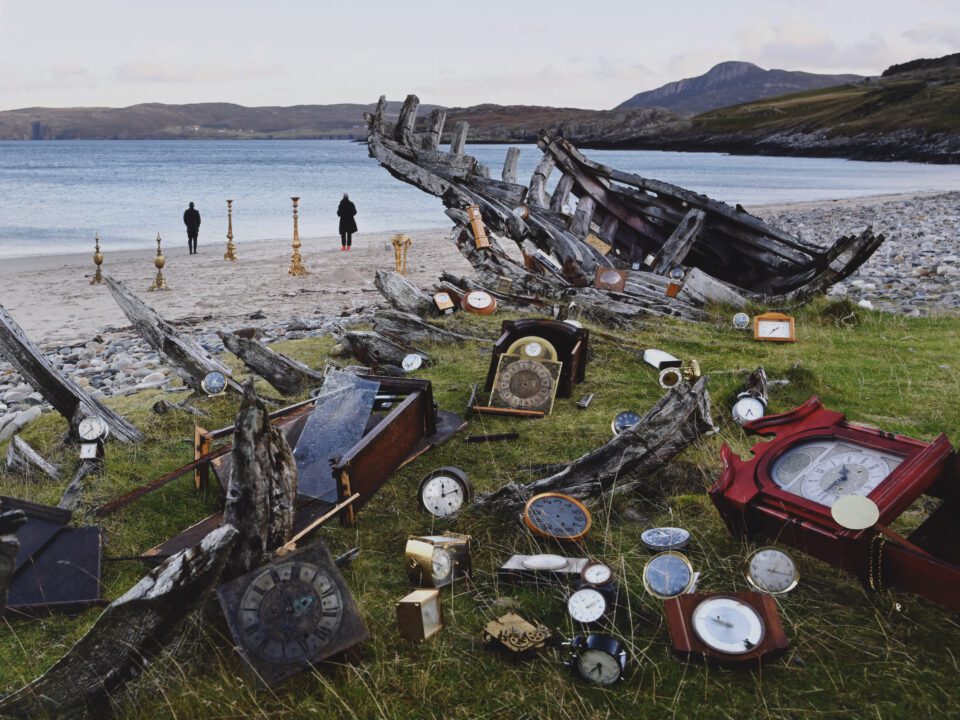
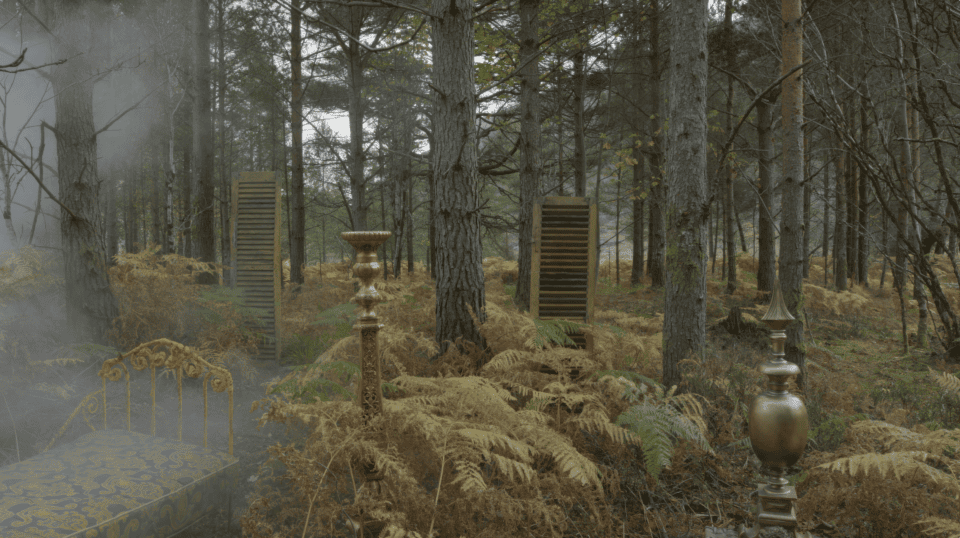
Across five synchronised screens, Akomfrah constructs a cinematic landscape in which different geographies and temporalities unfold simultaneously. Deserts, ice fields, mountains, forests and underwater ecosystems appear alongside cargo, decaying ships and the material remnants of international commerce. These images are not arranged to illustrate a chronological account; instead, their juxtaposition creates connections between environments, historical events and systems of exchange. Sweeping panoramas initially evoke the visual language of the sublime, yet their grandeur is repeatedly interrupted by evidence of human intervention. An evocative soundscape deepens this tension, allowing moments of stillness to give way to a more unsettling sensory experience. The installation’s multi-screen structure is integral to its meaning, presenting a world that cannot be understood through a single perspective.
This fragmented approach has its foundations in Akomfrah’s longstanding engagement with archival material, historical memory and postcolonial identity. As a founding member of the Black Audio Film Collective, established in London in 1982, he helped develop an experimental filmmaking practice that challenged conventional documentary representation. The collective’s acclaimed debut, Handsworth Songs (1986), examined the 1985 disturbances in Birmingham and London through a layered arrangement of archival footage, still photography, sound and contemporary images. The film questioned how historical events are recorded and whose experiences become part of collective memory. Its refusal of a singular narrative established an approach that continues to inform Akomfrah’s installations. In Arcadia, however, the archive extends beyond human testimony, encompassing movement of species, transformation of landscapes and environmental consequences of colonial encounters.
Displacement and belonging have similarly shaped earlier works, including Mnemosyne (2010), which examined migrant experiences in Britain and challenged idealised narratives of national identity. The Unfinished Conversation (2012) turned to the life and intellectual legacy of cultural theorist Stuart Hall, combining archival footage and multiple screens to explore the relationship between personal memory and wider social change. These installations demonstrate how Akomfrah uses individual experience to interrogate the political structures that determine whose histories are preserved and understood. Arcadia develops this enquiry by placing human migration within a wider ecological framework. The movement of populations is considered alongside the transportation of commodities, the introduction of foreign species and the circulation of disease. Such parallels complicate conventional distinctions between human and natural histories, revealing how both have been shaped by the same processes of expansion and exchange.
The Natural History Museum provides a significant context for this investigation. Installed in the Jerwood Gallery, Arcadia enters into conversation with collections assembled over more than three centuries of scientific exploration and discovery. The Museum holds more than 80 million specimens, documenting the diversity of life across geological time, but its collections also reflect the historical circumstances through which scientific knowledge was accumulated. The institution acknowledges that natural history collecting has frequently been entangled with colonialism, including the transportation of specimens through imperial trading networks and aboard slave ships. Nineteenth-century museums could also function as showcases for imperial expansion, displaying natural resources from territories controlled by European powers. Akomfrah’s intervention brings these histories into the gallery, encouraging visitors to consider how knowledge of the natural world has been acquired, classified and represented.
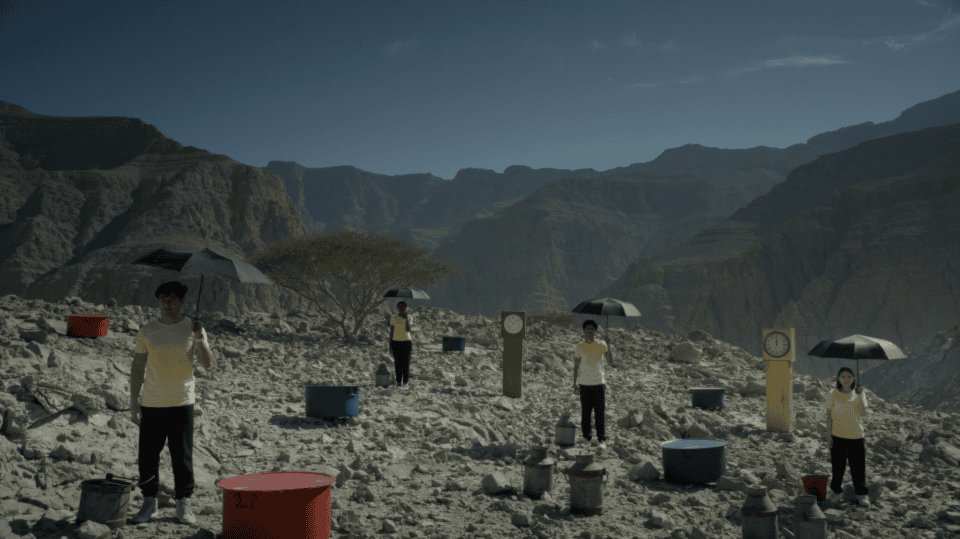
The question of institutional responsibility extends beyond acknowledging historical practices to examining how museums interpret their collections today. In its published material, the Natural History Museum recognises the need to address historical exclusions, broaden perspectives and challenge established narratives surrounding its holdings. Its collections management and acquisition policies also provide frameworks for investigating provenance, assessing ownership histories and exercising due diligence. These measures acknowledge that the circumstances through which specimens entered institutional collections are not always straightforward, and that historical records can be incomplete. Importantly, this does not mean that every object has a colonial provenance; rather, it establishes the need to examine individual histories within their wider political and institutional contexts. Arcadia offers a critical perspective on the relationship between exploration, possession and scientific knowledge, making the Museum itself part of the work’s wider conversation about historical interpretation.
This dialogue between contemporary art and scientific enquiry informs the Museum’s Jerwood Contemporary Arts Programme, supported by Jerwood Foundation. The initiative brings artistic practice into contact with environmental research, creating opportunities to approach ecological questions through different forms of knowledge and interpretation. Alex Burch, Director of Public Programmes at the Museum, describes Akomfrah’s work as bringing together “powerful human stories with sweeping visions of the natural world”. He also emphasises its capacity to encourage reflection on how migration, trade and empire have shaped both people and planet. The curatorial significance of the presentation lies in this exchange between artistic and scientific perspectives. Rather than using art to illustrate established research, the programme allows aesthetic experience to challenge assumptions, introduce alternative historical narratives and complicate the ways environmental change is understood.
Such questions have become increasingly urgent within contemporary art discourse, particularly as the Anthropocene has emerged as a framework for examining humanity’s impact on planetary systems. The term has also generated criticism because its emphasis on collective human responsibility can obscure substantial differences in historical agency. Colonial extraction, industrial capitalism and resource exploitation have affected populations in profoundly different ways, while the benefits and consequences of these systems remain unevenly distributed. Akomfrah’s focus on the Columbian Exchange provides a historically grounded perspective on ecological crisis, connecting environmental disruption to the expansion of empire and the unequal movement of wealth, labour and resources. This approach places Arcadia within a wider movement of artistic practice that connects environmental justice with postcolonial thought, questions of representation and the enduring consequences of historical inequality.
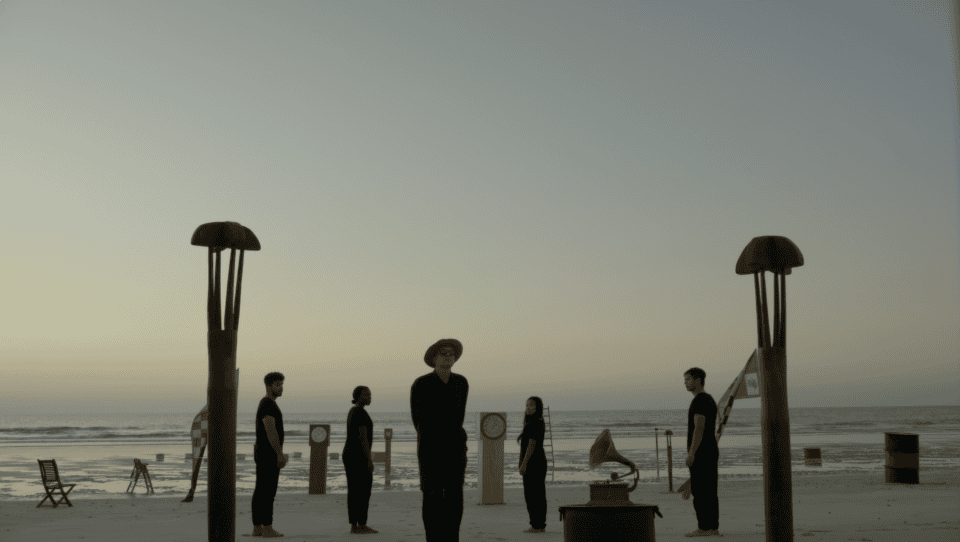
Landscape becomes one of the installation’s most effective critical devices. The imagery recalls traditions of Romantic painting and the sublime, in which vast natural environments were understood as sites of beauty, uncertainty and human insignificance. Akomfrah draws upon this visual inheritance while refusing its tendency to separate nature from the conditions of human existence. Forests reclaiming ancient ruins, turbulent seas and fragile coral reefs appear as environments marked by change rather than timeless wilderness. The recurring presence of cargo and decaying vessels further disrupts any suggestion that these landscapes exist independently of global commerce. Through these visual contrasts, the installation questions the longstanding cultural tendency to position the natural world as a resource.
The work also invites consideration of how moving-image art can communicate environmental crisis without reproducing the conventions of scientific documentary. Akomfrah’s method privileges montage, rhythm and atmosphere over linear explanation, allowing meaning to emerge through the relationships between images. Historical references sit alongside contemporary landscapes, collapsing distinctions between past and present and suggesting that the consequences of earlier encounters remain embedded in current ecological conditions. This approach gives viewers a role in interpreting the material, rather than directing attention towards a predetermined conclusion. Beauty and devastation occupy the same visual field, producing a tension between contemplation and responsibility. The result is an experience in which environmental change becomes perceptible through both its material evidence and its cultural memory.
The Museum’s wider programme extends these questions into its scientific and educational spaces. The Fixing Our Broken Planet gallery presents research into nature-based approaches to contemporary environmental challenges, while the Nature and Us display examines changing relationships between humans and the natural world through 50 objects. Its collection ranges from a bryozoan-encrusted Star Wars toy to a 400,000-year-old handaxe, bringing together unexpected encounters between cultural production, scientific discovery and human history. These displays provide a counterpoint to Akomfrah’s more open-ended visual language, demonstrating how material objects can reveal changing attitudes towards the environment across different periods. Their proximity to Arcadia reinforces the Museum’s ambition to connect historical understanding with contemporary environmental research.
Akomfrah’s representation of the UK at the 2024 Venice Biennale further established the international significance of his practice, but Arcadia brings particular urgency to his longstanding investigation of historical power and collective memory. Its presentation at the Natural History Museum places these concerns within an institution devoted to documenting the complexity of life, exposing connections between scientific knowledge, colonial histories and environmental change. As Akomfrah observes, the work considers “what other, less visible forms of power were also at work”, whilst recognising that “humans are never the only actors on the historical stage.” This understanding is central to the installation’s wider argument. The natural world cannot be reduced to a backdrop for human ambition, nor can contemporary ecological conditions be separated from the histories that produced them.
Running until May 2027, Arcadia is free to visit at the Natural History Museum’s Jerwood Gallery, where the film plays continuously in a presentation lasting just under an hour. Its London debut brings together questions of colonial history, environmental responsibility and artistic representation in a work that resists easy conclusions. By connecting the movement of people and species with the systems of trade and extraction that transformed the modern world, Akomfrah challenges the boundaries between natural history and human history. The landscapes across his screens are neither pristine wildernesses nor passive records of environmental damage; they are sites in which political, ecological and cultural histories intersect. Arcadia asks viewers to reconsider how the present has been constructed, and what it means to acknowledge the histories that continue to shape the planet’s future.
Arcadia is at the National History Museum, London until May 2027: nhm.ac.uk
Words: Simon Cartwright
Image Credits:
1&5. Arcadia, John Akomfrah 2 © John Akomfrah. Courtesy Smoking Dogs Films and Lisson Gallery.
2. Arcadia, John Akomfrah 3 © John Akomfrah. Courtesy Smoking Dogs Films and Lisson Gallery.
3. Arcadia, John Akomfrah 4 © John Akomfrah. Courtesy Smoking Dogs Films and Lisson Gallery.
4. John Akomfrah, Arcadia, 2023 © John Akomfrah. Courtesy Smoking Dogs Films and Lisson Gallery.


