Between 1945 and 1959, more than 1,600 German and Austrian scientists, engineers and technicians were relocated to the United States. Operation Paperclip sought out those who had worked on guided missiles, jet and rocket engines, aerodynamics, aerospace medicine and submarine technology. This was the era of the Cold War, where tensions with Soviet powers were at their height, and the US Government hoped these minds would bring them a technological advantage. As writer Parissa Djangi sums up in a National Geographic article about the controversial move: “After all, Americans were simultaneously impressed and terrified by what they had considered to be German technological supremacy during the war.” Perhaps the most notorious of the people involved was Werner von Braun, an aerospace engineer who led the development of German rocket technology in WWII, during which time he became a member of the Nazi Party and the Allgemeine SS. His move to the US saw him assimilate into NASA, where he was one of the leading figures who developed the Apollo spacecraft, which successfully went to the moon.

Photographer Lewis Bush has investigated the dark origins of modern rocketry for the best part of a decade. His work considers the “moral vacuum at the heart of contemporary space travel,” and von Braun is at the very heart of this examination. An Infinitely Dark Legacy, a new exhibition at international Centre for the Image, Dublin, brings Bush’s work to new audiences. The show traces the links between technological power, state interests and ethical concerns, reflecting his long-term focus on revealing hidden dimensions of institutional and technological influence. Here, audiences are challenged to consider the ethical consequences of scientific progress built on morally questionable foundation. Today, almost a century on from von Braun’s involvement in NASA, Artificial Intelligence and data centres bring new questions of scientific morality to the fore. The topic may have shifted, but the question remains as relevant as ever.

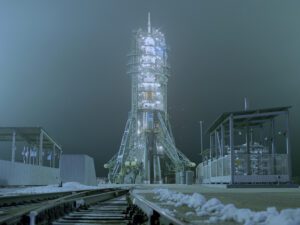
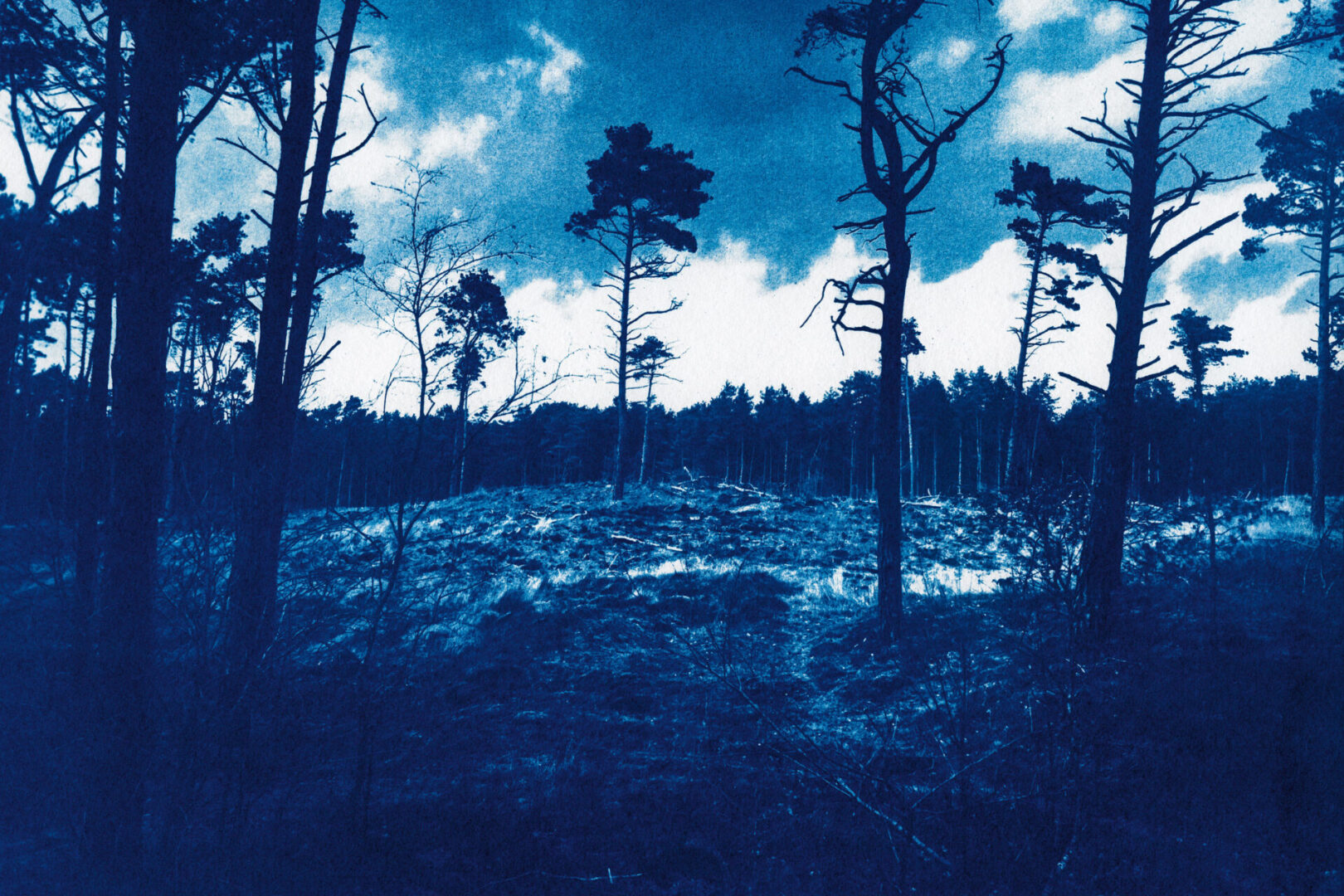
International Centre for the Image’s exhibition is built upon Bush’s photographic project and book Depravity’s Rainbow (2018 – 2023). The series draws on a mixture of images, documents and government archives made during visits to key early rocket developments sites across Europe, many of them today largely forgotten and unmarked. These pieces are then printed as cyanotypes. It is the earliest form of photography and originally intended for astronomical photography, with the process used throughout the 20th century to produce engineering and architectural blueprints. Bush explains how: “in the project, von Bruan’s pre-war and post-war lives, and the trajectories of the rockets he built, are juxtaposed in a narrative arc shaped like the parabola of a ballistic missile. These two contradictory sides to the man are laid bare, and through this the problematic histories, moral ambiguities and Faustian pacts of van Braun’s life, and of space exploration in general, are laid bear.”
Bush’s practice traces a distinct throughline from the beginning on modern rocketry during WWII and the Holocaust, right through to the Cold War era space programs of the Unites States, to the present-day space exploration. There are countless exhibitions in museums and galleries across the world that have considered the marvel of humanity’s journey to the moon, but Bush reminds us that there is always two sides to every story. He asks: what is the real cost of scientific progress?
An Infinitely Dark Legacy is at International Centre for the Image, Dublin until 23 December: image.museum
Words: Emma Jacob
Image Credits:
1. Lewis Bush, Depravity’s Rainbow.
2. Lewis Bush, Depravity’s Rainbow.
3. Lewis Bush, Depravity’s Rainbow.