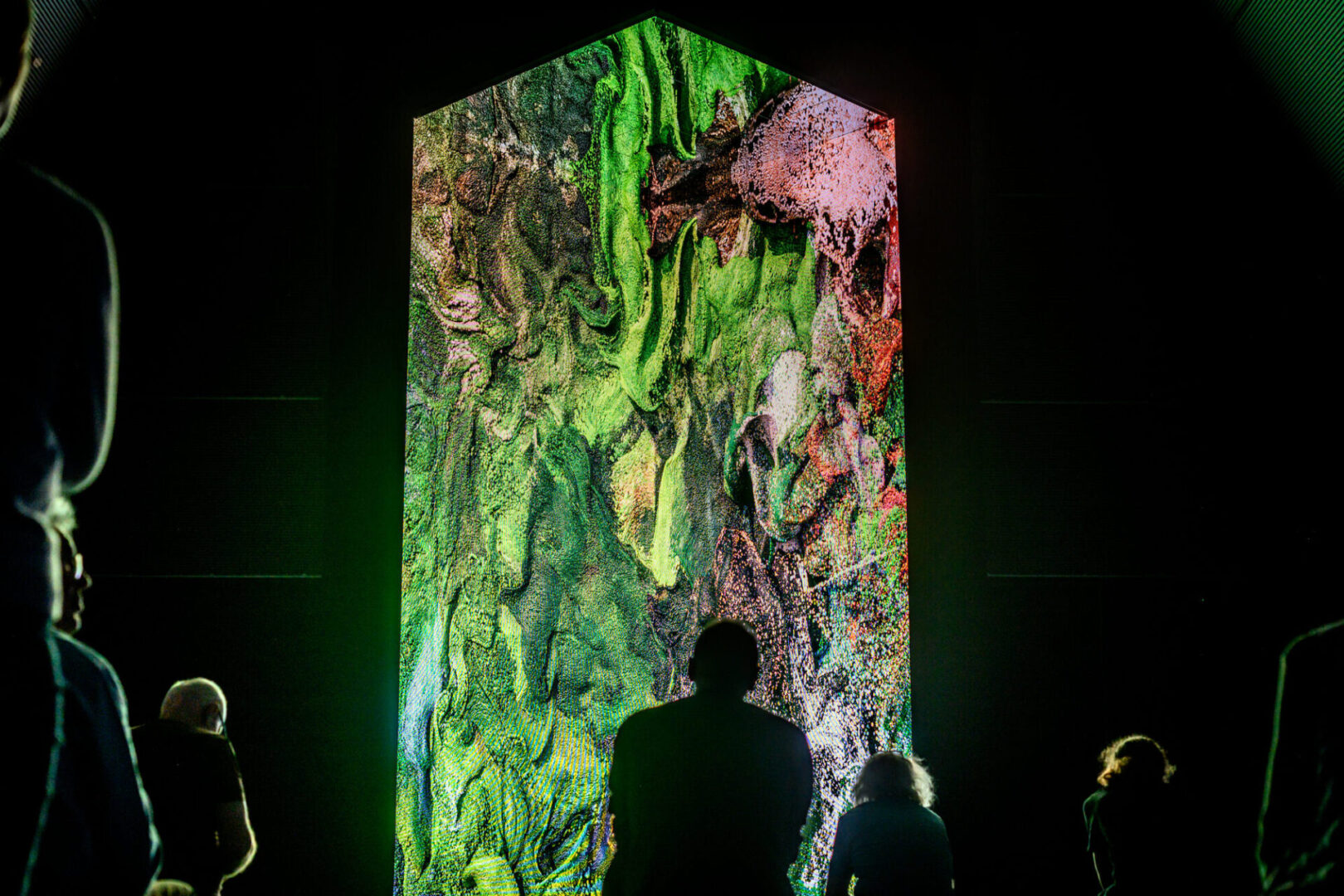
Refik Anadol’s practice exists in the space between what is remembered and imagined. Across a body of work that has transformed perceptions of AI, the Turkish–American (b. 1985) artist has approached data not as a technical resource, but as a material with emotional, architectural and cultural potential. His immersive installations propose that machines might offer new ways of understanding collective memory – not by replacing human experience, but by revealing hidden patterns within it. From vast visual archives to environmental datasets, Anadol’s works ask what happens when technology collaborates in the act of seeing. Latent City, created for the opening of BRUSK in Bruges, extends this ongoing enquiry into the relationship between place, perception and the invisible systems that shape contemporary life.
Over the past decade, Anadol has established himself as one of the leading figures in digital art, developing large-scale environments where AI becomes both medium and subject. In Machine Hallucination, the artist transformed millions of images of cities into constantly evolving digital landscapes, exploring how algorithms might reinterpret architectural memory. His acclaimed installation Unsupervised at the Museum of Modern Art in New York examined the possibilities of machine learning through the museum’s own collection, allowing AI to generate new visual relationships from one of the world’s most significant archives. Meanwhile, projects such as WDCH Dreams, which show Frank Gehry’s Walt Disney Concert Hall with data-driven imagery, and Quantum Memories, explores connections between quantum physics and visual perception, expanding his investigation into how technology reshapes our understanding of reality.
What distinguishes Anadol’s work is the way it moves beyond technological spectacle. AI is not presented as a futuristic novelty or a replacement for human creativity; instead, it becomes a lens through which overlooked dimensions of existence can be reconsidered. His installations transform abstract information into sensory experiences, allowing audiences to encounter data as something atmospheric, emotional and almost organic. Thus, Anadol’s work belongs to a longer artistic tradition concerned with perception and representation – from the invention of photography to digital image-making – questioning how every new tool changes the way humanity records and understands the world. His practice suggests that memory itself is not fixed, but constantly reconstructed through interpretation, exchange and transformation.
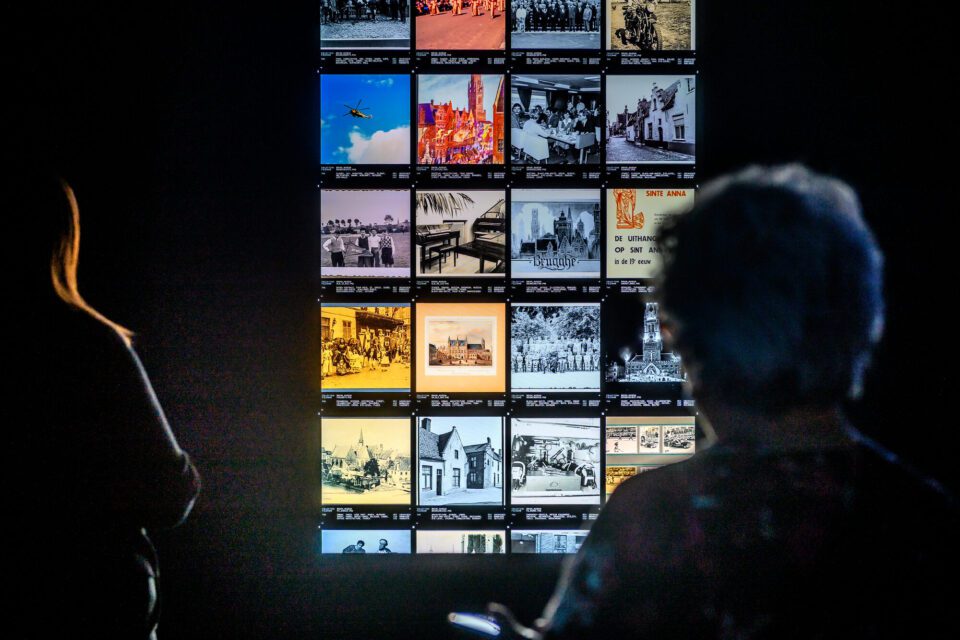
Latent City brings these questions into dialogue with Bruges, a city whose identity has long been shaped by layers of historical memory. Developed as part of Anadol’s wider exploration of urban consciousness, the installation uses AI models trained on millions of images of cities worldwide, allowing it to generate new interpretations of urban environments. For Bruges, the dataset becomes a talk between architecture, history and imagination. The medieval city is not reproduced literally, nor treated as a preserved object frozen in time; instead, it becomes a living field of possibilities. Buildings, streets and landscapes appear to dissolve into shifting digital forms, suggesting that every city contains countless unseen versions of itself.
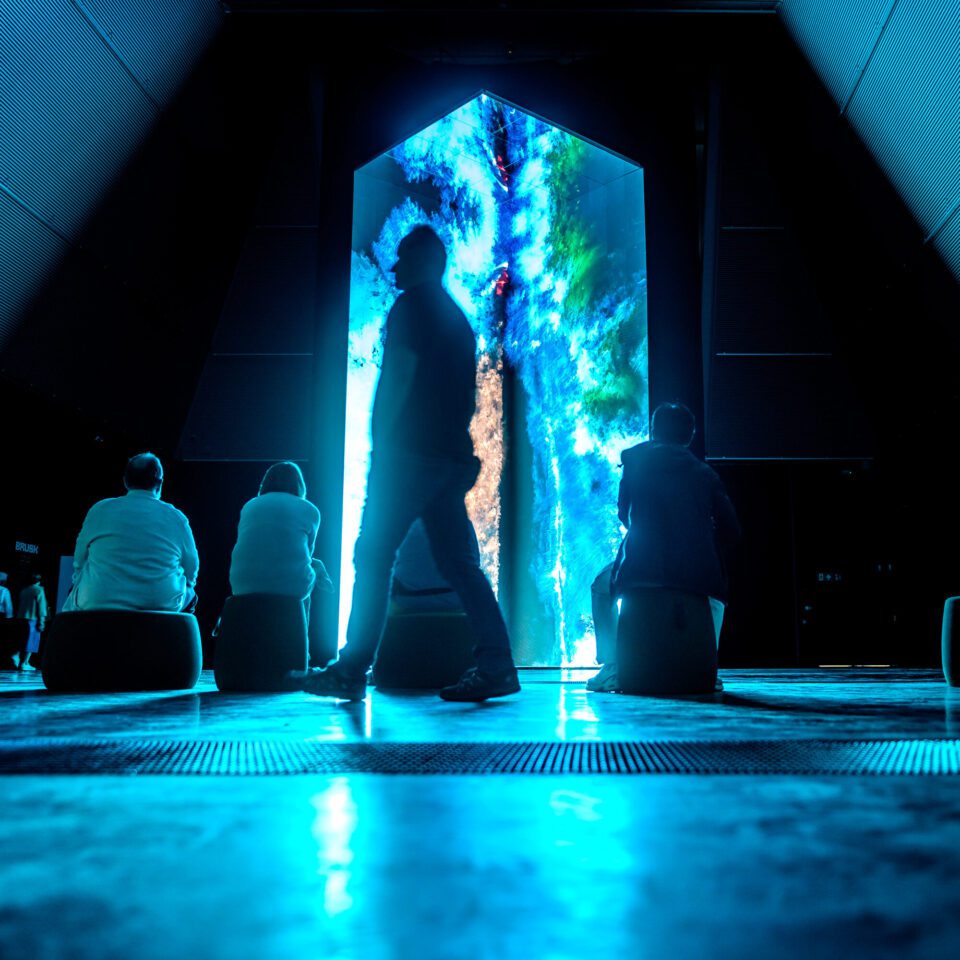
Within this particular gallery environment of BRUSK, Latent City creates not simply a strong, but powerful tension between permanence and change. Bruges is globally recognised for its medieval architecture, canals and historic character, yet Anadol’s installation proposes that heritage is not simply something inherited from the past. It is continuously rewritten through memory, technology and human experience. The familiar becomes unfamiliar as architectural fragments emerge, disappear and reform within a constantly changing digital atmosphere. The work does not attempt to simulate Bruges; instead, it explores the idea of Bruges – the emotional and cultural traces that exist beyond physical structures.
This makes the choice of location especially significant. BRUSK arrives in Bruges at a moment when the city is reconsidering its relationship with contemporary culture. Historic cities often face the challenge of balancing preservation with progress, protecting their architectural identity while avoiding becoming monuments to a completed past. Bruges has always carried this delicate responsibility. Its beauty lies not only in its remarkable buildings, but in the way history remains embedded within everyday life – in its streets, waterways and rhythms. The arrival of BRUSK represents a new chapter, demonstrating that a heritage city can embrace contemporary artistic practices without abandoning its identity.
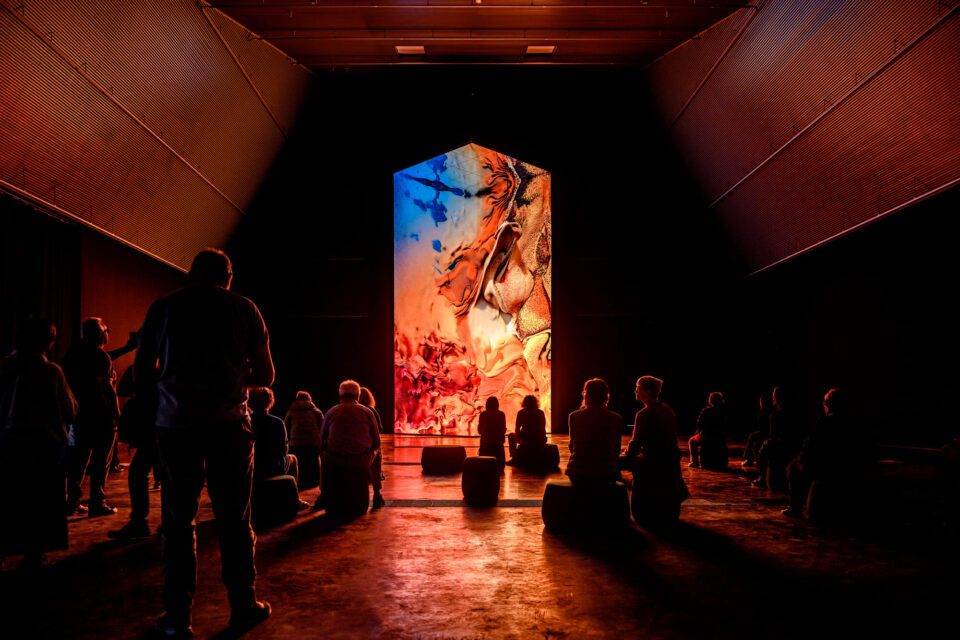
Designed by Robbrecht en Daem architecten in collaboration with Salens Architecten, BRUSK has been conceived as more than an exhibition building. Its architecture responds to the city around it while creating a new cultural destination for the future. Rather than functioning as an isolated institution, the building is imagined as part of Bruges’ wider urban fabric, connecting museum spaces, public areas and research facilities. The design reflects an understanding that contemporary museums are no longer simply places where objects are displayed; they are spaces for dialogue, experimentation and collective experience. BRUSK’s openness mirrors Anadol’s own artistic approach – both seek to create environments where boundaries between disciplines, histories and audiences become more fluid.
Its relationship with the Groeningemuseum is central to this ambition. The Groeningemuseum has long represented one of Belgium’s most important collections, particularly through its extraordinary holdings of Flemish art and the works of the Flemish Primitives. BRUSK does not challenge this legacy; it expands the conversation around it. The dialogue between historical painting and contemporary digital practice reveals unexpected connections across centuries. Just as Renaissance artists explored new technologies of representation through oil paint, perspective and scientific observation, today’s artists are questioning the possibilities of artificial intelligence, data and machine-generated imagery.
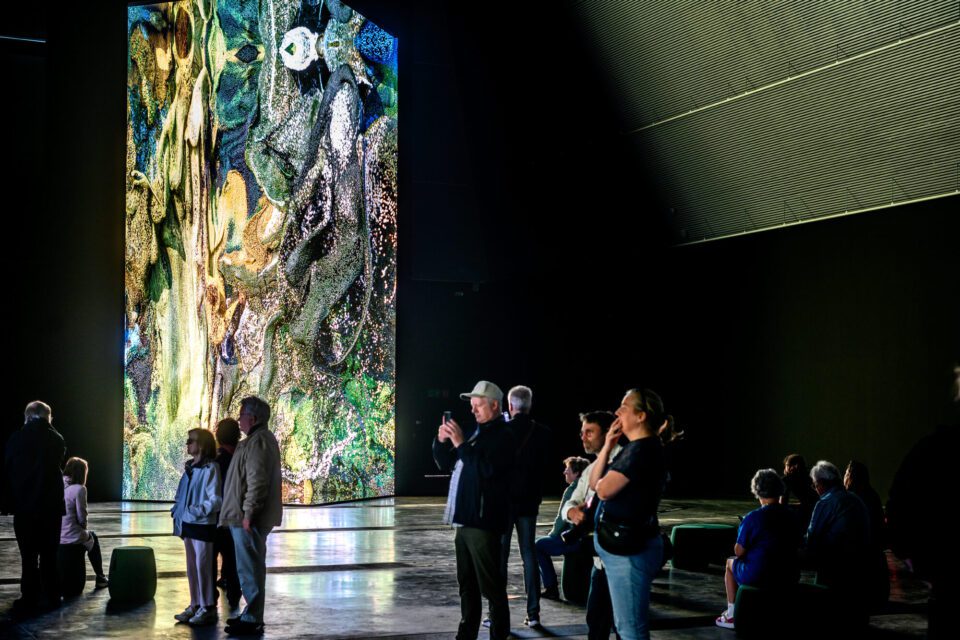
The partnership between BRUSK and the Groeningemuseum reflects a broader cultural vision – one where past and future exist in conversation rather than opposition. Alongside Anadol’s Latent City, the opening programme considers Bruges as a historically connected, globally engaged city rather than an isolated medieval centre. This perspective is important because Bruges’ history has always been one of exchange. Its artistic achievements emerged through networks of trade, movement and cultural encounter, making it a fitting place to consider how digital technologies are creating new forms of connection today.
Something is deeply appropriate about Anadol introducing BRUSK to the world. His work examines hidden systems – networks of information, memory and collective intelligence – whilst BRUSK represents a new cultural infrastructure in Bruges. Behind the galleries and exhibitions – networks of conservation, research, education and public engagement. The building becomes not a container for art, but a framework for new ideas to emerge. Thus, artist and institution are concerned with making hidden structures visible.
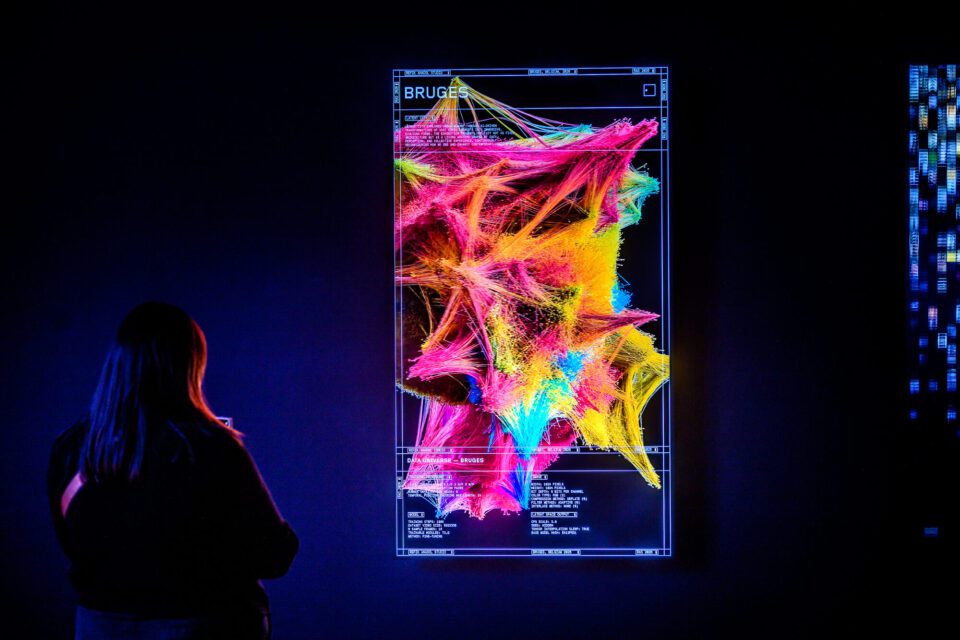
Bruges has always held a particular warmth – a city inviting contemplation rather than admiration. Its beauty is undeniable, but what remains most memorable is its atmosphere: the quiet movement of water through the canals, the texture of old brick and stone, the sense that every street carries accumulated stories. Returning to Bruges feels like encountering a familiar memory from a slightly different perspective. The is the territory Anadol explores – the space where recognition and discovery meet.
Latent City captures that feeling of returning to somewhere and seeing it differently. It suggests that cities are not static environments but living archives, shaped by human presence and constantly transformed by new interpretations. AI becomes a tool not for predicting the future, but for reconsidering the present. Through luminous images and evolving forms, Anadol reveals Bruges as both historic and unfinished.
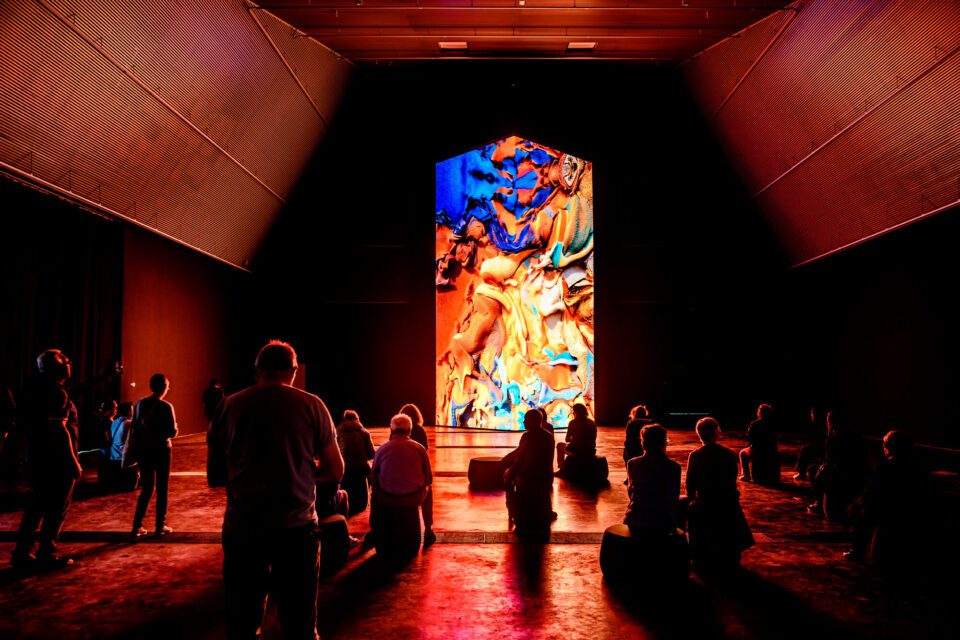
The significance of BRUSK lies in this same ability to hold multiple timescales at once. It respects the city’s remarkable heritage while acknowledging that culture must continue to evolve. By placing a pioneering digital artist at the centre of its opening programme, Bruges makes a confident statement about its future – one where contemporary art becomes part of the city’s ongoing story rather than an interruption to it. The result is a dialogue between medieval architecture and artificial intelligence, between memory and invention, between what has been preserved and what has yet to emerge.
Refik Anadol’s Latent City offers more than an exploration of technology. It is a meditation on how places live within us and how they continue to change through every act of observation. In Bruges, a city defined by memory, the installation becomes a reminder that the past is never truly finished. It remains active, shifting and open to reinterpretation. BRUSK provides a space where those possibilities can unfold – ensuring that one of Europe’s most treasured historic cities continues to imagine what comes next. This is an exciting new chapter for Bruges and its forward-thinking instincts.
Refik Anadol: Latent City is at BRUSK, Bruges until 8 November: bruskbrugge.be
Words: Cherie Federico
Image Credits:
ALL IMAGES: Refik Anadol. Latent City 8/5/2026 to 8/11/2026 One of the two opening exhibitions in art hall BRUSK. With Latent City, BRUSK presents the first solo exhibition in Belgium by Refik Anadol, an international pioneer in AI-driven art. Visit Bruges – © Jan Darthet