What does it mean to listen radically? To consider listening as a way of understanding people, places, histories and the world around us? Now in its sixth year, the Listening Pitch, a film grant by Aesthetica Film Festival and Audible, continues to provide a distinctive platform for ambitious, sound-led documentary work. More than a funding initiative, it has developed into a curatorial position: one that considers listening as a method, with sound not simply illustrating an image, but generating new ways of shaping, questioning and understanding a story. In a contemporary nonfiction landscape defined by scale and saturation – where short documentary circulates across festivals, broadcasters and digital platforms – the Listening Pitch creates space for a different kind of attention. Its 2026 commissions sit within Radical Listening, this year’s main programme theme, which brings together film, sound, moving image and public art to consider how listening can reshape perception. At its centre are the premieres of three new documentaries – Duncan Cowles’ Nibclout Neebors, Sofia Cissé Akel and Tobi Kyeremateng’s Cissé-Ceesay, and Hermione Spriggs’ Worm Charming – each using sound as a means to open up new ways of seeing.
Across the three films, listening becomes both subject and form, moving between family memory, ancestral knowledge and more-than-human communication. In Nibclout Neebors, Cowles begins with a recording made in 1964 of his great-grandfather reading a Scots poem, using the difficulties of deciphering the voice to explore how meaning shifts between generations. Cissé-Ceesay follows Cissé Akel as she reconnects with her family lineage in Senegal’s Casamance region, encountering the Griot tradition and the role of oral storytelling in carrying histories across time. Meanwhile, Worm Charming takes an altogether different route, exploring vibrations, soil and the practice of drawing earthworms to the surface through sound. Together, the films demonstrate the breadth of the Listening Pitch – showing how sound can preserve what is fragile, connect us to inherited knowledge and reveal forms of communication beyond language. Their premieres offer three distinct interpretations of what it might mean to listen closely.
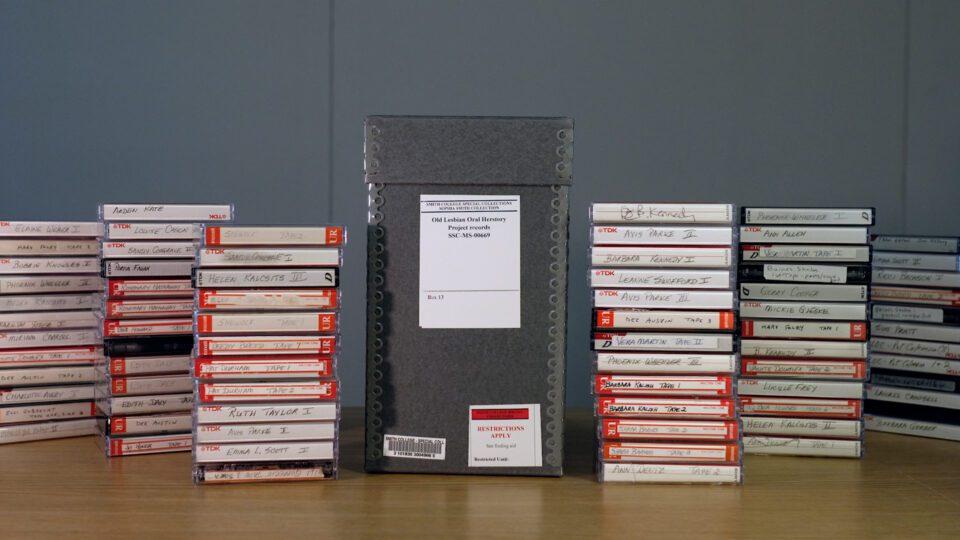
A voice recorded more than 60 years ago provides the starting point for Nibclout Neebors, which takes an apparently modest piece of family history and opens it into a wider investigation of language, memory and interpretation. In 1964, Duncan Cowles’ great-grandfather recorded himself reading a Scots poem about a village shop in the Scottish Borders. The cassette preserves the textures and rhythms of a voice from another generation, yet parts of the recording are difficult to decipher, with dialect and distance creating gaps in meaning. Instead of attempting to resolve these uncertainties, Cowles brings the recording to residents of Blyth Bridge, asking them to interpret what they hear. The result considers how stories change as they move between voices – and how the act of listening can become a form of collective storytelling.
Ancestral knowledge is similarly rooted in the spoken word in Cissé-Ceesay, which follows cultural historian Sofia Cissé Akel as she reconnects with her family lineage in the Casamance region of southern Senegal. Guided by village elder Omar Touré and a local Griot, she encounters a tradition in which histories are carried through storytelling, music and performance, existing as living knowledge rather than fixed archival record. The film asks what it means to approach heritage through listening, particularly when dominant forms of historical documentation have often privileged written sources over oral traditions. Here, the voice becomes both archive and inheritance – a means through which the past remains present and continually renewed. Produced by Tobi Kyeremateng, Cissé-Ceesay considers listening as a form of cultural exchange, requiring attention to the systems through which knowledge is held.

Vibrations travelling through soil provide the unusual point of departure for Worm Charming, Hermione Spriggs’ exploration of communication beyond human language. The film takes its cue from the rural practice of worm charming – also known as grunting, fiddling or rooping – in which vibrations are used to draw earthworms towards the surface. From the Willaston Worm Charming Championships in Cheshire to the wetlands of Florida’s Everglades, Spriggs follows the practice across radically different landscapes, using field recordings and granular synthesis to create an immersive sonic environment. What begins as a curious rural tradition becomes a meditation on the physical properties of sound and the relationships between humans and ecosystems. Listening therefore becomes something more, asking what forms of communication might be perceived when language is no longer the measure.
These three films form the centrepiece of Radical Listening, this year’s overarching theme, while also representing the latest commissions from the Listening Pitch, Aesthetica’s partnership with Audible. The initiative gives filmmakers the opportunity to develop ambitious, sound-led documentary projects, supporting approaches that challenge conventional relationships between image and audio. Alongside the three new Listening Pitch premieres, the wider Radical Listening programme features six newly commissioned scores for silent films, bringing contemporary approaches to sound into dialogue with early cinema. It also extends beyond the gallery and screening room through a large-scale outdoor Media Arts Trail, featuring new works by Steve Messam, Squidsoup and Being Nowhere. Across these projects, sound becomes a means of transforming familiar environments and encouraging audiences to pay attention.

The Listening Pitch has become an important platform for filmmakers working at the intersection of documentary, sound and experimental practice, with previous winners going on to reach audiences well beyond the initial commission. Alumni have screened at festivals including Sundance, SXSW, San Francisco International Film Festival and Sundance London, demonstrating the opportunities that can follow from the programme. Sparsh Ahuja and Omi Gupta’s Birdsong, Jade Ang Jackman’s Speed of Sound, Ross McClean’s Echo and Jessi Gutch and Liz Jackson’s Blind as a Beat are among the projects that have continued their journeys through international exhibition. Other films have found new audiences, including Ornella Mutoni’s The Things We Don’t Say, acquired by The Guardian. Collectively, these trajectories point to the role of the Listening Pitch as a space where filmmakers can take formal risks.
Voice, meanwhile, becomes a site of identity and transformation in Roberto Duque’s Voice Shift, which will screen as part of this year’s programme. The film follows trans femme individuals working with a vocal coach as they develop voices that feel aligned with their identities, opening up questions around pitch, expression, perception and the social codes attached to how people are heard. Its inclusion creates a direct dialogue with the new commissions, extending Radical Listening’s enquiry into the ways voices are interpreted and understood. If Nibclout Neebors considers the slipperiness of dialect and Cissé-Ceesay explores voice as a carrier of ancestral memory, Voice Shift‘s examination leaves us to appreciate the voice as something that can be consciously shaped and reclaimed. Across the films, listening emerges as an active process – one that is influenced by culture, expectation and experience.

The premiere event will bring these ideas into a shared space, offering audiences the chance to encounter the work alongside the filmmakers themselves. Taking place on Friday 6 November from 19:00–21:00, the evening will feature screenings of Nibclout Neebors, Cissé-Ceesay and Worm Charming, alongside Voice Shift, followed by a Q&A with the artists. The programme will then continue with a DJ, drinks and networking, creating an informal setting in which audiences and practitioners can meet, exchange ideas and discuss the work beyond the screening. This movement from cinema to conversation is a reflection of the broader ethos of Radical Listening – an emphasis on participation, encounter and the exchange of different perspectives. The event offers attendees both an initial first look at three new documentaries commissioned through the Listening Pitch and an opportunity to discover the wider programme.
Ultimately, what binds these works is an interest in the things that become perceptible when we slow down and pay attention. A fragment of a family recording becomes a communal act of interpretation; an inherited story becomes a living archive; vibrations in the earth reveal forms of communication beyond the human. Rather than simply illustrating their subjects through sound, the films use listening as a way of thinking – a method through which histories, identities and environments can be approached from different perspectives. Their premieres therefore represent more than the presentation of three new documentaries; they form part of a wider artistic investigation into how listening might transform our relationship with the world around us. Radical Listening asks audiences to reconsider what it means to hear – and, in doing so, what else might become possible when we learn to listen differently.
Radical Listening – Friday 6 November, 19:00–21:00. Screening and Q&A followed by DJ, drinks and networking.
Meet the filmmakers and experience the premieres of Nibclout Neebors, Cissé-Ceesay and Worm Charming, with Voice Shiftscreening as part of the programme.
Words: Shirley Stevenson
Image Credits:
1&5. Film Still. Banana. Matthew Herbert (2023).
2. Film Still. Old Lesbians. Meghan McDonough (2023).
3. Film Still. Banana. Matthew Herbert (2023).
4. Film Still. The Things We Don’t Say. Ornella Mutoni (2024).