

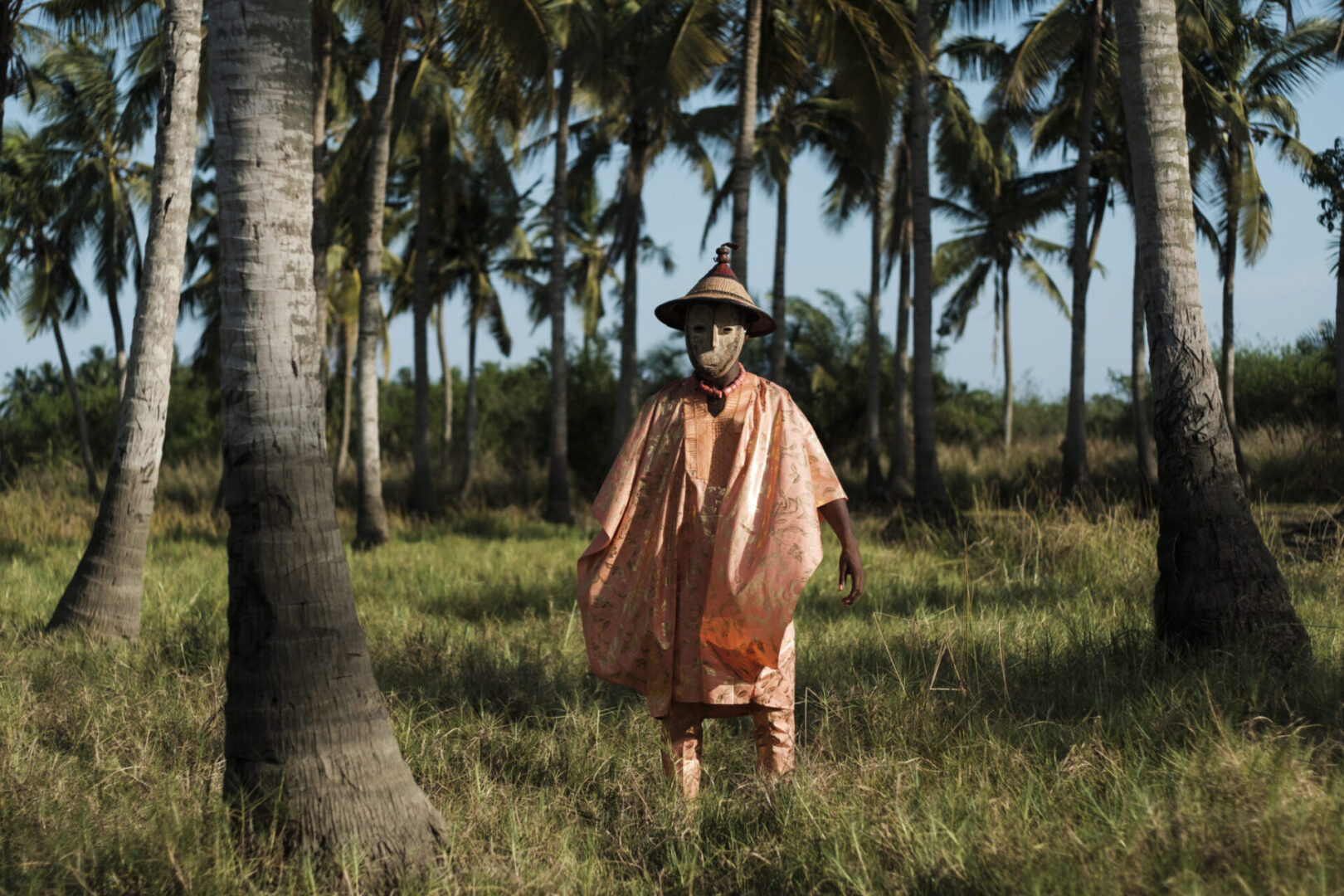
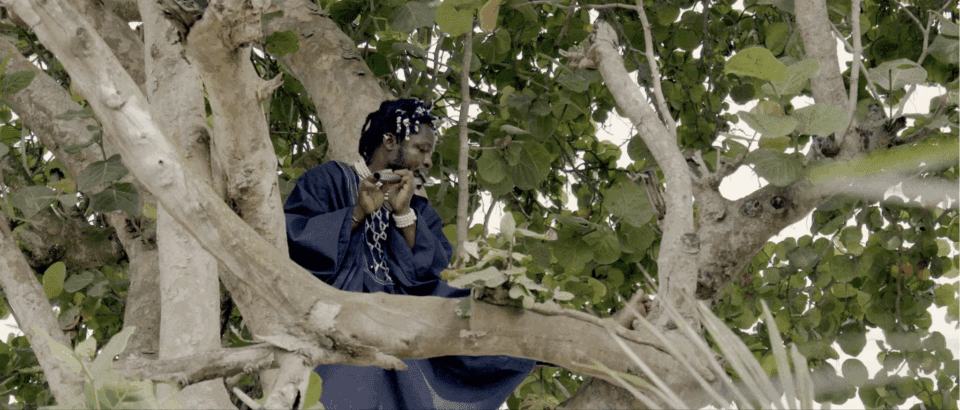
Tobi Onabolu is an artist-filmmaker and writer from London, now based in Grand Popo, Benin Republic. His film, Danse Macabre, was awarded this year’s Aesthetica Art Prize. The moving-image piece explores spirituality, mental health and the human psyche. Here, Onabolu brings together a vast range of ideologies, uniting Jungian psychology, which stipulates that all humans share a “collective unconscious,” informed by our ancestors; with Yoruba cosmology, a belief system stating that the universe has two interconnected worlds, one physical and one spiritual. The work synthesises elements from Yoruba traditions, European cinema and experimental music, creating a performance that draws from multiple geographies and timelines. We caught up with Onabolu to chat about the award-winning artwork.
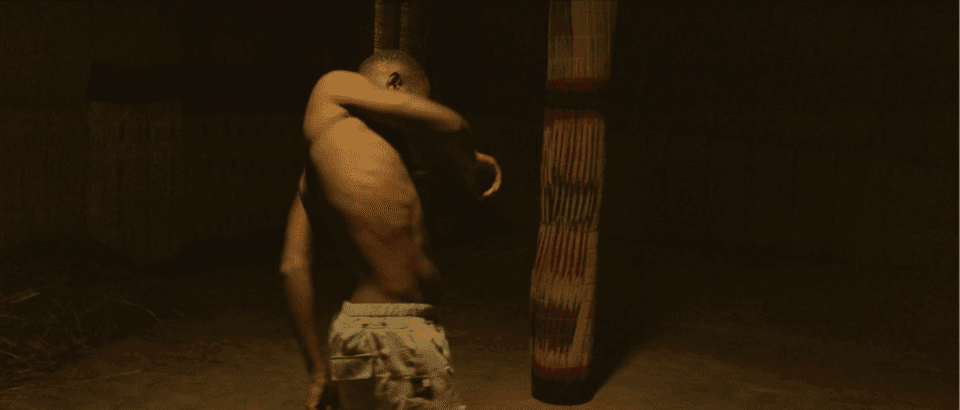
A: Danse Macabre weaves together Jungian psychology, Yoruba cosmology and dance. How did you come to connect these diverse systems of thought in your practice?
TO: I am interested in how truths can exist in parallels. I have a heightened curiosity of Yoruba heritage because, having grown up in the UK and now living in west Africa, I’m playing a “catch-up” of sorts. Meanwhile, amongst circles of friends who undertake psychological therapies, my interest in Carl Jung has emerged, because there’s a slight mysticism and magic to his approach which sits outside of the strictness of empiricism. Dance has always been a form of release and liberation for me. Some of these intersections are quite obvious, for example the centrality of dance in Yoruba practices. Furthermore, in many west African cultures, plurality and even syncretism is so prevalent – for example in a nuclear Yoruba family it is not uncommon to have parents of different faiths. This has been inspiring in terms of seeing how different schools of thought can live side by side or even intersect with each other. Ultimately, I find that moving-image is such an expansive medium that can hold space for multiplicity and coexistence. For instance, when I watch Tarkovsky, there’s this widening effect that happens that gives me the feeling of infinity.
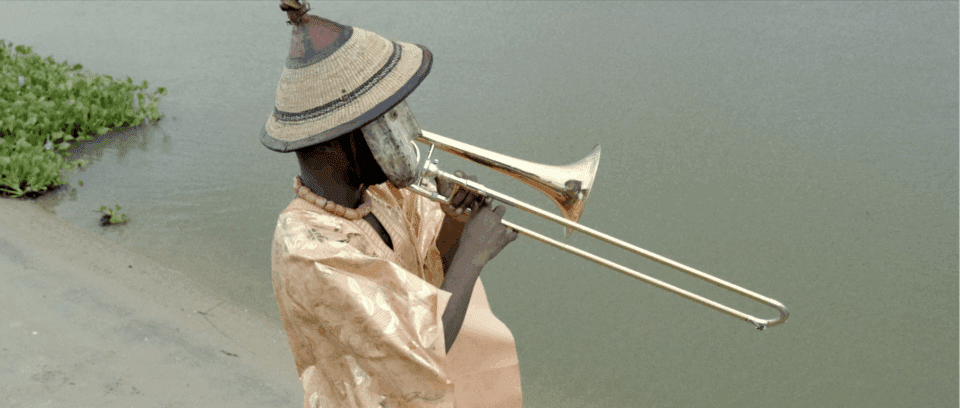
A: The performance integrates poetry, music, archival audio, and movement – how do you approach balancing these elements to create a cohesive experience?
TO: It’s definitely tough, and I’m grateful to work with amazing people who allow me to play, and let me know when to reign it in. In particular, 4Stringsz (composer) and Nic Wassell (Editor) were central to this balancing act. I tend to hear the film before I see it, so in my collaborations with 4Stringsz, I am clear on the sound palette I am going for, which allows us to have a lot of fun in building out the score. My research over the past few years has explored theories around the mind-body connection. In this space, the link between poetry and dance has become really apparent to me, especially how these two languages of expression can dovetail and almost complete each other’s sentences. My process is not linear, so experiments with words, body movements and sounds are happening concurrently, as well as sourcing archival audio. The process allows for these “collage-like” experiments to happen as we piece together the various elements.
A: Can you talk about how the concept of the collective unconscious resonates with Yoruba ideas of ancestral memory and Egúngún masquerades?
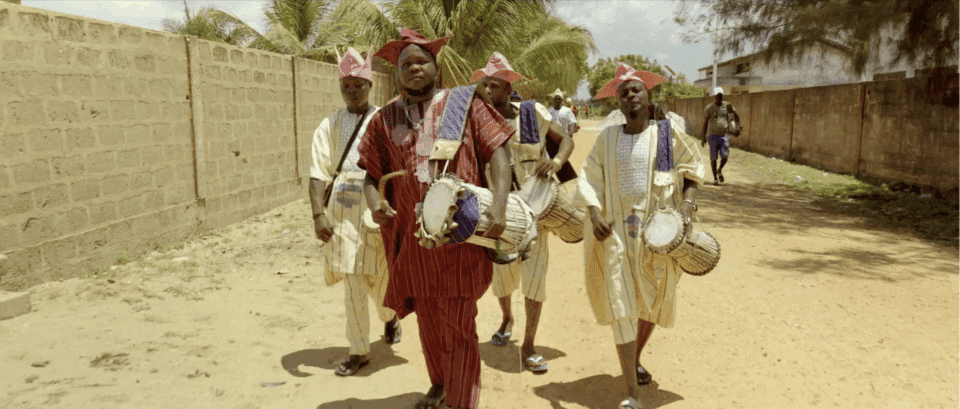
TO: Jung’s theory argues that the “collective unconscious” is an aspect of the human mind, but it remains inaccessible to us. The collective unconscious is shared amongst all humans, since we have common ancestors. This is connected to the Egúngún masquerade, which celebrates male ancestry. The Yorubas also have the Gẹlẹdẹ masquerade, which venerates women in society. In the costume making of the masquerade, new layers and materials are added as more family members become ancestors, which is almost similar to the way the collective unconscious gains new material generation by generation, over the course of human history. Since the dead play a critical role to the living in Yoruba cosmology, the masquerades are brought out intermittently such that the ancestors can intervene in the lives of the people, to warn, celebrate and heal. I am fascinated by how the wearers of the masquerade – always a secret – must go into a trance state. Their body becomes a medium, where they are able to access information from the unconscious, which they communicate to the living through dance.
A: What does it mean for your artistic trajectory to win the Aesthetica Art Prize?
TO: To receive this noteworthy and well-respected prize is definitely a proud moment and a confidence boost for my practice. I know a number of the other artists who were shortlisted, and I really admire their work, so to be featured in such good company in the first place already gave me a sense of reassurance and an injection of positivity. In winning, there’s an added sense of affirmation that my work resonates, is interesting and has potential, which gives me a lot of impetus to keep going, especially at such an early stage of my career. I have a few imminent engagements, and a good sense of the next few works I would like to create, and now it feels like a good time to lean in and trust my gut and my instincts. The prize is a very welcomed boost to continue on the path and keep going.
A: Looking forward, are there new themes or mediums you’re interested in exploring next?
TO: I once re-imagined one of my existing video works as a two-channel video installation, however, I feel ready to take my practice up a level and conceive more ambitious multi-channel video works. I want to fully lean into themes of circular time, presence and consciousness. In thinking more deeply about the material presentation of my work in exhibition spaces, coupled with the centrality of material culture in west African contexts, I am excited to experiment more with materials within my installations. I normally place objects and literature within my video installations anyway, to bring more tactility and tangibility to the work. I’m also keen to engage other senses, such as smell. I’m always collecting, repurposing and playing with objects, so I’m excited to see what may come from even just allowing myself to experiment freely, without any end goal in sight. I would also like to lean into my photography more, and I’m always playing with graphite and charcoal, so there’s a lot for me to get stuck into! One step at a time.
The Aesthetica Art Prize is Open for Entries. Submit here.
The Aesthetica Art Prize Exhibition 2025 is at York Art Gallery until 25 January.
tobionabolu.com | yorkartgallery.org.uk
Find out more about the Aesthetica Art Prize 2025 Shortlist here.
Words: Emma Jacob & Tobi Onabolu.
Image Credits:
All images courtesy of Tobi Onabolu.


