

Andoni Beristain was born in a small village in northern Spain in 1989. He’s been fascinated with shapes and colours since an early age, observing the world and what it means to fit in. Today, Beristain is a creative director, photographer and graphic designer. He works between San Sebastián and Barcelona, collaborating with brands like Adobe, Kenzo, Louis Vuitton, Netflix and Veuve Clicquot. Above all, he’s passionate about telling stories: using images to navigate life-changing events, take a political stance, or give shape to human emotion. He does so through large-scale outdoor still life, studio projects and a signature sense of optimism.
Beristain started his creative journey with the series Pieza Redonda (Round Piece), which spoke about weight, obesity and the social pressure around size. This was followed by Pieza Rota (Broken Piece), whose central issues were disease, cancer and stigma. Now comes Pieza Madre (Mother Piece), a body of work navigating unconditional love, loss and death.
In 2022, Beristain’s mother, Ángeles Isidora Zabalo, sadly passed away aged 63. She left suddenly, “without leaving a manual to understand how to go on without her.” Pieza Madre emerged from this moment. It’s an homage to Ángeles – “a woman who gave when she had none and helped when she had no time for herself.” She was generous and community-minded: caring for the elderly, collecting clothes and food for refugees and assembling first aid items for the homeless.
Now, the series is published by Setanta Books – realising one of Beristain’s dreams. We spoke with the artist about this deeply personal, symbolic collection, which reveals photography’s power as a tool for both communication and healing.
A: How did your journey into art and image-making begin? And in what ways has it developed over the years? AB: It all started by chance. A professor noticed I had a talent for photography whilst I was studying design in Barcelona, and encouraged me to pursue it and keep going – so I did. I learned mostly on my own. Commercial projects began to come in, and I also started exploring my ideas through personal series. The passion has grown gradually, too: understanding the medium, enjoying each small step. To this day, I haven’t stopped making pictures, and I hope it stays that way.
A: How would you describe your visual style? What are your favourite aspects of being behind the camera? AB: I always find this hard to explain. I’d definitely say that my work, at first glance, is colourful with a touch of surrealism. Looking closer, I’d also describe it as minimalist: a blend of the poetic, the everyday and the emotional, but without dramatics. In my personal projects, my intention is to express what I feel, what I’ve lived and what troubles me. Through that, I sometimes break taboos, or talk about the experience of simply being alive from a positive perspective – no matter how raw the subject may be. I really enjoy thinking and imagining how I can translate what I feel into images. I get truly excited when I sketch ideas in my mind and sense that these concepts might actually work in reality, in the tangible world.
A: Who, or what, have been your most significant creative inspirations? How have they influenced your approach?
AB: I’d say Surrealism is a key artistic movement. But without A doubt, what influences me the most is day-to-day life. It’s perhaps a type of costumbrismo – the trend in 19th century Spanish and Latin American literature and painting that focused on depictions of local everyday existence. Basque and Spanish cultural traditions are a big source of inspiration for me, too. Humour plays an important role in both my life and work, and a cocktail of all of that shapes how I develop my ideas and express what I feel. When I was a kid, I was always drawing, playing the clarinet, experimenting (terribly) with design on the computer. I was fascinated by fashion and dance. I guess creativity stirred something inside me very early on, and little by little, everything has found its form.
A: Your mother, Ángeles Isidora Zabalo, who passed away in 2022, is at the heart of your new book, Pieza Madre. Could you share some insight into her story and what led you to dedicate this very personal series to her?
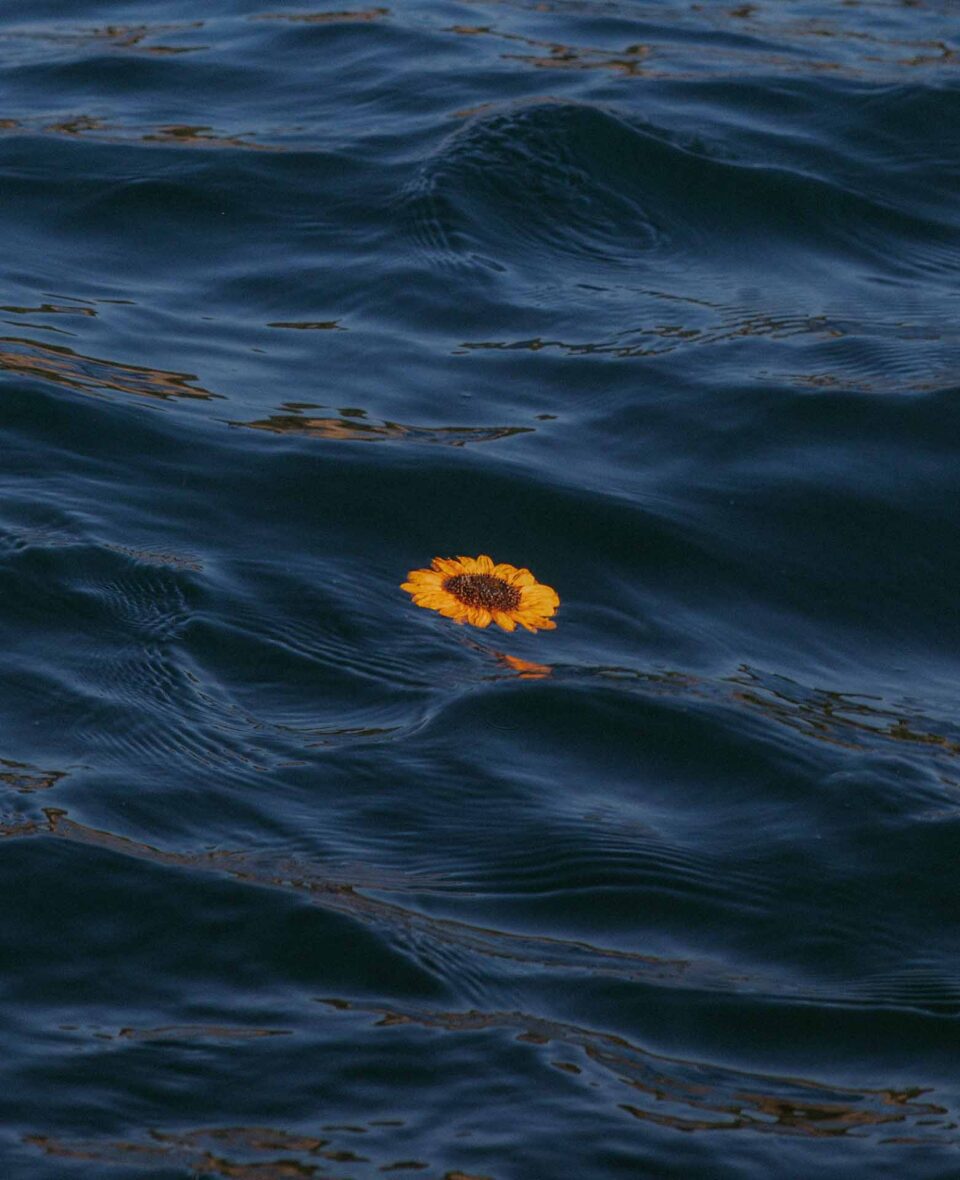
AB: My mother meant everything to me. We had a very close relationship; we got along incredibly well, and with her I always felt safe. She was my home, my unconditional love. She taught me to be who I am, what humour was, and without ever needing to say it, she was an example of strength, perseverance, patience and kindness. She was a special woman, very sensitive, with a heart far too big for her chest. I know every son would say that, but in her case it was genuinely true. She was extraordinary. Her death turned my life upside down. I suffered, and still do, deeply. But somehow, the experience filled me with strength to keep going and look ahead. Pieza Madre also began by chance: on the day of her funeral, I decided to photograph the flowers to give as a keepsake to everyone who attended. And in the days that followed, I started capturing my memories with her, who she was, what we lived together. Later, I decided the series would be 63 photographs, and that a “dream” outcome of this tribute would be for it to become a book – a tangible object that could give new form to all of that pain, love and admiration.
A: This collection comprises one image for each year of her life. What was the process of putting these compositions together like for you, both creatively and emotionally?
AB: It was intense and painful, but healing at the same time. I think the series became my therapy, and my mourning was painted in yellow. It enabled me to start conversations with my father and my family, to become aware of certain emotional gaps, and to take care of my mental health. It helped me to cry, but also to learn how to laugh again. Pieza Madre allowed me to share what I was feeling, in my own way, with others. It was something unexpected, but it has allowed me to grow, develop my career further, and understand what I want to do with my work in future. It helped me realise what truly matters in life, and to recognise the strength we all carry within us when we go through difficult or painful moments.
A: Yellow appears as a throughline across the entire body of work. What significance does this shade hold for you?
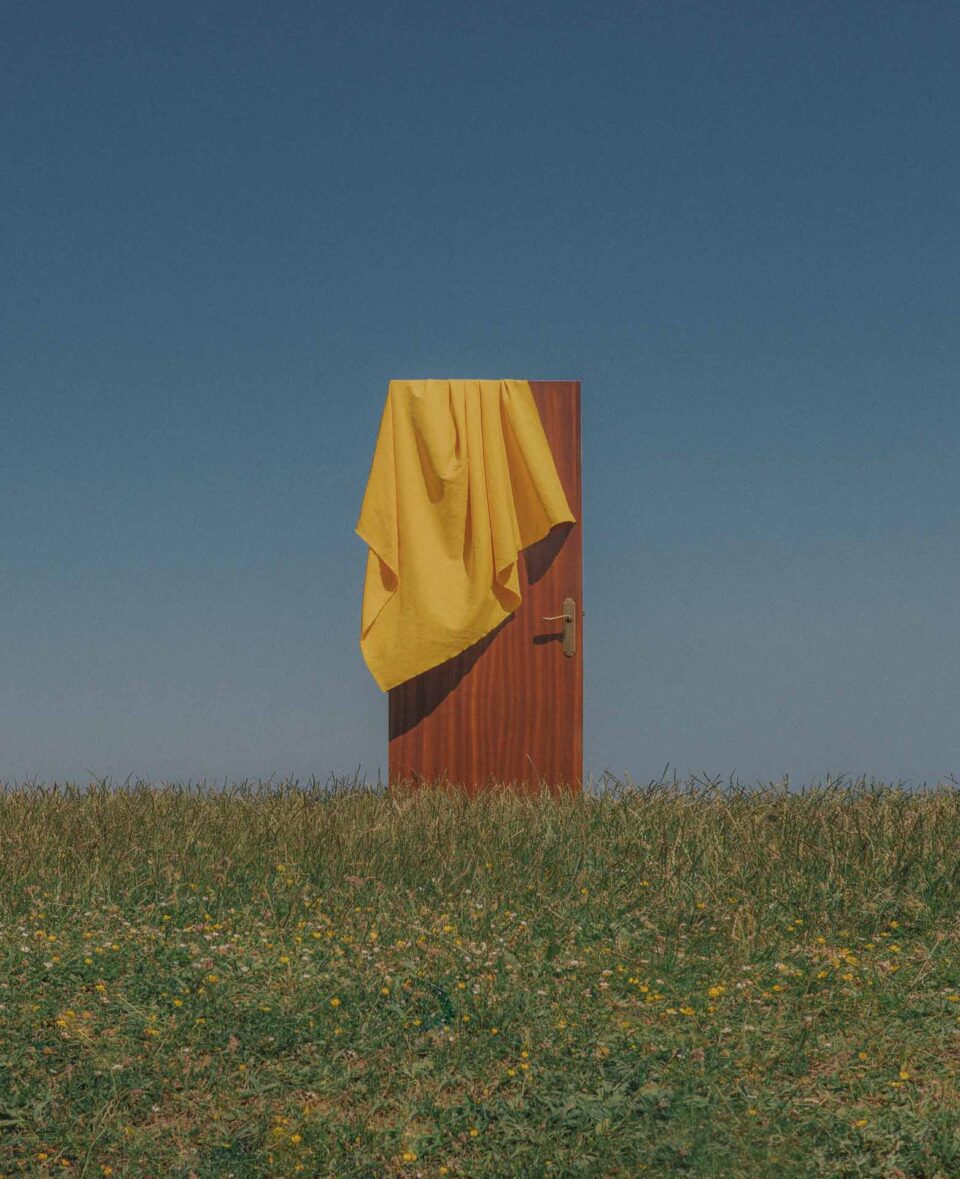
AB: It has always been my favourite colour, and my mother liked it too. I have been drawn to it ever since I was very little. I recall having a yellow coat that I absolutely loved. Although I also remember people saying that it is the colour of bad luck, at least here in Spain. But in terms of what it represents for me: it is about light, joy and warmth. That’s why I decided to use it as the guiding thread across the Pieza Madre series.
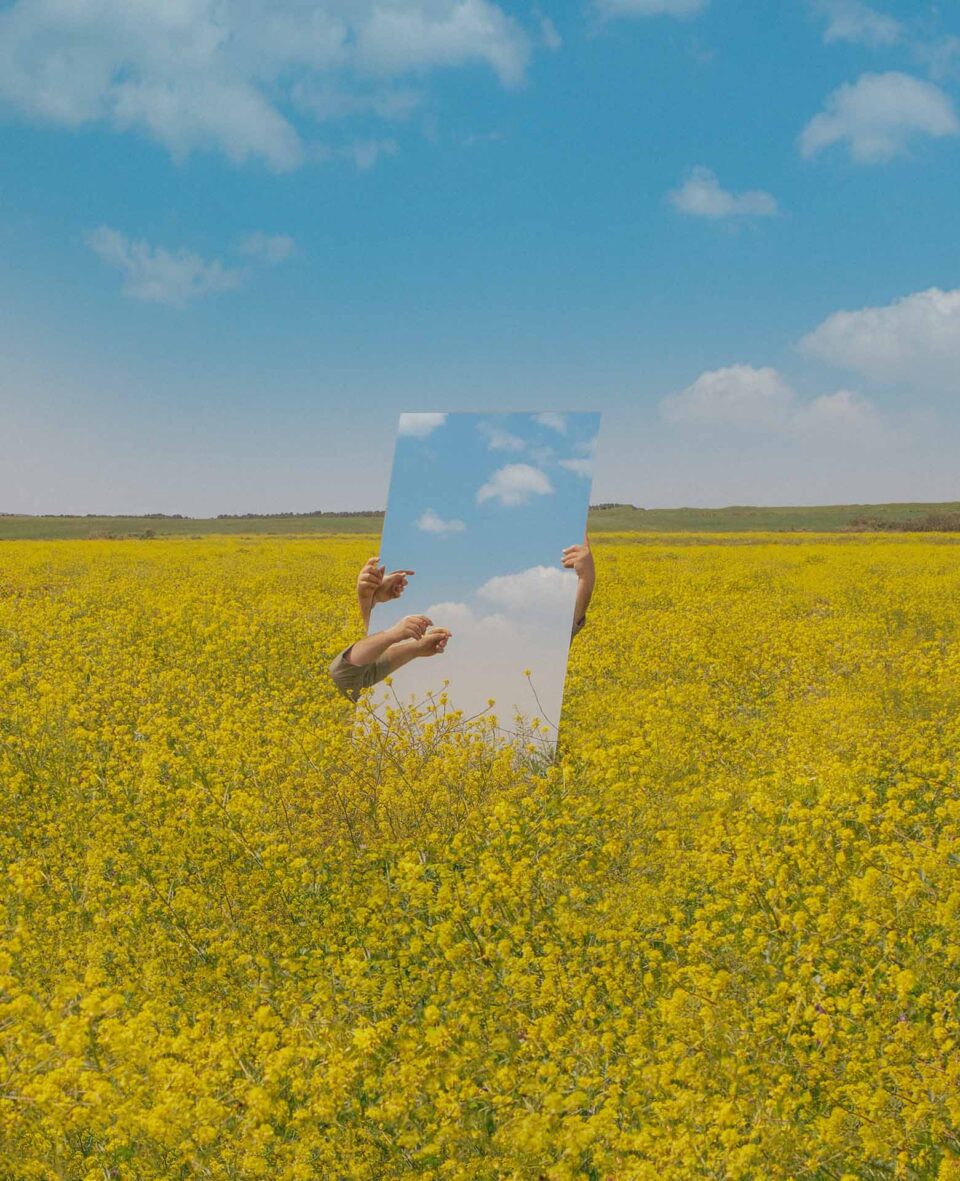
A: Doorways, mirrors, umbrellas, flags and plastic seats are woven into the compositions. What do these elements symbolise, and how do they relate to Ángeles’ story?
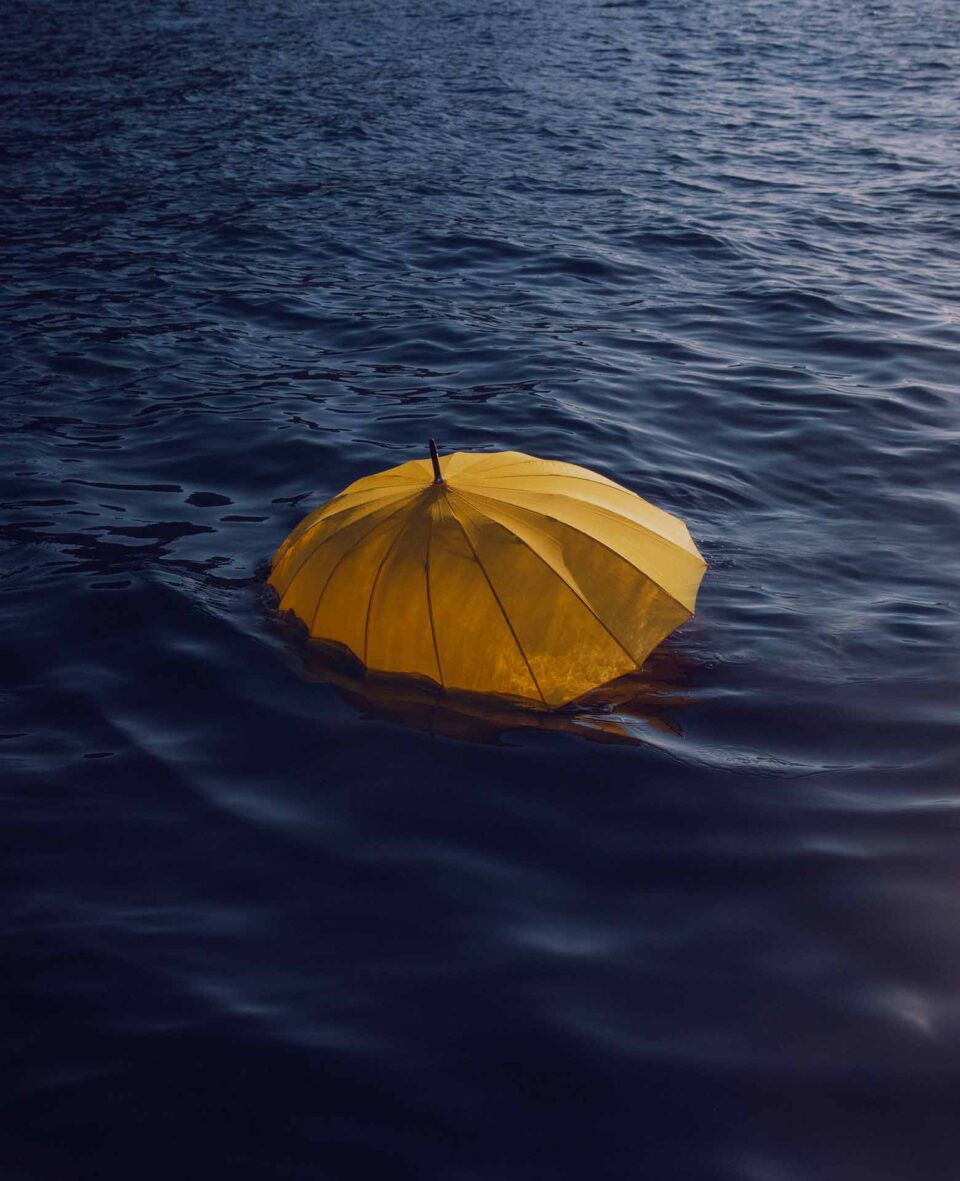
AB: These objects are tools for expression. The plastic chair, for instance, speaks about absence, but also about eternity. It’s a universal piece of furniture: affordable, durable and instantly recognisable. It’s such a familiar and popular design; we all have it somewhere in our collective memory. I wanted to reflect all of that. The umbrellas are another example. They refer to the storm my mother lived through for many years for different reasons. But they are also a reflection of the Basque weather: it rains a lot here, and so umbrellas are characteristic of our roots. The broken mirror, meanwhile, expresses a message that is very simple and relatable: it’s about not liking what you see, not feeling comfortable in your own skin and not accepting your body. These are everyday items I’ve filled with meaning to help communicate wider concepts.
A: The sea, coasts and waves are also key motifs throughout. What does water represent within this body of work?
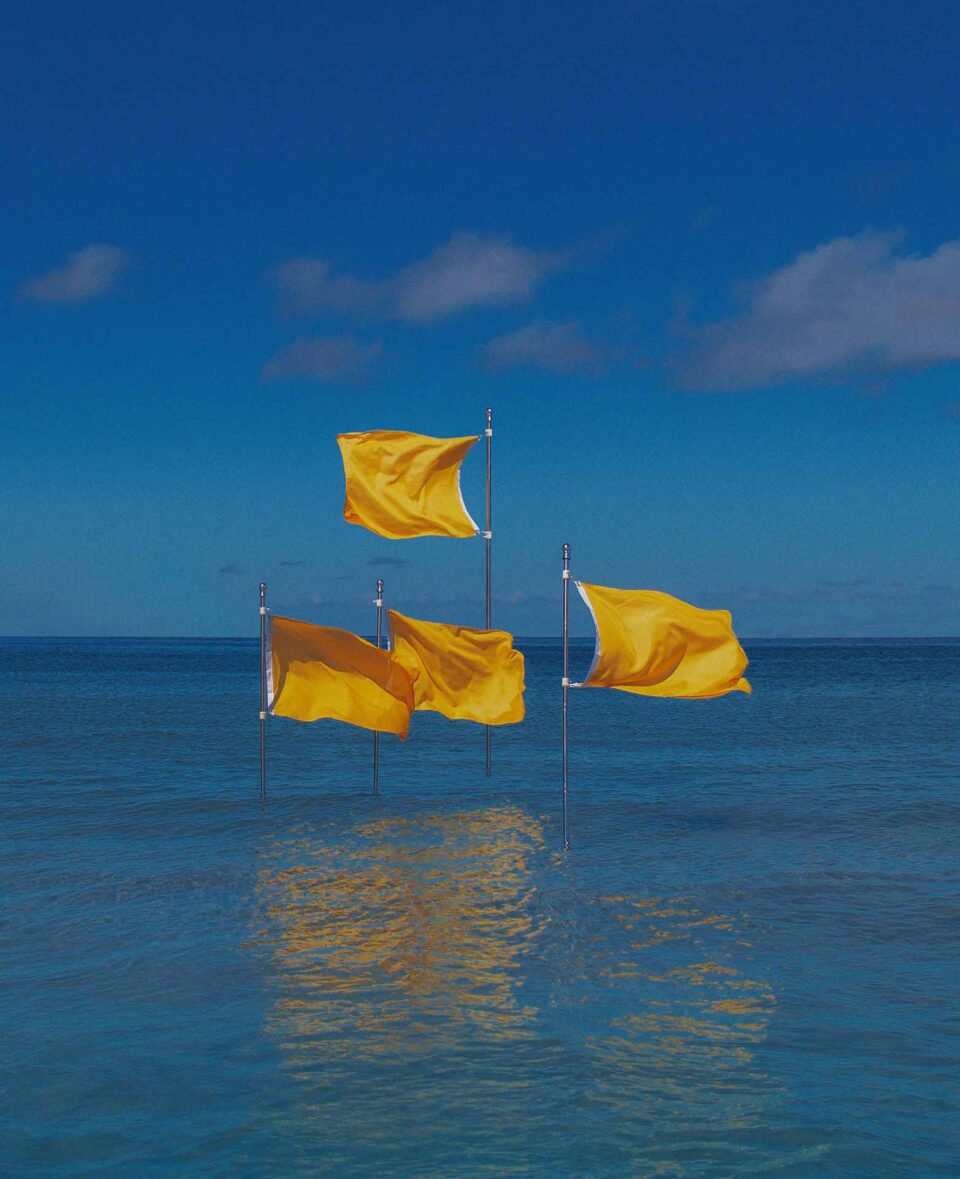
AB: It is part of our heritage. The Basque Country is a very special and incredibly beautiful place. I love it – its culture, gastronomy, character and language. We live by the sea – a very rough one – and so water is a key part of this narrative. My mother spent her whole life dealing with insecurities and feeling ashamed of not having a “normative” body. Even though she loved the water and swimming, she rarely did – because of the stares, the teasing, and not feeling comfortable in her own skin. The same thing happened to me. When I was a child, I dealt with mockery and a constant battle to lose weight. I eventually stopped swimming too, when I was around 14-years-old. But four years ago, I moved from Barcelona back to San Sebastián, after living there for 14 years. It is such a small city with three beaches, and so the sea is always present. I decided to start working with water and began to swim again. It was also another way to honour my mother. The waves here are wild, and I’ve used their movement as a metaphor to help me talk about strength, abysses and very deep emotions. Now, I’m addicted to the summer. The sea is also a form of therapy, and I feel like it heals me.
A: What makes the camera such a powerful tool for exploring themes of grief, memory and personal histories? AB: Photography has helped me express what I can’t put into words, and to tell a story visually. I think that’s where I feel most comfortable. It also allows viewers to understand the images in their own way. I love the idea that everyone can have their own interpretation of what they see. Some people look at the photographs and simply see something “beautiful,” and that’s great too. But the fact that those who want to dig deeper can find the real meaning fulfils me most of all.
A: Finally, what’s next for your practice? Are there any new projects or ideas you’re now beginning to explore? AB: It’s been three long years, and this time period had left me feeling a bit “empty” and sometimes lacking in inspiration. But since the Pieza Madre was published, I’ve felt that it’s done. I’ve closed that chapter, the mourning – and this book, ultimately. Right now, I’m starting to feel the urge to start telling stories again. It’s likely that my next project will focus on bullying. It’s a complex and delicate subject, but I believe I have a lot to say about it, and I would really like to do so.
Andoni Beristain | Pieza Madre | Setanta Books
setantabooks.com
Words: Eleanor Sutherland
Image credits:
1. Andoni Berstain, Umbrella, from the series Pieza Madre. Image courtesy of the artist.
2. Andoni Berstain, Door, from the series Pieza Madre. Image courtesy of the artist.
3. Andoni Berstain, Flower, from the series Pieza Madre. Image courtesy of the artist.
4. Andoni Berstain, Flags, from the series Pieza Madre. Image courtesy of the artist.
5. Andoni Berstain, Mirror, from the series Pieza Madre. Image courtesy of the artist


