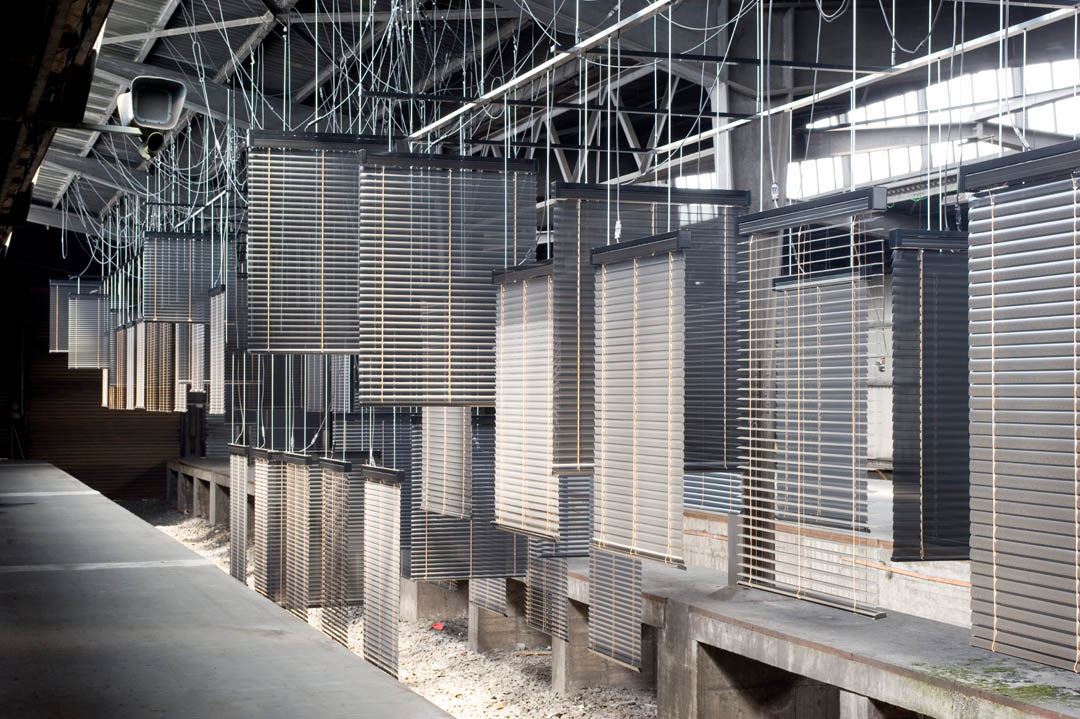
Site, movement and translation sit at the centre of Haegue Yang’s Through, a new commission at Dia Beacon that turns architecture into something active, unstable and lived. Across two levels, Yang brings light, sound, sculpture and movement into dialogue with migration, memory and the histories embedded in modernist form. Industrial fabrication meets folk craftsmanship; ancient philosophy meets the geometry of the factory; music becomes sculpture. The result is an exhibition concerned less with resolving oppositions than with allowing them to remain in productive tension. For Yang, abstraction is not a retreat from history but a means of carrying it – through materials, bodies, sounds and spaces that have crossed borders.
Dia Beacon is a charged setting for this enquiry. The former factory is closely associated with the development and preservation of the large-scale, process-led practices that transformed American art in the 1960s and 1970s, and Yang works directly against the sense of formal stability that this history can imply. Her installation occupies both levels of the building, using its changes in elevation, light and scale as part of the work rather than as a backdrop. Natural and artificial illumination, horizontal and vertical structures, and aerial and subterranean spaces become paired conditions through which the visitor moves. Jessica Morgan, Dia’s Nathalie de Gunzburg Director, notes that the institution has “long invited artists to respond to the scale, light conditions, and material presence” of its distinctive spaces. Yang proceeds to takes up that invitation while making the building answer to another set of histories.
Modernism, in this context, becomes less a period than a question. What appears universal from one position can look culturally specific from another, and Yang’s work makes that instability visible without abandoning the formal rigour of abstraction. The repeated unit, the manufactured component and the carefully organised grid remain, but they are subjected to sound, movement, mythology and colour. A louver can become architectural skin; a blind can become a sculptural landscape; light can behave as a material instead of merely illuminating one. Such shifts place Through within a wider contemporary appraisal of Minimalism, particularly among artists questioning the historical assumptions behind neutral forms. Yang, instead of rejecting that legacy opens it up, allowing other systems of thought to pass through.
Isang Yun gives the exhibition its deepest historical meaning. The Korean composer, whose life was marked by political violence and exile, has been an important figure in Yang’s practice for over a decade, and his 1968 quartet Images is woven through all four works at Dia Beacon. Yun’s composition draws on the Four Guardian Deities, while Yang translates its musical structures into colour, movement and sculptural form. Min Sun Jeon, the exhibition’s assistant curator, describes this as a “decade-long posthumous collaboration”, noting how Yun’s experiences of violence and exile became embedded within, but could also be obscured by, his music. That tension of presence and disappearance is crucial to Through: history is never presented as stability that can simply be retrieved, but as continually altered through transmission.
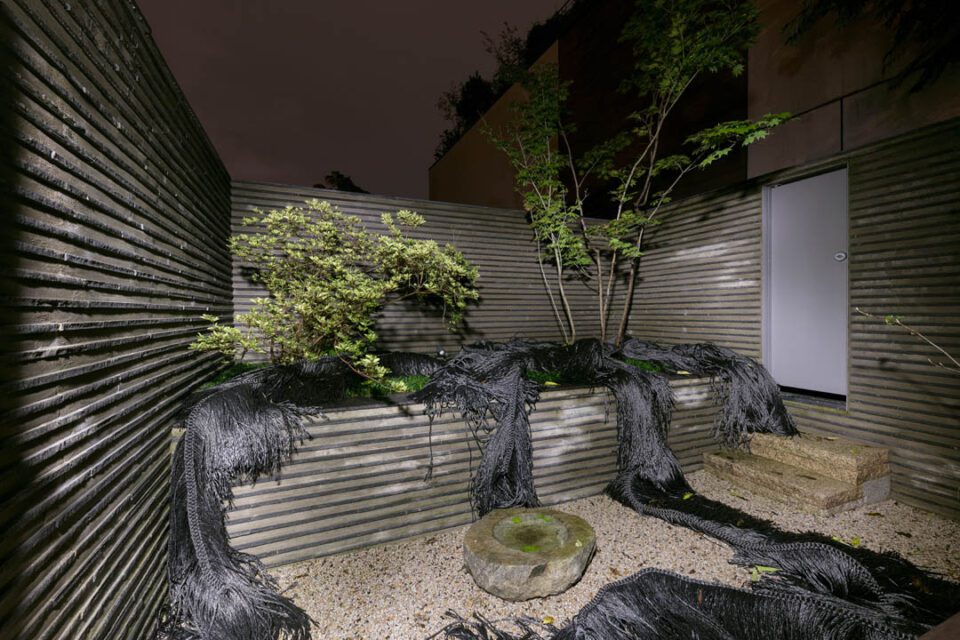
On the ground floor, Tidal Field transforms Venetian blinds into a dark, draped environment, replacing their familiar horizontal logic with curving forms that seem almost bodily. The object is still recognisable, but its ordinary function has been suspended. Privacy becomes opacity; architectural control becomes something fluid. Nearby, Fallen Field takes the imoogi – a mythical creature positioned between serpent and dragon – as its point of departure, its tentacular forms suggesting a state of perpetual becoming. Bells and light bulbs form Sonic Field, meanwhile, creating a landscape in which seeing and listening begin to overlap. Across these works, Yang makes familiar industrial materials strange without disguising what they are.
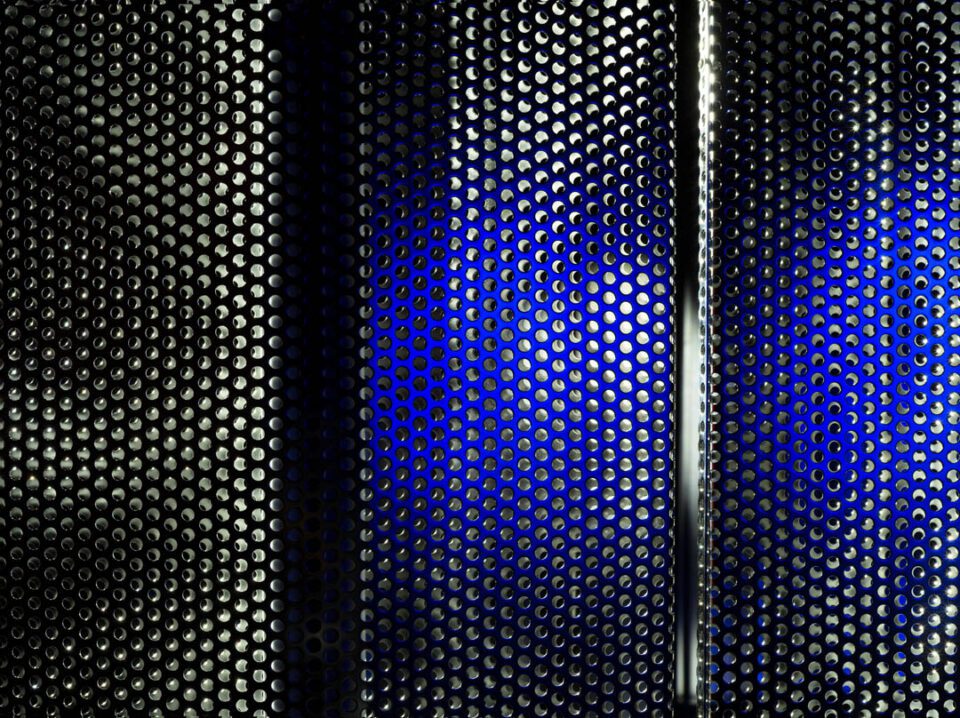
The lower level introduces another kind of movement. In Axial Flow, shuttering metal slats and choreographed lights are aligned with the architecture and keyed to the directional colours of the Five Phases theory, bringing an ancient East Asian philosophical system into direct contact with the industrial building. The effect is not decorative. Instead, another logic begins to organise the space, complicating the authority of the architectural grid. Yang’s use of movement is important here because it shifts the work away from the static object and towards experience: the installation changes as the viewer moves, while light and metal produce an environment that cannot be apprehended from one fixed position. Minimalism’s unit-based geometry remains present, but its apparent permanence is unsettled by the body.
That attention to material as something that carries history places Yang within a wider field of contemporary practice. Otobong Nkanga, for instance, has traced the movement of materials, people and resources through sculpture, textiles, performance and installation, repeatedly connecting the physical properties of objects to histories of extraction and circulation. Dineo Seshee Bopape similarly allows soil, clay, water, sound and found materials to carry memories that exceed their physical presence, bringing geological and political time into the same space. Yto Barrada’s work offers another route into the question, moving between photography, film, textiles and installation to consider migration, place and cultural translation. Their practices are markedly different, but they share an interest in matter as a form of knowledge – something that can record where it has been, what it has encountered and lost along the way.
This makes Yang’s relationship to craft particularly significant. Industrial production is often understood as the defining material language of modernity, while craft has historically been positioned as local, traditional or peripheral. Yang refuses that hierarchy, placing manufactured components alongside techniques and forms associated with folk traditions. The contrast is not simply visual; it raises questions about which kinds of making are granted historical authority. Within Through, the distinction between the machine-made and the handmade begins to feel increasingly unstable. Both become methods for transmitting knowledge, and both carry cultural associations that change when they are moved into a new context.
Carter and Jeon’s approach allows these connections to emerge without reducing the exhibition to a single explanatory framework. Carter describes Through as staging “dialogues between doubles”: transparent and opaque, aerial and subterranean, modern and prehistoric, minimal and maximal. The paired terms are useful precisely because the works never settle comfortably on one side of them. Dia’s long-term presentation also gives the project an unusual temporal aspect, encouraging visitors to return to the same materials and spaces instead of consuming the exhibition as a single visual encounter. Yun’s music, the shifting light and the movement between floors all contribute to this sense of duration. The exhibition must be experienced over time because its subject is, in part, how meaning changes as things move through time.
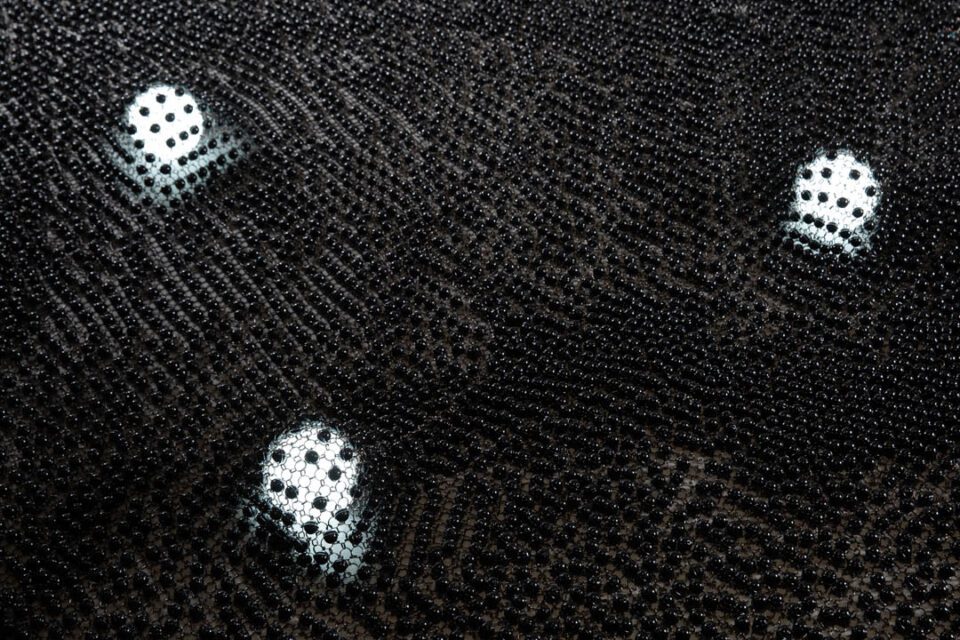
What emerges is a grasp of migration that extends beyond biography or geography. Yang is interested in what happens when an idea, material or form leaves its original context and acquires another meaning. Yun’s music becomes sculpture; Chinese cosmology enters an American industrial building; Venetian blinds become an abstract landscape; a mythical creature becomes a contemporary installation. None of these translations is seamless. Their friction is precisely what makes them productive, revealing the assumptions attached to objects and ideas when they move between cultures. In this sense, Through treats displacement not simply as a condition of loss but as a process through which new relationships can be formed.
Through asks how a modernist space might accommodate histories that were never contained within its original vocabulary. Yang’s answer is neither to erase that history nor to place an alternative tradition alongside it as an illustrative counterpart. Instead, she makes the systems collide: factory architecture meets Five Phases theory, Minimalist geometry meets myth, experimental composition meets sculpture, and industrial materials acquire another life through movement and sound. Carter goes on to describe the resulting experience as an “unfolding drama across time and space”, and the phrase captures something distinctively essential about the project. Through approaches modernism as a living passage – one in which architecture, artwork and viewer continually shift into new relationships.
Haegue Yang: Through is at Dia Beacon, New York, from 10 October.
Words: Anna Muller
Image Credits:
1. Haegue Yang, Approaching: Choreography Engineered in Never-Past Tens, 2012. Installation view, Documenta, Kassel, Germany, 2012. Photo: Nils Klinger
2. Haegue Yang, Axial Flow (detail), 2026. © Haegue Yang. Photo: Bill Jacobson Studio, New York, courtesy Dia Art Foundation
3. Haegue Yang, The Intermediate – Seven- Legged Carbonous Male Imoogi, 2023. Installation view, Haegue Yang: Latent Dwelling, Kukje Gallery, Seoul, 2023. Photo: Chunho An
4. Haegue Yang, Sonic Field, 2026 (detail). Courtesy of the artist. © Haegue Yang