

Chitra Ganesh’s Journey to the Great Below at Baltic Centre for Contemporary Art, Gateshead, is an exhibition of impressive scope and scale. It is the artist’s first substantial solo show in the UK and a significant undertaking. Ganesh is ambitious, filling a sizeable space with an array of multi-disciplinary and multi-media artworks, ranging from paintings, sculpture and collage, to animation and immersive installation. Ganesh weaves specific themes including mythology, female and queer discursive landscapes, speculative futures, South Asian histories and interrogations of power. These ideas have emerged from Ganesh’s studies in semiotics, literature and art practice, through which she has accumulated a distinctive knowledge bank and a recognisable aesthetic. She harnesses these here to create layers of narrative, access and applicability, forming a response to the contemporary world.
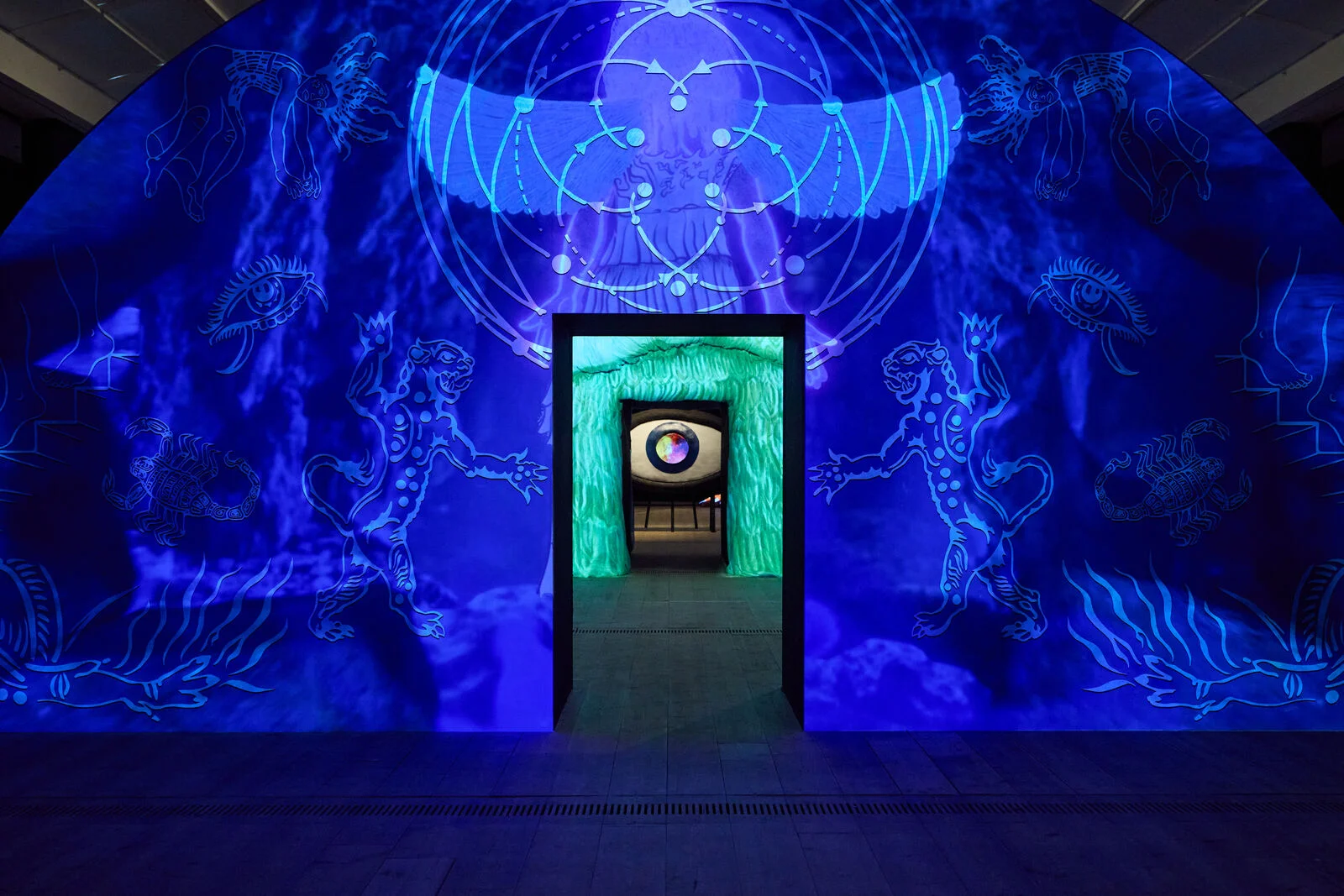
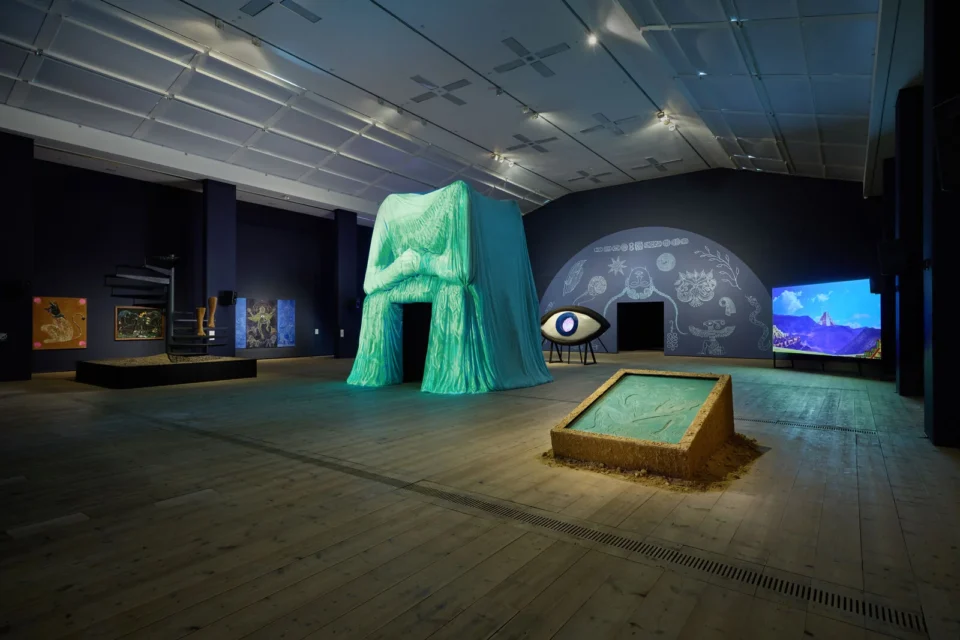
An imposing arch greets those who enter the space, with animal figures, symbols and a projected images creating a sense of push and pull. The arch is somewhat mirrored on the far wall, with the mural-style Untitled (wall drawing) (2026), based on a reinterpretation of the Disk of Enheduanna (c.2300 BCE), connecting with the mythical story of the goddess Inanna from Mesopotamia (1900-1600 BCE). It is blended with a Medusa-style head, inspired by a specific depiction in the Basilica Cistern in Istanbul (circa 600 CE). Throughout, Ganesh reworks historical references into interconnected visual narratives. Upon superficial observation, circular shapes resonate with the life cycle, speaking to cultures across time, space and religions; articulations of the human form depict strength and fragility; and reinterpretations of archaeological contexts speak of a past that we all variously emerge from. This is a story of humanity.
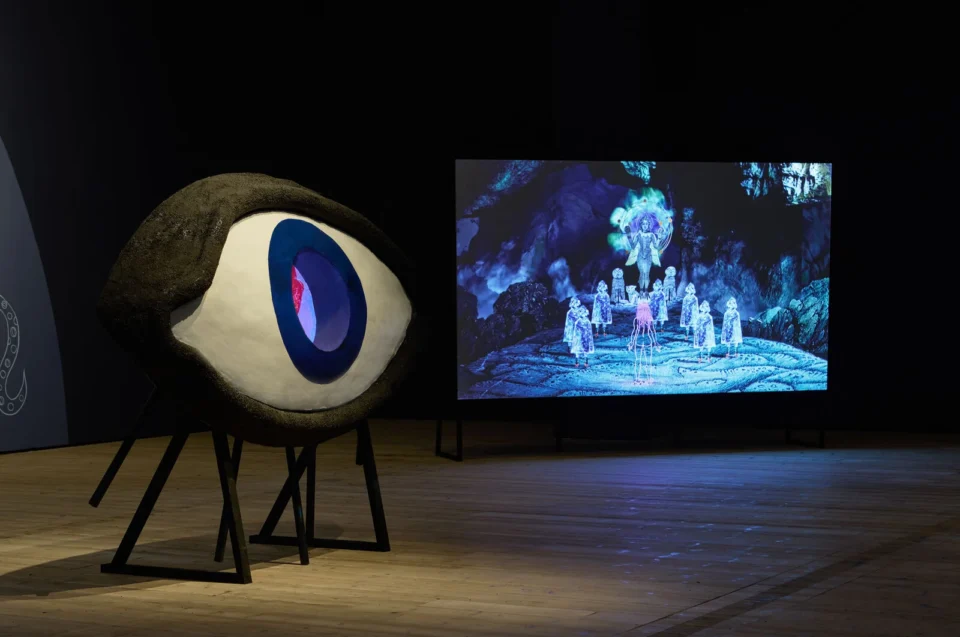
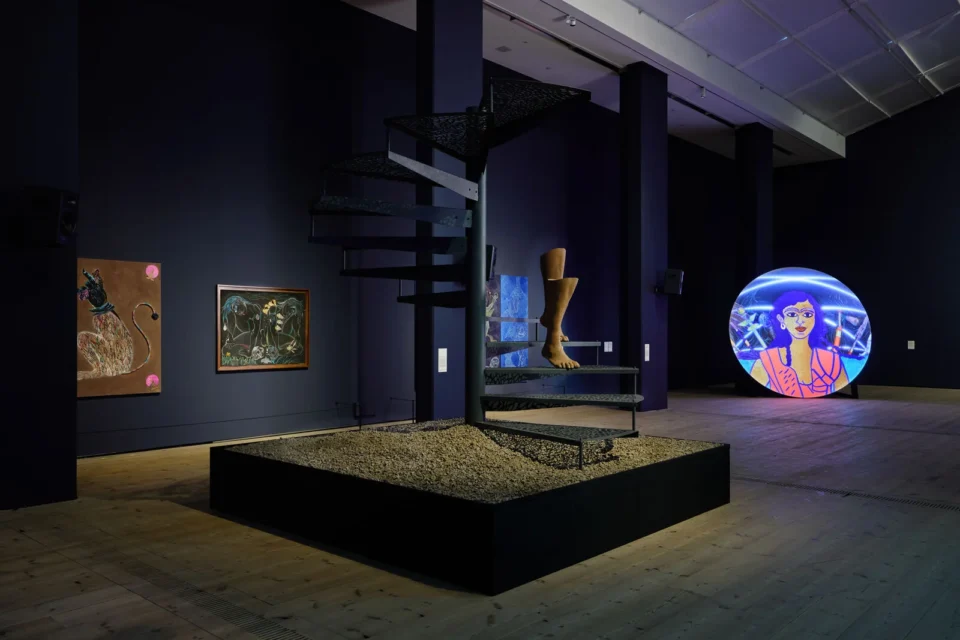
The new animation Journey to the Great Below explores what is presented as the earliest recorded myth that emerged from Mesopotamia (Iraq) around 1900-1600 BCE, The Descent of Inanna into the Underworld. Two large-scale screens operate as standalone pieces showing vibrant animations. The story follows the goddess Inanna (otherwise referred to as the Queen of Heaven), as she journeys through the underworld. She is focused on coming face-to-face with her formidable sister Ereshkigal (Queen of the Underworld), before rising back to the “surface.” The polarising forces of good and evil, light and dark, are recognisable, as are the various diverse cultural iterations of this story. Ganesh seeks to harness this power to convey the potential for change, evolution and strength in times of adversity. The story depicts a rise from the darkness into hope. It is an appealing message and perhaps something to strive for.
In another section of the exhibition, Memories of the Fugue State (2024) consists of nine relief prints on Okaware paper. Emerging from the artist’s imagination, the works similarly highlight the way we can all be remade, re-articulated, re-imagined – often drawing on a mythical and futuristic visual language. Themes of nature, figural depictions and emotive experiences are variously explored within the prints. We are welcomed into Ganesh’s mind, arguably seeking clarity. Yet we are also invited to reimagine our own dream-like, un-directed sense of self and the imaginative possibilities that emerge from uncertainty.
Twelve comic-style digital prints titled Multiverse Dreaming (2020-21) represent similar ruminations that Ganesh relates in part to the Covid-19 pandemic, emphasising the potential for collective dreaming of alternative worlds. These works foreground female identity and queer experience, with a breadth of visual associations including tarot, underpinned with ideas of psychology and psychic exploration, among other motifs that investigate the meaning of life and the human condition.
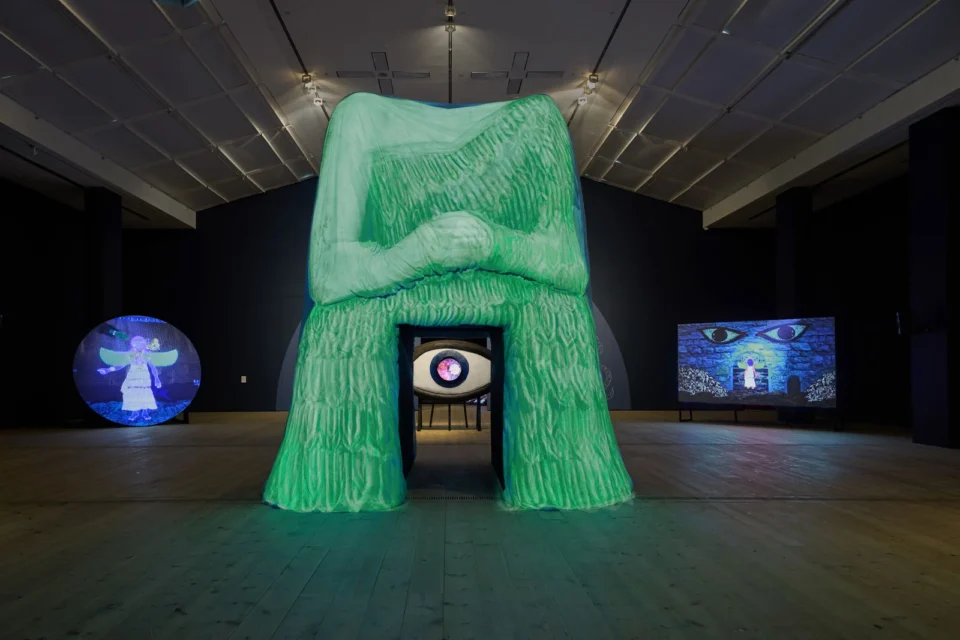
Bodily forms are a connecting strand within the exhibition. Ganesh’s sculpture Votive Figure (2026) is inspired by a figurine from the collection in the Iraq Museum in Baghdad, depicting a female Sumerian worshipper in connection with the Temple of Inanna. Yet in this instance there is no head: a metaphor for the various disappearances of artefacts, whilst also alluding to a gate to pass through, like Inanna’s journey to the underworld. It is also easy to project other associations with monuments, with this piece acting like a sci-fi Arc de Triomphe. There is a strange visual resonance with Christo and Jean-Claude’s Arc de Triomphe, Wrapped (1961-2021), for example, in part due to the materiality of its draped fabric and projections.
The line of sight from the entrance to the gallery draws you towards a large eye. Viewers can walk beneath the arch and Votive Figure (2026) to approach it. Cosmic Eye (2026) is inspired by a Sumerian eye inlay (c. 2600-2500 BCE) featured in the collection of The Metropolitan Museum of Art in New York. The piece is presented as a portal, implying a sense of transformation and escapism. Despite the artworks not being available to touch, visitors are to be observed grasping into the eye – a powerful metaphor for our desire to reach towards the depths of the human condition, listening to some deep-rooted instinct.
The sculptural work Descent (2026) specifically focuses on the journey that features within the mythic story of the goddess Inanna. The detailed pattern on the staircase mimics reptilian skin, alluding to the stripping away aspects of selfhood on a passage downwards. A pair of feet act as a stand-in for Inanna enroute to the underworld. Whilst unmentioned within the exhibition, there is resonance here with other narratives, such as Adam and Eve in the Bible, and Eve’s encounter with the snake representing descent into evil. Here again, Ganesh invites audiences to re-think meaning-making, belief systems and narrative.
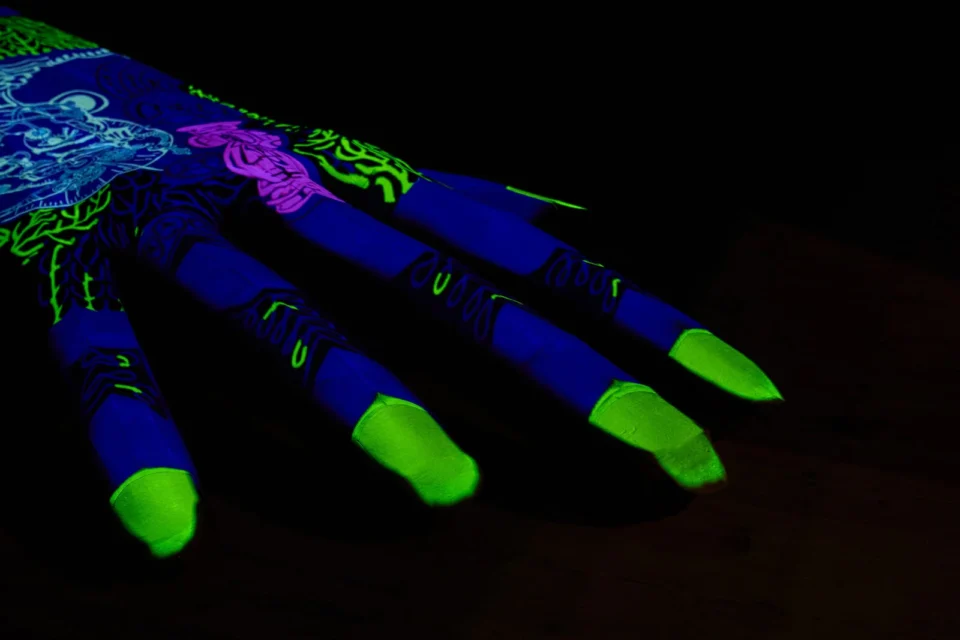
Ganesh’s own body forms the basis of the sculpture Manuscript (2018), which acts as an experiential insight into the artist’s visit to the Ajanta and Ellora caves in India. Set back in a separate room, it is reliant on darkness: a single-channel video projects neon details onto a giant hand, constructed from aluminium and raw silk. The work incorporates specific Indian cultural traditions of tattooing and Mehndi designs, blended with an array of futuristic symbols. The potential for reformulating and repurposing narratives is evident.
Elsewhere, viewers will encounter Rebirth (2026), another newly commissioned work. It based on a historical Cypriot artefact in the collection of The Walters Museum, Baltimore, which depicts birth, the female figure and identity. In response, Ganesh has created a large-scale wax seal sculptural interpretation of Ereshkigal, connecting this piece with the myth detailed in the titular animation.
Where execution in some of the collages appears less convincing, their unresolved nature remain part of an exhibition that masters concept, narrative and connectivity. Ganesh’s ability to create a discursive series is compelling. She is a genius in layered storytelling, whilst maintaining a connected body of work. Moreover, Journey to the Great Below offers nuanced forms of audience engagement. The physical scale, lighting, colourways and immersive nature of the sculptures provide a fantastical form of escapism.
This show is underpinned by a feeling of hope and strength against the odds, which feels needed in today’s conditions of crisis – emerging from geopolitical tensions, war, violence and environmental disaster. Ganesh harnesses the power of semiotics and narrative to convey the universality of the human condition, arguably creating a sense of connection and empathy in our fractured contemporary landscape.
Chitra Ganesh: Journey to the Great Below is at Baltic Centre for Contemporary Art, Gateshead until 17 January 2027: baltic.art
Words: Dr Gabrielle Barkess-Kerr
Image Credits:
All images: Chitra Ganesh: Journey to the Great Below (installation view), Baltic Centre for Contemporary Art, Gateshead, 2026. Photo: Tom Carter © 2026 Tom Carter & Baltic.


