Museums are sites of cultural and ecological negotiation. Beyond their traditional roles as spaces of preservation and display, institutions are increasingly confronting questions of environmental responsibility, collective knowledge and public engagement. Cecilia Vicuña’s forthcoming exhibition at the Museum of Contemporary Art, Los Angeles (MOCA), brings these concerns into focus, exploring how art might reconnect ancestral knowledge with the fragile relationships between human communities and the natural world. Opening on 15 November 2026, The Dream of Water: Quipu of Encounters Maricunga considers what cultural institutions can contribute to debates about environmental destruction, memory and collective responsibility. Its premise also speaks to a wider shift in the museum landscape, where the emphasis is moving beyond the display of objects towards experiences that invite audiences to engage with urgent cultural and political questions.
Across the international art world, new institutions are reconsidering how architecture, technology and interdisciplinary programming shape the relationship between audiences and cultural experience. BRUSK in Bruges and Dublin’s International Centre for the Image reflect an interest in expanding the ways contemporary art and visual culture are presented, while V&A East Museum in London, the Tashkent Centre for Contemporary Arts in Uzbekistan and the Lucas Museum of Narrative Art in Los Angeles each bring different histories and disciplines into the institutional conversation. Their approaches vary, from design and fashion to contemporary artistic practice and popular visual storytelling, but share an ambition to reach audiences beyond established definitions of art and cultural heritage. Such developments suggest that museums are responding to expectations for more accessible, participatory and experiential encounters. However, the value of this expansion cannot be measured by novelty or spectacle alone; the more important question is whether these experiences deepen understanding and create space for perspectives that institutions have historically overlooked.
Environmental crisis demands precisely this kind of critical engagement. Its causes and consequences cannot be understood through images of damaged landscapes alone, but require attention to the political, historical and cultural structures that determine how natural resources are used, controlled and distributed. Art can make these structures perceptible by bringing scientific knowledge into contact with lived experience, collective memory and forms of understanding that have frequently been marginalised. Vicuña’s exhibition approaches this challenge through water, connecting ecological vulnerability with the preservation of ancestral knowledge. Born in Santiago de Chile in 1948, the artist has developed a multidisciplinary practice spanning poetry, sculpture, film and performance, consistently bringing artistic production into dialogue with activism and Indigenous cultural traditions.
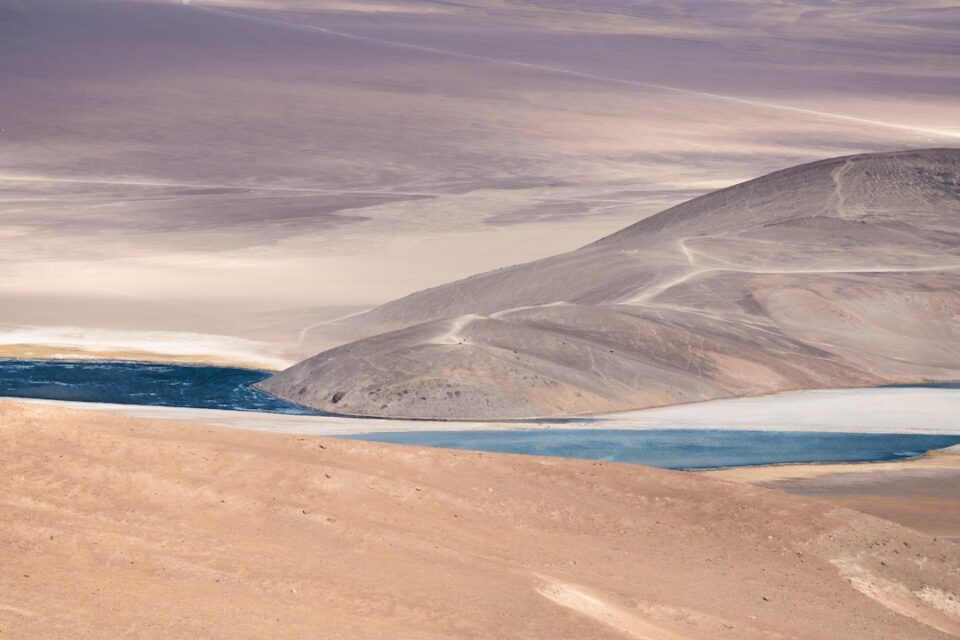
Central to this practice is the quipu, an ancient Andean system of knotted cords historically used for recording information and communicating messages. Vicuña reimagines this form not as an artefact to be reconstructed, but as a living language through which relationships between people, landscapes and histories might be recovered. Its knots suggest connection, while its absences evoke knowledge and cultural systems disrupted by colonialism and the passage of time. The political implications of this approach become particularly apparent in the exhibition’s focus on the Maricunga Salt Flats, situated in the southern Atacama Desert. High-Andean lagoons and salt flats support diverse microbial communities, plants and wildlife, including parinas, or Andean flamingos.
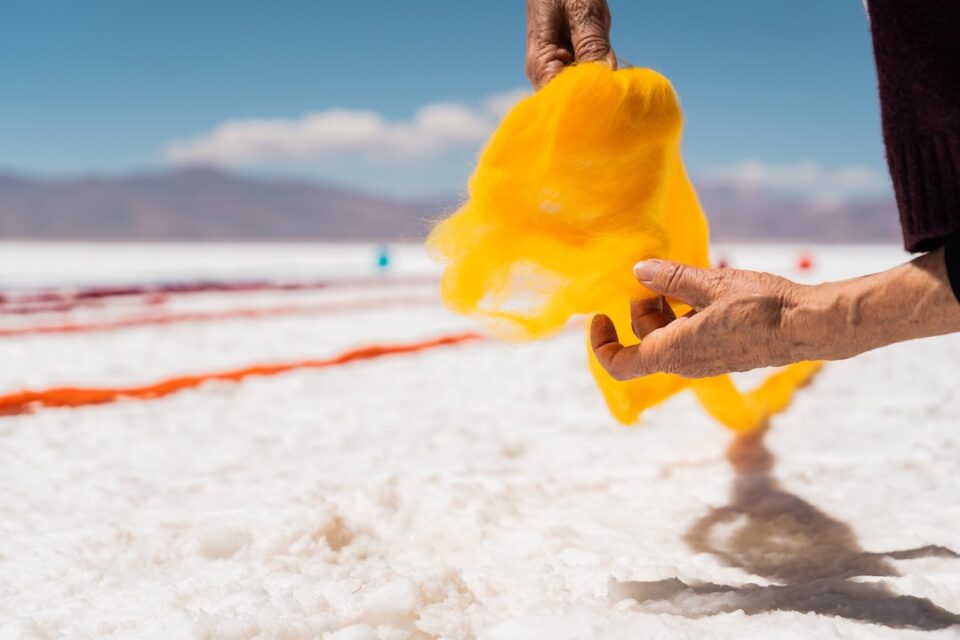
The territory also forms part of the ancestral lands of the Indigenous Colla people, for whom the landscape holds sacred significance. These interconnected ecosystems now face increasing pressure from lithium extraction, an industry whose water-intensive processes intensify competition for an already scarce resource. Vicuña’s attention to Maricunga therefore extends beyond documenting environmental damage; it challenges the understanding of landscape as an economic resource, detached from the ecological, cultural and spiritual relationships that sustain it. At the centre of the exhibition, Parina Quipu (2026) translates these concerns into a striking sculptural form. Suspended in MOCA’s tallest gallery, the work is constructed from unspun wool sheared by artisans in the Cauquenes region of southern Chile and naturally dyed in vivid shades of pink.
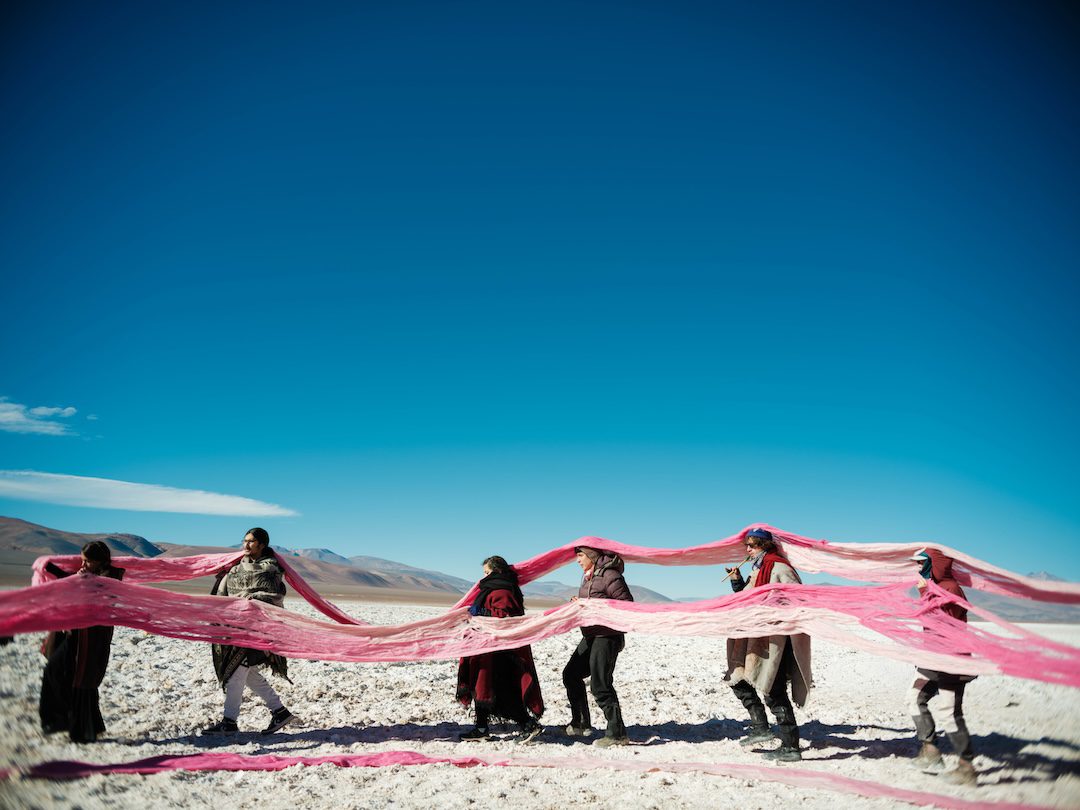
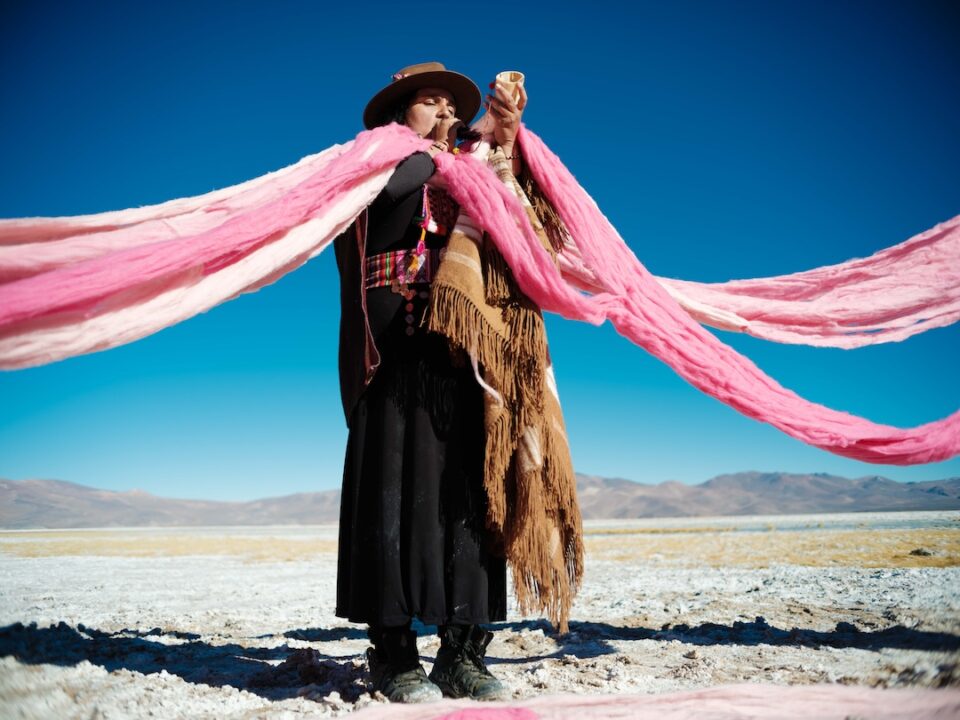
The colour recalls the plumage of the Andean flamingo, whose habitat is threatened by changing conditions in the salt flats. Smaller sections of yellow, green, orange, purple, black, brown and grey introduce further variations across the suspended structure, suggesting an intricate network of relationships. Wool carries its own histories of labour, land and traditional making, giving the sculpture a material connection to the communities and environments that inform the project. An adjacent gallery develops this relationship through Salar de Maricunga Quipu de Encuentro (2026), a five-channel video installation assembled from footage recorded during Vicuña’s visits to the region in December 2025 and May 2026. Moving between dusk and dawn, the images register the landscape’s biodiversity, from microscopic organisms to the expanses of desert and high-altitude lagoons.
Rather than following a conventional documentary narrative, the installation allows different images and perspectives to coexist, encouraging a more attentive encounter with the environment. It also records two rituals involving the artist and collaborators from scientific, artistic and activist communities, alongside members of the Colla people. Their participation places shared knowledge at the heart of the work, resisting the idea that environmental understanding belongs to any single discipline or authority. Sound introduces another dimension to this encounter. British musician Cosmo Sheldrake has composed Canto de Maricunga (2026), a polyphonic sound poem incorporating underwater recordings, cosmic radio waves and field recordings gathered during the project.
These elements combine with Vicuña’s chants, the voices of ritual participants and performances by Chilean ensemble La Chimuchina, whose instrumentation draws on ancestral Andean musical traditions. The composition moves between human and non-human registers, bringing scientific observation into contact with ceremonial expression. Listening becomes an essential part of the exhibition’s engagement with place, extending its attention beyond what can be seen towards the less immediately perceptible life of an ecosystem. This emphasis on collective experience also belongs to a longer history of Vicuña’s artistic practice. Since the 1960s, she has developed actions involving communities and publics in museums and natural environments, using the quipu as a framework for shared encounters.
Previous projects have taken place around glaciers in Chile, at the Solomon R. Guggenheim Museum in New York and at London’s Tate Modern, among other international venues. These Living Quipus challenge the conventional understanding of an artwork as a self-contained object, locating its meaning instead in participation, exchange and the relationships formed through its making. Collective experience is not an additional programme surrounding the artwork, but an artistic proposition, through which memory and cultural knowledge become active. At MOCA, the curatorial approach places this proposition within a wider institutional context. Organised by Senior Curator José Luis Blondet, with Curatorial Assistant Ariana Rizo and Kelsey Shell, the museum’s Environmental and Sustainability Strategist, the exhibition brings artistic, ecological and curatorial perspectives into conversation.
Blondet identifies the quipu’s metaphorical significance as central to understanding Vicuña’s practice, observing: “As a poet, Vicuña is less concerned with the quipu’s archaeological dimension than with its endless metaphorical power.” His comment distinguishes between preserving the past as an object of study and recognising ancestral knowledge as something capable of shaping contemporary thought. Chief Curator and Director of Curatorial Affairs Clara Kim similarly describes Vicuña’s practice as “a living act of listening”, emphasising its capacity to connect communities and landscapes through poetry and action. This relationship between artistic research and institutional responsibility will continue beyond the exhibition’s initial presentation. In spring 2027, Vicuña will convene a further Quipu of Encounters at MOCA, bringing together artists, activists, scientists and water defenders from across the Los Angeles basin.
Conceived as a counterpart to the encounters in Maricunga, the gathering will establish a dialogue between two territories confronting distinct but interconnected water crises. The geographical distance between Chile and California offers a way to consider how questions of access, extraction and environmental justice extend across national boundaries, whilst remaining rooted in communities and histories. A forthcoming illustrated catalogue, featuring a conversation between Vicuña and UCLA professor Elizabeth DeLoughrey alongside contributions from the artist’s advisers, will further develop the project’s engagement with environmental and cultural discourse. The exhibition also invites a more critical consideration of the museum itself. Institutions increasingly use the language of participation, accessibility and community, but these ambitions are meaningful only when they address who is represented, whose knowledge is valued and who has the authority to shape the conversation.
Vicuña’s project makes these questions particularly pertinent because its subject cannot be separated from the political conditions affecting the people and ecosystems of Maricunga. The involvement of scientists, artists, filmmakers, activists and Colla participants establishes a plurality of perspectives, while raising the distinction between representing a community and creating the conditions for its knowledge to be heard. This is where the exhibition’s institutional ambitions become most significant: environmental responsibility cannot be reduced to a theme or aesthetic but must involve engagement with the systems and interests that produce ecological harm. Through the quipu, Vicuña proposes a way of understanding the world in which knowledge is held not only in written histories or institutional archives, but also in materials, rituals, landscapes and relationships. Her work asks what contemporary culture might recover by taking these forms of knowledge seriously, particularly as environmental exploitation continues to threaten the communities and ecosystems that sustain them.
For museums seeking a more meaningful relationship with their audiences, the proposition is both artistic and institutional: participation must involve listening, and experience must make room for critical understanding. The exhibition resists the tendency to turn ecological crisis into spectacle, instead asking viewers to consider the histories and relationships that are often obscured by the language of progress and resource extraction. Water becomes the thread connecting these ideas, carrying histories of loss while insisting on the possibility of different futures. Vicuña’s work ultimately suggests that the task of art is not simply to make environmental destruction visible, but to help imagine other ways of living with nature.
Cecilia Vicuña, The Dream of Water: Quipu of Encounters Maricunga
The Museum of Contemporary Art, Los Angeles, from 15 November – 6 June.
Words: Anna Müller
Image Credits:
1. Cecilia Vicuña, Quipu de encuentro Maricunga, 2025-26, ritual performance, Atacama, Chile. Photo: Nicolas Amaro.
2. Cecilia Vicuña, Quipu de encuentro Maricunga, 2025-26, ritual performance, Atacama, Chile. Photo: David Cossio Sánchez.
3. Cecilia Vicuña, Quipu de encuentro Maricunga, 2025-26, ritual performance, Atacama, Chile. Photo: David Cossio Sánchez.
4. Cecilia Vicuña, Quipu de encuentro Maricunga, 2025-26, ritual performance, Atacama, Chile. Photo: Nicolas Amaro.