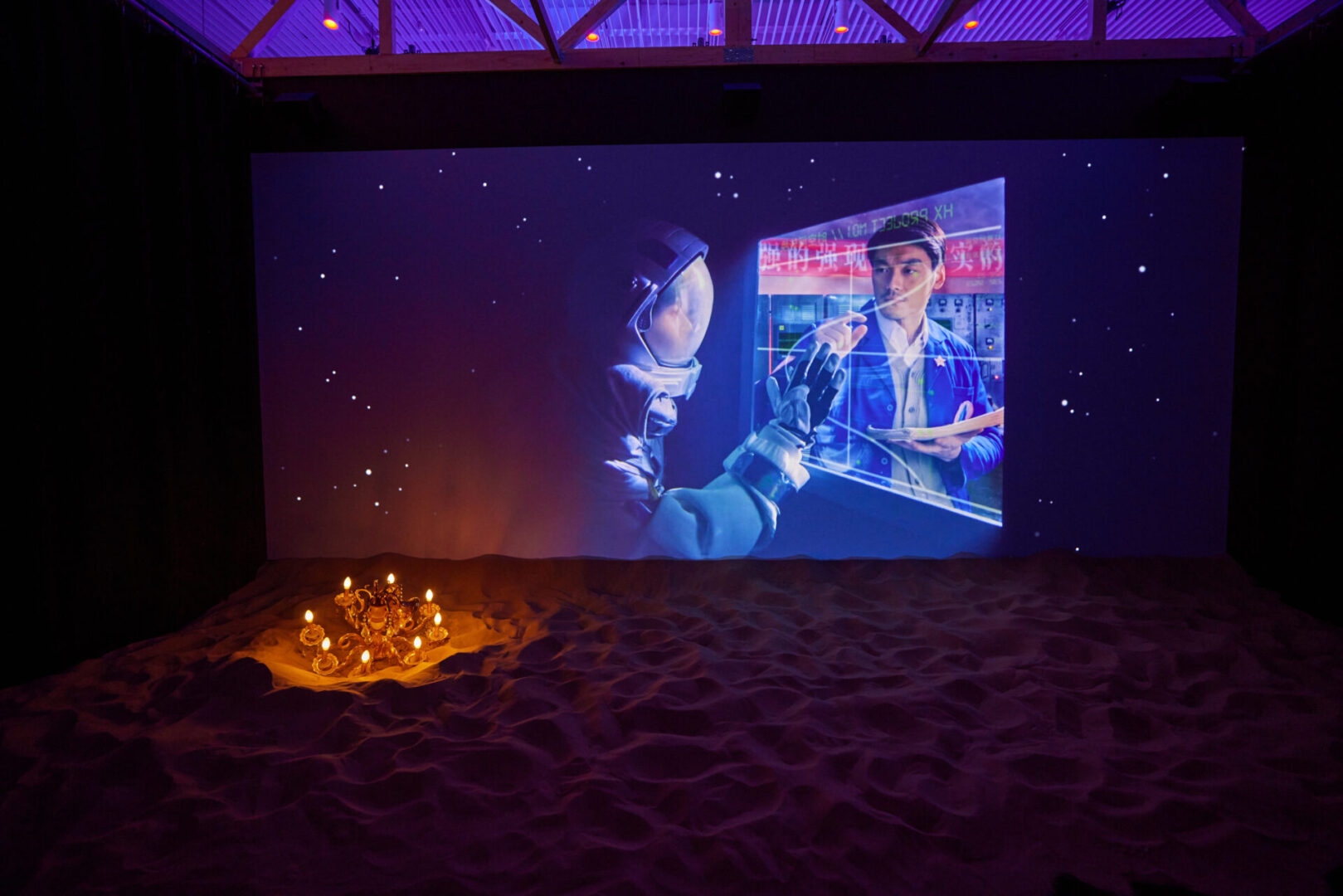
Cao Fei has spent two decades imagining what happens when the future arrives before we are ready for it. Factories become stages for private fantasies; virtual cities acquire the contradictions of real ones; abandoned buildings become portals into technological memory. Across film, gaming, installation and digital worlds, her practice asks what remains of human desire when the systems around us are continually being rebuilt. Her forthcoming exhibition at Hayward Gallery, the largest UK presentation of her work to date, brings these concerns into focus at a moment when artificial intelligence, automation and virtual life are no longer just speculative ideas but part of the texture of everyday human experience.
Technology, for Cao, is never simply a matter of machines. It is bound up with labour, identity and memory – with how people spend their time, how they imagine themselves and what they carry forward when a city or industry changes. Born in Guangzhou in 1978, she developed her practice during a period of profound economic and social transformation in China, but her work has never been confined to documenting those changes. Instead, she moves between the factual and the fantastical, finding ways to make large-scale shifts feel intimate. Yung Ma, Senior Curator at Hayward Gallery, describes her practice as one that “straddles immediate realities and speculative futures”, moving between “the real, the fantastical and the virtual”. That elasticity is vital to grasping why works made 20 years ago can still feel close to the present.
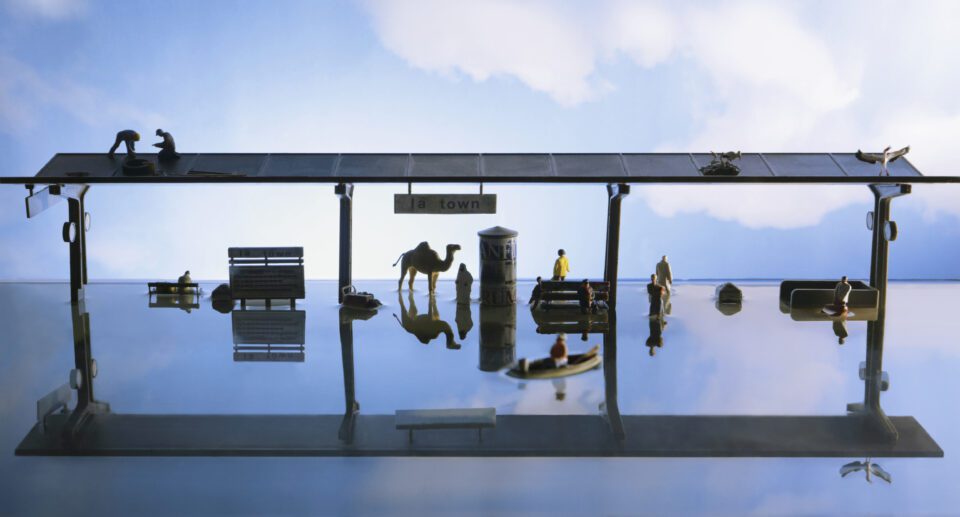
Labour is where this becomes most apparent. In Whose Utopia (2006), Cao filmed workers inside a lightbulb factory with sequences revealing their personal dreams and fantasies. The contrast is simple but powerful: the repetitive movements required by industrial production sit beside dancing, music and imagined escape. Instead of presenting the factory as a symbol of alienation, Cao makes room for the lives taking place in it. Her workers are not anonymous bodies in an economic system; they have desires that exceed the roles assigned to them. The work as a result sits in a wider history of artists examining labour and automation, including Harun Farocki, whose films repeatedly considered how images, machines and systems organise human activity. Cao shares Farocki’s interest in the machinery of work, but her focus on fantasy gives the subject a different register – one in which imagination becomes a quiet form of resistance.
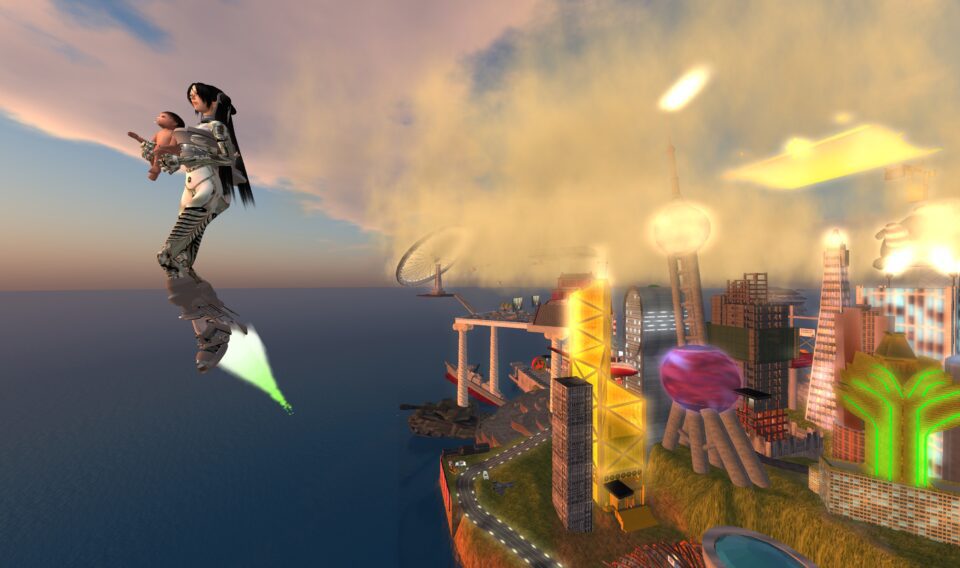
That idea of escape takes a very different form in RMB City (2007–2011). Created within the online platform Second Life through Cao’s avatar China Tracy, the project imagined a virtual metropolis populated by architecture, characters and events that could be shaped by its participants. At the time, such a project could still be approached as a glimpse of a strange digital future; now, its questions feel considerably less remote. Online identities, virtual economies and simulated spaces have become ordinary parts of social life, while the language of the metaverse has entered mainstream culture and then, in many cases, receded again. RMB City is interesting because it has acquired this historical distance. Its imagined future has become a kind of digital past, showing us how quickly technology can move from novelty to infrastructure.
The figure of the avatar appears earlier in Cao’s work, notably in Cosplayers (2004), which follows young people adopting fictional identities in everyday urban environments. Here, performance becomes a way of testing the self not dressing up as someone else. Cao was already interested in a question that is central to debates around social media and digital identity: how much of the self is performed, and does that make it any less real? The difference between an online persona and a physical one has become more difficult to maintain, particularly as platforms encourage us to edit, stage and circulate versions of ourselves. Cao’s early work does not offer a neat answer, but it recognises that identity has always involved invention.

Memory enters the picture most strongly through Hongxia (2019–2024), developed during a period when Cao used an abandoned 1950s theatre in Beijing as her studio. The building became both workplace and material, its histories absorbed into a work combining VR, film and multimedia installation. What matters is not simply nostalgia for a disappearing building, but the friction between physical memory and technological change. A ruined theatre carries its history differently from a digital archive: its traces are uneven, partial and embodied. Contemporary culture gradually treats digitisation as a form of preservation, however, Cao’s work suggests that preserving information is not the same as preserving experience. Memory has texture, atmosphere and absence, and these are difficult to translate into data.
The exhibition’s five thematic chapters should allow those connections to emerge across Cao’s career rather than presenting her work as a straightforward technological progression. Ma’s curatorial approach brings early experiments with gaming and virtual identity into dialogue with more recent works concerned with artificial intelligence, participation and memory. This matters because Cao’s practice does not suggest that each new technology simply replaces the previous one. Instead, older forms remain embedded within the new: factory discipline survives in digital platforms, nostalgia surfaces inside virtual environments, and traditional rituals can coexist with automated machinery. The exhibition therefore has the potential to read less like a history of technological innovation than a history of changing human relationships with it.
The Birth (2026), which receives its UK debut at Hayward Gallery, makes that relationship particularly clear. The three-channel installation takes the form of a shrine constructed from fertiliser sacks, harvest props and decorative paper banners, while its imagery considers the use of drones in farming across China and Southeast Asia. Cao places contemporary agricultural technology alongside rituals involving incense, offerings and hopes for a successful harvest. The combination is deliberately unexpected, but it avoids the easy opposition between ancient tradition and futuristic machinery. Technology does not necessarily erase older beliefs; people incorporate it into existing systems of meaning, giving machines their own cultural associations. The drone becomes more than a symbol of automation – it becomes part of a greater landscape in which technology, ritual and human hope occupy the same space.
Recent works bring the same concerns into the language of contemporary popular culture. Meta-mentary (2022) asks passers-by where the Metaverse is and what they think it means, turning a supposedly futuristic concept into a rather ordinary question. Super Delivery (2024), meanwhile, invites visitors into a playable environment combining physical reality with a Super Mario-style digital experience. Both works are interested in participation, but neither treats interactivity as an end in itself. Cao is attentive to the strange moment when new technologies become familiar enough to enter everyday language, advertising and entertainment. Games, in her work, offer a way of thinking about rules and agency – about what choices are genuinely available when the environment itself has been designed by someone else.
That concern has become more urgent with the rise of artificial intelligence. Cao describes her practice as responding to a trajectory “from China becoming the world’s factory, to urbanisation, the virtual world and artificial intelligence”, arguing that these changes have “profoundly reshaped how we live and perceive”. The important word here may be “perceive”. Her work is less interested in predicting what machines will eventually do than in examining how technological systems alter what people notice, desire and remember. “I try to capture the confusion, imagination, and hope within them,” she says. It is a more useful position than the familiar split between technological optimism and technological fear, because it acknowledges that individuals rarely experience change in only one singular emotional register.
Cao’s approach also belongs to a longer history of artists questioning the supposedly neutral nature of technology. From Nam June Paik’s experiments with television to Farocki’s studies of surveillance, warfare and automated vision, artists have repeatedly shown that machines do not simply extend human abilities – they change the conditions under which humans see and act. Cao adds popular culture, gaming and virtual world-building to that conversation, refusing the division between high technology and everyday entertainment. Her references are deliberately broad because contemporary technological experience is broad too. A game, a factory, a social-media profile and an AI-generated image may seem worlds apart, yet each can shape how people understand themselves and the systems around them. That is part of what makes Cao’s work feel current without being tied to any one technological fashion.
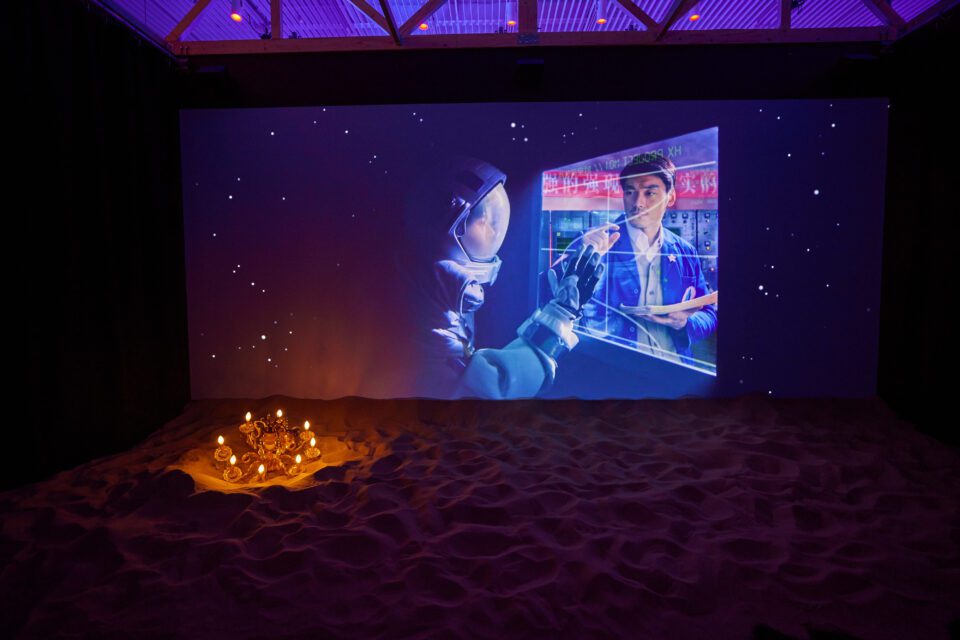
The Hayward’s own history adds another layer to this. Mark Ball, Artistic Director of the Southbank Centre, connects the exhibition to an institutional interest in art and technology that reaches back to the first digital computer game shown at the 1951 Festival of Britain. However, Cao’s work makes it difficult to celebrate innovation without asking who benefits from it, who is displaced and what forms of experience might disappear in the process. Her factories are full of people rather than abstract systems; her virtual worlds retain traces of physical cities; her futuristic installations remain haunted by older technologies and rituals. This tension prevents the exhibition from becoming a simple celebration of technological novelty.
What makes Cao Fei’s work endure is its understanding that the future is never entirely new. It is assembled from things that are already here – old buildings, popular images, working lives, memories and technologies that have not quite disappeared. Her worlds may be virtual, but their concerns remain stubbornly physical: how we work, what we remember, where we belong and what happens when the places around us change. As Cao puts it, “We share the same era of accelerating change, and the same questions about identity, memory, and the future.” Hayward Gallery’s exhibition brings those questions together without pretending they can be settled. Its real interest lies in the space between what technology promises and what people actually experience when they have to live with it.
Cao Fei is at Hayward Gallery, London from 20 April – 25 July 2027: southbankcentre.co.uk
Words: Anna Müller
Image Credits:
1&4. Installation View of Nova in CAO FEI_ MY CITY IS YOURS, Art Gallery of NSW, 2024.
2. Cao Fei, La Town, 2014. Single channel HD video, 16_9, colour with sound, 42min 14sec. Courtesy of the artist, Vitamin Creative Space and Sprüth Magers.
3. 2026 Cao Fei: Testimonies to the Near Future_kunstmuseum basel_Photographer: Samuel Bramley_01.jpg
4. Cao Fei, Still from Live in RMB City, 2009. Machinima, 24 min 50 sec. Courtesy of the artist, Vitamin Creative Space and Sprüth Magers.