This year marks the 50th anniversary of the death of Alexander Calder (1898–1976), the iconic American artist remembered for his pioneering sculptural inventions. Over the last three years, Seattle Art Museum (SAM) in Washington has been celebrating his life, legacy and work through Calder at SAM, a programme of exhibitions and events made possible by the Shirley Family Calder Collection – a “transformative” gift of 45 works from every decade of his career, courtesy of longtime supporters Jon and Kim Shirley. SAM is not the only major institution to honour Calder in 2026. This summer, Paris’ Fondation Louis Vuitton presents Calder. Rêver en Equilibre – “one of the most important exhibitions ever dedicated to [the artist]” – featuring 300 objects across 3,000 square metres, alongside contributions from his contemporaries.
Calder started out in the 1920s by developing new methods of sculpting in wire – essentially “drawing” 3D figures in space. He’s best known for the invention of the “mobile” – suspended, abstract forms that move and balance as air flows around them. It was Marcel Duchamp, pioneer of the “readymade”, who gave them their name in 1931 – in reference to the French words for “motion” and “motive.” Many of the earliest examples were animated via motors, although these mechanics were abandoned as Calder developed sculptures that responded instead to the breeze, gravity, light, humidity and human interaction. He also created stationary works that Jean Arp, the Dadaist, dubbed “stabiles.” The difference? “The mobile has actual movement in itself, while the stabile is back at the old painting idea of implied movement,” Calder explained. “You have to walk around a stabile or through it – a mobile dances in front of you.”
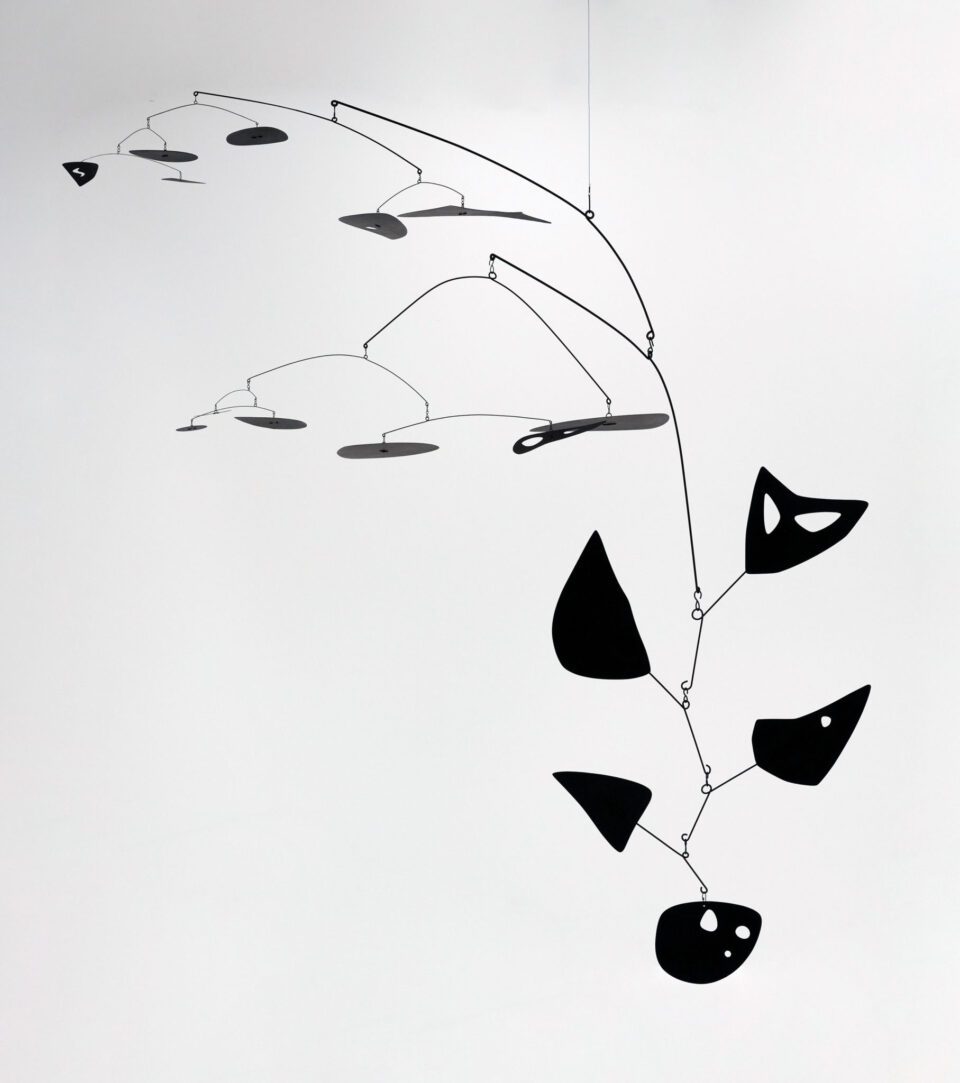
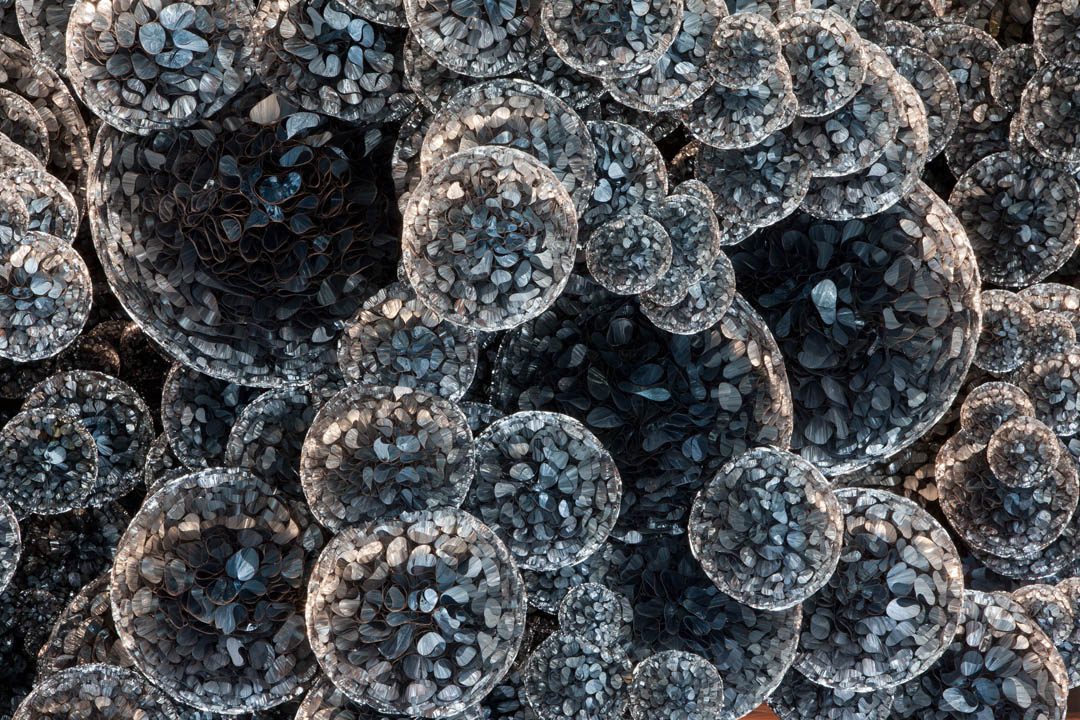
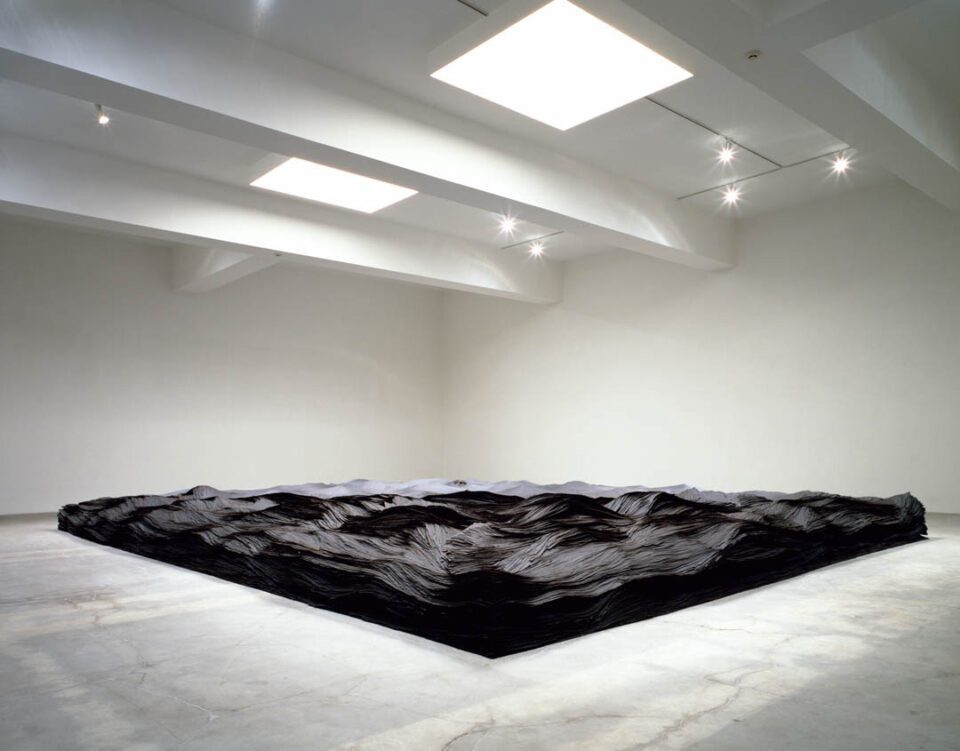
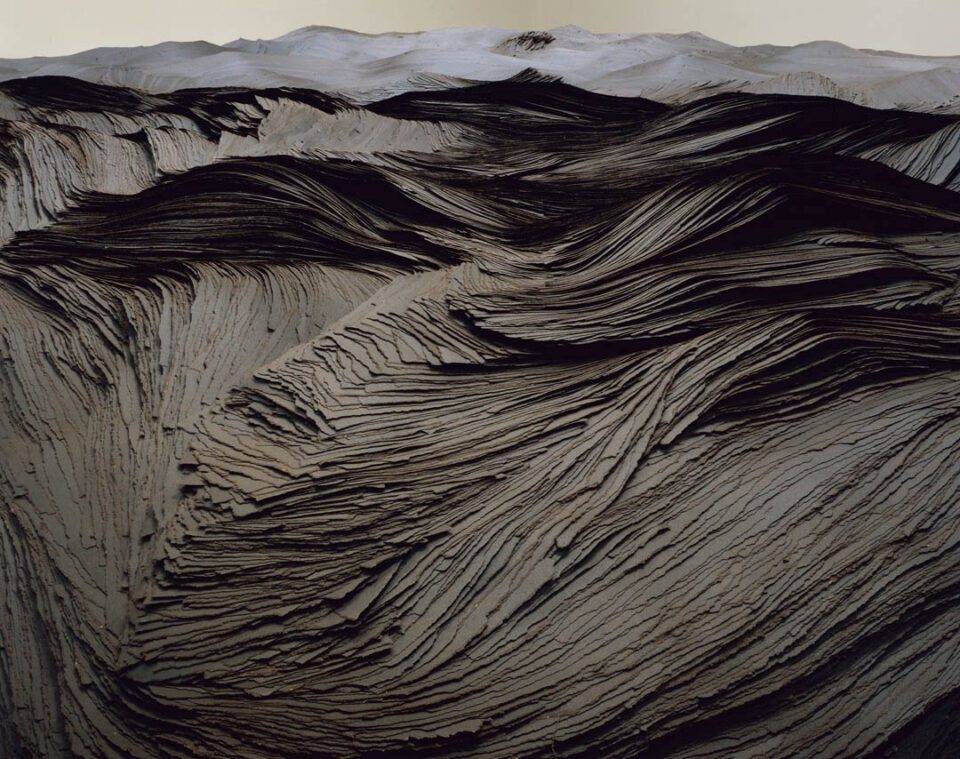
Monochrome is the latest incarnation of Calder at SAM. It puts Calder’s work in dialogue with that of Tara Donovan (b. 1969), the New York-based installation artist who is recognised for turning mass-produced industrial materials – including polystyrene cups and the silvery metal rings of “slinky” toys – into mesmerising installations reminiscent of biological structures and rock formations. Donovan has selected two of Calder’s matte black works as touchpoints for the exhibition. First, the cascading hanging mobile Jacaranda (1949), on loan from The National Gallery of Canada, Ottawa, and second, the bold “stabile” (a stationary sculpture) Mountains (1976), from SAM’s permanent collection. In Donovan’s Transplanted, thick layers of tar paper form a floor installation evoking a geological formation. Apertures features black squares made from hundreds-of-thousands of backlit coffee stirrers, whilst the largest work in the exhibition comprises clusters of Mylar (a highly durable, stretched polyester film), resembling a molecular structure.
One of the most immediate similarities between Donovan and Calder is their choice of palette. When asked about the role of colour in his work, Calder replied: “Well, it’s really secondary. I want things to be differentiated. Black and white are first – then red is next – and then I get sort of vague.” For Donovan: “My primary (though not sole) focus on the colour black references Calder’s use of black in many of his works as a neutralising force that flattens sculptural shapes.” There are also parallels between how both artists integrate animation into their sculptures; Donovan’s are often activated by light, incorporating materials that glimmer or shine, like the reflection of silvery metals. Calder’s, meanwhile, move in a different way – subtly changing shape and position with the passing of time. Monochrome is a mesmerising and hypnotic show that revels in the power of humble materials and simple forms. It celebrates the legacy of a master of 20th century sculpture, whilst enthralling audiences with one of today’s most exciting names.
Monochrome: Calder and Tara Donovan is at Seattle Art Museum until 17 January.
Words: Eleanor Sutherland
Image Credits:
1. Untitled (Mylar) (detail), 2011/2013, Tara Donovan, American, b. 1969, mylar and hot glue, dimensions variable, Courtesy Arp Museum Bahnhof Rolandseck, © Tara Donovan, photo: Mick Vicenz.
2. Transplanted, 2001/2003, Tara Donovan, American, b. 1969, tar paper, 32 x 404 1⁄4 x 294 1⁄2 in., Installation view, Tara Donovan, Pace Gallery, New York, March 8–August 16, 2003, © Tara Donovan, courtesy Pace Gallery, photo: Dennis Cowley.
3. Jacaranda, 1949. Sheet metal, wire, and paint, 131 7/8” x 175 3/16”. © 2026 Calder Foundation, New York / Artists Rights Society (ARS), New York. Photo courtesy of Calder Foundation, New York.
4. Transplanted, (detail), 2001/2003, Tara Donovan, American, b. 1969, tar paper, 32 x 404 1⁄4 x 294 1⁄2 in., Installation view, Tara Donovan, Pace Gallery, New York, March 8–August 16, 2003, © Tara Donovan, courtesy Pace Gallery, photo: Dennis Cowley.