Worldwide, more than 47,000 species are threatened with extinction. Meanwhile, only 17.5% of land and 8.6% of oceans are protected. Explorers Against Extinction is a conservation charity, working across 30 countries to help protect endangered species from the forest to the ocean, as well as supporting reforestation and habitat protection. The organsation, as well as carrying out tangible, practical projects, believes in the art and photography to help raise public awareness of issues ranging from the illegal wildlife trade to climate change. This approach aligns them with major names like WWF who use imagery, exhibitions and photography books to help promote environmental activism.
The visual arts exhibition brings together some of the world’s most celebrated artists, from Turner Prize winners to Indigenous voices across four continents, as an urgent reflection on humanity’s relationship with the natural world. The show features sculpture, photography, film and contemporary art, exploring humanity’s relationship with a changing planet. Works come from the studios of East London, the highlands of Scotland, the rainforests of Malaysia, the steppes of Mongolia and the atolls of the South Pacific, and each one has been donated by the artists themselves. This act of generosity is central to the spirit of Explorers Against Humanity, with creatives of international stature displayed alongside those whose communities are living on the frontlines of climate collapse, united in a common purpose: to bear witness to a planet under pressure and to imagine what renewal might look like.

Visitors are welcomed by an audio introduction, narrated by Stephen Fry, before entering the first of four distinct sections. The opening zone, Extinction, is anchored in Happisburg Beach on the Norfolk coast, the oldest archaeological site in northern Europe at over 800,000 years old. Coastal erosion, accelerated by rising sea levels, has exposed fossils, bones and worked flints that have lain undisturbed for epochs. Highlights in this section include works by Turner Prize-winner Richard Deacon, who fashioned a piece from the fossilised teeth of three vanished species: the southern mammoth, steppe mammoth and straight-tusked elephant. All three were originally driven to extinction by historic climate shifts, whilst the teeth themselves washed from Happisburgh’s sediments. Meanwhile, Andy Goldsworthy, one of the pioneers of land art, contributes a video work in which ancient objects are reactivated and knowledge is honoured, and Emily Young contributes a sculpture of an ancient face, found within a fossil stone at the site.
The second one turns to the present day, and the work of some of the most important documentary photographs of the past century: Sebastião Salgado, Daniel Beltrá, Richard Mosse, Cristina Mittermeier, Ami Vitale, Paul Nicklen, Michael Kenna, the Swedish duo Bigert & Bergström, and Beverly Joubert. Collectively, their work traverses the broad geography of the climate crisis: melting ice sheets, ravaged forests, drought-stricken landscapes and degraded habitats. Perhaps most powerful amongst the collection is an image from Sebastião Salgado, taken in the eastern Brooks Range in Alaska. It shows a stretch of rugged mountains, rising to over 9,800 feet, sliced by deep river valleys and numerous glaciers. The Arctic National Wildlife Refuge, spans ecozones and is the largest in the USA. It is warming and becoming wetter, with dire consequences for its ecosystem.
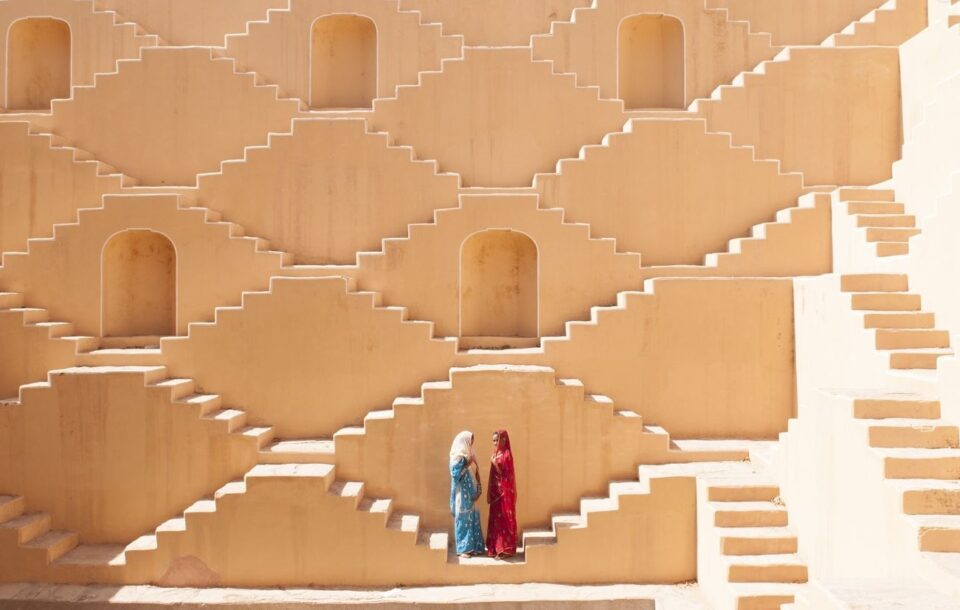
In the latter half of the exhibition, audiences shift from establishing the extend of what is being lost to focus on what is losing it and the efforts to combat that loss. Here, stories of displacement, food insecurity, water shortage and the erosion of traditional ways of life come to the fore. Rashid Diab, exiled in Spain after war forced him to leave the Rashid Diab Art Centre he founded in Khartoum, paints in richly layered earth pigments that carry the weight of a landscape being lost to sand and silence. Jantsankhorol Erdenebayar, builds sculptures from animal horn and found materials, articulating a way of life now under acute pressure in Mongolia, a country that is warming at more than twice the global average rate. Iranian-American artist Nasim Hantehzadeh’s deeply personal work reflects a cultural duality, exploring personal and collective memory through Persian visual traditions, ancient textiles, and Islamic and pre-Islamic art, often looking to nature and Indigenous wisdom for insight.
Extinction: Renewal, Art of a Living Planet concludes on a note of hope. The final section spotlights people across the world who are restoring forests, recovering species, protecting ecosystems and finding new ways to live alongside nature. The curators describe this chapter as “deliberately optimistic,” focusing on creativity, collaboration and community-led responses to environmental change. It includes paintings and videos by Sophie Green, Gary Hodges, Emma Swift, Karen Laurence Rowe, Emily Lamb, and Anne London. The show concludes with Survivor’s Guilt, a powerful spoken-word film by conservation artist Luke Western, voiced by Sir Stephen Fry. It brings together the exhibition’s themes of extinction, climate change, community and hope, offering a moving reflection on humanity’s relationship with the natural world.

There is no shortage of exhibitions about the climate crisis, and in recent years, there has been much discourse about “climate fatigue.” Put simply: it’s getting harder to stop people looking away. In the face of such devastating activity, many struggle to look the situation in the eye. Extinction: Renewal, Art of a Living Planet walks a delicate line. It does not shy away from our situation or gloss over the unbelievable difficulties many communities currently face, but the show is not without hope. The exhibition leaves visitors with a powerful message: while much has been lost, the future of the living planet is ours to shape.
Extinction: Renewal, Art of a Living Planet is at Eden Project, Cornwall from 18 September: edenproject.com
Words: Emma Jacob
Image Credits:
1. Daniel Beltra, Iceland #5 Hvita River.
2. Paul Goldstein, Big Blue.
3. Ami Vitale, Well.
4. Ashley Cooper, Russell Glacier.