Buildings are never just buildings. They determine how people move, where they gather and what they can see, while carrying ideas about who a public space is intended to serve. Gordon Matta-Clark and Prem Sahib approach these questions differently, but both challenge the notion of architecture as fixed or neutral. Their exhibitions at De La Warr Pavilion this autumn – Gordon Matta-Clark: Discrete Violations and Prem Sahib: Chamber – bring together two practices concerned with the relationship between built environments and lived experience. Across the First Floor and Ground Floor Galleries, walls, thresholds, surfaces and views become ways of thinking about power, intimacy and belonging.
That conversation is sharpened by the Pavilion itself. Designed by Erich Mendelsohn and Serge Chermayeff and opened in 1935, the building was conceived as a modern public space where culture, leisure and collective life could meet. Its history, however, has not been static: periods of neglect have been followed by restoration, and another significant period of transformation now lies ahead. Matta-Clark’s suspicion of permanence and Sahib’s interest in the emotional life of particular spaces therefore take on an immediate relevance here. The exhibitions encourage visitors to look at the building differently.
For Matta-Clark, looking differently could mean cutting directly through a wall. His architectural interventions of the 1970s turned abandoned and soon-to-be-demolished buildings into temporary sites for sculpture, photography, film and performance. Associated with the loose Anarchitecture group and with artist-run spaces such as 112 Greene Street, he questioned the assumptions embedded in property and urban development. Buildings that appeared solid and complete became open, unstable and revealing. His work remains influential because it made architecture itself available for scrutiny.
Discrete Violations approaches this history through the material that surrounded those interventions. Rather than concentrating solely on the dramatic building cuts for which Matta-Clark is known, the exhibition brings together works on paper, notebooks, index cards, correspondence, photographs, photomontages and film. These materials show how much negotiation sat behind the seemingly spontaneous quality of his work. Letters to collaborators and exchanges with city agencies reveal an artist working within systems that he was trying to disrupt. Ned McConnell, Head of Visual Arts at De La Warr Pavilion, points to this distinction when he describes Matta-Clark as someone who understood that “architecture is never finished, it is always being negotiated, used, abandoned, and reimagined.”
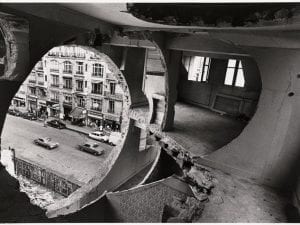
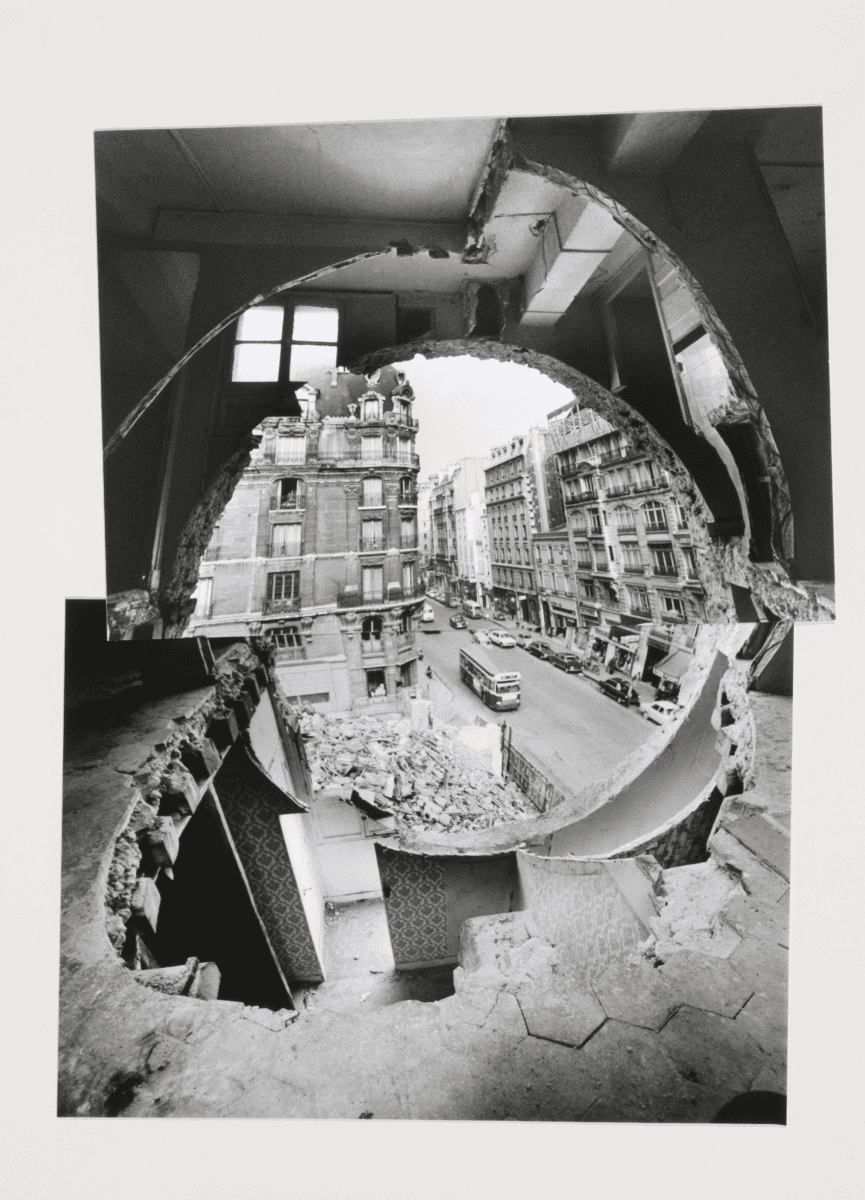
The photographs are particularly important because they complicate the idea of documentation. Matta-Clark’s interventions were temporary, but the photographs gave them another life, often turning the altered building into an abstract composition of light, shadow and intersecting planes. Conical Intersect (1975), made in Paris during the redevelopment of Les Halles, is a striking example: the opening carved through two connected buildings created new views across the city while also exposing the buildings’ imminent disappearance. Photomontages from the project do not simply preserve that moment. Their joins and repetitions become part of the work, echoing the physical cuts they depict.
Film adds duration to this record. It captures the movement of people through altered interiors, the changing quality of light and the physical process of making the cuts. What remains after the building has gone is therefore not a single image but a collection of perspectives, fragments and memories. Matta-Clark understood that an intervention could continue to change once it had been photographed or filmed. The artwork could move from building to image and from image into collective memory. That interest in what remains becomes a useful point of entry into Sahib’s Chamber. The two artists could hardly appear more different: Matta-Clark used saws and physical force, while Sahib works through colour, material, atmosphere and small shifts in perception. Yet both are interested in what happens to people inside particular environments. Sahib’s work frequently considers queer histories and forms of intimacy that have developed in places outside conventional public life. Glass, rubber, aluminium, neon and paint become carriers of those histories without turning them into straightforward illustrations.
One of the most suggestive works in the exhibition is Fox (2004), in which a table laid with food and flowers becomes the setting for an unexpected visitor. The fox enters a scene associated with hospitality but does not quite belong within it, creating a quiet tension between welcome and intrusion. A similar uncertainty runs through Sahib’s Exit works, where small droplets applied to aluminium and resin recall sweat or condensation. Their references to the sauna introduce a history of queer social space – places that could offer privacy and connection while also carrying the possibility of scrutiny or exclusion.
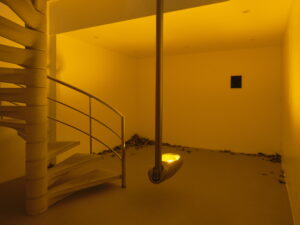
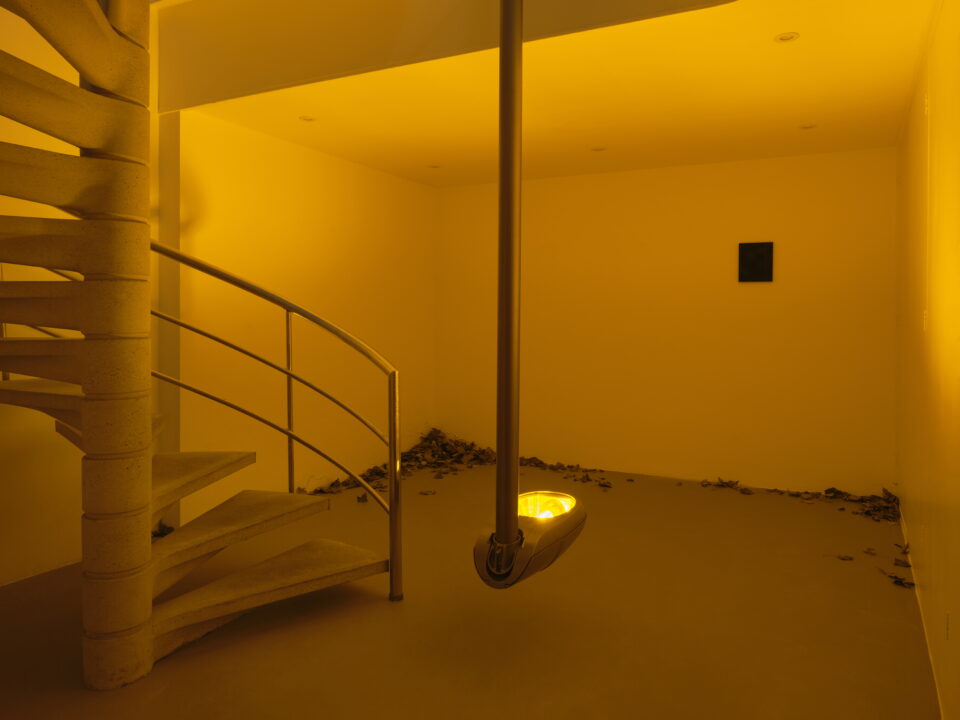
What you need to know to get rid of these blood sucking parasites (in the form of a whisper) (2023) takes this interest in marginal spaces further. Amber light, fallen leaves and a low lamp create an environment that suggests an underpass or another nocturnal urban meeting place. The work does not attempt to reconstruct a particular history. Instead, it evokes the experience of occupying a place whose significance may be understood by some people and remain invisible to others.
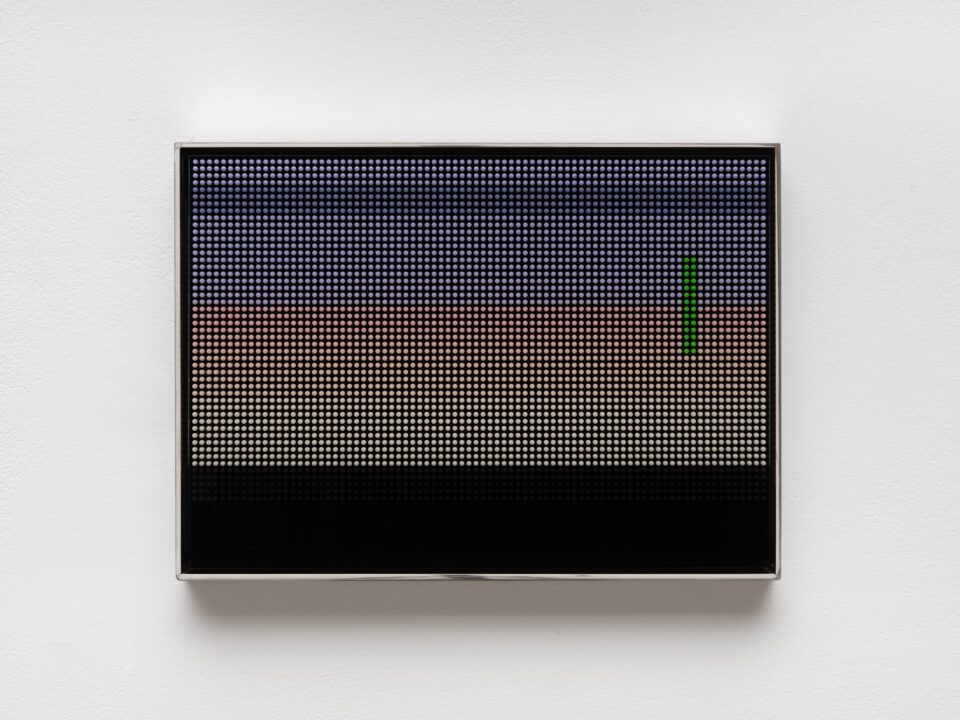
The Pavilion’s own architecture becomes part of this encounter through Horizon (2026). Small acrylic panels sit against the building’s broad views towards the sea, bringing the constructed horizon of the artwork into contact with the real one outside. Mendelsohn and Chermayeff designed the Pavilion around openness, light and access to the coast, and Sahib’s intervention makes those qualities newly noticeable. A familiar view becomes something to consider rather than simply look through. The work also asks who can occupy public space comfortably, and whose experience of openness might be very different.

These questions belong to a much wider history of artists challenging the supposedly universal nature of architecture. Feminist artists have questioned the politics of domestic space; queer artists have documented places of gathering and concealment; disability-led practices have exposed the assumptions built into supposedly accessible environments. Contemporary artists working with migration, surveillance and urban redevelopment continue to ask similar questions. Matta-Clark’s work sits at an earlier point in this history, but its concerns remain recognisable. Sahib approaches them through a different vocabulary, one that places greater emphasis on intimacy and the body.
Curatorial choices make the relationship between the two exhibitions especially productive. Discrete Violationsasks visitors to look closely at the ideas, paperwork and images behind Matta-Clark’s interventions, while Chamber creates an experience in which material and atmosphere gradually alter the perception of the gallery. Neither exhibition treats architecture as an inert backdrop. Instead, the building becomes something to notice – its surfaces, windows, proportions and routes. For De La Warr Pavilion, that approach has significance at a moment when the institution itself is considering its next chapter.
Stewart Drew, CEO of De La Warr Pavilion, describes the connection between Matta-Clark and the building through a simple question: “who architecture really serves.” It is a question that extends beyond the Pavilion. Cultural buildings are often presented as open to everyone, yet access is shaped by economics, physical design, social expectations and histories of representation. The modernist dream of public space can therefore be both generous and incomplete. Matta-Clark exposes the structure; Sahib asks us to consider the people living with its consequences.
Seen together, Discrete Violations and Chamber resist the idea that architecture ends at the point of construction. Matta-Clark cuts into buildings to reveal what their surfaces conceal, while Sahib finds significance in the quieter traces of bodies, encounters and memories. One works through removal, the other through accumulation. At De La Warr Pavilion, where a landmark of British modernism is itself approaching another period of change, that distinction matters. The exhibitions leave architecture where it has perhaps always been – unfinished, contested and shaped by the people who pass through it.
Gordon Matta-Clark: Discrete Violations and Prem Sahib: Chamber open at De La Warr Pavilion, Bexhill-on-Sea on 10 October: dlwp.com
Image Credits:
1&5. Gordon Matta-Clark, Conical Intersect, 1975. Gelatin silver prints, 17.1 x 14.5 cm. Courtesy of Canadian Centre for Architecture, Gift of the Estate of Gordon Matta-Clark © Estate of Gordon Matta-Clark/SODRAC.
2. Prem Sahib, what you need to know to get rid of these blood sucking parasites (in the form of a whisper), 2023. Image by Fine Art Documentation / Ben Westoby, courtesy the artist and Phillida Reid, London.
3. Prem Sahib, Horizon 1.3, 2014. Image by Lewis Ronald, courtesy the artist and Phillida Reid, London.
4. Prem Sahib, Fox, 2004 (still). Courtesy the artist and Phillida Reid, London.