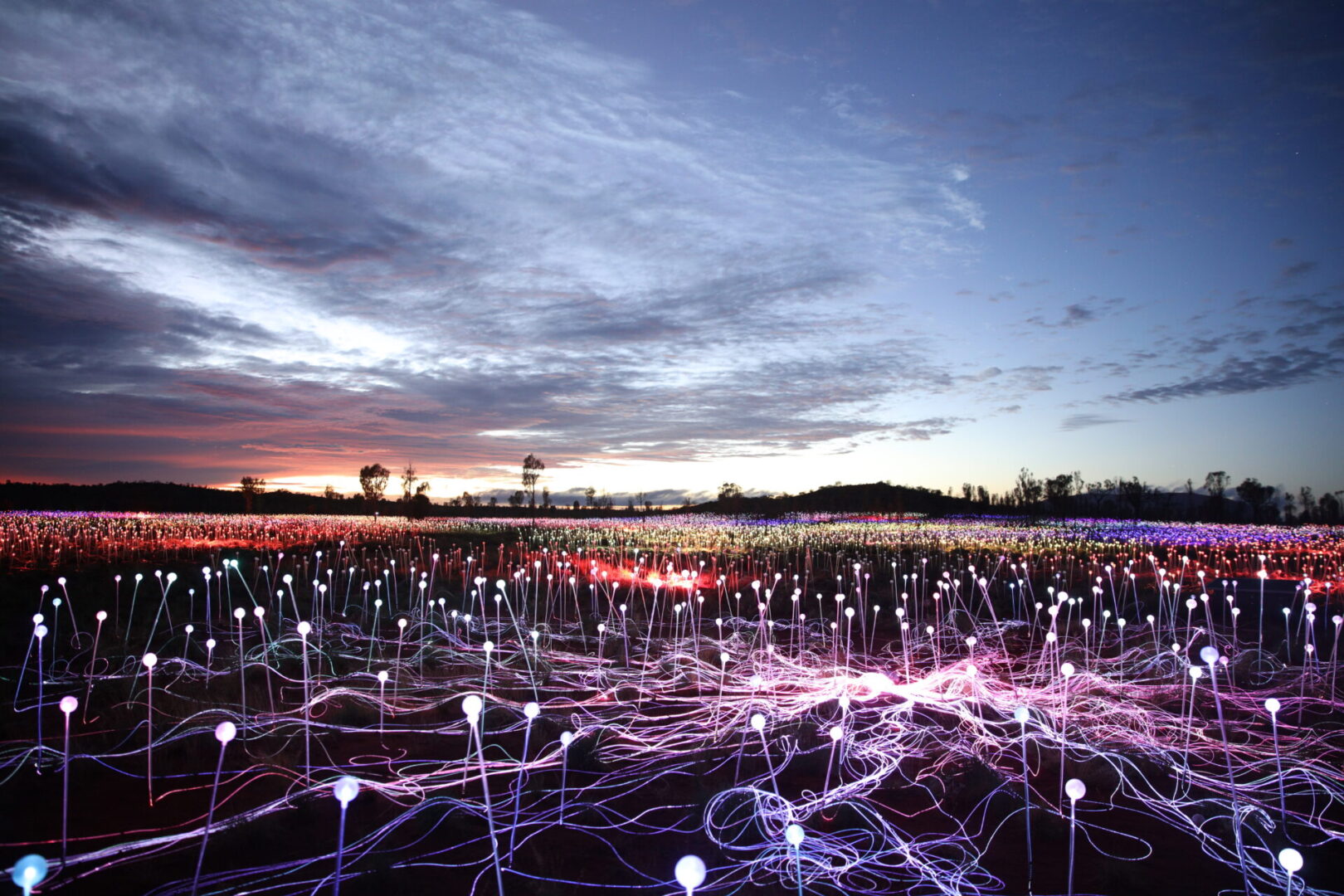
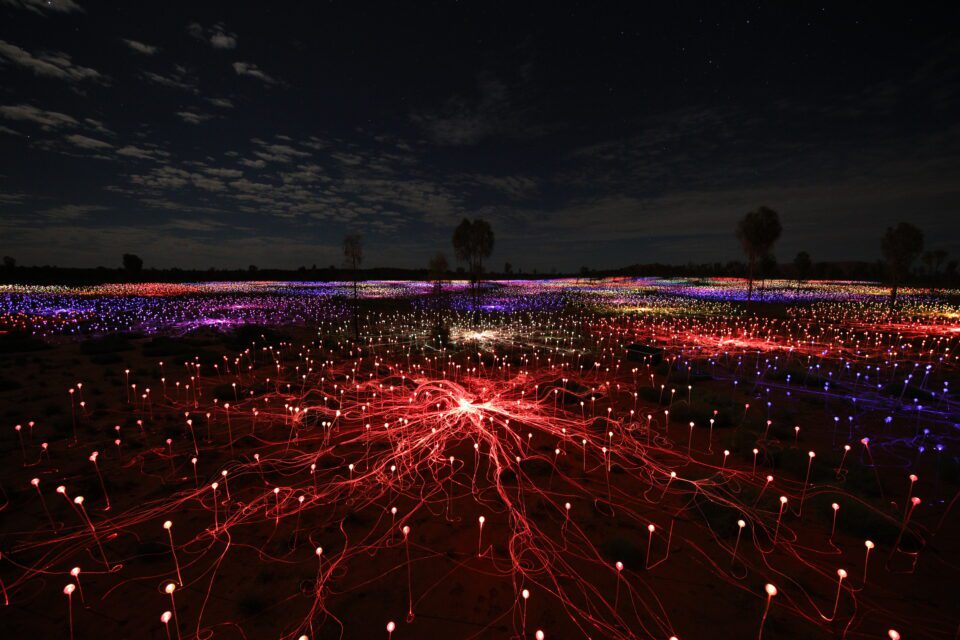
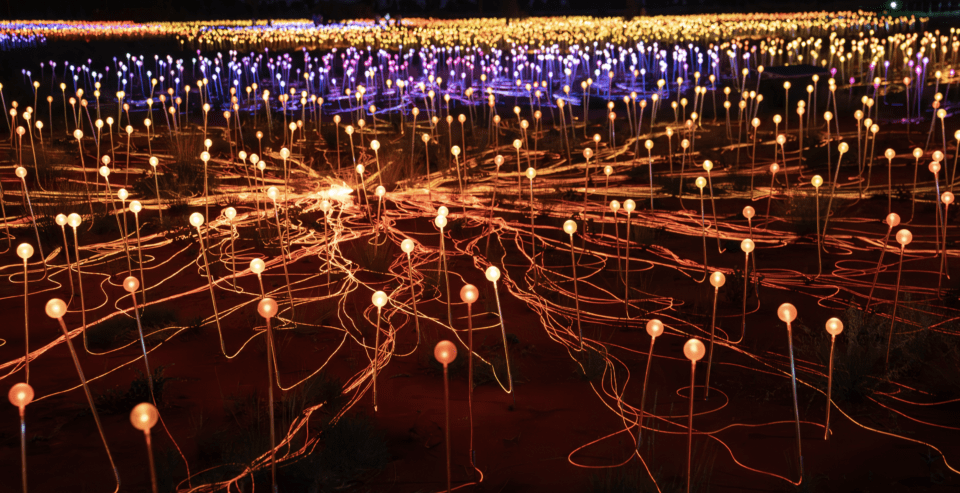
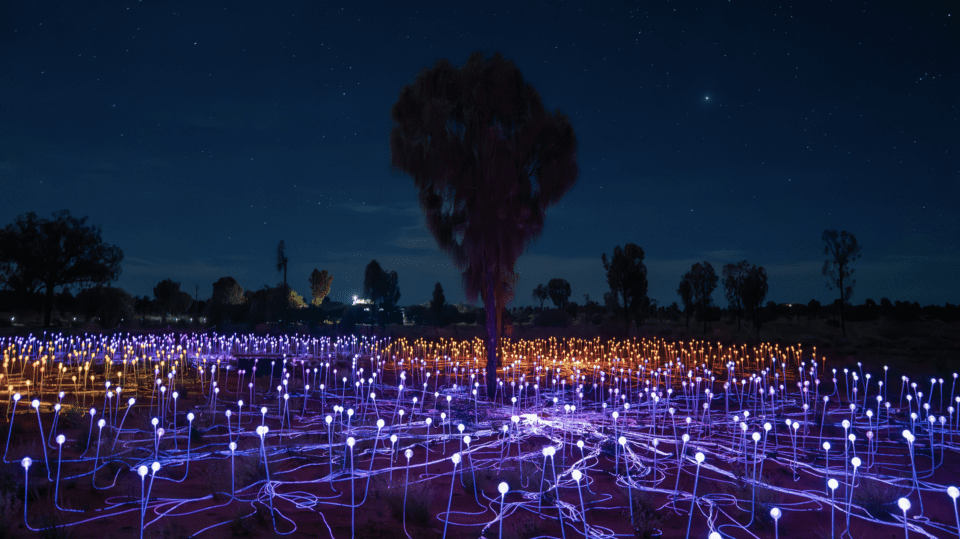
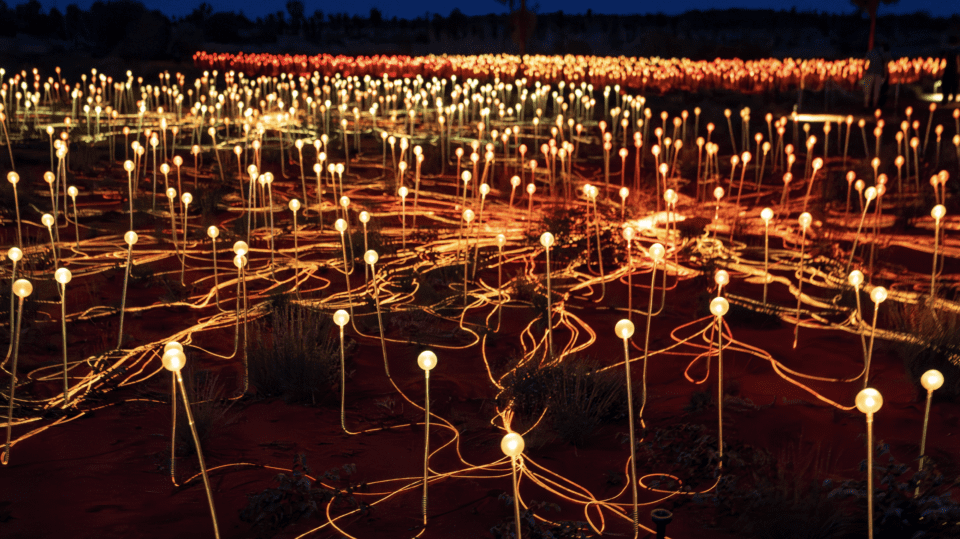
Uluru stands at the heart of Australia’s “Red Centre.” The sandstone monolith, rising 348 metres above the desert, has stood for 550 million years. The natural wonder is a symbol of Aboriginal land rights and a source of spiritual connection with the continent. Artist Bruce Munro (b. 1959) visited the site in the 1980s. The trip, which began as part of a journey around Australia, marked a turning point in both his life and artist trajectory. The location inspired Field of Light, an installation of 50,000 solar powered stems, which illuminates an area the size of seven football fields. The piece, first opened in 2016, was intended to be a one-year exhibition, but has since received 750,000 visitors across 10 years. Today, it’s one of Australia’s most beloved art experiences. We spoke to Munro ahead of Ayers Rock Resort’s anniversary celebrations to discuss his enduring relationship with the sweeping Australian landscape.
A: How did you start working as an artist?
BM: It really began when I was a kid. I probably felt the most comfortable when I was drawing or painting. In those days, that was what art was. Luckily, I had very nice parents who seemed to notice that I enjoyed immersing myself in art and encouraged me to pursue it. It’s something I never thought about – I just did it.
A: What first drew you to working with light as a medium?
BM: I moved to Australia in 1984 and I was doing lots of different part-time jobs around Sydney. One day, I was going to catch a ferry across the harbour to get to work and I walked by a display shop that had some unusual lights in the window. They caught my eye every time I went past, and I kept stopping until eventually I went into the shop. They were expensive, but I looked at the label and it said they were made in North Sydney. I jumped on a bus a couple of days later and found the supplier, and bought $500 worth of kit, which was quite a lot of money. I didn’t have an idea of what I was going to do with it, but I thought I could make some displays or maquettes. I’d go and buy boxes, black them out and put the UV lights in them. I had a studio apartment with a friend so I was just making them on the living room floor. I ended up with the piece in an awards evening for ad agencies, where I was working at the time, and from there I started a little business in light displays. From that point on, light was my focus.
A: Talk us through Field of Light Uluru. How did the idea first come about?
BM: I went to Uluru by chance, on a journey around Australia with my girlfriend at the time – now my wife – Serena. We arrived after being told by many of our Australian friends that Uluru was amazing. I was cynical because in my head it was just a “big red rock,” but when we got there, it completely bowled me over. It was a place that made me want to create. I aimed to make something that reflected how Uluru made me feel. That was the genesis of Field of Light. I was keeping a diary and sketchbook at the time, and I wrote a lot about how the place gets into your body, mind and spirit. It just made you feel so alive.
A: How did visiting Uluru change the trajectory of your creative career?
BM: It’s an interesting question. I’ve never thought about it because I’ve just accepted it as part of who I am. In my 20s, I used to look around me and there was this kind of wonder about the magical path you go on in life, where all these new experiences and places just loom up out of nowhere. I’ve been on this journey to try and understand what life is all about and how you can explain it to other people.
A: Field of Light was originally intended to be temporary. What made you realise it had longevity?
BM: It took 10 years to get the project from my sketchbook into a field. It was at that point that I thought, “if I don’t do it now, I’m never going to do it,” and I need it off my chest. Once it was finally in the world, there were a couple on interactions that made it really significant. There was a lady who was very ill, and later died, who just burst into tears in front of it. I thought: “you know, I’ve never done anything like that in my life before.” It connected with people in a way that I wasn’t expecting. It ended up at the Eden project, before moving to different galleries and institutions around the world. I then received a phone call from ABC Radio in Alice Springs, Australia, because they’d heard that it was inspired by Uluru. The interviewer asked “what would your dream of dreams be?” and I said that I wanted to bring The Field of Light to the place that sparked it. Three days later, I was contacted to discuss that possibility. It took about three and a half years to get to that point, and I went out to install it in 2016. Most importantly, I wanted to get permission from the Indigenous communities and landowners there. It was essential to ensure they were comfortable, and I tried to make it clear that this was a visitor who was inspired by their land – I wanted it to be not only respectful, but joyful. Uluru, and the project, changed my life and gave me a purpose.
A: How has your relationship to the location and the work shifted over the past 10 years?
BM: The work is the work, and I don’t want to tamper with it at all. But it has inspired other pieces, which I’ve been making over the past decade. Field of Light isn’t about me. No artwork is created by only one person. Even the painter who produced a picture does not make it in a bubble, they are connected to those who make the brushes or the paints, for example. It’s the same for me and Uluru, my work doesn’t exist without it. Field of Light is really an expression of the beauty of the world around us. That, more than anything, is what the location has given me, a feeling of being at peace.
A: More than 750,000 people have experienced Field of Light since it opened in 2016. What do you hope some of those people have taken away from viewing it?
BM: You can’t demand how people see a piece of work. I’m sure there are some people who don’t connect with it at all, but there are a lot who really do, and you can tell because it often goes silent. I was asked to add music, many years ago, but the whole point is to be in balance with the landscape. It’s hard not to feel a pull towards nature in a place like that, because you’ve got these vast skies and when the sun goes down, you can see the incredible Milky Way. That was an accident, we didn’t realise that the stars came right the way down and kissed the horizon until we were installing the artwork. The result is feeling like you are standing in a ring of light. I hope people feel that connection to our world.
A: What’s next for you? Anything we can look forward to?
BM: I’ve just finished an orchestral piece in New South Wales, which was a lifelong dream of creating an orchestra that could you walk through. I have so many new projects that I’m dying to get out of my sketchbook and into reality. So that’s the main priority for the next few years.
Find out more about Field of Light’s 10 year anniversary celebrations: ayersrockresort.com
Words: Emma Jacob & Bruce Munro
Image Credits:
All images courtesy of Bruce Munro and Ayres Rock Resort.