Water has long operated as both mirror and medium in contemporary art, a site where aesthetics meet ethics and where planetary narratives unfold with unsettling clarity. In the context of climate crisis, the ocean becomes a charged archive, recording histories of extraction, exploration and ecological fragility. Julian Charrière’s Midnight Zone arrives with provocation, inviting viewers to descend into a realm that is at once materially remote and conceptually urgent. His exhibition proposes immersion as a mode of thought, asking us to consider how knowledge is shaped by depth, darkness and the limits of perception. Rather than offering spectacle for its own sake, the artist frames water as a living system entangled with political, scientific and poetic registers. The result is an exhibition that moves fluidly between sensual experience and critical inquiry, positioning the ocean as both subject and collaborator. In doing so, he contributes to a lineage of artists who have turned to elemental matter to articulate the stakes of the Anthropocene, yet his voice remains singular in its emphasis on descent, illumination and the ethics of seeing.
Born in 1987 and now working between Berlin and Paris, Charrière belongs to a generation for whom environmental instability is not a distant threat but a lived condition. His training at the École cantonale d’art de Lausanne fostered an early interest in material processes and planetary systems, interests that have since expanded into an expeditionary practice that blurs the boundaries between art, science and anthropology. He often situates himself within extreme environments, collaborating with scientists, divers and explorers to access landscapes that are at once fragile and symbolically charged. These journeys are not simply backdrops for image-making but integral components of his methodology, producing works that register the tension between human presence and geological time. Over the past decade he has developed a body of work that is both cinematic and analytical, seducing the viewer while insisting on the material realities that underpin aesthetic experience. The projects position him as a key figure in contemporary ecological art discourse and a mediator between research cultures and public audiences.
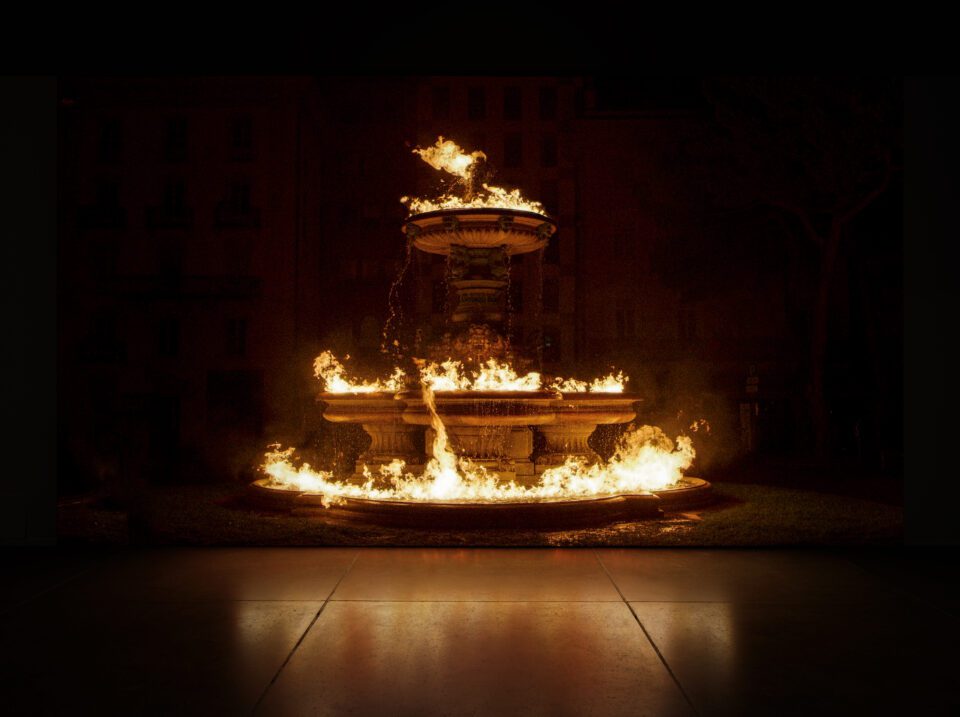
Earlier works chart a trajectory through some of the planet’s most emblematic sites of environmental transformation. In An Invitation to Disappear Charrière staged interventions in threatened ecosystems, probing the slow violence of climate change and the politics of visibility. Toward No Earthly Pole traced the mythologies and material histories of polar exploration, revealing how narratives of conquest and discovery continue to shape our understanding of remote territories. His investigations into urban ecologies, such as Some Pigeons Are More Equal Than Others, examined the adaptive strategies of non-human life within human infrastructures, complicating notions of dominance and cohabitation. These projects have been shown at institutions including the Centre Pompidou, the Palais de Tokyo and the Venice Biennale, often accompanied by publications that bridge scientific research and critical theory. Across these contexts, thresholds between human and non-human, surface and depth, visibility and obscurity, crafting an aesthetic that is both lyrical and forensic have been consistently explored. This duality situates his practice within debates on how climate change is represented, felt and understood.
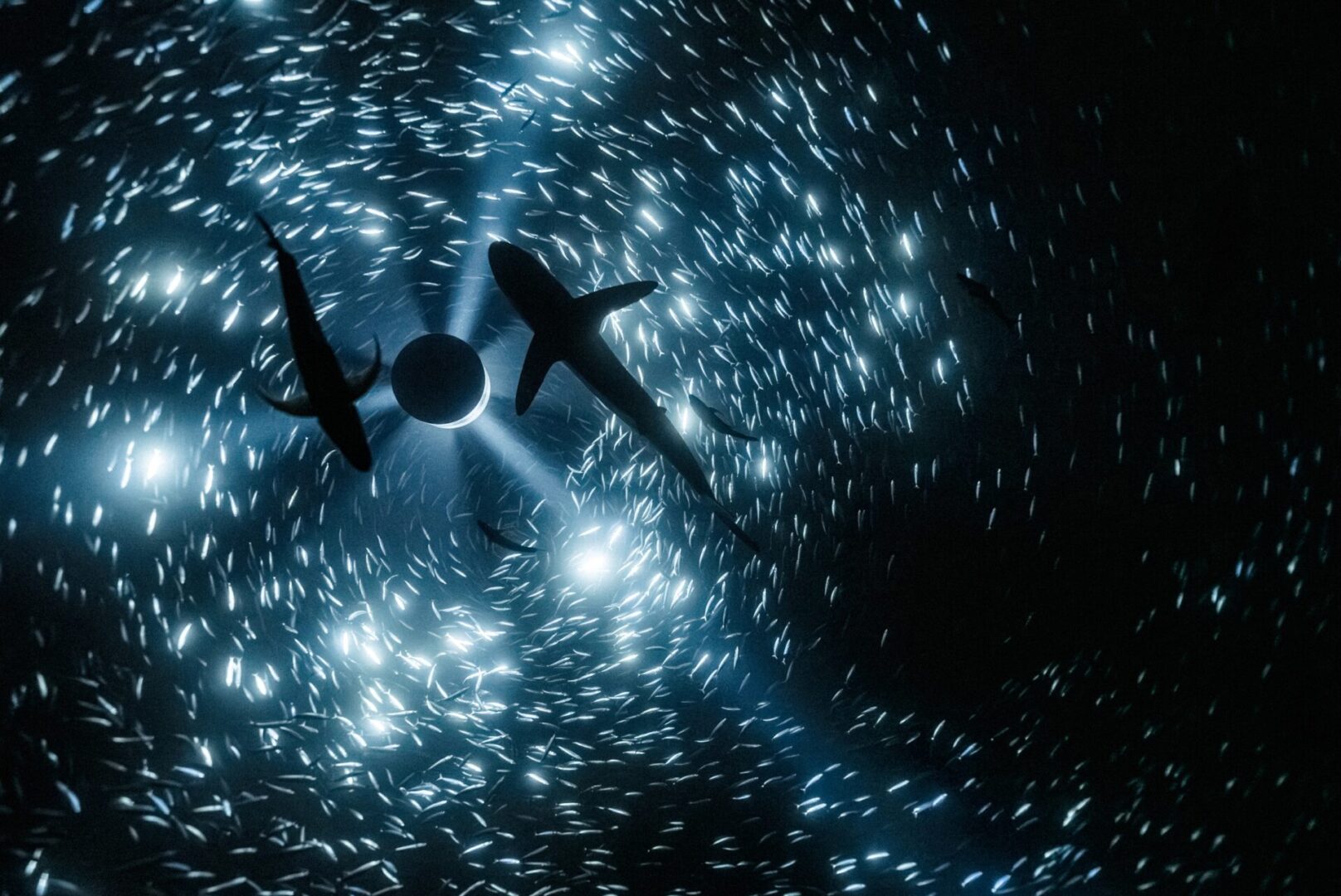
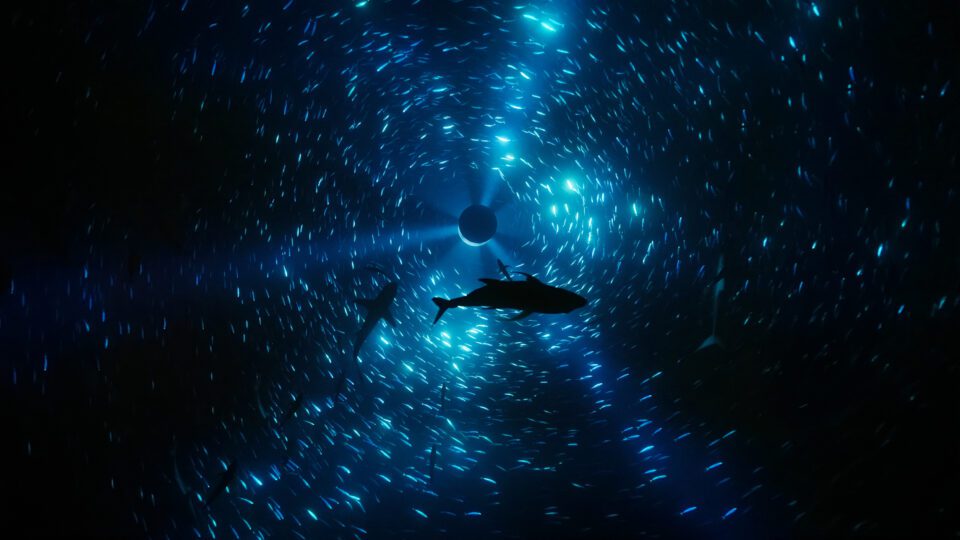
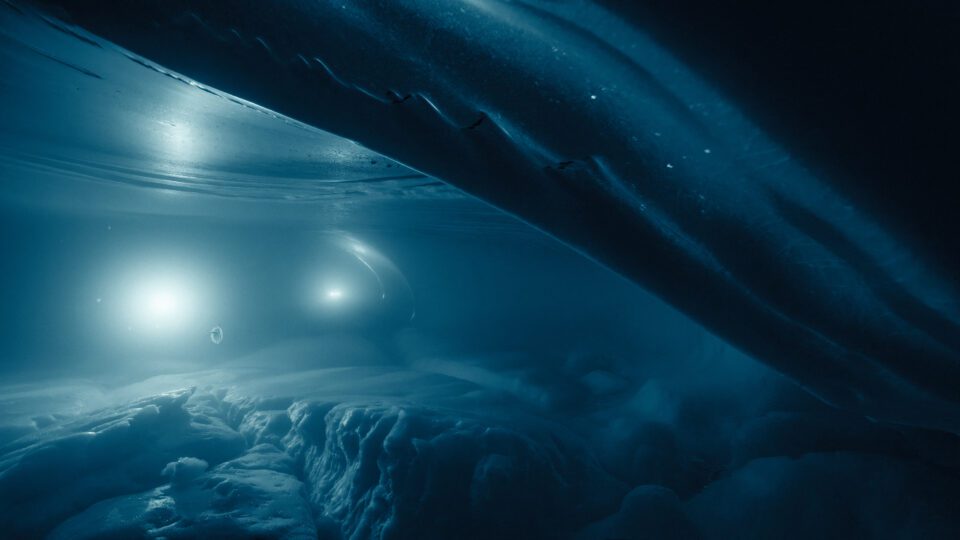
Midnight Zone, presented at Kunstmuseum Wolfsburg, marks Charrière’s most ambitious solo exhibition to date and is staged within a purpose-built glass pavilion that functions as both lighthouse and observatory. At its core hangs a rotating Fresnel lens, historically used in lighthouses and here transformed into a sculptural and symbolic engine. The video installation that shares the exhibition’s title documents the descent of this lens into the Pacific Ocean, its beams slicing through the darkness and attracting swarms of fish that circle the light in a choreography of curiosity and disturbance. The gesture is deceptively simple, yet it resonates with histories of maritime exploration and the technologies that have enabled humans to penetrate and map the ocean’s depths. Surrounding works extend this inquiry to submerged glaciers, cenotes and deep-sea environments, creating an immersive scenography in which film, sound and architecture converge. Viewers are encouraged to move through shifting fields of illumination and shadow, their bodies implicated in a sensory encounter with aquatic temporality. Charrière constructs an experiential laboratory, asking how we might sense the ocean beyond the abstractions of data and policy.
Within this framework, water becomes both medium and message, a conduit for questions of stewardship, extraction and vulnerability. Charrière foregrounds issues such as ocean acidification, melting ice and the emerging threat of deep-sea mining without resorting to overt didacticism, allowing material and metaphor to intertwine. The midnight zone, defined scientifically as the oceanic stratum between 1,000 and 4,000 metres where light does not penetrate, functions as a conceptual anchor, evoking both empirical specificity and existential darkness. The descending Fresnel lens conjures colonial histories of navigation and extraction, yet its ghostly beams also suggest care, curiosity and interspecies encounter. The work oscillates between awe and unease, mirroring the emotional complexity that characterises contemporary ecological awareness. By staging light as an invasive presence, Charrière implicates vision itself in processes of disturbance and domination, inviting a reflexive consideration of how seeing can be an act of power. In this sense, Midnight Zone positions perception as both a tool and a responsibility.
Charrière’s practice resonates with a cohort of contemporary artists who similarly navigate the aesthetics of environmental entanglement. Ursula Biemann’s video essays on water, migration and planetary circulation offer a feminist and geopolitical perspective on fluid systems, while Otobong Nkanga’s installations trace the embodied geographies of resource extraction and the scars left by colonial economies. Tomás Saraceno’s research-based explorations of atmospheres, webs and speculative ecologies propose alternative frameworks for thinking about interspecies cohabitation and planetary futures. Charrière shares with these figures a commitment to interdisciplinary research and a sensitivity to the poetic potential of scientific imagery, yet his emphasis on descent and immersion distinguishes his approach. Where others map networks and flows, Charrière insists on the vertical axis as a site of epistemic and affective transformation, inviting viewers to consider what lies beneath the surface both materially and metaphorically. Together, these practices signal a broader shift in contemporary art towards systemic thinking, where materials are understood as nodes within global networks of power.
The wider impact of Charrière’s work can be traced in the growing convergence of art, environmental humanities and climate science, where artists increasingly operate as translators between research and public perception. His collaborations with scientists and explorers exemplify a model of practice that is both speculative and grounded, capable of generating new imaginaries while engaging with empirical realities. By aestheticising remote and often inaccessible environments, he expands the sensory vocabulary through which audiences can think about climate change, biodiversity loss and planetary thresholds. His images circulate within art institutions and beyond, contributing to a visual lexicon of the Anthropocene that resists both apocalyptic fatalism and naïve optimism. Charrière’s influence is evident in a generation of artists who embrace expeditionary methods, material research and long-term collaborations as integral to their work. He demonstrates that ecological art can be rigorous without sacrificing sensuality, offering instead a nuanced space where complexity can be felt as well as understood. In this sense, his legacy may lie in reshaping how we see, sense and ethically engage with planetary change.
Midnight Zone stands as a compelling meditation on visibility, responsibility and the ethics of exploration in an era defined by environmental precarity. Charrière’s editorial voice, articulated through film, sculpture and architecture, is one of urgency, demanding a reconsideration of how we inhabit and perceive the planet’s aqueous realms. His fusion of art, science and environmental philosophy exemplifies a contemporary practice that is reflective, immersive and critically attuned to the stakes of the present moment. By situating the ocean’s depths within a theatrical yet contemplative space, he renders the invisible legible without diminishing its mystery, allowing viewers to encounter the unknown as both wonder and warning. The exhibition proposes immersion not only as a physical act but as a moral and intellectual stance, a willingness to descend into complexity, ambiguity and responsibility. As we navigate an era of climatic uncertainty, Charrière’s work becomes a call to attention, care and sustained enquiry, reminding us that what lies beneath the surface is as crucial as what we choose to illuminate.
Julian Charrière: Midnight Zone is at Kunstmuseum Wolfsburg from 14 March – 12 July: kunstmuseum.de
Words: Simon Cartwright
Image Credits:
1. Julian Charrière, Midnight Zone (video still), 2024, 4K video, 16:10 aspect ratio, color, 3D ambisonic soundscape, 56 min., © the artist / VG Bild-Kunst, Bonn 2026.
2. Julian Charrière, Midnight Zone (video still), 2024, 4K video, 16:10 aspect ratio, color, 3D ambisonic soundscape, 56 min., © the artist / VG Bild-Kunst, Bonn 2026.
3. Julian Charriére, And Beneath It All Flows Liquid Fire, 2019, UHD video, 16:10 aspect ratio, color, stereo sound, continuous video loop, installation view, Towards No Earthly Pole, Aargauer Kunsthaus, Aarau, Switzerland, 2020, © the artist / VG Bild-Kunst, Bonn 2026, Photo: Jens Ziehe.
4. Julian Charriére, Albedo (video still), 2025, 4K video, 16:10 aspect ratio, color, 3D ambisonic soundscape, 42:20 min., © der Künstler / VG Bild-Kunst, Bonn 2026.