Ruth Asawa’s work arrives into the present with a rare clarity, as if her sculptures had been waiting for this moment to be fully understood. In an era where museums are rethinking narratives and audiences are seeking art that feels ethically and materially grounded, her practice reads as both historical and startlingly contemporary. Her forms do not demand attention through spectacle but through quiet insistence, asking viewers to slow down and consider how space is shaped, occupied and shared. The retrospective currently on view across SFMOMA, MoMA and now the Guggenheim Museum Bilbao proposes continuity as a central theme, not only in Asawa’s formal vocabulary but in her understanding of life as an interconnected system. It suggests that abstraction can be intimate, and that structure can be deeply personal. Asawa’s legacy is philosophical, offering a model for how art can be woven into everyday existence.
To understand Asawa’s work is to begin with ideas about permeability, process and belonging. Her sculptures collapse distinctions between inside and outside, figure and ground and object and environment, proposing instead a fluid continuum where boundaries dissolve. The looped wire becomes a line that never quite ends, an unbroken gesture that defines volume, while remaining porous to air and light. This formal strategy mirrors a broader conceptual stance, where art and life are inseparable and making is a form of thinking. Asawa’s practice resists the myth of the solitary genius and instead foregrounds repetition, labour and the ethics of attention. Her work is less about monumental statements and more about sustained inquiry, about what happens when one follows a material to its limits.
Born in 1926 to Japanese immigrant farmers in California, Asawa’s early life was marked by rupture and displacement, experiences that would shape her worldview. During World War II she and her family were forcibly incarcerated by the US government, an injustice that denied her both freedom and a straightforward path into professional life. After being refused an art teaching degree due to anti-Japanese prejudice, she enrolled at Black Mountain College, the experimental institution that became foundational to her artistic development. There she encountered a multidisciplinary approach to learning that fused mathematics, philosophy, music, dance and visual art into a single pedagogical ecosystem. She later recalled that Josef Albers taught her “how to see,” a lesson that extended far beyond colour theory into a way of perceiving the world as an interconnected system of forms and relationships. That ethos of seeing and doing would become a guiding principle throughout her six-decade career.
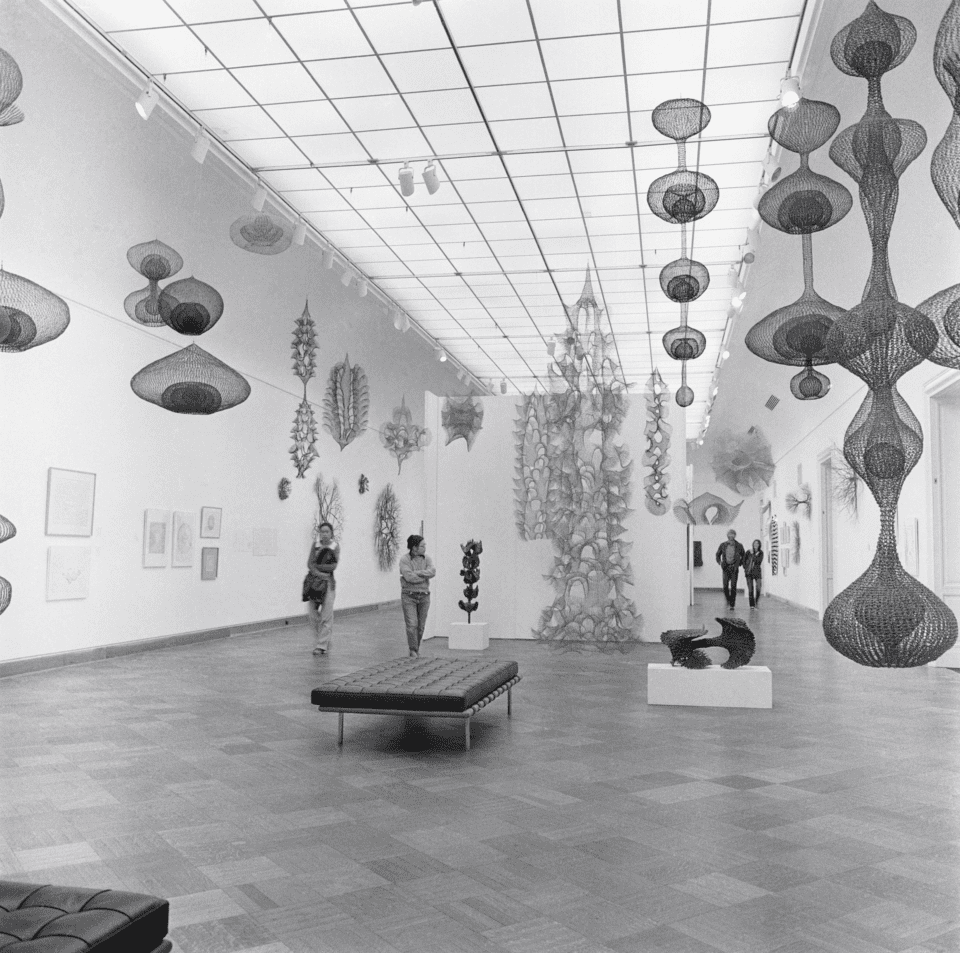
The recent MoMA retrospective marked a significant moment in the institutional recognition of Asawa’s work, presenting an expansive survey that traced her evolution from early drawings to monumental public commissions. Spanning some 300 works, the exhibition foregrounded her wire sculptures while situating them within a broader practice that included printmaking, painting, photography and pedagogy. Critics noted the way her hanging forms transformed the galleries into immersive environments, with shadows functioning as secondary sculptures that expanded into architectural space. Asawa herself once articulated this ambition, explaining that she wanted to make “sculpture that would itself have a form and volume, whose silhouette would also have volume, and sculptures whose shadow would have volume.” Her insistence on continuity between object, environment and viewer felt especially resonant in the MoMA context, where the institutional frame itself became part of the work’s spatial dialogue. The exhibition positioned her not as a peripheral figure but as a central architect of post-war sculptural language.
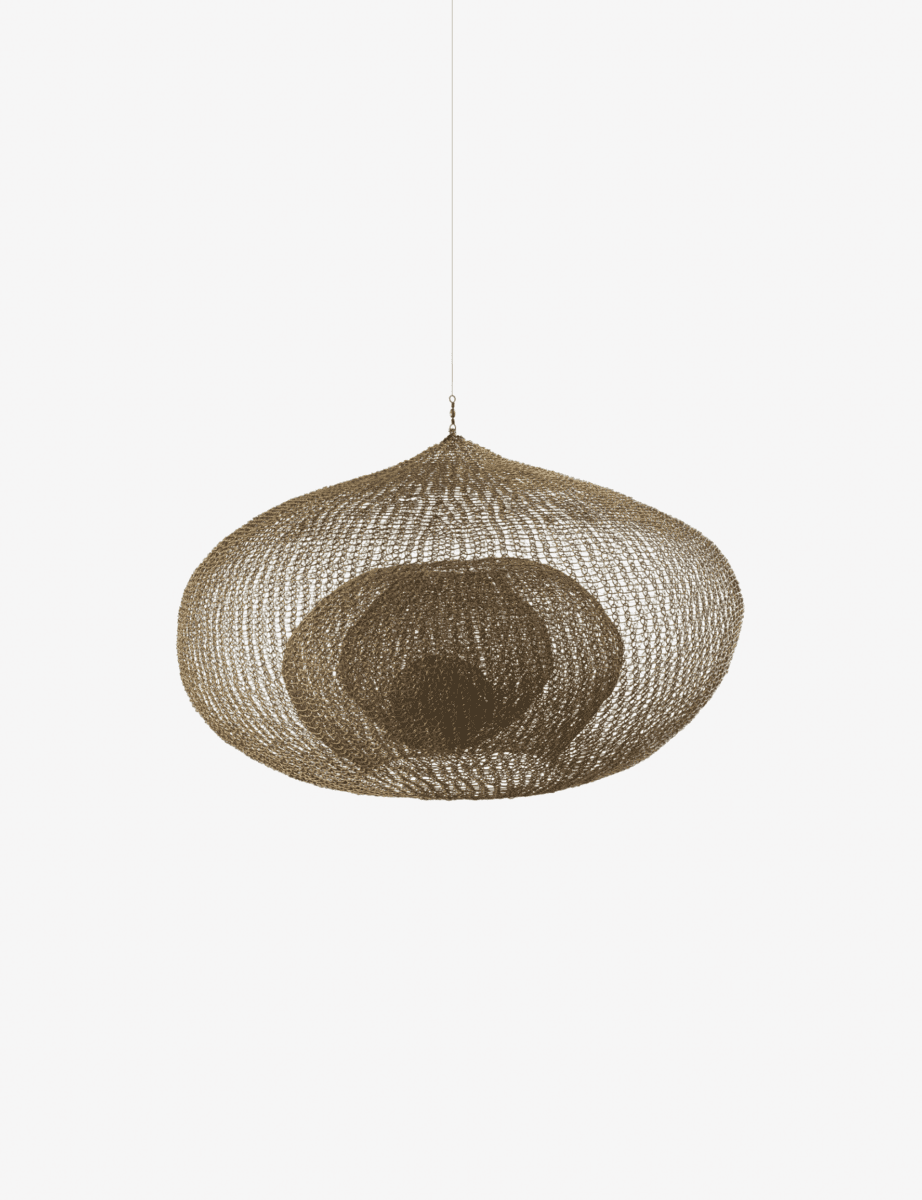
At the heart of Asawa’s practice is a commitment to material intelligence, a belief that form emerges through sustained engagement with matter. Her signature looped-wire technique developed from basketry traditions she encountered in Mexico and transformed into a sculptural language that was at once industrial and organic. These works articulate nested lobes and interlocking spheres that appear simultaneously delicate and structurally complex, like skeletal systems suspended in air. By using industrial wire and hand-looping it into continuous surfaces, she created volumes that are defined as much by absence as by presence. The sculptures invite viewers to move around them, to look through them and to recognise that space itself is a collaborator in the act of perception. Asawa once described her “continuous form within a form” as “a shape that was inside and outside at the same time,” a statement that encapsulates both her formal innovations and her philosophical stance on interconnectedness.
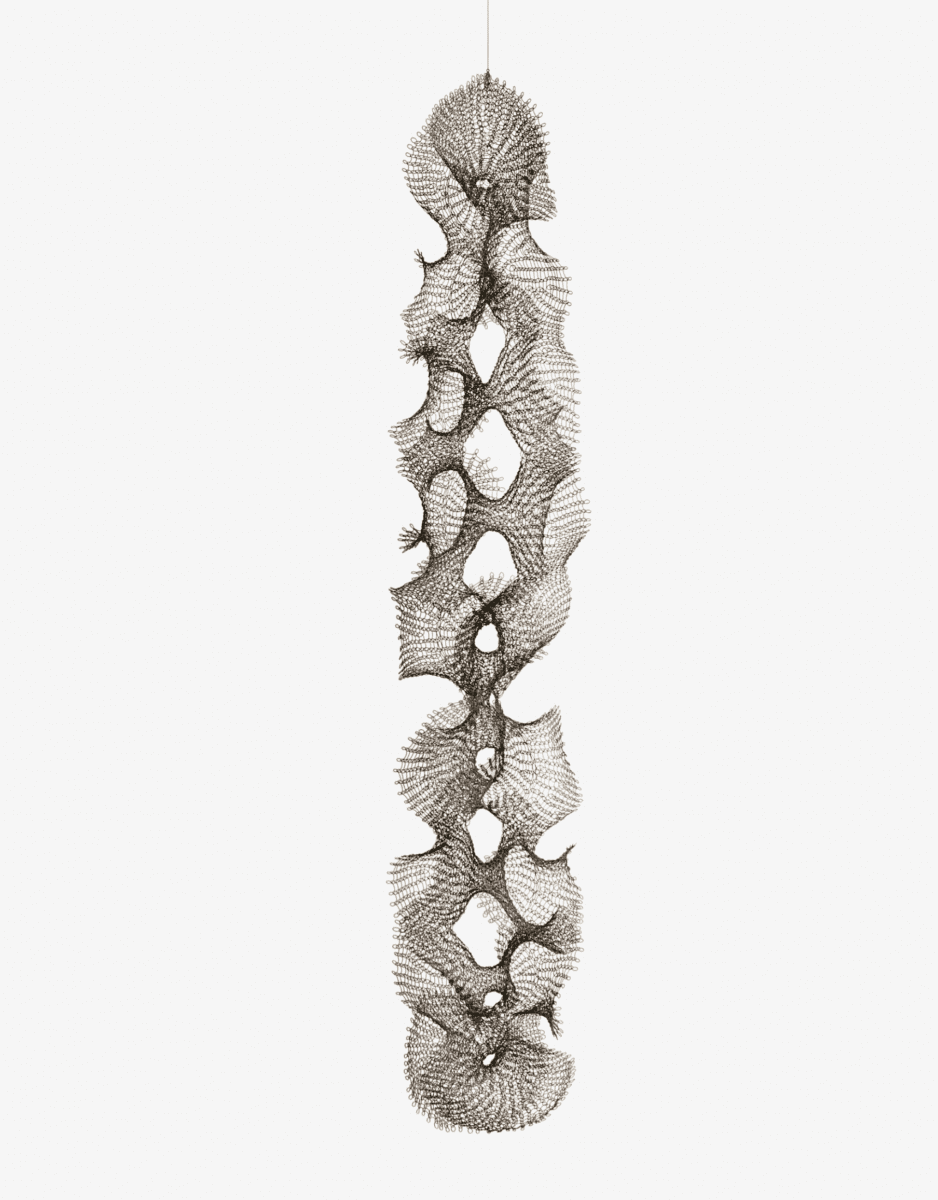
Her later tied-wire sculptures extended this inquiry into the rhythms of nature, drawing on botanical forms and growth patterns as compositional frameworks. Inspired by a dried desert plant gifted to her in the early 1960s, she began to explore branching structures that echoed stems, flowers and cellular systems. These works blur the line between abstraction and representation, suggesting that geometry and biology share a common language. Asawa articulated this synthesis succinctly when she said, “Nature is my teacher, and I have used materials that are a product of our twentieth century to study her growth patterns.” The sculptures are neither purely naturalistic nor purely conceptual, occupying a hybrid territory that feels increasingly relevant in an age of ecological awareness. They demonstrate how industrial materials can be reimagined as vehicles for studying organic systems rather than dominating them.
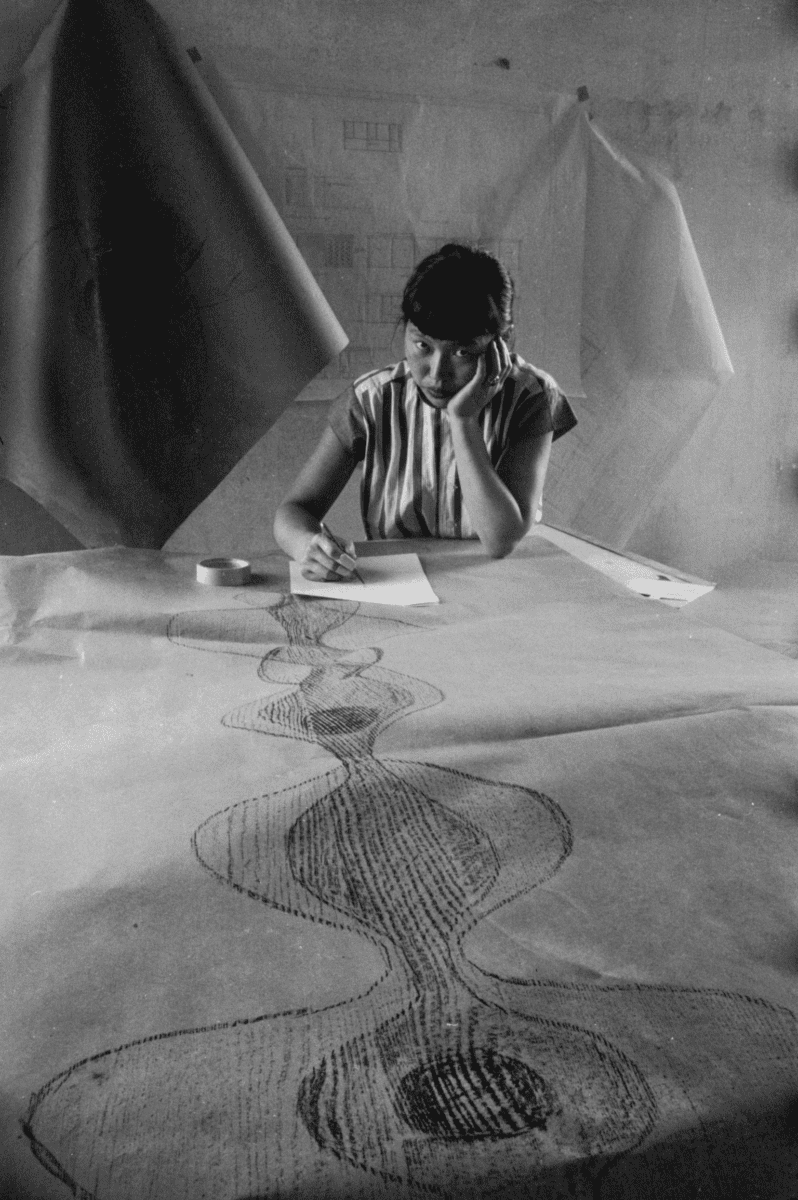
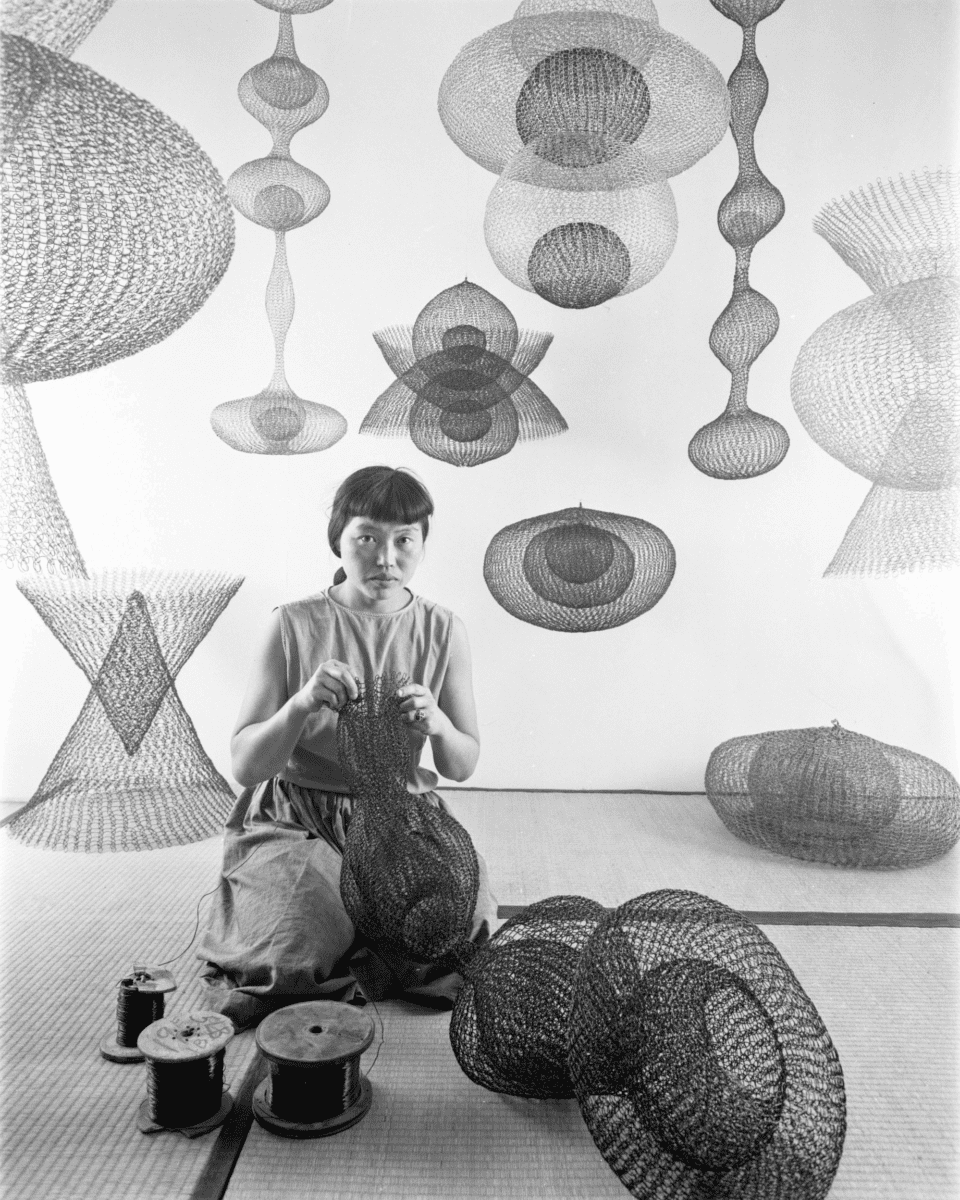
Drawing and printmaking remained parallel practices throughout her career, functioning as both documentation and experimentation. Her Tamarind lithographs from the mid-1960s depict flowers, family members and abstracted forms with a sensitivity that mirrors the spatial complexity of her sculptures. Even in her most representational works, line functions as an investigative tool rather than a descriptive endpoint, tracing the contours of perception itself. During periods of illness, particularly after her lupus diagnosis, drawing became a primary mode of engagement, a way to continue working when large-scale sculpture was physically demanding. She wrote that “life draws,” a phrase that suggests both that she drew from life and that life itself inscribes marks upon the artist. This reciprocal relationship between living and making underpins her entire practice, reinforcing the idea that art is embedded within daily experience.
The Guggenheim Museum Bilbao’s presentation of Asawa’s retrospective situates her within a global conversation about modernism, diaspora and institutional power. Since its opening, Bilbao has been emblematic of the transformative potential of cultural architecture, but it has also become a site for rethinking whose histories are foregrounded in global narratives. Placing Asawa within this context challenges Eurocentric and male-dominated accounts of post-war abstraction, proposing instead a more inclusive and transnational framework. Her biography intersects with histories of migration, incarceration, feminism and community activism, making her work particularly resonant for contemporary audiences grappling with similar issues. The collaboration between SFMOMA, MoMA and Guggenheim Bilbao also signals a shift towards distributed curatorial authority, where narratives are shaped across institutions rather than dictated by a single centre. In Bilbao, Asawa’s sculptures converse not only with Gehry’s architecture but with a global audience attuned to questions of belonging and representation.
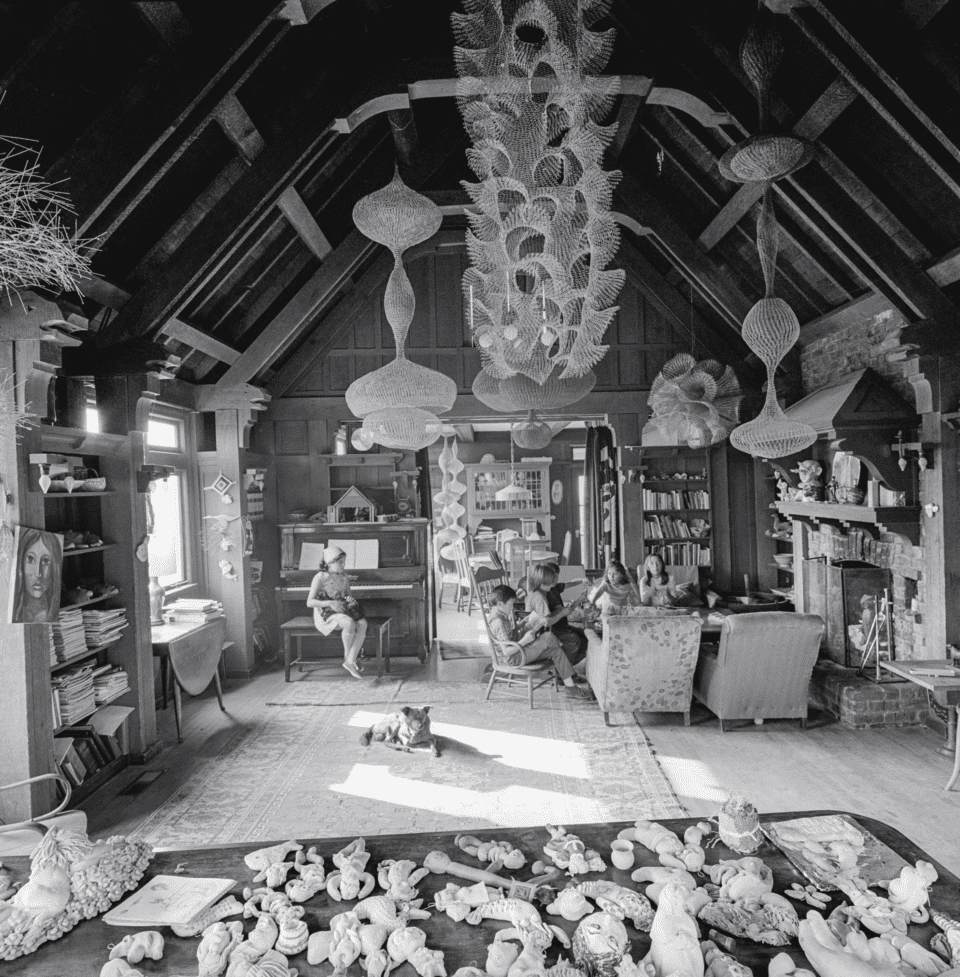
Within the Guggenheim’s galleries, her suspended forms acquire new resonance against the building’s titanium curves and vast atrium spaces. The sculptures appear to float within Gehry’s architecture, their delicate lattices echoing the building’s own complex geometry while asserting a quieter and more human scale. Archival material documenting her public commissions expands this dialogue into civic space, showing how her belief in continuity extended beyond the studio into the city. Works such as her fountains and memorials demonstrate a commitment to art as social infrastructure, creating spaces for gathering, remembrance and reflection. Asawa once stated her desire “to make a sculpture that could be enjoyed by everyone,” a democratic ethos that resonates strongly in the context of contemporary debates about public art. Her civic projects reveal an artist who understood sculpture as a catalyst for community.
Asawa’s influence on contemporary artists is both formal and ethical, shaping approaches to material, process and social engagement. Damián Ortega’s deconstructed objects and explorations of everyday materials echo her insistence that humble substances can carry complex meanings. Tara Donovan’s accumulative installations, built from industrial materials that mimic organic forms, resonate with Asawa’s synthesis of the manufactured and the natural. Senga Nengudi’s sculptural environments and collaborative practices reflect Asawa’s integration of life, body and community into artmaking. These artists inherit not just her visual language but her commitment to continuity, experimentation and inclusivity. Through them, Asawa’s legacy continues to unfold, expanding into new contexts and conversations.
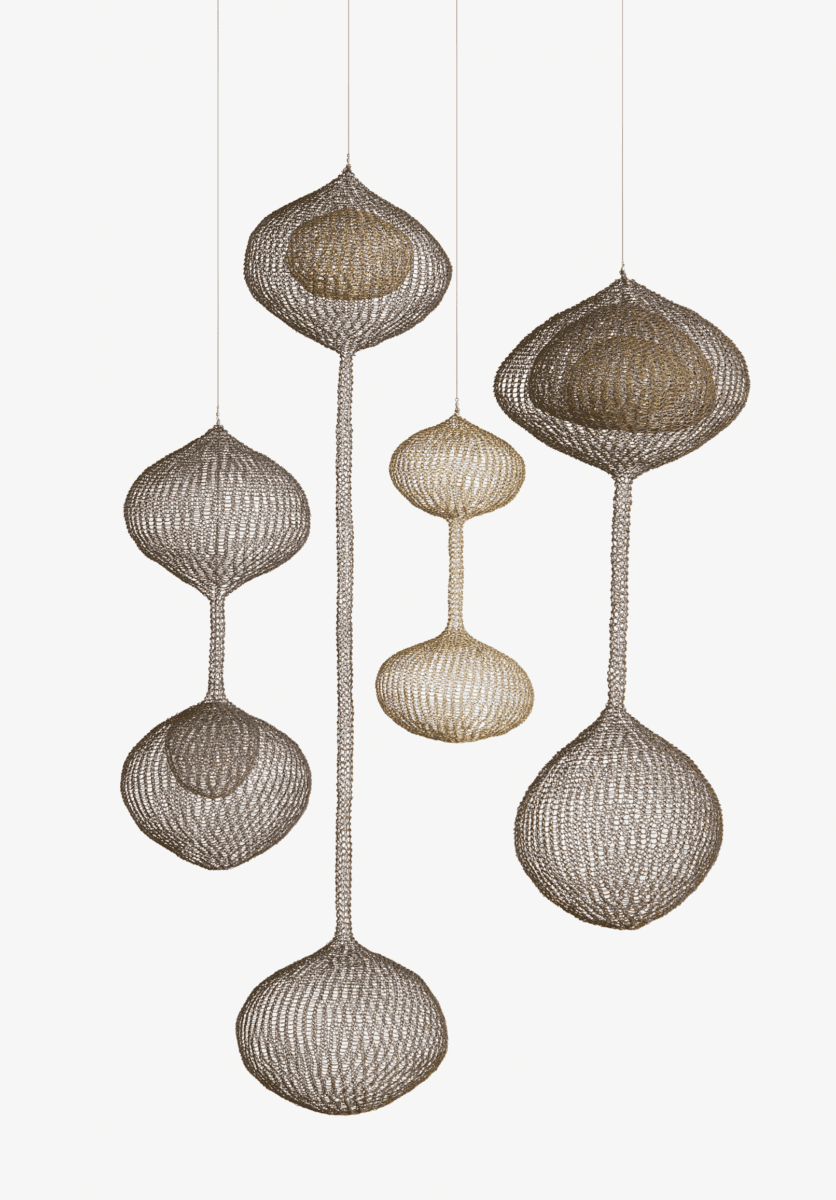
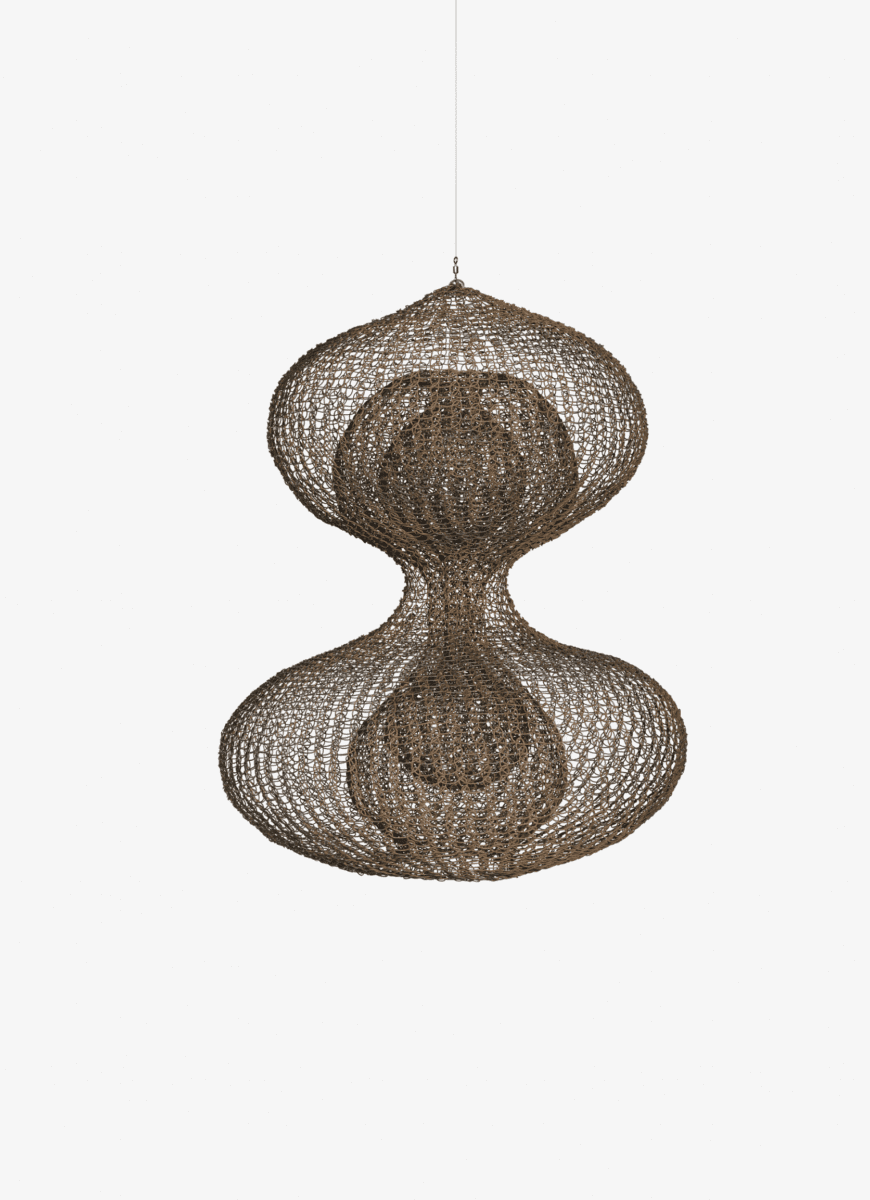
What emerges from this retrospective cycle is not simply a reassessment of an individual career but a broader reflection on how we narrate modern art. Asawa’s work complicates the binary between abstraction and biography, showing that formal innovation can coexist with deeply personal and political histories. Her sculptures offer a model of making that is iterative, relational and attentive to both material and social contexts. In a moment when institutions are seeking to reconcile aesthetic excellence with ethical responsibility, her practice offers a blueprint that feels both rigorous and generous. The looping wire becomes a metaphor for interconnectedness, a reminder that art and life are entangled systems.
Asawa’s retrospective at the Guggenheim Museum Bilbao is less about closure than about continuity, less about summation than about ongoing conversation. Her forms invite viewers into a spatial ethics where inside and outside are linked, where presence is defined by relation and where making is a way of thinking through the world. In their quiet persistence, her sculptures resist the spectacle-driven tendencies of contemporary culture and instead propose an art of attention, care and sustained inquiry. Asawa once reflected that “how one sees, one does, how one does, one is,” a statement that resonates as both an artistic credo and a philosophical proposition. To see her work today is to encounter a geometry of belonging that continues to shape how we imagine the possibilities of form and community.
Ruth Asawa: Retrospective is at Guggenheim Bilbao from 19 March – 13 September: guggenheim-bilbao.eus
Words: Simon Cartwright
Image Credits:
1&6. Artist Ruth Asawa making wire sculptures, California, United States, November 1954; image: Nat Farbman/The LIFE Picture Collection/Shutterstock; artwork: © 2026 Ruth Asawa Lanier, Inc., courtesy David Zwirner.
2. Untitled (S.427, Hanging Single-Lobed, Five-Layered Continuous Form within a Form), 1953 Brass wire, 45.7 × 71.1 × 71.1 cm; Collection of Don Kaul and Barbara Bluhm-Kaul, Chicago
© 2026 Ruth Asawa Lanier, Inc., courtesy David Zwirner; photo: Maris Hutchinson, courtesy David Zwirner.
3. Untitled (S.433, Hanging Nine Open Hyperbolic Shapes Joined Laterally), ca. 1958 Cooper wire 193 x 38.1 x 38.1 cm; William Roth Estate © 2026 Ruth Asawa Lanier, Inc., courtesy David Zwirner; photo: Laurence Cuneo.
4. Ruth Asawa (second from left) with visitors to her exhibition Ruth Asawa: A Retrospective View, San Francisco Museum of Art (now SFMOMA), 1973; © 2026 Ruth Asawa Lanier, Inc., courtesy David Zwirner; photo: Laurence Cuneo.
5. Portrait of Japanese American artist sculptor Ruth Asawa as she sketches a design, 1954; image: Nat Farbman/The LIFE Picture Collection/Shutterstock; artwork: © 2026 Ruth Asawa Lanier, Inc., courtesy David Zwirner.
7. Living room of Ruth Asawa’s home in San Francisco’s Noe Valley neighborhood, 1969; photograph by Rondal Partridge; Photo © 2026 Rondal Partridge Archives; Artwork © 2026 Ruth Asawa Lanier, Inc., courtesy David Zwirner.
8. Untitled (S.046a-d, Hanging Group of Four, Two-Lobed Forms), 1961. Copper and brass wire, (a): 152.4 × 43.2 × 17.8 cm; (b): 53.3 × 30.5 × 30.5 cm; ©: 81.3 × 33 × 33 cm; (d): 104.1 × 40.6 × 40.6 cm. Collection of Diana Nelson and John Atwater, promised gift to the San Francisco Museum of Modern Art © 2026 Ruth Asawa Lanier, Inc., courtesy David Zwirner; photo: Laurence Cuneo.
9. Untitled (S.797, Hanging Two-Lobed, Three-Layered Continuous Form within a Form), ca. 1954 Steel wire, 49.5 × 38.7 × 38.7 cm; private collection © 2026 Ruth Asawa Lanier, Inc., courtesy David Zwirner.