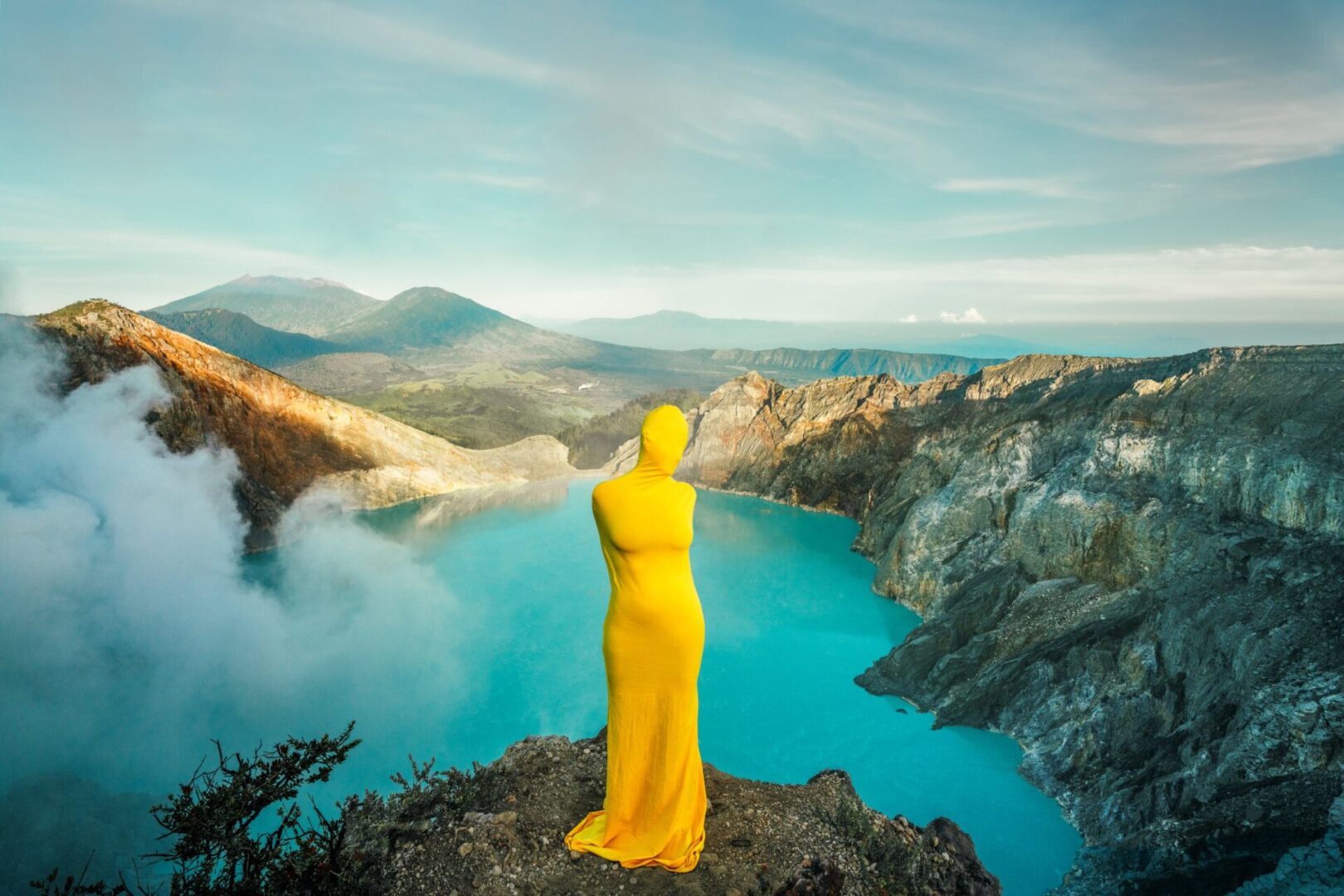
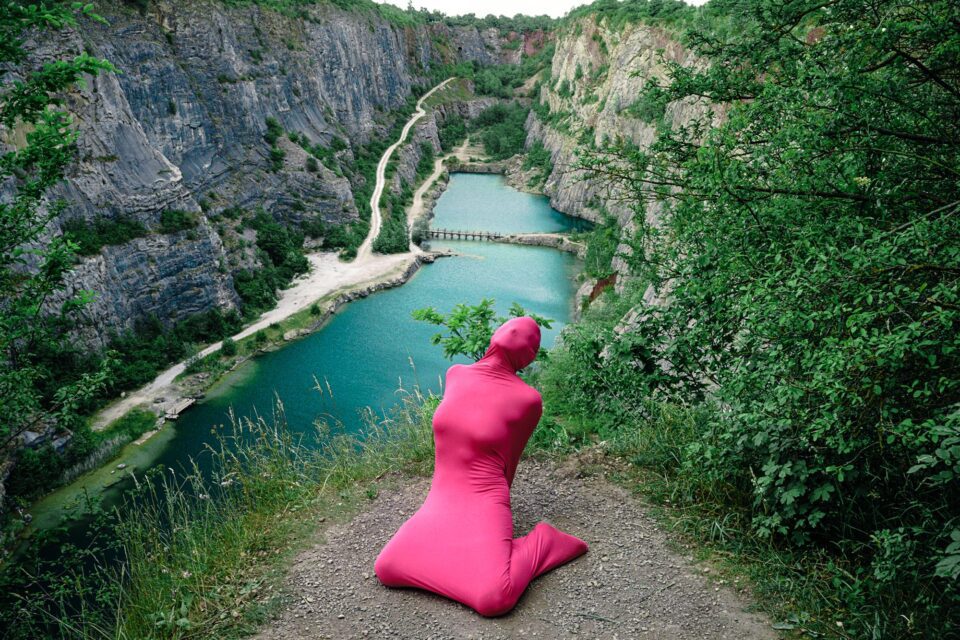
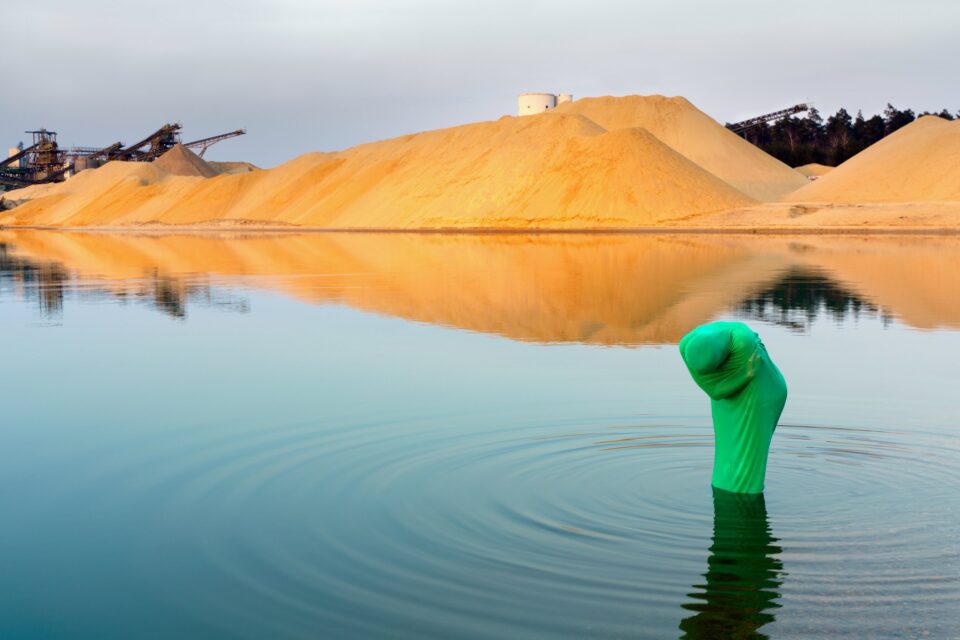
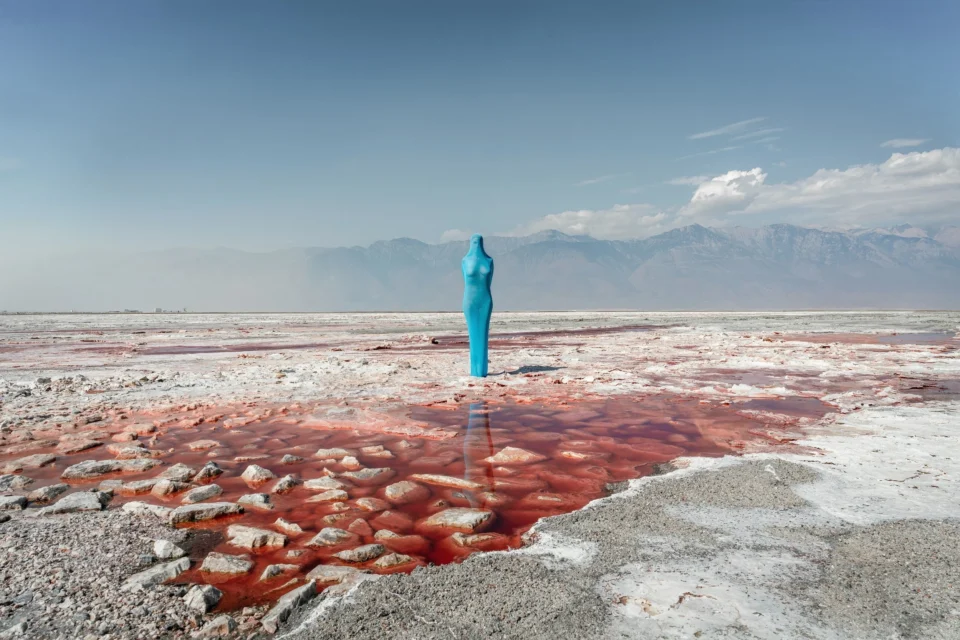
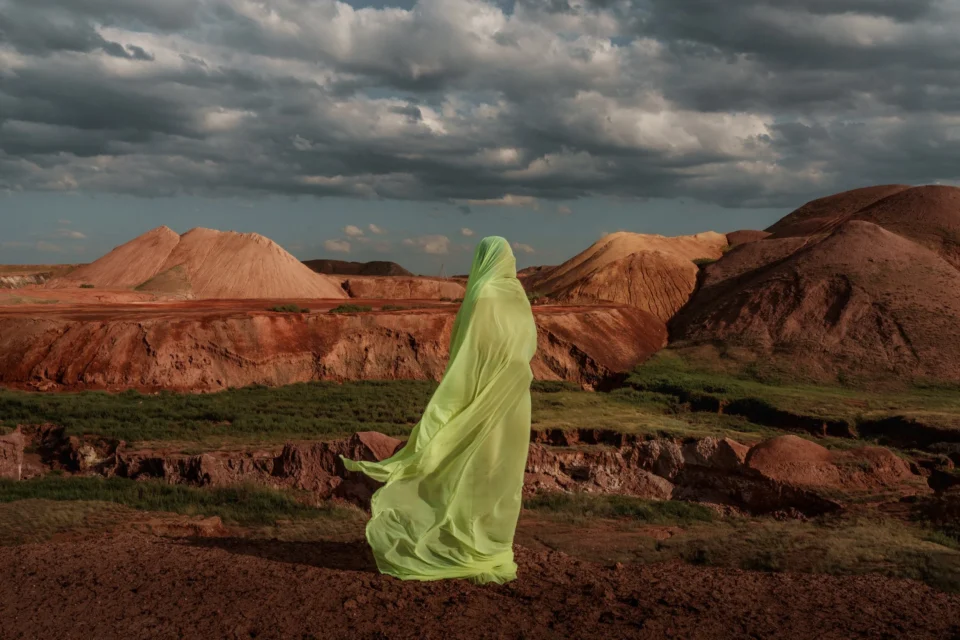
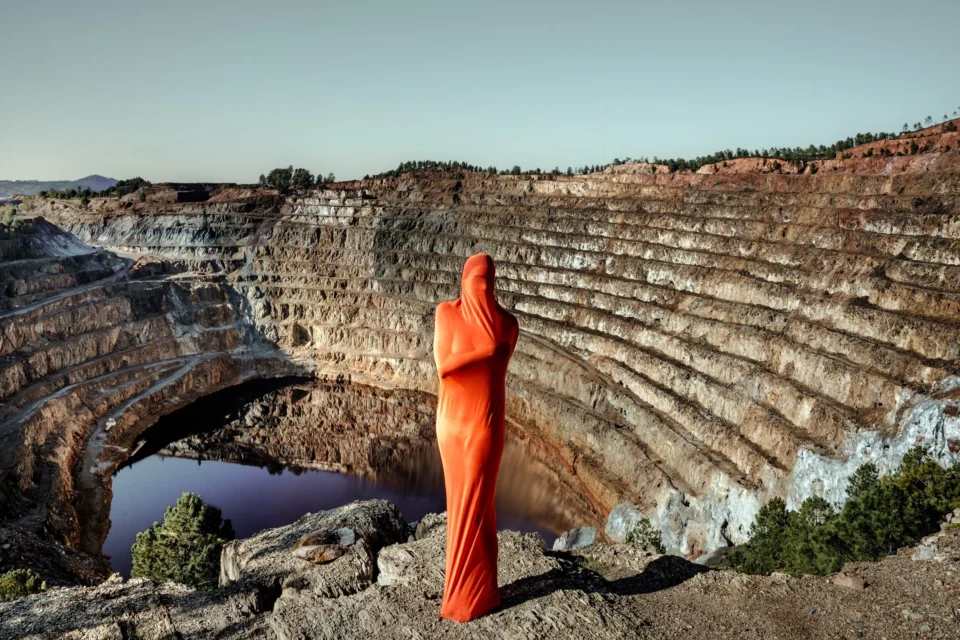
Liz Miller Kovacs photographs herself in scarred, extractive landscapes, exploring the link between environmental destruction and the objectification of femininity. The Aesthetica Art Prize shortlisted series Supernatural sees the artist draped in colourful fabric, her identity obscured and her body separated from her surroundings. Her poses echo classical paintings and art-historical archetypes. These gestures sit uncomfortably against the backdrop of ecological damage – mines, quarries and industrial ruins – calling attention to the violence enacted on both land and body. The work challenges viewers to consider how future societies might interpret these ruined environments and what they reveal about past attitudes. Aesthetica caught up with Kovacs to chat about the powerful series.
A: What first drew you to connect the female body with extractive landscapes?
LMK: For many years, I have been inspired by female artists of the 1970s who used photography as a response to the male-dominated Land Art movement, such as Ana Mendieta’s earth-body works and Judy Chicago’s Smoke Bodies. I started a photo series in 2018, where I photographed my body trying to meld into various types of terrain – desert, dry lake beds, tropical rainforest. During the pandemic, I spent a lot of time researching locations. One day, I stumbled across a photo of some unusual canals in the middle of the Mojave Desert filled with iridescent turquoise water. The place turned out to be the National Chloride Company’s evaporation ponds, where calcium chloride is harvested from underground brine pools. I decided to drive out to see this place and shoot some photos of myself there in a costume I had lying around. I then began to study the scope, scale and diverse effects of extraction industries on the land.
A: Can you describe your process of selecting sites? What are you looking for in these landscapes?
LMK: I look for visually striking landscapes of extraction – places about with unique geology and colourful soil or water. By capturing these compelling locations, I hope to encourage the viewer to learn more about the resources we consume. I want to show the global extent of extractivism and spend countless hours searching for locations around the world. I find most of the spots online, employing a variety of methods, including targeted queries through search engines and social media platforms with specific keywords to discover geotagged photos. I also discover locations through word of mouth. For instance, when I connect with people in person or online, I often ask if there is a history of mining in their region. I then read about what past or present extraction industries exist near the places I visit for work or personal reasons. I collect photos, articles and press releases about potential sites for my project to establish if and how access is possible. It is also important to assess the health and safety risks of each spot.
A: Your work situates the body in surroundings marked by violence. How do you view the relationship between environmental destruction and the objectification of femininity?
LMK: I see parallels between our culture’s exploitation of nature and the objectification of women. The commodification of natural resources echoes that of women’s bodies, both of which are viewed as objects for consumption. Patriarchal dominance over land and societies contributes not only to gender and social injustices, but also to environmental issues. By positioning my body in these scarred surroundings, I explore the connection between the feminine body and the natural world. I agree with many of the principles of Ecofeminism, although the movement stems from western institutions that don’t sufficiently address colonisation as extractivism and lack crucial Indigenous perspectives on sustainability. Yet, I feel it is imperative not to be didactic or hypocritical, as modern life relies on extracted materials. While many of the sites where I stage my photographs are scarred and dystopian, not all are. Some of the places I work are carefully considered to minimise environmental impact, and others develop their own unique ecosystems.
A: You photograph yourself in these environments. Can you talk us through the process of capturing these self-portraits?
LMK: Since I photograph all of my work on location, orchestrating these photos involves travel, planning and costume design. When I first started this project, I worked with a costume designer to create identical suits in almost every color of the rainbow. Since then, I have added different outfits and fabrics to my project wardrobe. Several weeks before the shoot, I decide on costuming: What colours will contrast with my surroundings? Is it hot or cold? What shapes and poses might work in the space? If time allows, I spend the first day on location photographing the site. I scout angles and lighting conditions and decide on which focal lengths and lenses I will use. For practical reasons and safety, I almost always travel with an assistant who stands in place for me as I set up the camera. Then we switch places, and they help me into costume. My camera has an “interval shooting mode,” so I only have to tell them when to start the shutter rolling.
A: How do you envisage your creative practice developing in the future?
LMK: I envision adding new dimensions to this ongoing, long-term project, which may never be “complete.” As I continue learning about the subject of extraction, the project evolves. I anticipate dedicating several more years to this work, and am starting to photograph people I meet in mining towns along with documenting the vicinity of extraction industries. After experimenting with various materials and printing techniques, I’ve created a companion series called Rare Earth, which consists of prints of landscapes on different metal substrates that complement the figurative works. This format highlights the preciousness of the earth and its resources. I also see the project eventually incorporating interactive elements like maps, resource information and community impact, alongside moving images. There are still many gaps in my world map of extraction locations due to financial constraints and geopolitical complications. Recently, the series garnered enough recognition to secure funding for documenting more remote locations. I’ll be an artist-in-residence in the Goldfields of Western Australia for six weeks in 2026. During this time, I aim to connect with locals and photograph people and the aspects of life shaped by extraction industries. There are also crucial locations in Africa that I plan to include, for which I am investigating funding opportunities.
The Aesthetica Art Prize is Open for Applications. Win £10,000 and Exhibition. Submit Here.
The Aesthetica Art Prize Exhibition 2025 is at York Art Gallery until 25 January.
miller-kovacs.art | yorkartgallery.org.uk
Words: Emma Jacob & Liz Miller Kovacs.
Image Credits:
All images courtesy of Liz Miller Kovacs.