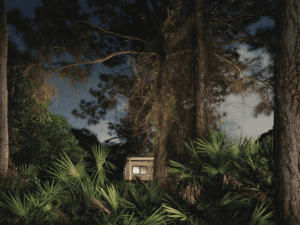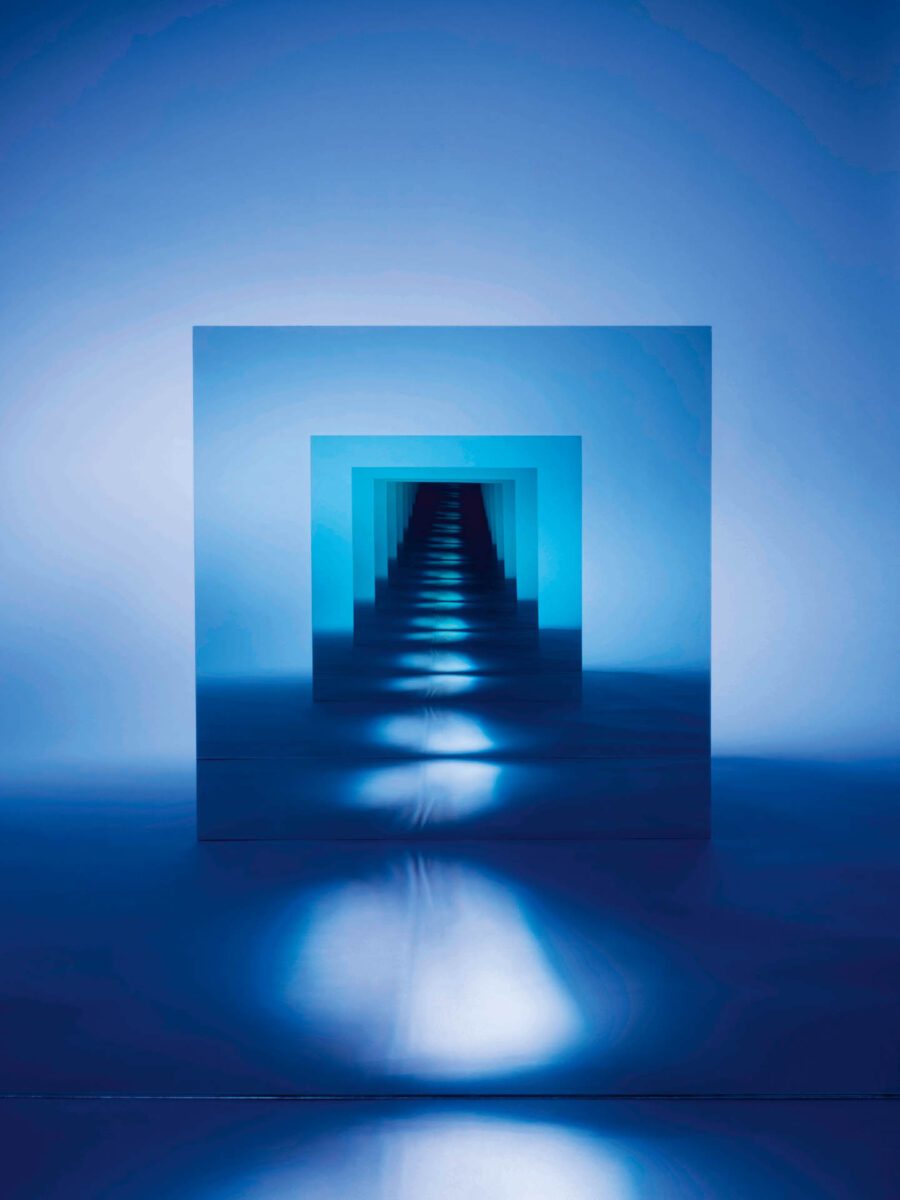
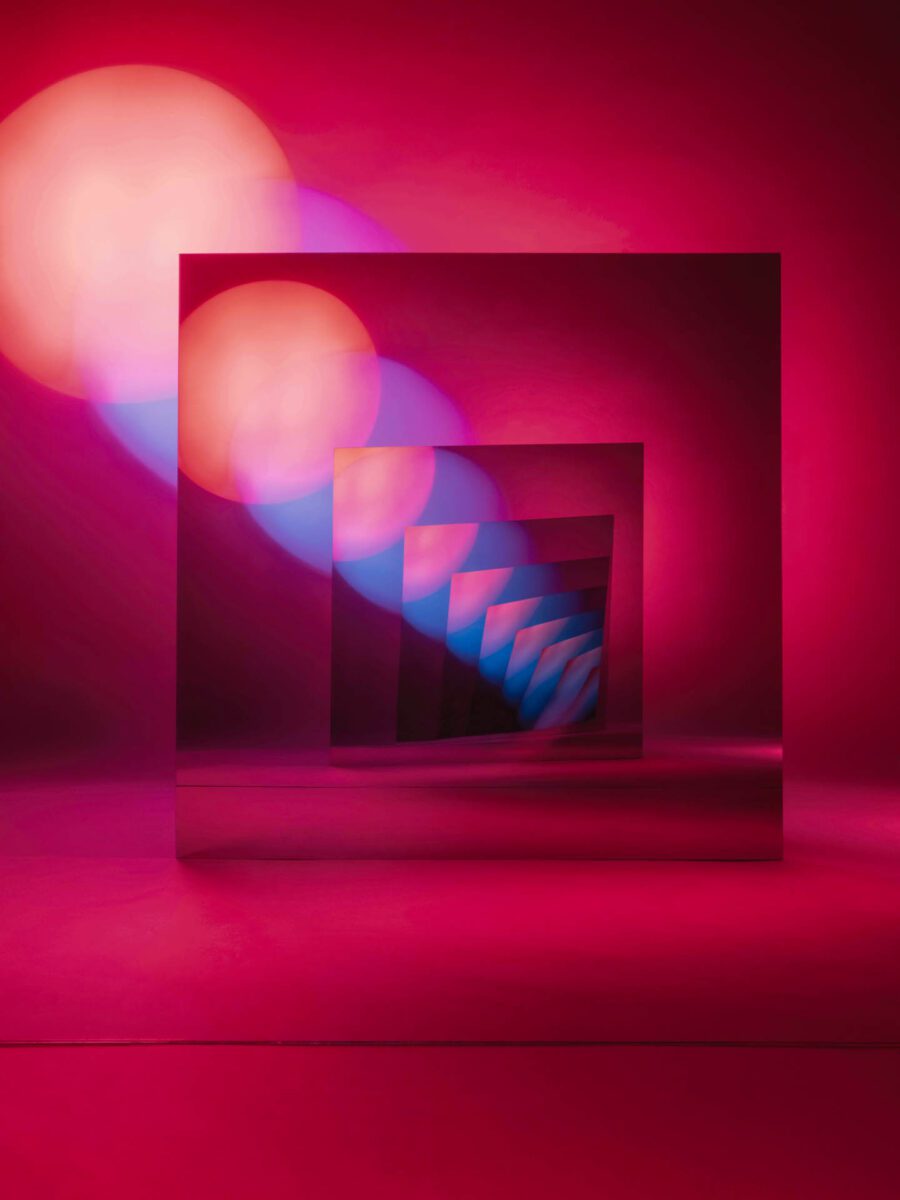
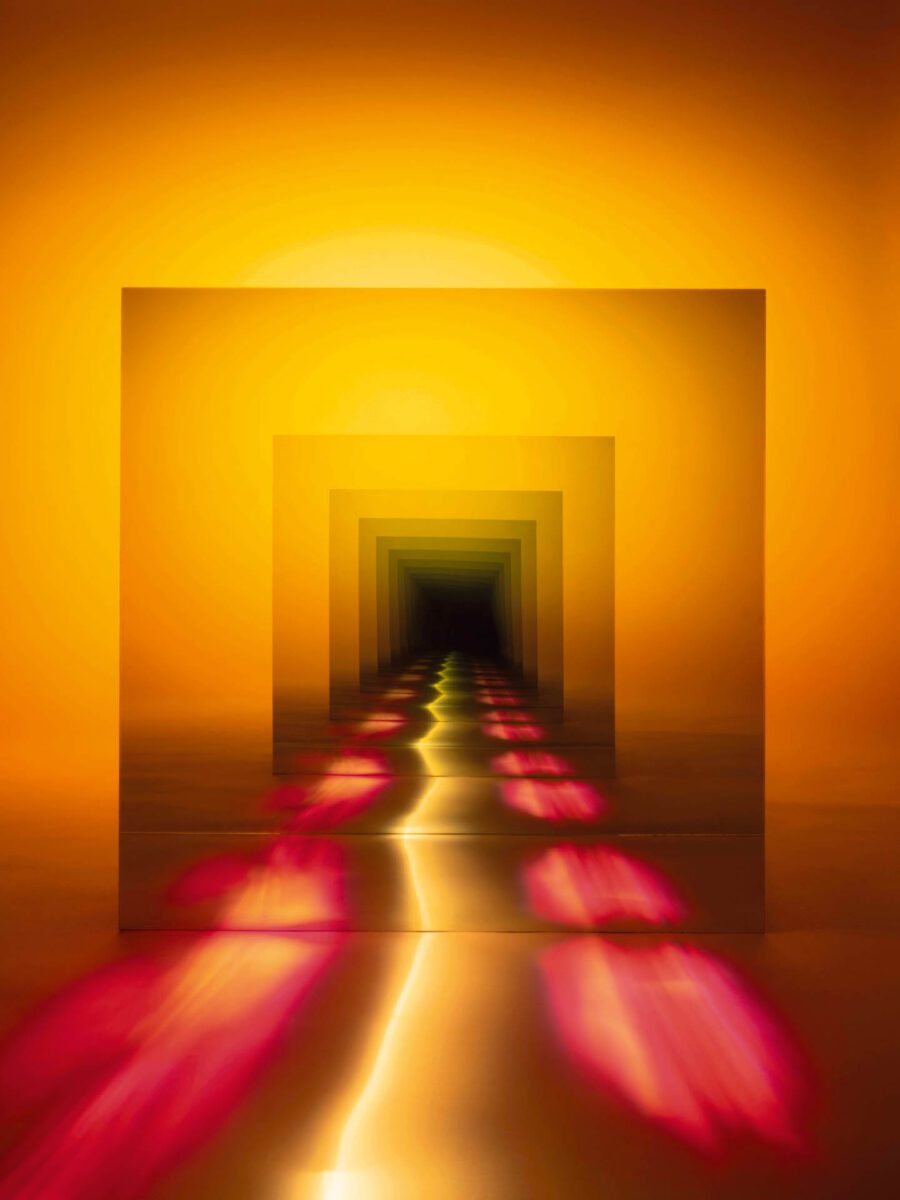
Societies operate through intricate networks – automated systems, advanced technologies and structures of power, value and control. Artist Sarah Meyohas (b. 1991) is dedi- cated to making these constructs visible. One of her best- known pieces is Bitchcoin, a cryptocurrency-as-artwork that launched in 2015 to question the speculative value of cryp- tocurrency and the ineffable value of art. It was released five months before the launch of Ethereum and predated the NFT boom, leading The Wall Street Journal to place her “at the vanguard of an art-world revolution.” But Bitchcoin is just one of the many innovative projects that make up Meyohas’ ever-growing oeuvre: she’s also synchronised the movement of birds to unpredictable stock market fluctuations, built an AI dataset of rose petals and created Speculations: a series of brightly-coloured mirror images that “literally never ends.”
Meyohas is a leading voice on the capabilities of emerg- ing technologies in art and culture. As such, she wears many hats: as an artist, inventor, economist and technologist. This interdisciplinary approach has led to substantial recognition. In 2017, she was included on the Forbes 30 Under 30 list, and her work now sits in the collection of Centre Pompidou, Paris. She has been published in Artforum, The Financial Times, The New York Times and Vice, and has exhibited work at The Barbican Centre, London, as well as The New Museum of Contemporary Art and Rockefeller Center in New York City.
Now, the artist is part of Desert X 2025, the fifth edition of the site-specific, international art exhibition that takes place in the Coachella Valley. The event breaks free from gallery walls, inviting creatives to riff on the desert landscape. Eleven installations have been designed and implemented; they not only respond to the region’s vastness and beauty, but also comment on issues that matter in today’s world. Meyohas joins an impressive line-up: Agnes Denes, Alison Saar, Can- nupa Hanska Luger, Jose Dávila, Kapwani Kiwanga, Kimsooja, Muhannad Shono, Raphael Hefti, Ronald Rael and Sanford Biggers. The themes cover everything from deep time to In- digenous futurism, design activism, colonial power and the impact of humanity on the land. Their interventions take on ambitious forms: a giant pyramid covered in plants, a gas station “for the soul” and a towering 30 foot cloud sculpture.
Meyohas’ contribution is Truth Arrives in Slanted Beams, which showcases “caustics” – light patterns formed by the refraction or reflection of light through curved surfaces. They often occur naturally, like at the bottom of a swimming pool. In Coachella, Meyohas enables visitors to project sunlight onto a ribbon-like structure cascading across the desert floor. The installation recalls ancient timekeeping methods, like sundials, whilst paying homage to 20th century land art. The artist has carefully mapped the sun’s path over the site, or- chestrating the interaction between mirrors and the artwork’s surface to craft precise reflections and shadows all day long.
The piece encourages Coachella Valley visitors to create unexpected illusions in the desert – waves, moiré patterns, or perhaps a mirage – “stirring a longing for the desert’s ever- present water.” As Desert X’s Artistic Director Neville Wake- field explains: “Time, light and space permeate every aspect of this work, but so too does an urgency to find new sustaina- ble approaches to living in an increasingly imperilled world.”
A: What was it like to work with the Coachella Valley as a backdrop, as opposed to a traditional gallery space?
SM: I’ve long imagined working at this scale and in an out- door setting. The desert offers artistic possibilities that a traditional white cube simply cannot – especially when it comes to light, which has always been central to my practice, whether in photography, holography, or, in this case, caus- tic reflections. For years, I had been experimenting with this type of technology. It redirects light through a lens or off a mirror to generate images purely from light itself. When I at- tempted to adapt this technique for a gallery setting, I found that artificial lighting dulled its magic. This approach thrives on natural sunlight, which made the invitation from Desert X feel serendipitous. The desert – where the sun is ever-pre- sent – became the ideal site to fully realise this vision. From there, the work took shape around a single question: How could I make sunlight the medium, the bearer of a message?
A: Truth Arrives in Slanted Beams focuses on refraction and reflection – themes that also appear in your Speculations series. Why do you return to the mirror image?
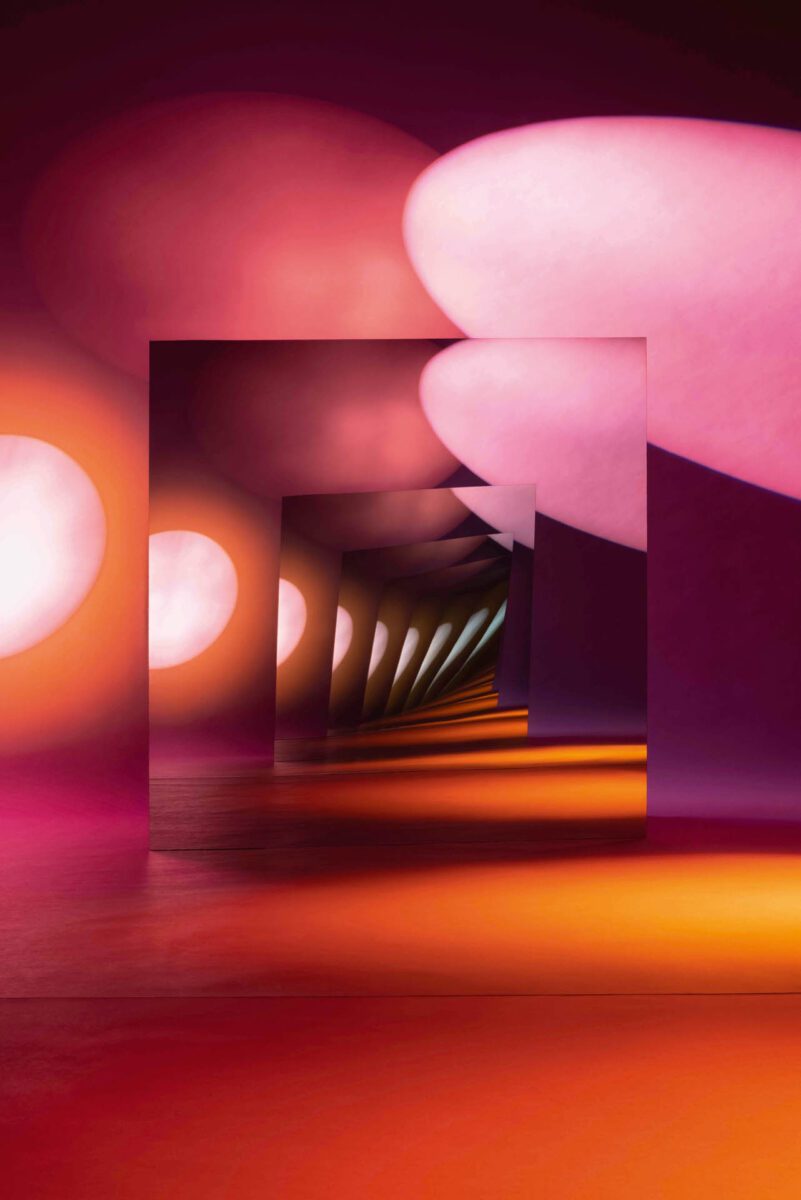
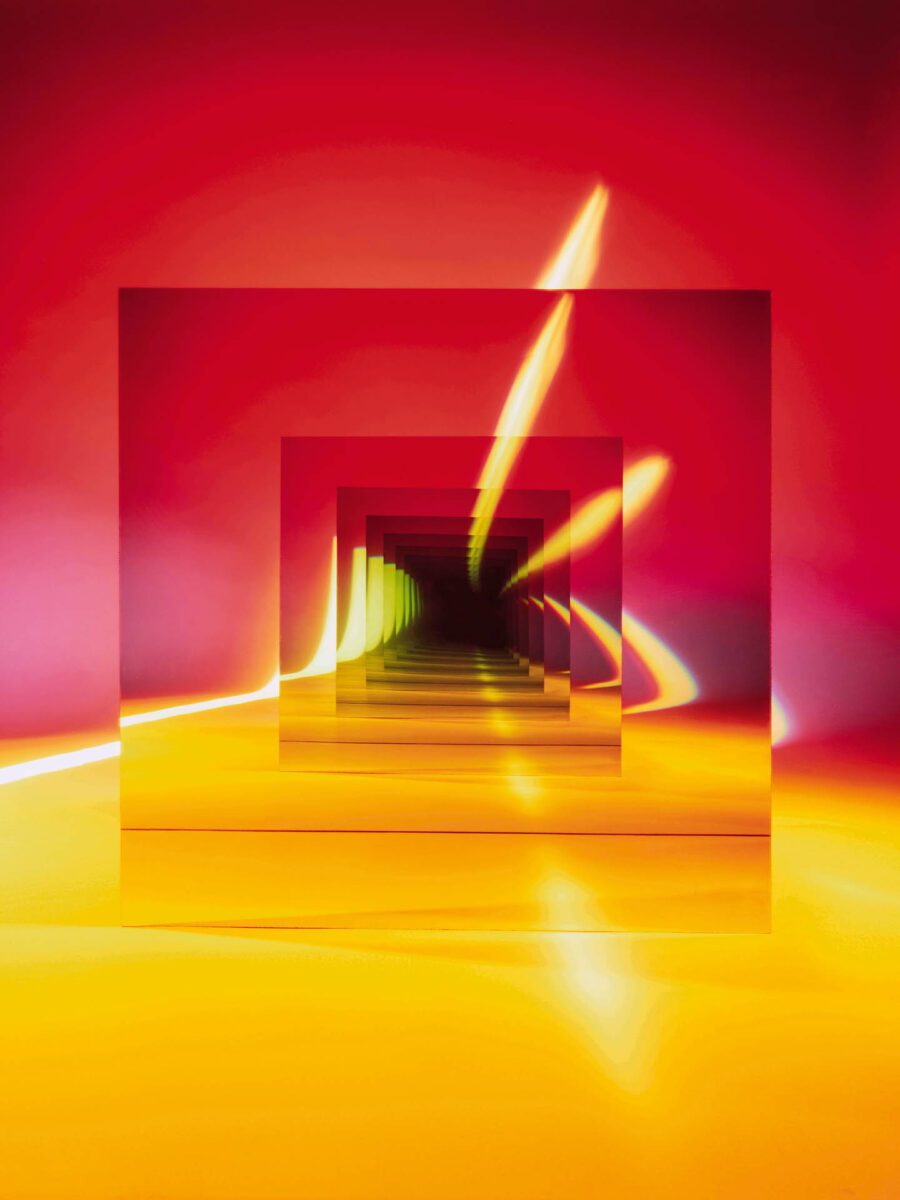
SM: Speculations was originally conceived in the context of Bitchcoin, where I tied the financial concept of speculation to the specular nature of mirrors – the way both involve an act of projection, and an imagined value. Both Speculations and Truth Arrives in Slanted Beams explore how light can be reflected, but in distinct ways. In Speculations, light is effec- tively trapped through an optical effect between a mirrored plane, creating a sense of illusion and depth. In Truth Ar- rives in Slanted Beams, it is reflected off an uneven surface, making the projection dynamic and ephemeral. I’m drawn to the way in which light structures perception, how it reveals and distorts, and how it can be used to make visible the sys- tems – both physical and conceptual – that shape our world.
A: How does the new installation relate to previous work?
SM: It is both an extension and a new beginning. Conceptually, it aligns with my ongoing explorations of light, percep- tion and systems of value. But in terms of execution, Truth Arrives in Slanted Beams represents new ground for me – I had never worked architecturally or with caustic technology at this scale before. This piece has opened up exciting new avenues that I now plan to continue exploring into the future.
A: It is also interactive, allowing visitors to manipulate the mirrors. How important is audience collaboration?
SM: Participation has always been integral to my practice. I’ve long been interested in relational aesthetics, and in many of my works, the meaning is activated through interac- tion – whether it’s a live audience engaging with Interferences (where holograms shift with movement), an AI responding to human input in Cloud of Petals, or financial markets shaping Stock Performance and Bitchcoin. In Truth Arrives in Slanted Beams, the audience physically moves mirrors, bringing pro- jected images into focus. I see this as a metaphor for human perception – how we actively shape what we see around us.
A: Which Desert X works are you looking forward to?
SM: I’m particularly eager to see Agnes Denes’s The Living Pyramid. She is a pioneer in land art, and I admire her ability to fuse mathematical precision with ecological conscious- ness. I am also very intrigued by Sanford Biggers’s Unsui (Mirror) – perhaps for obvious reasons – but also because of how the artist harnesses the desert’s natural forces. Biggers is using wind to create a shimmering, kinetic interplay of light.
A: Who, or what, are your biggest creative inspirations?
SM: My background in finance informs my artistic practice in fundamental ways. I studied economics at The Wharton School of the University of Pennsylvania whilst simultane- ously exploring art, and when I first encountered Bitcoin in 2014, it was a revelation. The idea that a financial system could be conjured into existence by an anonymous individual through a creative, almost conceptual, gesture fasci- nated me. It reinforced my belief that value is, at its core, a construct – one that can be shaped through art just as much as through markets. Conceptual artist Adrian Piper has been a major influence, particularly in how she integrates phi- losophy, activism and performance to engage with reality in profound ways. Similarly, Yves Klein’s articulation of value and immateriality – his ability to frame art as both a spiritual and economic act – has deeply shaped my thinking about the intersections between aesthetics, finance and technology.
A: Bitchcoin was ahead of its time in 2015, merging cryptocurrency and art. Since then, we have seen a rise and fall in the NFT space. What does the future hold?
SM: The future of digital art is bright. The NFT boom during the pandemic was an inevitable speculative bubble, but digi- tal art itself is not a passing trend – it has existed for decades and will continue to evolve. Blockchain remains promising, particularly in its ability to offer provenance and decentralisation. Whilst the initial hype around it has faded, I believe we’re moving towards a more mature phase where more long-term applications for these technologies will emerge.
A: AI and machine learning are increasingly integrated into creative processes. Do you consider this type of software as a tool, collaborator, or something different?
SM: Like any powerful technology, AI presents both opportunities and challenges. It can certainly be a valuable tool for artists, but it also raises fundamental questions about au- thorship, creativity and labour. Rather than replacing artists, I see AI as a medium – one that requires a critical and inten- tional approach. In many ways, it’s like photography or video when they first emerged – initially it was disruptive, but they ultimately expanded the parameters for artistic possibilities.
A: You work with various media. Do you have a favourite?
SM: Fluidity is essential to my approach. Each idea dictates its own form, and I want my practice to remain responsive – to evolve alongside new technologies, new contexts, and new ways of seeing. Restricting myself to a single medium would be like trying to tell every story with the same vocabulary.
A: What’s on your radar for 2025? Any new projects?
SM: I’m expanding Truth Arrives in Slanted Beams. We’ve been filming on-site with Jacob Jonas The Company, who performed at the opening, and I’m currently in Joshua Tree creating holograms that will debut in 2026. My studio is re- fining a 6’x6’ drawing machine that produces pastel compo- sitions titled Millionfold, and we’re developing experiments in painting, sculpture, film, furniture and AI. There’s always more in motion – fresh ideas, technologies and frontiers.
Desert X 2025, Coachella Valley | Until 11 May
Words: Eleanor Sutherland
All images:
Sarah Meyohas, from the series Light Speculation (2023). C-Print. Image courtesy the artist and Marianne Boesky Gallery.