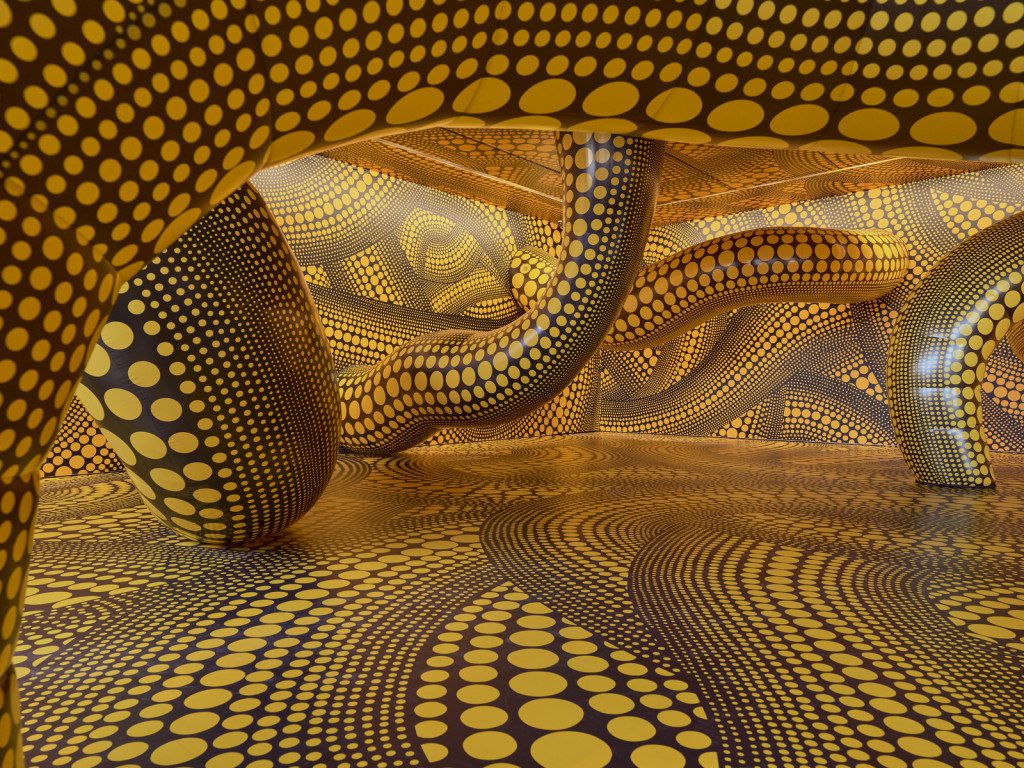
In the landscape of contemporary art, few figures command a visual and conceptual vocabulary as instantly recognisable – or as persistently influential –as Yayoi Kusama. Her practice has become synonymous with immersion, repetition and the dissolution of the self into boundless spatial fields, where the viewer is no longer external observer but absorbed participant. Across painting, installation, performance and fashion, Kusama has constructed an artistic universe that expands endlessly through pattern, light and reflection. In an era increasingly defined by experiential culture, her work feels not only historically significant but urgently contemporary. It offers a language through which ideas of infinity and psychological intensity are rendered physically navigable. This sustained relevance forms the backbone of a major new retrospective at the Stedelijk Museum, affirming her status as one of the most important artists working today.
Kusama’s early trajectory in the 1950s, beginning in Matsumoto and continuing into post-war Japan, established the foundations of her visual lexicon. Even in these formative years, the repetition of motifs and psychological intensity of her canvases signalled a departure from dominant modernist tendencies. After relocating to New York in the late 1950s, she quickly embedded herself within the avant-garde circles of the 1960s, staging provocative happenings that merged performance, activism and bodily engagement. Works such as her body-painting events and outdoor interventions changes the boundaries between art object and lived experience. Her infamous interventions on the Brooklyn Bridge in 1968 epitomised this radical energy, positioning her as both insider and disruptor. These years cemented her commitment to dissolution – of ego, of authorship, of fixed spatial limits.
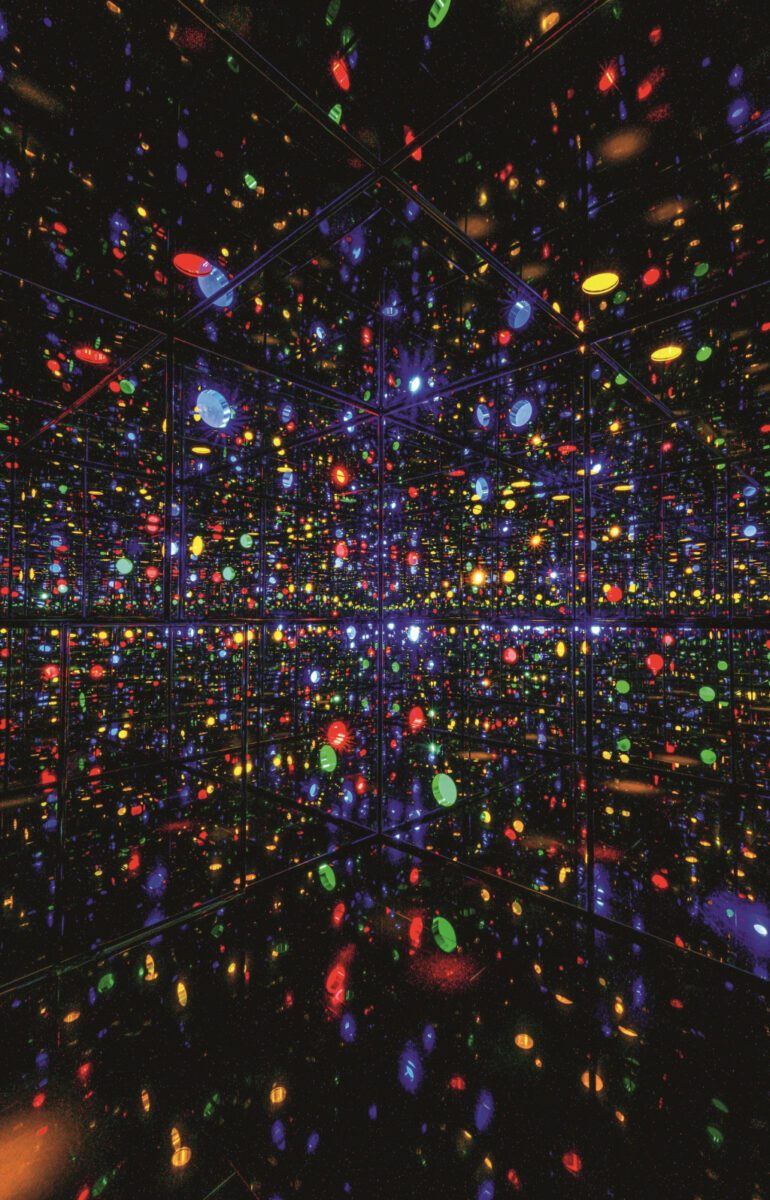
The idea of self-obliteration, central to Kusama’s philosophy, became increasingly articulated through her paintings of repetitive polka dots and obsessive patterning. Rather than decorative, these forms function as visual systems that consume surfaces, erasing hierarchy and depth. This logic would later evolve into her celebrated Infinity Mirror Rooms, first developed in the mid-1960s and continually reimagined throughout her career. These installations rely on mirrored walls that multiply light sources, objects and the viewer’s own body into an apparently limitless field. Entering them produces a disorientation that is both visual and existential, as the self becomes fragmented across endless reflections. The experience is deliberately time-bound, intensifying awareness of perception as something fleeting and unstable.
In the past five years, Kusama’s global presence has been reaffirmed through a series of major exhibitions that foreground the experiential power of her immersive environments. At Tate Modern, the continued presentation of Infinity Mirror Rooms drew unprecedented visitor engagement, with audiences queuing for hours to spend mere minutes inside luminous, mirrored constellations. The popularity of these installations underscored a broader cultural shift towards participatory art experiences that privilege immediacy and immersion. In 2021, the New York Botanical Garden presented Cosmic Nature, where monumental floral sculptures and polka-dotted environments extended her visual language into the landscape itself. The following year, the Hirshhorn Museum in Washington D.C. staged One with Eternity, a long-term presentation of Kusama’s mirrored environments that emphasised duration and repetition as curatorial strategies. Together, these exhibitions demonstrated the adaptability of her practice.
By 2024–2025, Kusama’s presence in Australia reached a significant institutional peak with a major survey at the National Gallery of Victoria. Opening in December 2024 and running into April 2025, the exhibition presented one of the most extensive presentations of her work ever staged globally, bringing together more than 180–200 works across painting, sculpture, installation, fashion and immersive environments. Rather than a narrowly defined single-theme show, it functioned as a comprehensive career-spanning survey, tracing Kusama’s practice from early works through to recent productions. A key component of the exhibition included large-scale immersive installations, including Infinity Mirror Rooms and new or recently developed works, reinforcing her ongoing engagement with perceptual instability and repetition. The exhibition was widely framed by the National Gallery of Victoria as the largest Kusama presentation ever mounted in Australia, and among the most comprehensive surveys of her career internationally. Far from a minor regional showing, it consolidated her institutional presence in the Southern Hemisphere.
By 2024, Kusama’s presence had expanded further through a sustained network of international exhibitions, reaffirming her global reach and enduring appeal across generations. These recent presentations have not simply reiterated established themes but have reactivated them within new spatial and cultural frameworks. The Infinity Rooms, in particular, continue to function as sites of collective fascination, where digital-era spectatorship meets analogue, bodily presence. In an age saturated with images, their appeal lies in their resistance to reproduction; they must be physically entered, however briefly. This insistence on embodied experience positions Kusama’s work in direct contrast to the flatness of digital consumption. Her installations therefore operate as both refuge and confrontation, offering moments of perceptual suspension within accelerated visual culture.
At the heart of Kusama’s sustained relevance is her ability to translate deeply personal psychological states into universal spatial experiences. Her recurring motifs – pumpkins, nets, dots and mirrors – function not as symbols but as systems, generating environments rather than images. The pumpkin, for instance, becomes both object and vessel, a stabilising form within otherwise destabilised fields of perception. Meanwhile, her net paintings from the 1960s anticipate digital patterns and algorithmic repetition, suggesting an uncanny prescience in relation to contemporary visual technologies. Rather than evolving linearly, her practice accumulates, layering decades of experimentation into a cohesive yet expanding universe. This temporal complexity is central to her impact on contemporary art.
It is within this context that the upcoming retrospective at the Stedelijk Museum in Amsterdam assumes particular significance. Opening on 11 September 2026 and running until January 2027, the exhibition marks one of the most comprehensive presentations of Kusama’s work to date. Spanning over seven decades, it will bring together painting, sculpture, installation, collage, fashion and performance documentation. The curatorial approach emphasises both historical depth and material diversity, tracing her development from early works in Japan to recent productions in Tokyo. Importantly, the exhibition will also include new works created for the presentation, extending her ongoing engagement with infinity and repetition. It is a rare opportunity to encounter the full breadth of an oeuvre that continues to evolve.
The retrospective is organised in collaboration with Fondation Beyeler and Museum Ludwig, forming a European circuit that underscores the institutional significance of Kusama’s practice. At the Stedelijk, the exhibition is positioned not merely as a historical survey but as a living environment, where earlier works converse with newly produced installations. A key highlight will be a specially created Infinity Room, designed to reconfigure her iconic mirrored environments for contemporary audiences. This new iteration reinforces the ongoing adaptability of her visual system, which continues to generate new perceptual conditions across decades. The museum’s director, Rein Wolfs, has described Kusama’s work as transformative in its ability to shift perception itself, a claim that resonates strongly within the immersive logic of the exhibition. The retrospective thus becomes both archive and activation.
Kusama’s legacy lies in her ability to sustain a coherent artistic vision while continually reinventing its spatial and material expressions. Her influence extends across installation art, performance practices and contemporary immersive environments, shaping how audiences now expect to encounter art. The Infinity Rooms, in particular, have become cultural touchstones, frequently referenced in digital media yet resistant to full translation outside physical experience. As the Stedelijk retrospective approaches, it reaffirms Kusama as an active force within contemporary visual culture. Her work continues to challenge the boundaries between self and environment, presence and disappearance, object and experience. In doing so, it offers not closure but continuation – an unfolding of perception that mirrors the infinite itself.
Yayoi Kusama is at Stedelijk Museum, Amsterdam from 11 September: stedelijk.nl
Words: Anna Müller
Image Credits:
1. Infinity Mirrored Room – ‘The Hope of the Polka Dots Buried in Infinity Will Eternally Cover the Universe’, 2025. Mixed media, detail. Photo: Mark Niedermann. © YAYOI KUSAMA
2. Yayoi Kusama, Infinity Mirrored Room – ‘Illusion Inside the Heart’, 2025. Mirror-polished stainless steel with glass mirrors and colored acrylic, 300 × 300 × 300 cm, inside view. Collection of the artist. Courtesy of Ota Fine Arts. © YAYOI KUSAMA.
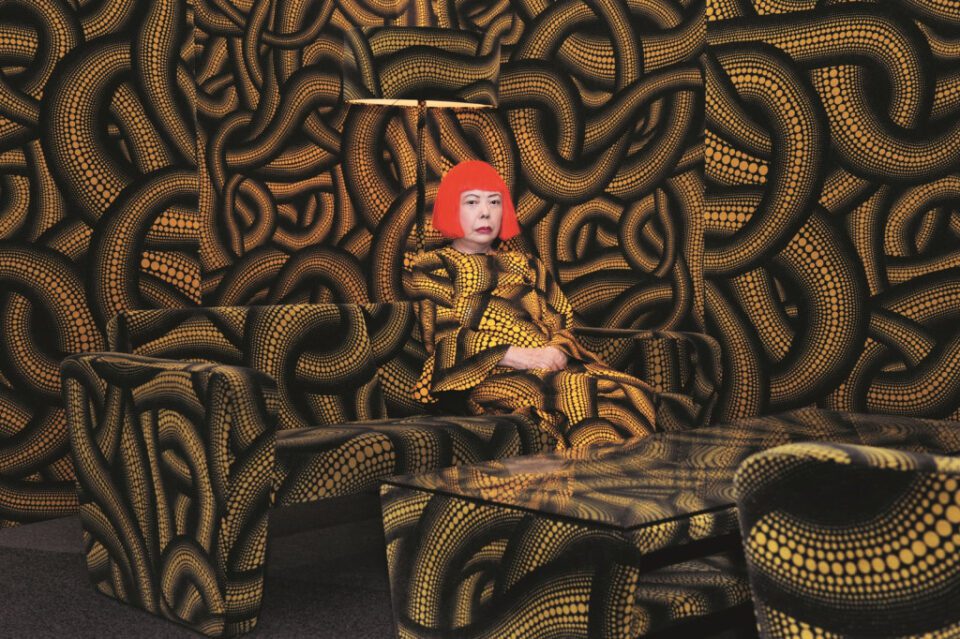
3. Yayoi Kusama in ‘Yellow Tree / Living Room’ during the Aichi Triennale in 2010 © YAYOI KUSAMA. Courtesy Ota Fine Arts and David Zwirner.
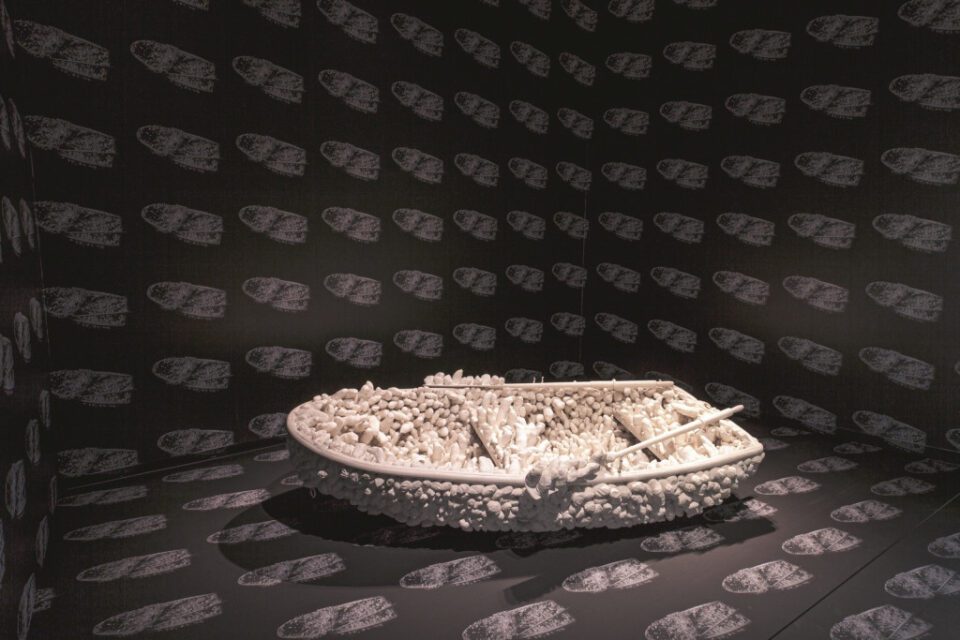
4. Yayoi Kusama, ‘Aggregation: One Thousand Boats Show’, 1963. Rowboat and oars covered by plaster castings in white cotton, a pair of women’s shoes, and black-and white posters; boat. Collection Stedelijk Museum Amsterdam, gift of the artist. © YAYOI KUSAMA.
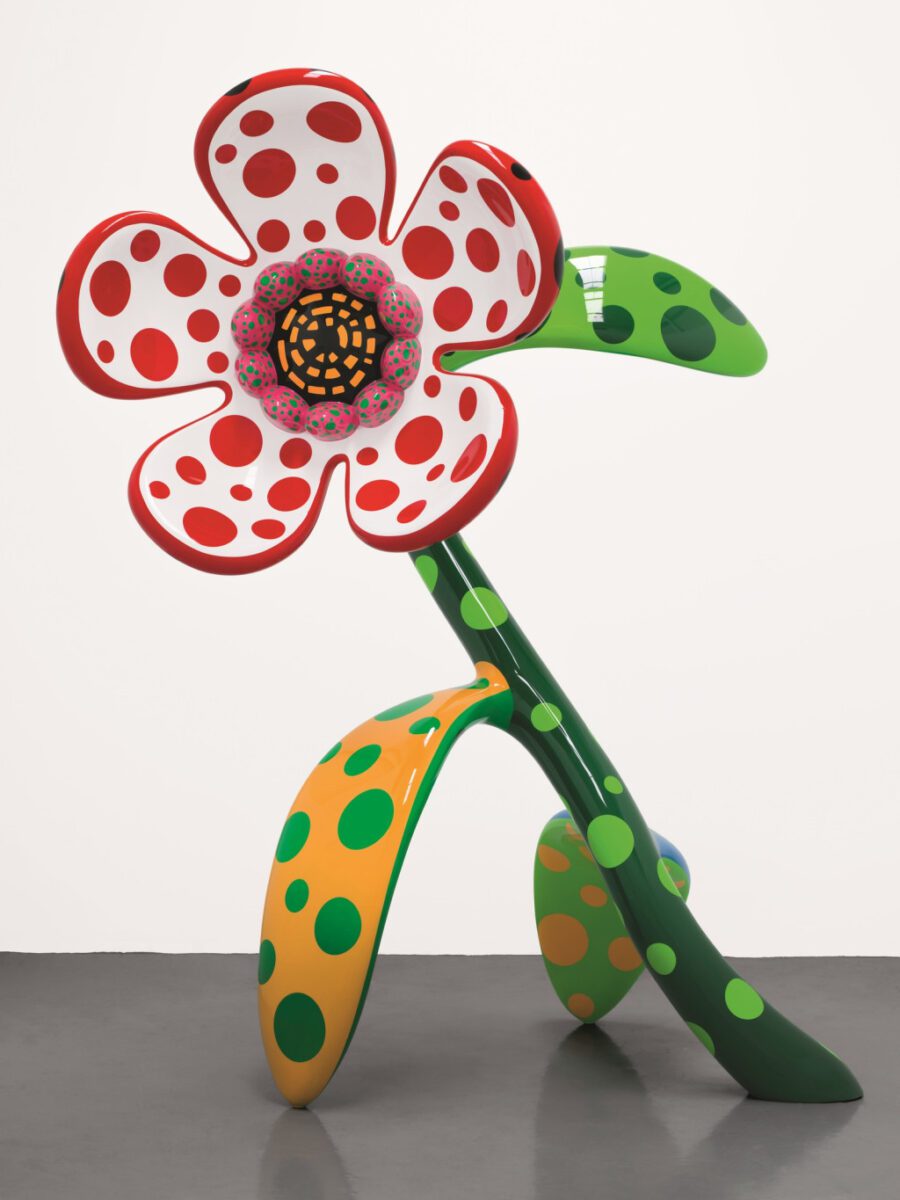
5. Yayoi Kusama, ‘Flowers That Speak All about My Heart Given to the Sky’, 2018. Painted bronze, 300 x 211 x 203 cm. Collection of the artist. Courtesy of Ota Fine Arts, Victoria Miro and David Zwirner. © YAYOI KUSAMA.