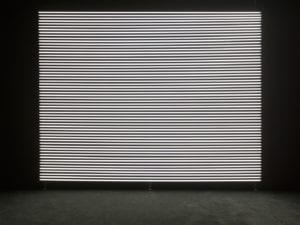
Jeremy Chen 陳純熙 (b. 1997) describes his work as occupying “the intersection between brain rot and Buddhism.” It’s a deliberately jarring framing that brings together the endless scroll of internet-era mental saturation with ideas of mindfulness, and the contrast is sharp enough to prompt a double take. Chen, a London-based artist and musician, was born in Hawaii and raised in Hong Kong. His practice spans site-specific installation, moving image, sound and performance, through which he explores the impact of online life on identity. “What exactly constitutes a self when the self is largely composed of borrowed imagery?” Chen asks. At its core, his work investigates artifice, alongside notions of detachment, ego and persona that have been reshaped by media saturation and exposure to the digital world. Drawing on cinema, Chen creates installations with all their components visible – as though revealing a film set.
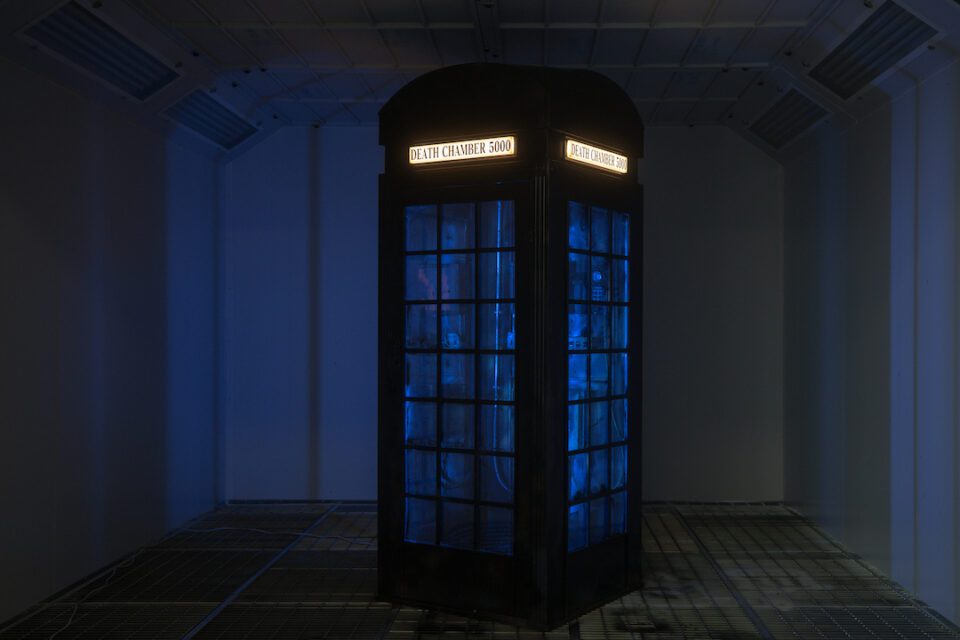
His most recent piece, In Perpetuity, Eternally, Forever!, presented at the 10th Bi-City Biennale of Urbanism/Architecture (UABB) in Shenzhen and Hong Kong, is an exercise in speculative world-building. It introduces the Afterlife Corporation, a fictional public utility operating in a parallel universe loosely modelled on our own. In this dystopia, medical advances have overcome human frailty, extending lifespans indefinitely. Here, death is no longer a natural occurrence but a regulated service, available only through authorised channels. The corporation’s flagship product – and the focal point of Chen’s installation – is the “Death Chamber 5000,” an antiquated phone booth tucked discreetly into the crevices of the city. It offers what its patent-pending literature (Chen has come up with the full fiction around the object, from branding to bureaucracy) describes as “a spiritual transitory system.” At the Biennale, Chen installed it “as though it has always been there” – questioning the normalisation of sinister systems embedded in our everyday.
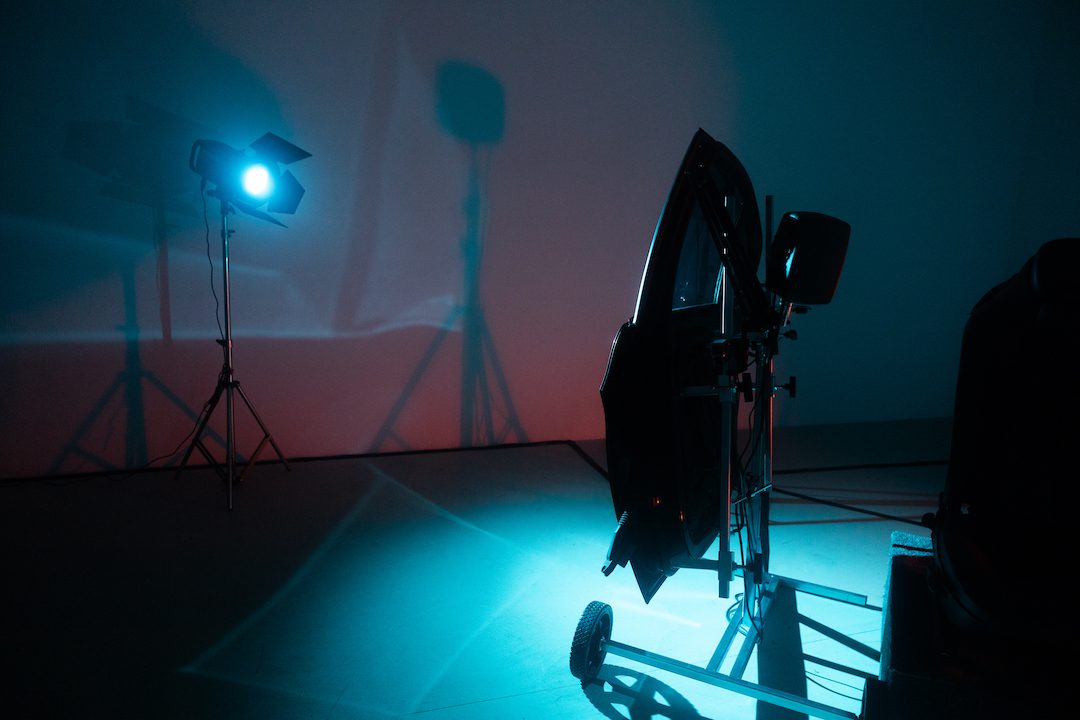
I Only Feel Feelings in Transit, which comprises car parts that have been disassembled and reconfigured, likewise treads the line between dystopia and real life. Here, Chen crafts an immersive audio environment drawn from “the iconography of the manosphere’s most canonised cinematic figures”: De Niro’s Travis Bickle, Ryan Gosling as the unnamed Driver and Christian Bale’s Patrick Bateman. These are the so-called “literally me” archetypes, “ostracised male figures who achieve a grotesque transformation from NPC to main character through ritualised acts of violence,” Chen says. The piece is timely, addressing troubling online communities and their growing real-world impact, whilst deconstructing concepts of masculinity.
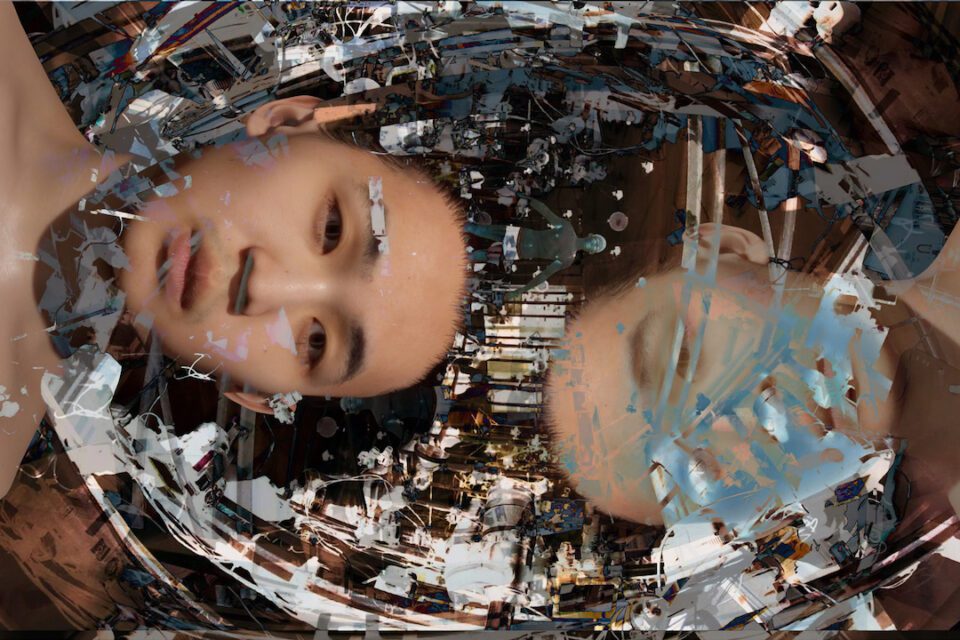
It’s worth noting that Chen is multi-instrumentalist and audio engineer who composes all his own scores. He treats sound as the structural foundation of his visual art; these fictional worlds find their identity as much in their music as anywhere else. I Only Feel Feelings in Transit is no exception. A single seat is positioned at the centre of the piece. “To sit in it is to perform the role of the passenger,” says Chen. Sitters are swept along by a soundscape that includes recordings of isolated pigeon wings, rain-soaked footsteps, tape-click radio channels and distant basslines. Chen’s interest in performance continues with FLAY, an ongoing AV series developed in collaboration with Zein Majali and first presented at FACT Liverpool in April 2025. Described by the artists as “kill-streak-theatre-open-world-karaoke-clickbait-expressionism-dance-dance-revolution-Mario-Kart-jazz”, it is deliberately undefinable.
Across installation and performance, Chen’s focus is consistent: the self is not a stable entity to be portrayed, but “a material to be shaped, scanned, rigged and rendered.” He believes that “art about digital culture too often positions itself at a safe critical remove,” and his practice offers a counter – distinguished instead by a willingness to build the experience from the inside out. Chen constructs worlds where dying is a public utility and masculinity is a performance no one remembers signing up for. This is work that resists easy diagnosis: it does not comment on the online world, so much as reproduce its logics at full volume.
Words: Eleanor Sutherland
Image Credits:
1. I only feel feelings in transit (2024)
2. In perpetuity, eternally, forever! (2026)
3. I’m so meta, hahaha: Explorations in Jeremy (2022)