
Photography is not a neutral witness. Every image is shaped by the conditions of its making: the photographer’s position, the subject’s visibility and the political circumstances that determine what enters the frame. In moments of protest, these considerations become charged. The camera can expose abuses of power, preserve the presence of those excluded from official histories and transform individual acts of dissent into collective visual memory. Photographs also shape how resistance is grasped, influencing which movements gain recognition and which stories remain at the margins. This complex relationship between representation, political agency and historical memory underpins Resistance – How Protest Shaped Britain and Photography Shaped Protest, a major exhibition by Steve McQueen, now on view at Leeds Art Gallery.
The distinction between photography of protest and photography as protest provides an important starting point. An image may record a demonstration, but its circulation can extend the event’s political significance, turning a local confrontation into a wider demand for accountability. Equally, the absence of certain images from public archives reveals how historical narratives are shaped by institutional priorities, editorial decisions and unequal access to representation. Spanning a century of British activism, Resistance considers these tensions through photographs documenting movements from the radical suffragette movement of 1903 to the mass demonstration against the Iraq War in 2003. Its chronology encompasses struggles for workers’ rights, racial equality, nuclear disarmament, environmental protection and social justice, connecting campaigns through their demands for dignity, representation and political accountability. By concentrating on photographs made before digital cameras became commonplace, the exhibition also considers a visual culture in which images circulated through newspapers, publications, archives and personal collections, not the instantaneous networks that now shape political visibility.
This historical perspective acquires urgency within contemporary Britain. Questions of national identity, migration, belonging and democratic expression have become increasingly prominent in public debate, while the electoral growth of right-wing populism has brought renewed attention to the histories of anti-racist organising, anti-fascist resistance and grassroots solidarity. At the 2024 general election, Reform UK received 14.3 percent of the vote and won five parliamentary seats, establishing a significant electoral presence within the first-past-the-post system. The result brought renewed attention to the changing character of British political debate and the relationship between national identity, migration and political belonging. Against this backdrop, Resistance offers an opportunity to revisit how previous generations confronted racism, inequality and political exclusion, without suggesting that historical struggles can simply be mapped onto the present. Its significance lies in recovering the experiences of individuals who challenged established structures of power, often at considerable personal cost, and reminding audiences that democratic rights and social freedoms have never been an inevitability.
Photography’s role in shaping political consciousness has also become a subject of renewed curatorial attention. At South London Gallery, Acts of Resistance: Photography, Feminisms and the Art of Protest (2024), organised in collaboration with the V&A, brought together international artists and collectives examining how the camera might challenge conventional representations of activism. Its focus on intersectionality, transnational solidarity and digital technologies explored the relationship between feminist practice and contemporary political movements. A different but related historical perspective emerged through Women in Revolt! Art and Activism in the UK 1970–1990, which toured from Tate Britain to the Whitworth in Manchester and National Galleries of Scotland. Bringing together more than 90 women artists and collectives at its Whitworth presentation, the exhibition recovered the visual culture of feminist organising, anti-racist activism, the peace movement and queer liberation, demonstrating how artistic production developed alongside wider struggles for social change. Both exhibitions established important precedents for reconsidering the relationship between cultural production and political agency, a conversation that McQueen’s project extends through the specific lens of photographic history.
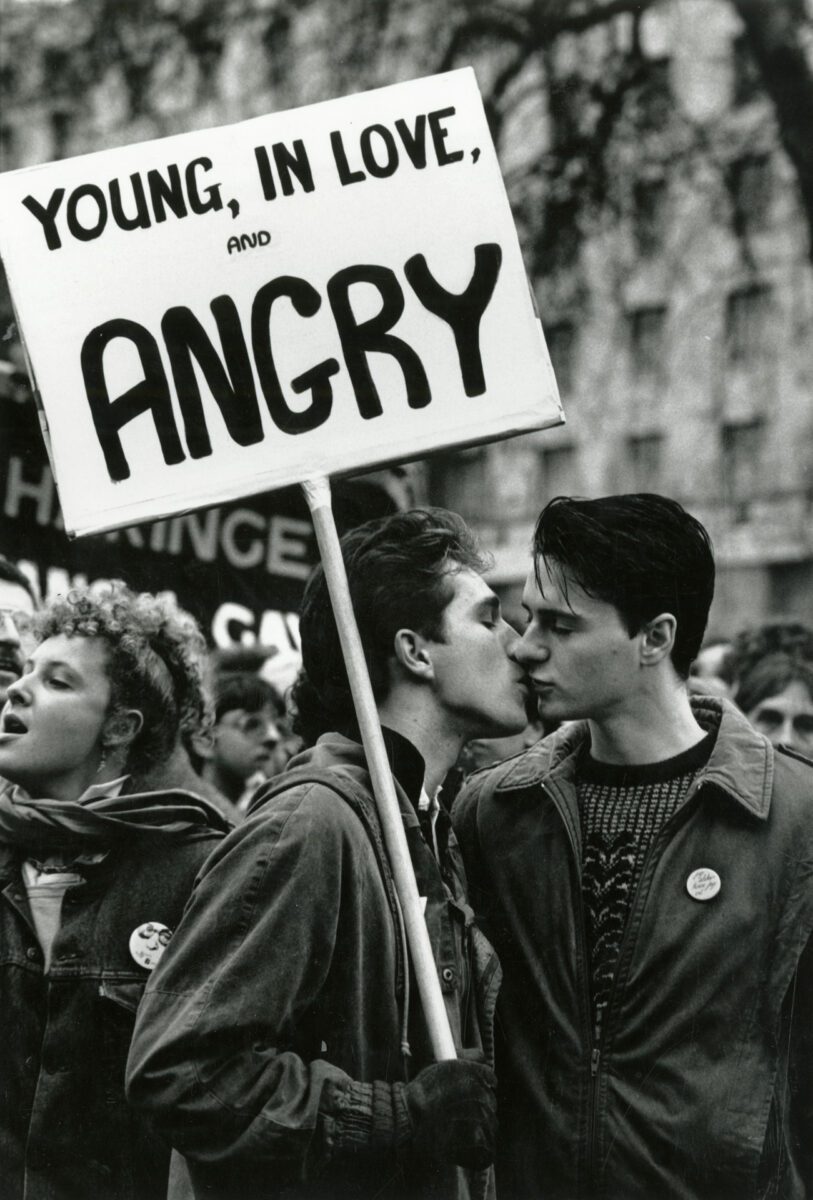
The photographic record of the 1980s offers another important point of connection. Tate Britain’s The 80s: Photographing Britain (2024–2025) assembled nearly 350 images and archival materials, tracing how photographers, collectives and independent publications responded to the social and political upheavals of the Thatcher era. Race uprisings, the miners’ strike, Section 28, the AIDS epidemic and urban transformation formed the backdrop to practices that used photography to give visibility to communities frequently misrepresented or excluded from mainstream media. Its attention to collaborative networks and independent photographic publications also challenged the idea that photographic innovation emerges exclusively through individual practitioners. The exhibition demonstrated how collective practices can create alternative visual histories, notably when established media structures fail to represent specific communal experiences. McQueen’s project develops this thinking across a longer chronology, placing photographic practices in a century of protest instead of focusing on a single decade.
The curatorial framework is central to this ambition. Conceived by McQueen and curated with Clarrie Wallis and Emma Lewis, Resistance brings together photographs from public archives, private collections and image libraries, placing celebrated practitioners alongside lesser-known photographers whose work might otherwise remain outside established accounts of British photographic history. The exhibition encompasses more than 40 photographers, allowing different approaches to documentary practice, reportage and visual testimony to exist in dialogue. Political research by Sarah Harrison provides a historical foundation, while the exhibition’s development through Turner Contemporary in Margate and National Galleries of Scotland: Modern Two in Edinburgh reflects a collaborative approach to presenting complex histories across different institutions. Its adaptation for Leeds, undertaken with curator Liza Butakova, creates an opportunity to consider how national narratives intersect with the histories and experiences of northern communities. Instead of organising protest into a succession of isolated political events, the curatorial approach suggests a continuous history of people challenging their living conditions.
In this wider account, individual photographic practices reveal the ways resistance becomes visible. Vanley Burke’s photographs of Black British life, specifically in Birmingham’s African-Caribbean communities, offer an important counterpoint to media representations that have historically framed these communities through the language of conflict or social crisis. His attention to everyday experience makes the personal inseparable from the political, recognising family life, neighbourhoods and cultural expression as essential parts of Britain’s social history. A similarly sustained engagement with working-class experience informs Tish Murtha’s photographs of young people in Newcastle’s west end during the early 1980s. Her images challenge the reductive visual language often applied to poverty and unemployment, presenting individuals whose lives cannot be understood through statistics or political rhetoric alone. Together, these practices show that documenting a community can become an act of resistance, particularly when its members have been denied the authority to represent their own experiences.
Questions of class, labour and social visibility also run through the work of Humphrey Spender and Fay Godwin, although their approaches reveal different dimensions of documentary practice. Spender’s involvement in Mass Observation placed photography within a wider attempt to record the habits, environments and social structures of ordinary British life, questioning what should count as historically significant. His work suggests that the everyday can be as revealing as the extraordinary, particularly when viewed against the political and economic conditions that shape it. Godwin’s wider photographic practice, meanwhile, brings questions of landscape, public access and environmental responsibility into the discussion, broadening the definition of resistance beyond the familiar image of a demonstration or confrontation. Her engagement with the British landscape invites consideration of who has the right to occupy, traverse and determine the use of shared spaces. Such perspectives recognise that political agency is not confined to moments of visible dissent; it is also expressed through the defence of common resources, cultural identity and the conditions of our everyday existence.
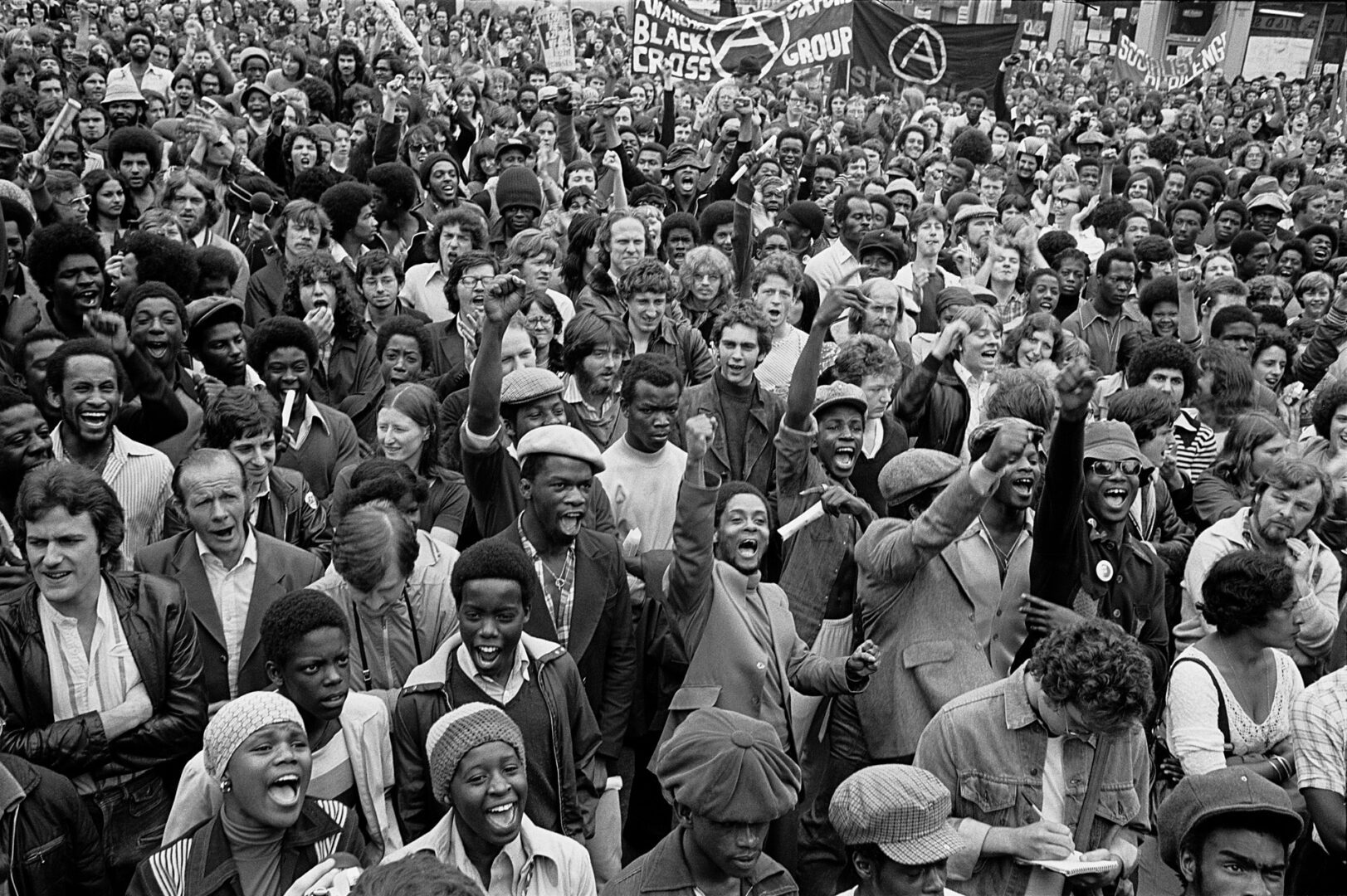
The relationship between the photographer and the protester becomes charged in images of organised racism and public opposition. Paul Trevor’s image of anti-racists gathering to block the route of a National Front demonstration on New Cross Road in August 1977 captures a moment when the street became a contested political space. The image records more than a confrontation between opposing groups; it preserves evidence of collective opposition to the public expression of racial hatred. Its historical weight also lies in the way it makes visible those who chose to intervene, not positioning protestors solely as spectators to political events. Other photographers in the exhibition, including Edith Tudor-Hart, Christine Spengler, Andrew Testa, Henry Grant and Janine Wiedel, extend this visual history through different forms of documentary engagement, from social observation to political reportage. Their juxtaposition resists a singular definition of protest photography, suggesting that its meaning emerges through the relationship between the image, its subject, the circumstances of its production and the audience it encounters.
These histories also raise significant questions about the ethics of photographic representation. Documentary photography has long been shaped by tensions between witnessing and appropriation, particularly when images depict communities experiencing poverty, discrimination or violence. Who has the authority to tell another person’s story, and what responsibilities accompany the act of recording their struggle? By bringing established photographers into conversation with lesser-known practitioners and archival material, Resistance complicates the conventional emphasis on individual authorship and the idea of the photograph as an uncomplicated historical document. The archive itself becomes a subject of scrutiny: a space in which decisions about preservation, attribution and visibility determine which experiences survive in collective memory. This shifts the exhibition’s attention from what photographs show to how they acquire meaning, authority and historical significance.
Leeds provides a particularly meaningful setting for these conversations. As the exhibition’s North of England venue, Leeds Art Gallery offers an opportunity to encounter national histories of protest from a region with its own substantial traditions of industrial activism, labour organisation and community resistance. The arrival of Resistance is especially welcome for audiences across Yorkshire and neighbouring northern communities, where questions of class, identity, political representation and social justice remain deeply embedded in cultural life. Its presentation also contributes to a wider discussion about the geographical distribution of major exhibitions, challenging the assumption that significant artistic and intellectual conversations must remain concentrated in London and the South East. There is considerable value in bringing this material to Leeds, where visitors can consider the relationship between the histories represented in the photographs and the communities, landscapes and political experiences that surround them. The gallery becomes more than a venue for a touring exhibition; it offers a space in which national histories can be reconsidered through regional perspectives.
The exhibition’s significance lies in its insistence that photography is never simply a record of events, but an active force in shaping how they are understood. Bringing together images made across a century of political and social struggle, it invites us to consider whose experiences have been made visible, whose voices have been marginalised and how collective memory is constructed. At a time when the language of division is once again prominent in public life, these photographs carry renewed urgency. They remind us that the rights and freedoms often taken for granted were hard won through the determination of individuals and communities prepared to challenge the status quo. Resistance asks us to look again at Britain’s history, and to recognise the continuing power of images to shape how that history is told.
Steve McQueen: Resistance is at Leeds Art Gallery until 25 April.
museumsandgalleries.leeds.gov.uk
Words: Anna Müller
Image Credits:
1. Paul Trevor, Anti-racists gather to block route of National Front demonstration, New Cross Road, London, August 1977. © Paul Trevor.
2. Pam Isherwood, Stop Clause 28 march, Whitehall, London, 9 January 1988. © Bishopsgate Institute.
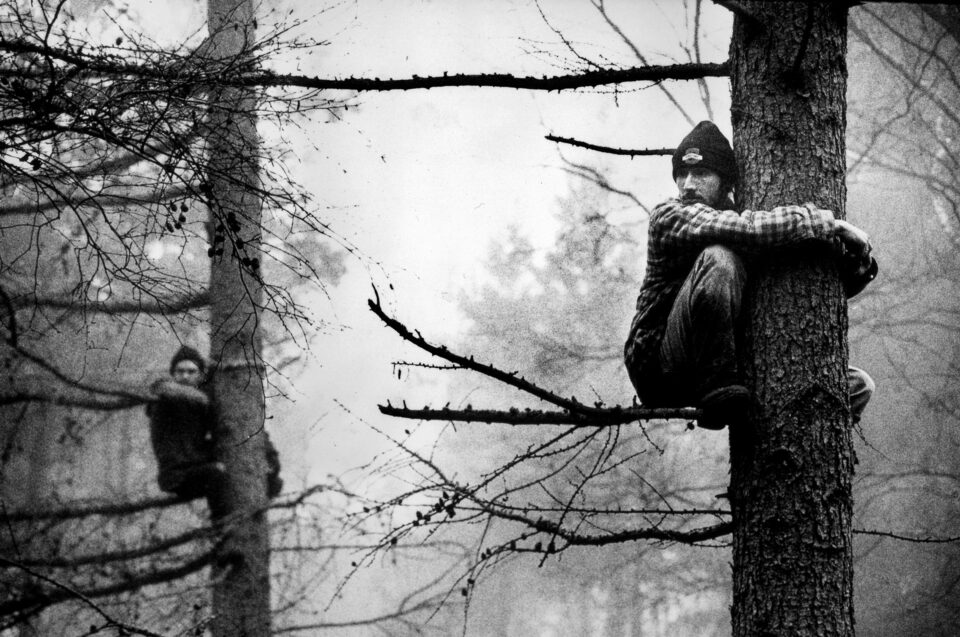
3. Andrew Testa, Protesters against the construction of the Newbury bypass occupy trees to prevent their destruction, Berkshire, 1996. © Andrew Testa.


