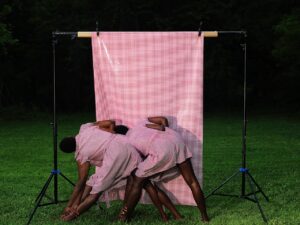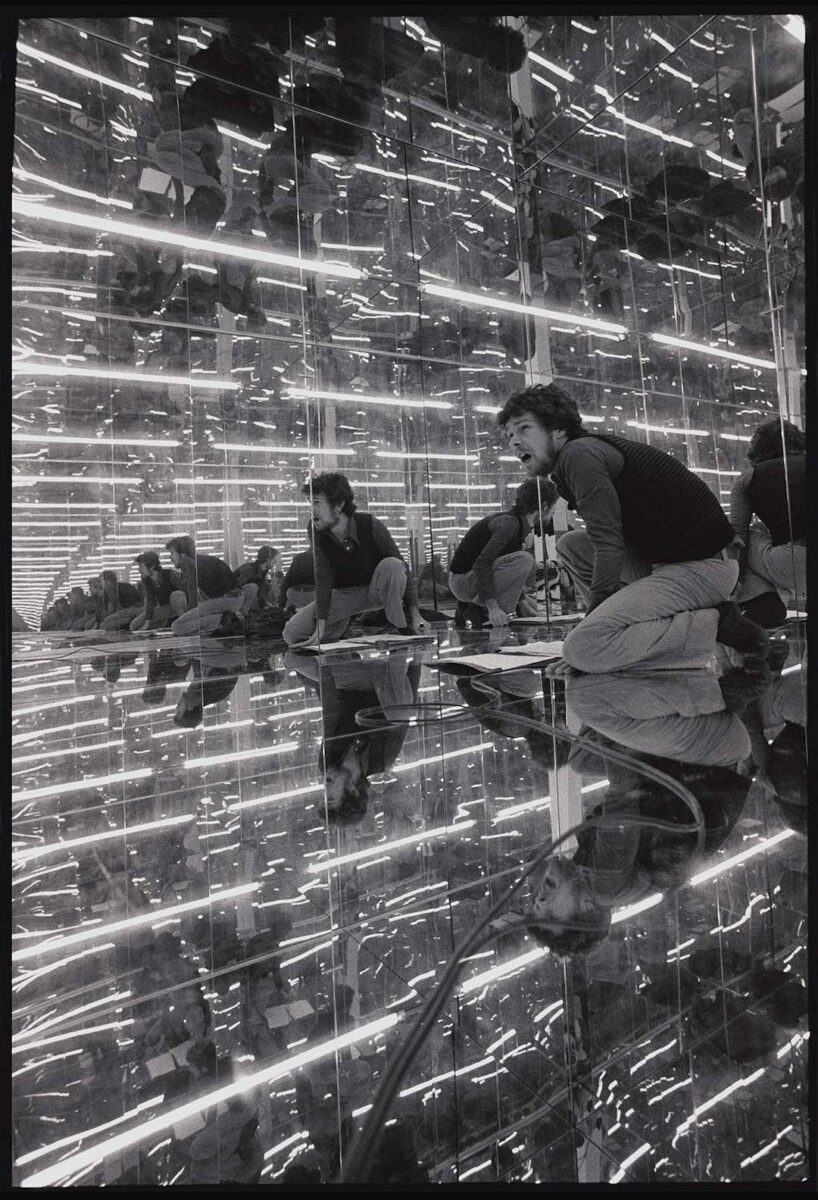
In October, London becomes an exhibition of itself. Frieze London and Frieze Masters return to Regent’s Park from 14 – 18 October, bringing almost 300 galleries from 48 countries and regions into the city, whilst exhibitions across its museums and galleries extend the meet beyond the fair. Frieze Week has become a moment when London can perform its claim to global cultural centrality, compressing a global art world into a geography of fairs, institutions, galleries and streets. Yet the significance of such a week lies less in its abundance than in the movement it needs: we pass from one space to another, continually adjusting our bodies, expectations and perspectives. This question of how space shapes our experience of art is central to Luciano Fabro’s Abitare lo spazio. Inhabiting Space, opening at Pirelli HangarBicocca on 8 October.
Bringing around 50 sculptures and installations, the exhibition is the first museum retrospective devoted to Fabro in Italy since his death in 2007. It traces a practice developed from the 1960s around perception, spatial experience and the relationship between viewer, artwork and environment, culminating in the architectural structures that Fabro called habitats. The concept provides a particularly apt lens through which to consider a week in which art is met through constant movement between spaces: for Fabro, the gallery was never simply a neutral container, but part of the experience itself. Drawing on habito, to dwell, and habitus, referring to bodily form and appearance, his idea of the habitat connects physical presence to viewing. Here, a habitat is less something to stand in front of than a situation through which to move.
This makes the timing of the exhibition particularly suggestive. A fair such as Frieze is itself a temporary environment, carefully organised around circulation, encounter and attention, with Frieze London and Frieze Masters offering distinct but connected views of contemporary practice and art history. Visitors move through galleries that resemble rooms, corridors and thresholds, encountering works at different scales and speeds, often carrying the residue of one space into the next. Fabro’s habitat provides a more radical version of this condition because it refuses to let the setting disappear behind the artwork. Walls, light, pathways and proportions become active elements in the encounter. The question is not simply where art is shown, but how the architecture of looking determines what art can become.
Brian O’Doherty’s account of the white cube remains relevant here: the apparently neutral gallery suppresses its own conditions to present the artwork as autonomous, timeless and self-contained. Fabro works against precisely this concealment, making the physical circumstances of viewing impossible to ignore. His habitats use paper, light and architectural divisions to establish temporary environments, sometimes within existing spaces and sometimes as self-contained structures. The press material connects these spaces to the Baroque piazza and to the radical and relational urbanism of the 1960s and 1970s. Emerging is a grasp of the artwork as something that can organise a situation, not simply occupy one.
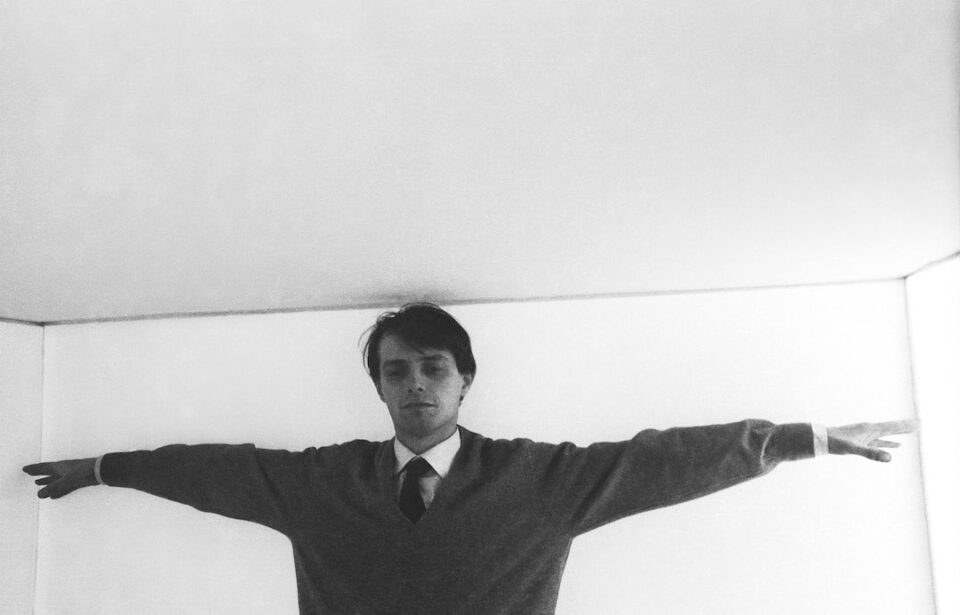
In cubo (1966) makes this proposition unusually intimate. A wooden structure enclosed on five sides by white canvas, it can be entered by lifting the fabric, creating a small enclosure in which the visitor remains connected to the outside through filtered light. The original version was calibrated to Fabro’s own body – its dimensions corresponded to his height and the span of his outstretched arms – so that the distinction between subject and object, inside and outside, becomes physical rather than theoretical. At HangarBicocca, five variants in different sizes invite visitors to consider which might correspond to their own bodies. The sculpture does not represent personal space so much as make the visitor negotiate it.
Phenomenology offers one language for understanding this shift from looking at an object to occupying a situation. For Maurice Merleau-Ponty, perception is not detached observation, but something formed through the embodied encounter between person and world; space is lived before it is abstracted. Fabro’s practice repeatedly approaches this condition, while retaining an interest in sculpture as a rigorous, autonomous form. His theoretical writing holds together formal order and sensory experience, allowing the work to remain both constructed object and encounter with the real. Presence, in this sense, is not an additional feature of the artwork. It is one of the means through which the work comes into being.
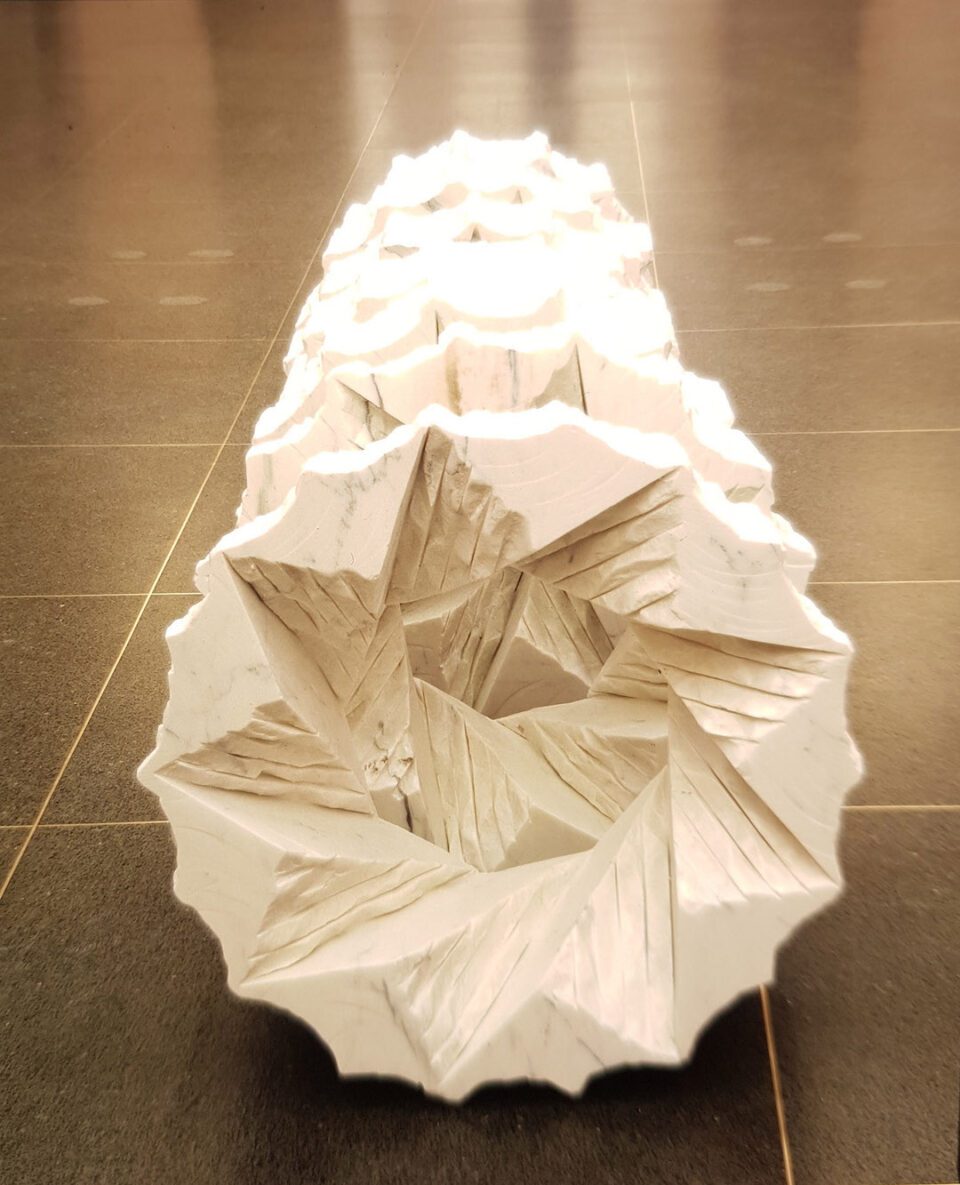
The same tension appears in Io rappresento l’ingombro dell’oggetto nella vanità dell’ideologia (Lo Spirato) (1968 – 73), where absence becomes a physical proposition. A marble bed supports a sheet whose folds retain the impression of a body that is no longer there, recalling the refinement of Baroque drapery while withholding the figure that might normally occupy it. Fabro described the sheet itself as the true subject, locating the work between fullness and emptiness, neither entirely real nor unreal. The viewer completes this suspended moment through memory and imagination, reconstructing the weight and volume that have disappeared. Here, as in In cubo, perception depends upon what the body knows even when absent.
Outside Milan, the question of inhabitation takes on another resonance during Frieze Week. Cecilia Vicuña’s Living Threads, opening at Whitechapel Gallery on 7 October, brings six decades of an interdisciplinary practice involving textile, installation, poetry, performance, ritual and film into a city that was itself formative for the artist. Vicuña came to London in the early 1970s after going into self-exile following the 1973 Chilean coup, studying at the Slade and working from a studio in Stepney Green. The exhibition consequently carries a particular relationship to place, memory and movement, without reducing the work to biography. Its presence in Whitechapel adds another dimension to the week’s question of what it means for an artwork to inhabit – and be shaped by – a particular environment.
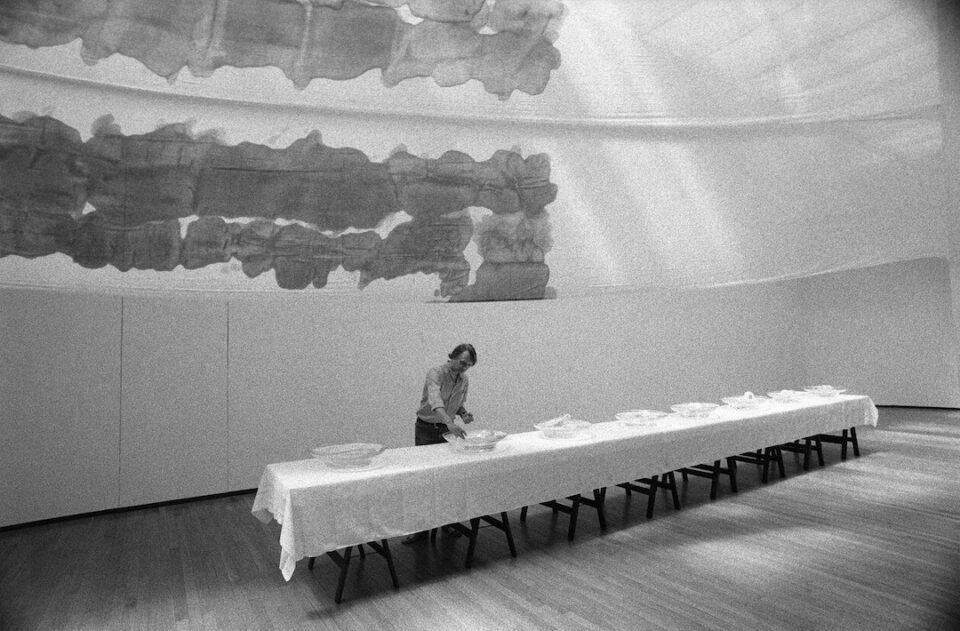
Fabro’s Habitat di Rotterdam (1981) makes the architecture of this encounter explicit. Recreated at HangarBicocca according to the original layout, it divides the space into five corridors formed by paper-covered walls, within which around 20 works are installed. The arrangement follows a geometric composition based on circles radiating from a single vanishing point, while white lines on the floor suggest trajectories continuing beyond the physical limits of the building. The visitor encounters the works through glimpses, openings and shifting perspectives rather than from a single fixed position. A retrospective becomes, almost paradoxically, a place through which one has to move.
Robert Ryman’s The Real Thing, opening at the Barbican on 8 October, offers a quieter parallel. More than 60 paintings from the mid-1950s to the early 2010s are presented through an exhibition that emphasises texture, brushwork, support, wall, light and the relationships between works. Ryman’s insistence on seeing the painting in person places physical attention at the centre of the encounter, just as Fabro makes the visitor’s body part of his spatial constructions. The difference is revealing: where Fabro builds an environment around perception, Ryman makes perception linger over the smallest material decisions within a painting. Both resist the idea that looking can be considered as instantaneous.
Sound introduces another form of spatial awareness. Tarek Atoui’s exhibition at Tate Modern, also opening during the week, extends the problem beyond the visual field, asking how bodies encounter environments through listening as well as sight. That matters in a city temporarily saturated with exhibitions, where attention is easily fragmented by scale, crowds and constant movement. Fabro’s insistence that a habitat assumes that “one is there” is therefore less an invitation to passive immersion than a demand for attention. Presence becomes something the visitor has to bring to the work.
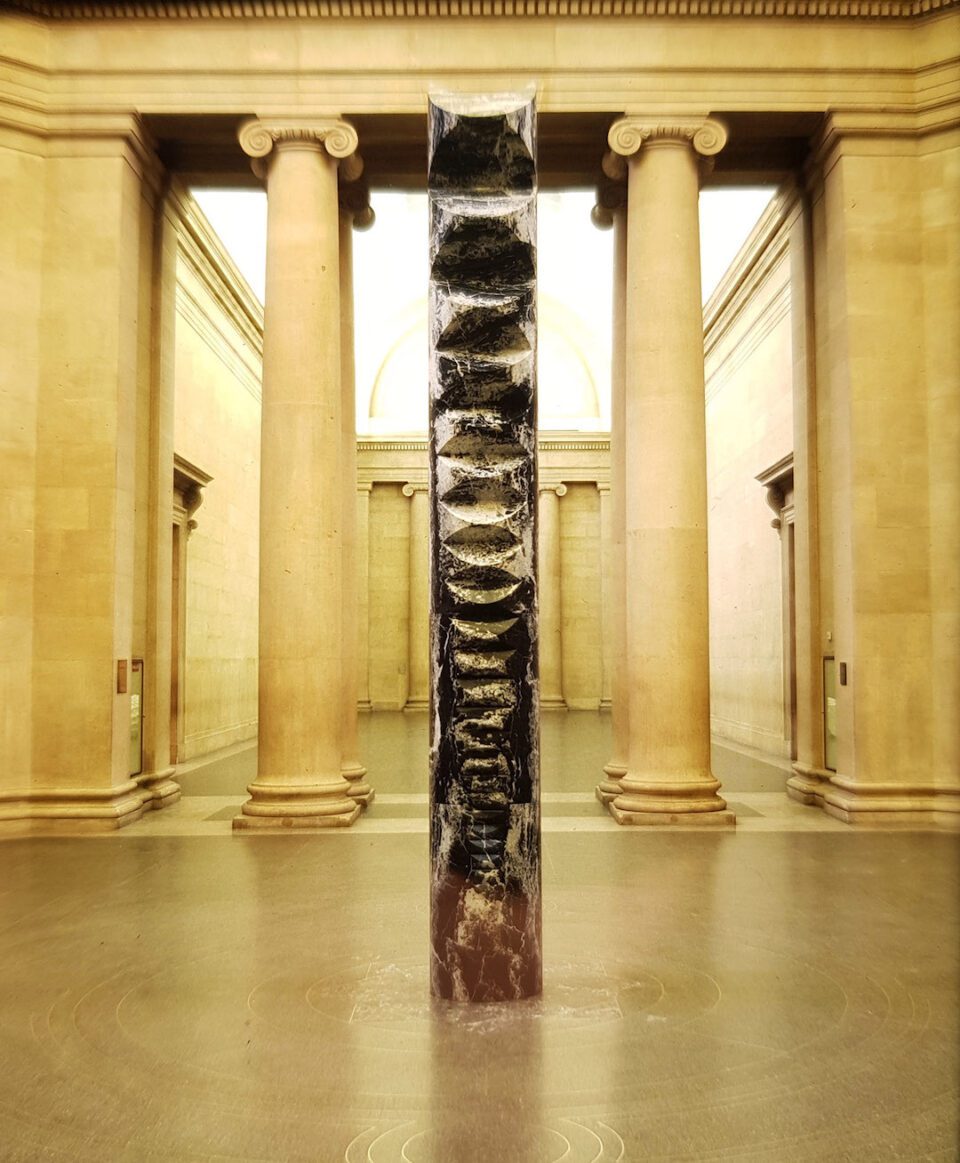
Perhaps this is where Fabro’s work becomes most pertinent to the culture surrounding Frieze. The fair depends upon movement, but movement alone does not constitute experience; an abundance of encounters can just as easily flatten them into a sequence of impressions. Fabro’s habitats interrupt that speed by making the physical circumstances of viewing tangible – a wall remains a wall, light remains light, a path has direction, a body has dimensions. He described the habitat as a topos, a place capable of generating logos – meaning, relationships and community. The exhibition consequently asks something more demanding than whether contemporary art can still surprise us.
It asks whether we are prepared to inhabit it. Across Fabro’s paper walls, marble surfaces, empty beds and carefully measured enclosures, the distinction between artwork and environment becomes difficult to maintain. London during Frieze Week briefly produces its own version of this condition, with galleries and institutions forming a shifting network of spaces that must be navigated rather than simply viewed. Yet Fabro’s work suggests that inhabitation is never merely a matter of being physically present. It requires attention to the distances between things, to what remains absent, and to the ways a space quietly changes the person moving through it. Perhaps the most enduring question of Inhabiting Space is therefore not where the artwork ends, but what kind of presence begins when we enter it.
Inhabiting Space opens at Pirelli HangarBicocca, Milan on October 8, 2026 – February 21, 2027
Words: Shirley Stevenson
Image Credits:
1. Luciano Fabro Allestimento teatrale, 1967-75 Performance view, Bagno Borbonico, Pescara, 1975 Photo © Giorgio Colombo, Milan
2. Luciano Fabro inside In cubo (1966). Image from the invite of Fabro’s show at La Galleria Notizie, Torino, 1967 © Archivio Fotografico A. Guidetti e G. Ricci Photo Giovanni Ricci
3. Luciano Fabro Il sole, 1995-97 Installation view, “Luciano Fabro”, Tate London, 1997 Courtesy Tate Gallery Photographic Department. Photo: Marcus Leith
4. Luciano Fabro with Iconografie, 1975, during the installation of the solo exhibition “Letture parallele IV,” PAC Padiglione d’Arte Contemporanea, Milan, 1980. © Archivio Fotografico A. Guidetti e G. Ricci. Photo: Giovanni Ricci
5. Luciano Fabro La luna, 1995-97 Installation view, “Luciano Fabro,” Tate London 1997 Courtesy Tate Gallery Photographic Department. Photo: Marcus Leith