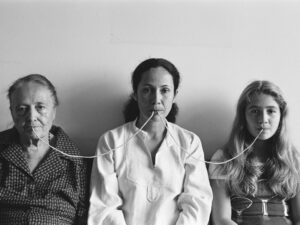
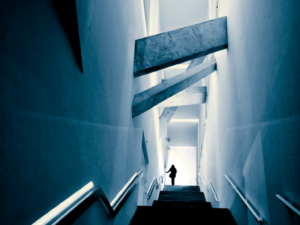
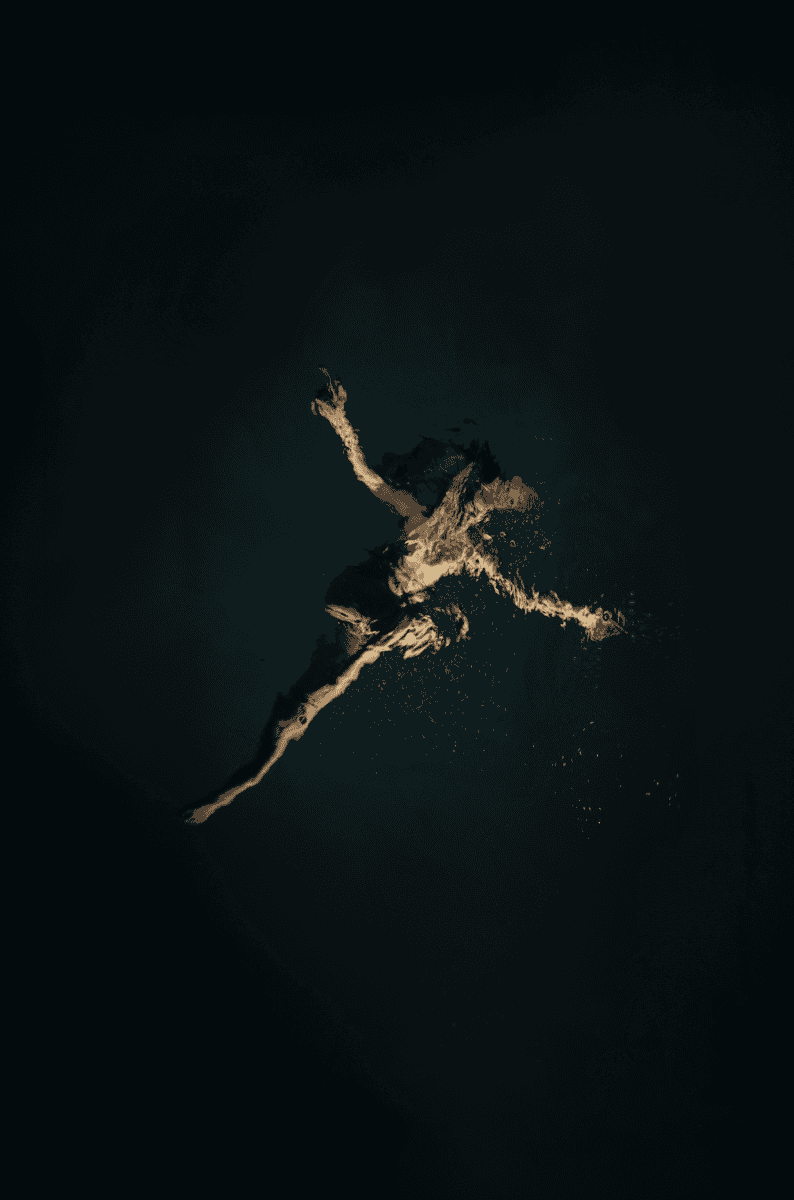
Sam Taylor-Johnson (b. 1967) has been at the forefront of contemporary art for decades. From participating in the Venice Biennale in 1997 and receiving a Turner Prize nomination, to directing films like Fifty Shades of Grey (2015) and Back to Black (2024), she is a figure that captures the zeitgeist. Her practice encompasses photography, video and feature film, often confronting the dichotomy between external perception and self-identification. Her latest venture is a book, which draws upon extensive archives to capture the evolution of her vision, including the acrobatic vitality of her iconic “floating” self-portraits and the intimate images made on set and behind-the-scenes of her films. Together, these pictures reveal a career-long inquiry into what constitutes a portrait and how identity can be expressed.
Self-portraits are integral to the artist’s practice, tracing the narrative of her own life. This book follows a similar structure, following from her early works that were taken after Taylor-Johnson finished cancer treatment – she was diagnosed with colon cancer in 1997, at the age of 30, and with breast cancer in 2000 – to her more recent pieces. The artist writes of her work: “My life has been challenged plenty, and I’ve stared into the abyss plenty, yet I can’t narrate that story or feel those feelings, for fear they may pull me into an importantly neglected place. Stil, I see these moments within the pictures I take, imbued with whispers of those endurances.” In Self-portrait in Single-breasted Suit with Hare, there’s a characteristic wit and sense of humour, poking fun at the stereotypes around cancer treatment. She said of the portrait: “with chemotherapy, the first thing you think is that you are going to lose your hair. The hare symbolises lust and passion, so here I am with a head of hair, in a single-breasted suit, holding onto lust and passion.”
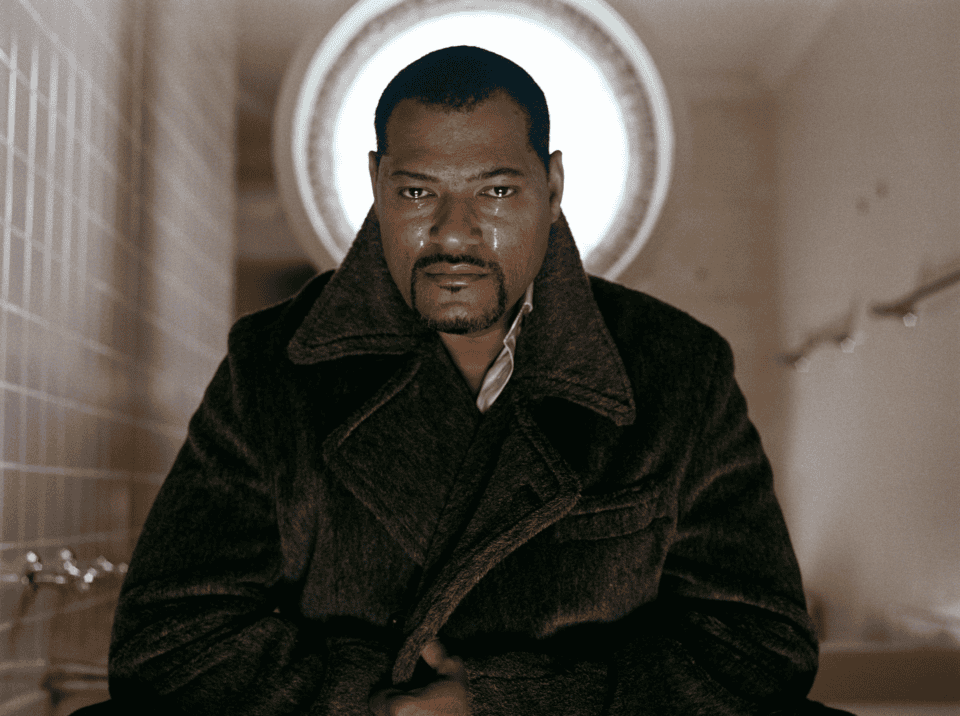
Taylor-Johnson’s images of others are equally as vulnerable, often bringing an entirely different perspective to renowned figures. She writes: “That is what it is to take a photograph – a portrait of somebody. It’s knowing and seeing, in the briefest of ethereal moments, something like a secret you have found. There’s the hit of a button and the steal of an eye, and all the history that belongs to it has been passed on. Gifted and taken.” The artist has a rare skill in drawing out the private and placing it in the personal realm. It is one thing to do this with yourself, in self-portraiture, but to do it for others is another matter altogether. Nowhere does Taylor-Johnson do this more skilfully than in Crying Men (2002 – 2004). Here, male celebrities are asked, only upon arriving at their shoot, that they need to cry. It is “not about a projection of ego but more about male vulnerability,” according to the artist. Benicio Del Toro. Robin Williams. Ryan Gosling. Michael Gambon. Philip Seymour Hoffman. Willem Dafoe. Woody Harrelson. Each one captured in moments of vulnerability. For figures like Daniel Craig, Ray Winstone and Laurence Fishburne, whose back catalogue includes particularly masculine characters, is groundbreaking.
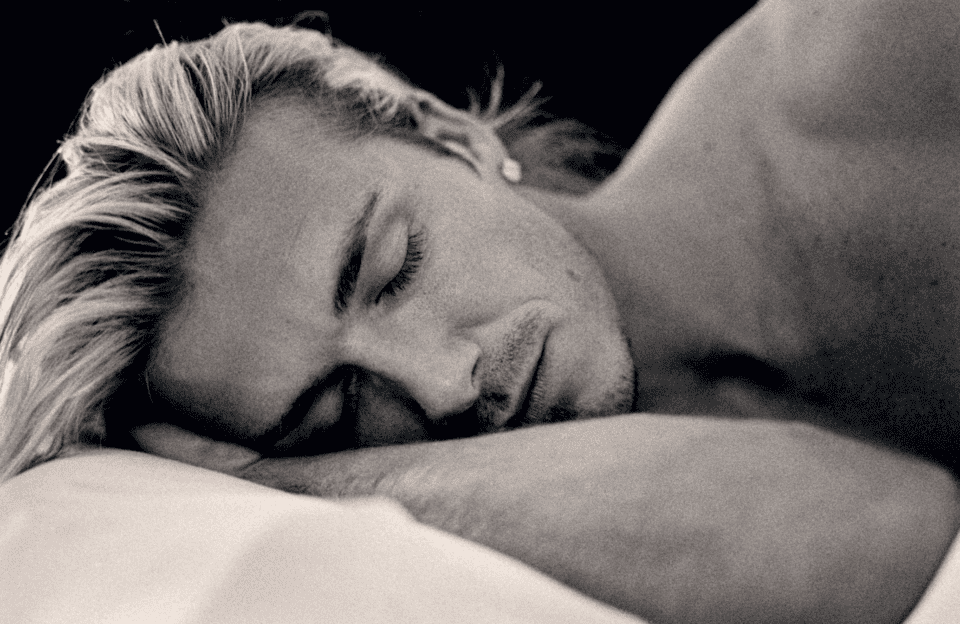
Recognisable faces are a throughline of this book, stretching far beyond that single series. It’s a hallmark of Taylor-Johnson’s career, extending to her 2004 video piece of David Beckham. Commissioned for National Portrait Gallery and created in a single, long take, the film captures the international icon taking a siesta after a training session for his team at the time, Real Madrid. Meanwhile, other shots in The Self and the Portrait include David Hockney, Gwyneth Paltrow, Florence Welch and Ralph Fiennes. Plus, the photographer’s husband, actor Aaron Taylor-Johnson, makes a frequent appearance, alongside shots of their children. These images act as a bridge between her self-portraits and images of others, revealing something about the artist’s personal life without requiring her to be in front of the camera.
At 121 pages, The Self and the Portrait is a book that knows what it’s doing. There are no unnecessary essays, no weak spreads. Instead, it makes each image count, relaying a rich and varied career in succinct and effective ways. Taylor-Johnson is an artist almost unparalleled in capturing moments of vulnerability, allowing a single shot to tell a story of a life – in all of its nuanced, messy, complicated glory.
Sam Taylor-Johnson: The Self and the Portrait is published by Rizzoli on 6 October: rizzoliusa.com
Words: Emma Jacob
Image Credits:
1&4. Sam Taylor-Johnson, Self Portrait in Dark Water XI, 2024. Courtesy Sam Taylor-Johnson.
2. Sam Taylor-Johnson, Bram Stoker’s Chair II, 2005. Courtesy Sam Taylor-Johnson.
3. Sam Taylor-Johnson, Crying Men (Laurence Fishburne), 2002. Courtesy Sam Taylor-Johnson.
5. Sam Taylor-Johnson, David, 2004. Courtesy Sam Taylor-Johnson.