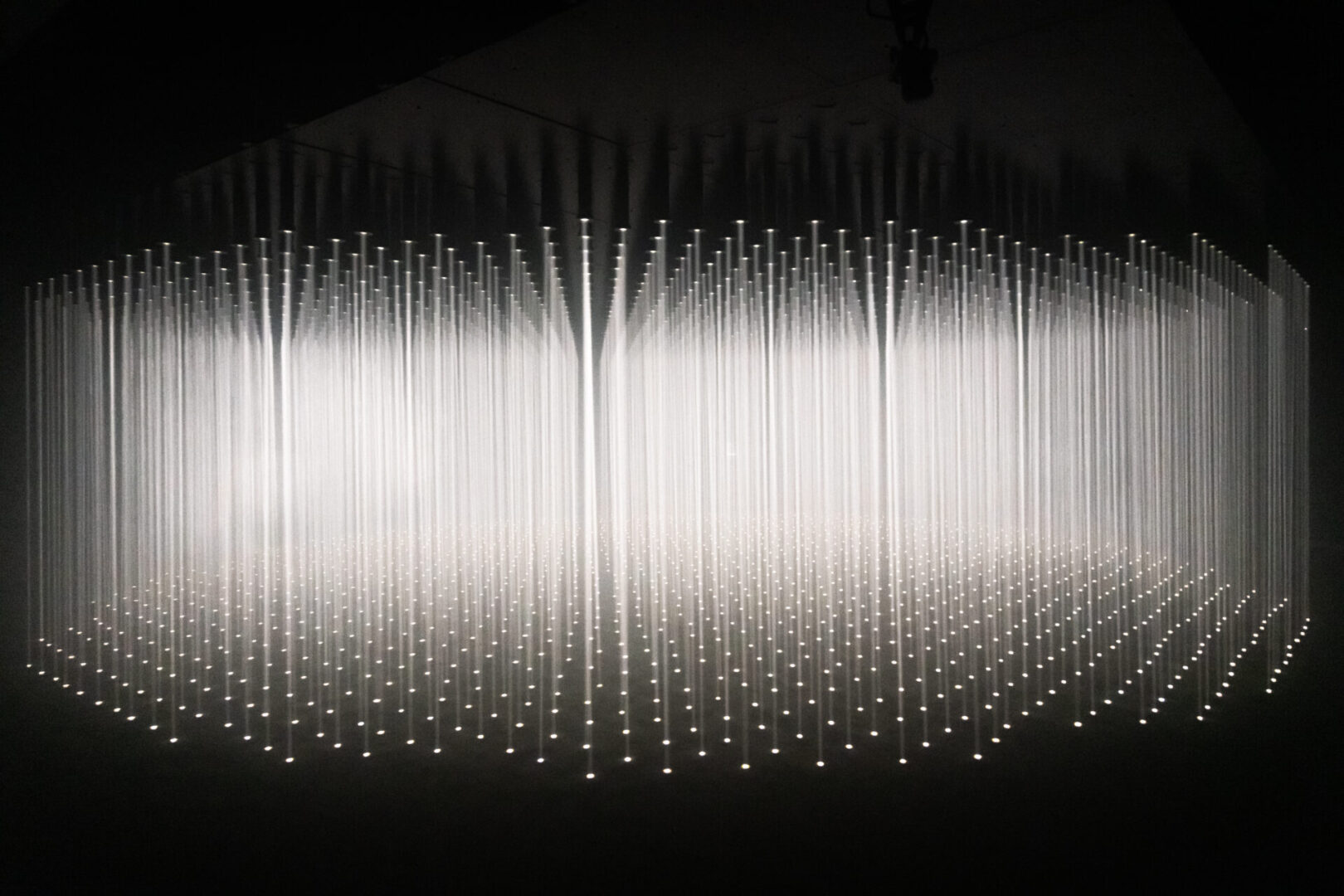
What happens when a machine begins to look back? As artificial intelligence moves beyond the screen and into physical space, the distinction between human presence and technological simulation becomes increasingly difficult to sustain. Contemporary artists are interrogating this boundary through responsive environments, generative systems and embodied interfaces, questioning the assumptions through which intelligence, consciousness and agency are defined. However, a machine’s capacity to register and respond to human behaviour does not necessarily mean that it understands what it encounters. The gap between perception and comprehension lies at the heart of Random International’s In all chaos there is a cosmos, presented with HOFA.io at Art Basel Miami Beach 2026 as part of Generation, the latest edition of Zero 10.
Curated by Karen Archey with Eli Scheinman, Generation considers how emerging technologies are reshaping artistic practice and the conditions in which art is produced and experienced. Its subject is particularly urgent at a moment when artificial intelligence is increasingly described as collaborator, tool and potential autonomous agent, often with little distinction between computational capability and consciousness. Random International approaches these questions through ambiguity. The London-based studio creates situations in which viewers become conscious of their own tendency to attribute intention to responsive forms. What appears to be an encounter with an independent intelligence becomes an examination of the expectations through which human beings recognise agency.
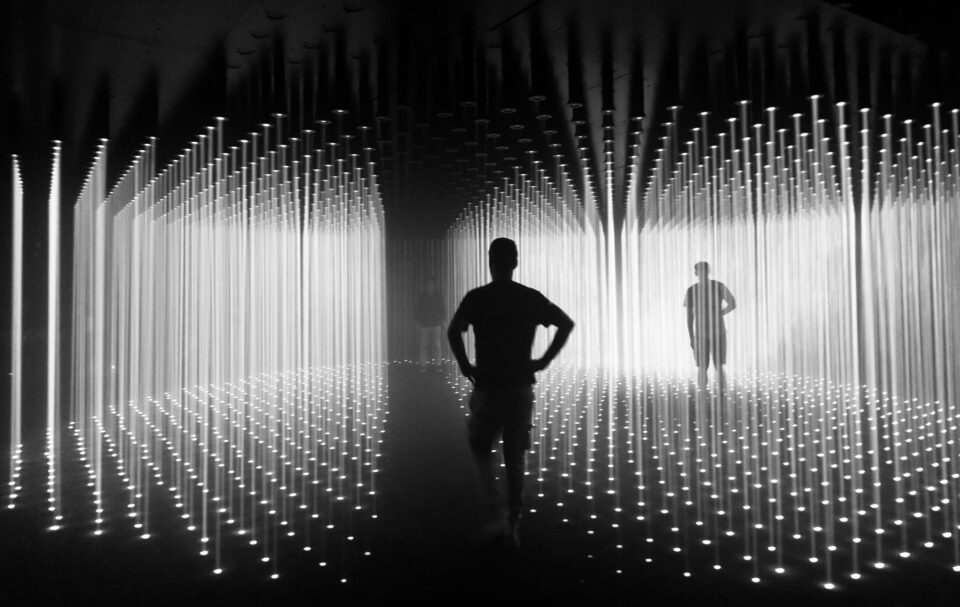
Donna Haraway’s writing on the cyborg offers a useful framework for understanding this instability, particularly her challenge to fixed distinctions between human and machine. In A Cyborg Manifesto, the cyborg unsettles the boundaries through which identity and subjectivity are conventionally organised, proposing hybrid forms that resist familiar categories. Random International’s sculptures do not simply illustrate this proposition; they bring its implications into physical space. Human figures emerge through computational processes, while their behaviour is shaped by the presence and movement of viewers. The resulting encounter complicates the separation between observer and observed: visitors approach the work expecting to look at a representation, only to find themselves implicated in its appearance.
At the centre of the installation, a sprawling ribbon of LEDs gives form to a life-sized human figure. Camera tracking and machine-learning processes enable the sculpture to register its surroundings, producing a responsive presence that appears to move between recognition and abstraction. Neither a conventional digital portrait nor a simulation of a person, the figure occupies an uncertain territory between representation and behaviour. Its body is distributed across light, fragmented by the structure through which it is rendered, and reconstituted through interaction. Although viewers may recognise a human presence, its apparent autonomy remains inseparable from the computational system that generates it.
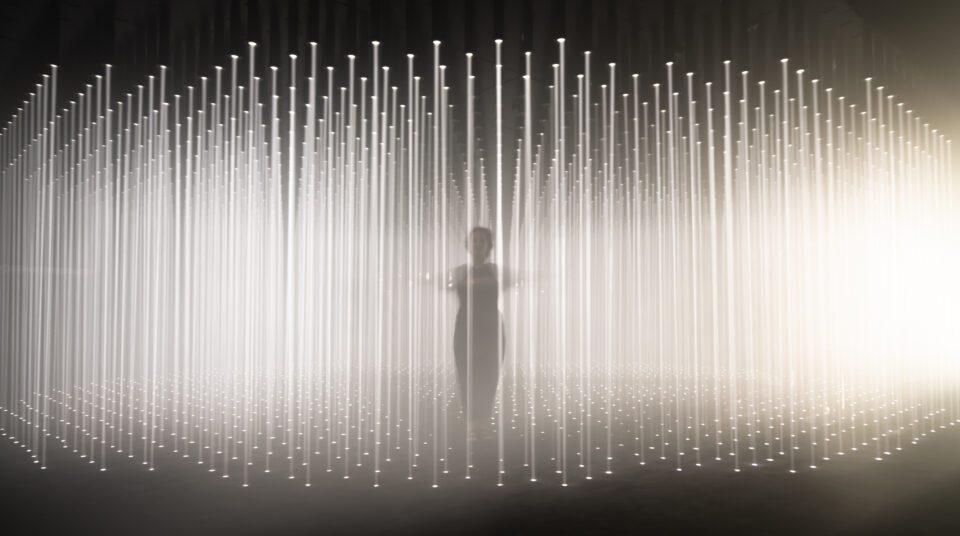
Machine perception, however, should not be mistaken for consciousness. The former describes the processing and interpretation of information; the latter implies subjective experience, an awareness of being and encountering the world. One does not establish the other, however convincing a system’s responses may appear. Random International’s sculptures do not claim to establish consciousness within their computational structures; instead, they expose the assumptions through which viewers recognise agency, often attributing intention to forms that reproduce familiar patterns of behaviour. A figure that appears attentive can prompt an emotional response even when there is no evidence of an interior life behind its gestures. Much of the meaning, therefore, is supplied by the viewer, who reads recognition, curiosity or intention into a system whose operations remain computational.
Elsewhere in the installation, the human figure assumes a more controlled form. Close To Me / I and Close To Me / II translate the body into half-scale forms composed from precise LED grids. Their regular structures evoke the pixel, the basic unit through which digital images are assembled and circulated. Yet the figures also suggest a tension between the apparent freedom of the body and the systems that seek to contain, measure and reproduce it. Where the central sculpture disperses the figure across a sprawling field of light, these works retain the discipline of the grid. Their formal contrast raises a question about representation itself: can the human body ever be separated from the technologies through which it is made visible?
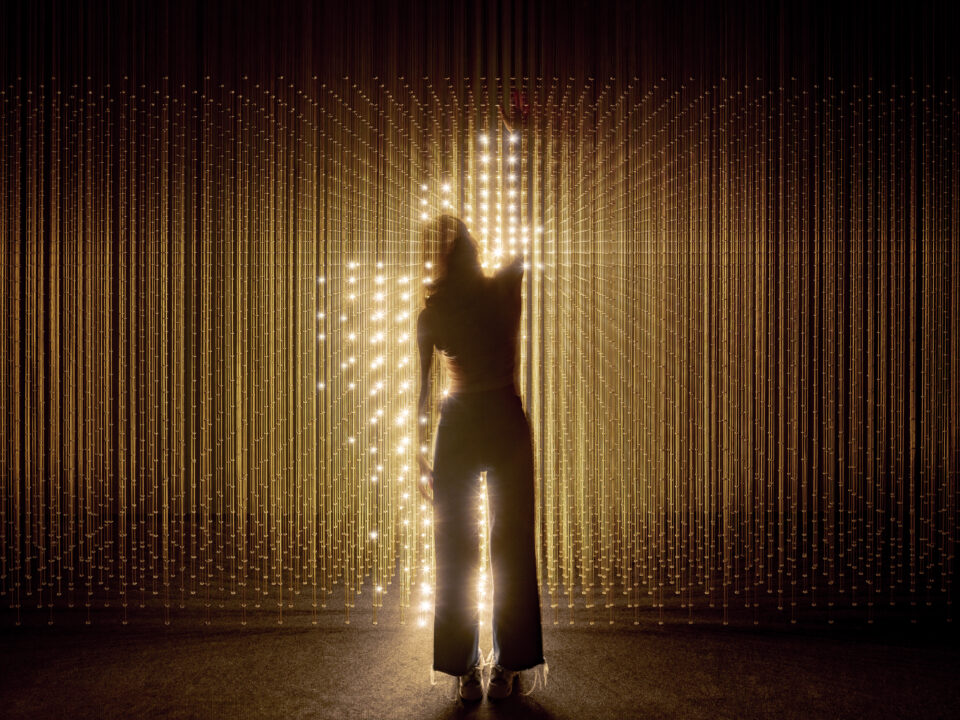
Light itself becomes central to the studio’s understanding of collective intelligence. Random International describes it as a medium through which individual elements produce complex and responsive wholes, an idea that gives the works a conceptual dimension beyond their technological construction. LED components matter through the relationships that allow a larger form to emerge. The resulting structures resonate with debates around distributed and non-human intelligence, while resisting the assumption that intelligence must resemble individual human thought. Complexity may arise through interaction, the sculptures suggest, although collective behaviour should not be confused with conscious experience.
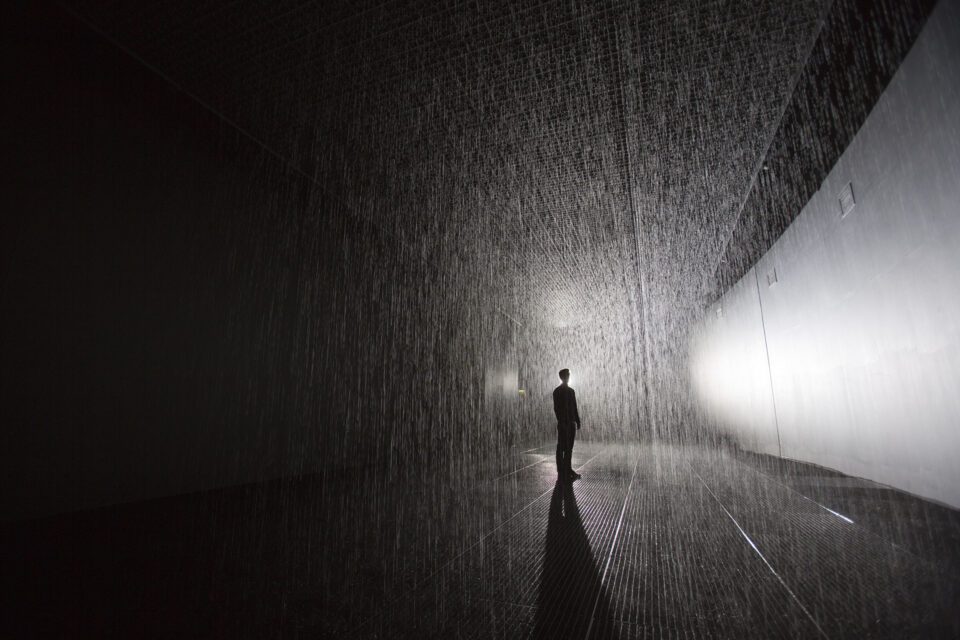
The questions explored here have shaped Random International’s practice since its founding in 2005 by Hannes Koch and Florian Ortkrass. Works such as Audience (2008) and Rain Room (2012) established the studio’s interest in situations that appear to respond to the presence of visitors. In Rain Room, the experience of moving through falling water without becoming wet turns the visitor into an active participant in a technologically controlled environment. Its effect depends on a negotiation between movement and an invisible system, making the mechanics of interaction felt. Across these projects, technology is not a neutral medium but a condition through which human behaviour becomes perceptible.
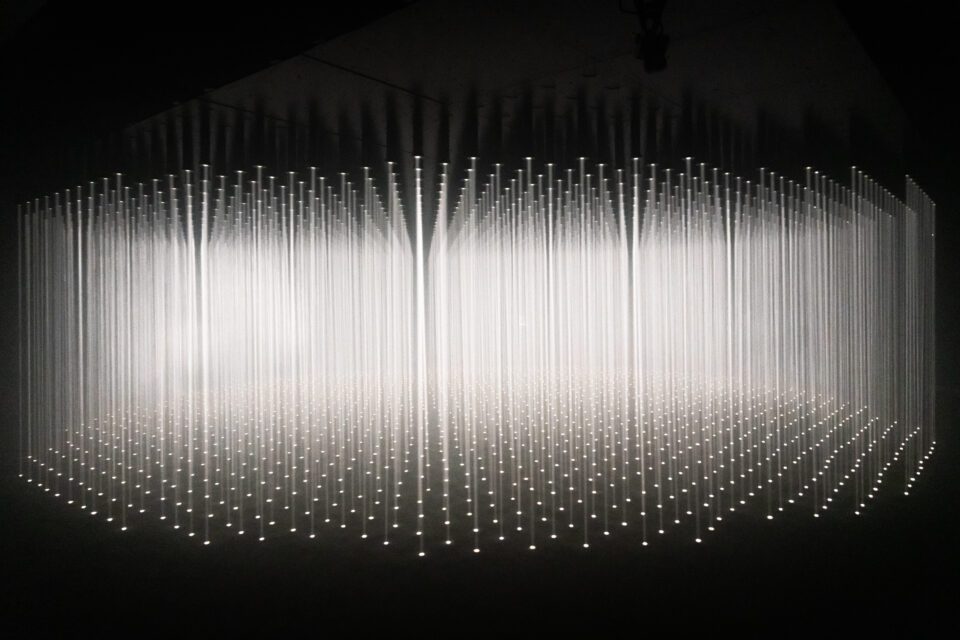
The origins of these fragmented bodies can be traced to the Future Self series, developed from 2012 onwards, which explored digital representation and bodily presence. Collaborations with choreographer Wayne McGregor and composer Max Richter have extended the studio’s engagement with movement, perception and the relationship between technological systems and expression. Such intersections matter because they place computational processes in dialogue with disciplines concerned with the body as a site of knowledge. Dance, music and sculpture each offer ways of understanding experience that cannot be reduced to information alone. Random International returns to a persistent tension: what happens when systems designed to register human behaviour begin to shape how that behaviour is experienced?
As machine-learning systems enter everyday environments, the language surrounding artificial intelligence is becoming increasingly consequential. Descriptions of processing frequently slide into claims of understanding, while prediction is mistaken for intention. These shifts are not merely semantic; they influence how authority, responsibility and agency are assigned to technologies. Art can make such assumptions visible by slowing down encounters that elsewhere are automated and difficult to scrutinise. Random International does not resolve whether machines might one day possess consciousness. Instead, the work draws attention to the ease with which human observers interpret responsiveness as evidence of an inner life, revealing how much of the apparent encounter is produced by their own expectations.
In all chaos there is a cosmos forms part of Zero 10’s broader effort to consider digital and technology-led practices within contemporary art. HOFA.io’s involvement brings the installation into contact with a platform operating across digital art and Web3, placing questions of technological authorship alongside those of perception and embodiment. Yet, the work’s most compelling proposition extends beyond its relationship to a particular technological market. Its force lies in the uncertainty produced when a familiar human form appears to act beyond the viewer’s control. The sculptures may seem to recognise us, but recognition is not the same as understanding. Their most unsettling effect is to expose a distinctly human desire: to find another consciousness looking back, even when there may be nobody there.
In all chaos there is a cosmos is at Zero 10, Art Basel Miami Beach, Booth Z7, 2 – 6 December: random-international.com
Words: Simon Cartwright
Image Credits:
1&5. Living Room variation II (2023), Random International. Installation view, exhibited in ‘Life in a Different Resolution’ at Nxt Museum, The Netherlands. Photograph: Esteban Schuneman.
2. Living Room variation II (2023), Random International. Installation view, exhibited in ‘Life in a Different Resolution’ at Nxt Museum, The Netherlands. Photograph_: Esteban Schuneman.
3. Living Room variation II (2023),, Random International. Installation view, exhibited in ‘Life in a Different Resolution’ at Nxt Museum, The Netherlands. Photograph: Riccardo De Vecchi.
4. Our Future Selves (2019), Random International. Installation view, exhibited in ‘Life in a Different Resolution’ at Nxt Museum, The Netherlands. Photograph: Riccardo De Vecchi.
6. Rain Room (2012), Random International. Installation view, The Curve, Barbican, London. Photograph: Random International.