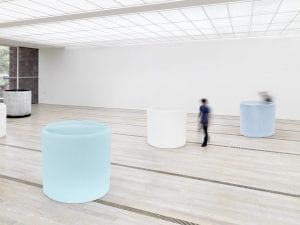
Contemporary art increasingly operates within a shift away from the object as stable form, toward exhibitions understood as evolving systems of perception, where meaning is produced through relations rather than fixed display. In this condition, attention is no longer anchored to individual works but distributed across environments, durations and material processes that continually adjust what is perceptible. The exhibition becomes less a container than a responsive field, where sound, light, matter, and time operate as interconnected forces shaping experience in real time. It is within this expanded understanding that Pierre Huyghe’s latest exhibition at Fondation Beyeler takes shape, positioning the museum in Basel as a site where perception is continuously reconfigured through unstable and living systems. The presentation brings together new works, recent films and selected earlier pieces, not as a chronological survey, but as a shifting environment in which each element alters the conditions of the others and no single reading can settle into place. What emerges is not a sequence of objects but a field of relations that continuously reorganises itself as it is encountered.
Huyghe constructs an exhibition that resists linear progression or fixed interpretation, unfolding instead as a constantly adjusting ecology of materials, organisms, and technological processes that behave as interdependent forces. Works do not present themselves as isolated objects but as active participants in a shared field, where sound travels between rooms, light behaves as a material presence, and temporal conditions appear uneven, elastic and continuously revised. The museum’s architecture becomes entangled in this system, no longer a neutral frame but an active component in the modulation of perception across space. Nothing remains stable long enough to be held as definitive, and each element appears to negotiate its position in relation to others as the exhibition unfolds. Rather than offering resolution, the exhibition sustains a condition of ongoing recalibration between viewer, work and space, where perception is continually reworked by proximity and duration.
This reorientation sits within a wider contemporary landscape in which exhibitions are increasingly conceived as situations rather than collections of objects, where relation and duration replace display as structuring principles. In Hito Steyerl’s Factory of the Sun (2015), presented at the German Pavilion, Venice Biennale, the moving image is destabilised through digital circulation, collapsing boundaries between labour, simulation, and immersive environment within a single looping system. In Tino Sehgal’s This Progress (2010), staged at the Solomon R. Guggenheim Museum, New York, the work unfolds as a choreographed ascent through spoken encounters, existing only in voice, movement, and duration as visitors move through the building. Tomás Saraceno’s Aerocene project, developed through presentations including the Serpentine Galleries in London (2018), extends exhibition-making into atmospheric conditions, where airborne structures and environmental forces become active agents rather than contextual backdrop. Taken together, these practices articulate a recalibration of exhibition form in which relation, duration, and responsiveness replace the logic of object permanence and static display. Within this broader field, Huyghe’s exhibition at Fondation Beyeler operates as a more biologically and technologically entangled variation, where systems appear not only responsive but partially autonomous.
At the centre of this show is Apnea, an artificial breathing organ that establishes respiration as both structural rhythm and ambient force shaping the entire spatial environment. Suspended in slow oscillation, it breathes with a cadence that echoes the human body yet never fully synchronises with it, producing a subtle dissonance that spreads outward through surrounding space. Air, sound, and vibration circulate in soft waves, as though the building itself has entered into a shared respiratory condition with the work. The effect is not dramatic or theatrical but atmospheric and persistent, unfolding gradually as breath becomes distributed across architecture, object, and visitor alike. Over time, Apnea dissolves distinctions between interior and exterior, shifting the exhibition into a shared rhythm of inhalation and release.
That sense of porous embodiment extends into Alchimia, where a wormlike entity occupies a fragile threshold between organism and material presence that resists stable definition. Its low-frequency emissions pass through surrounding matter rather than remaining contained within a fixed form, producing a field of vibration that resists localisation or clear interpretation. The work responds subtly to environmental conditions, particularly the presence or absence of air. Nothing about it stabilises into form, and instead it holds itself in a condition of suspended emergence that shifts with proximity and atmosphere. Contact with it is felt rather than understood, remaining partially inaccessible even at close range, as if perception itself cannot fully resolve its presence.
From this unstable ground, Liminals shifts into a register of perceptual uncertainty centred on identity, continuity, and temporal drift across shifting environments. A faceless human-like figure moves through spaces that never resolve into stable spatial or temporal coordinates, as if each moment were recalibrating its own conditions of existence. The figure persists without consolidation, repeatedly dissolving and reforming in ways that resist narrative coherence or psychological anchoring. Identity appears here as ongoing adjustment rather than fixed presence, unfolding through transitions that never fully complete or stabilise. The film holds perception within a continuous state of drift where meaning remains provisional.
Elsewhere, Adversary appears as a closed gate that operates simultaneously as object, threshold, and projection within the exhibition environment. It holds its position with quiet ambiguity, suggesting access while withholding it, as though constructed from collective imagination rather than singular authorship or intention. The surface carries the tension of something almost remembered, hovering between recognition and uncertainty without resolving into either. Passage becomes the subject rather than the function, with entry displaced into speculation rather than physical movement. The idea of “beyond” remains active within the work, yet never stabilises into confirmation, remaining suspended within its material presence.
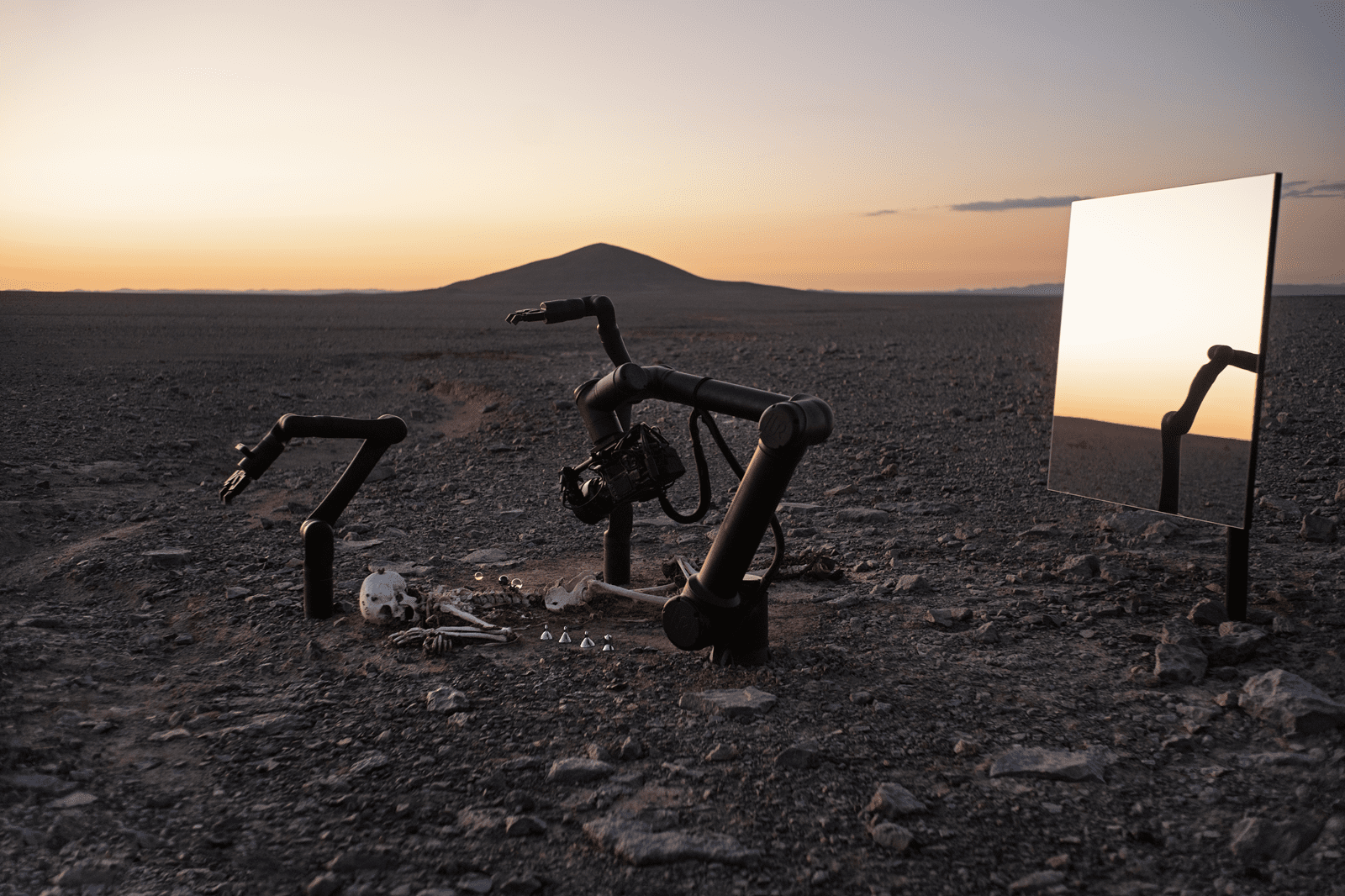
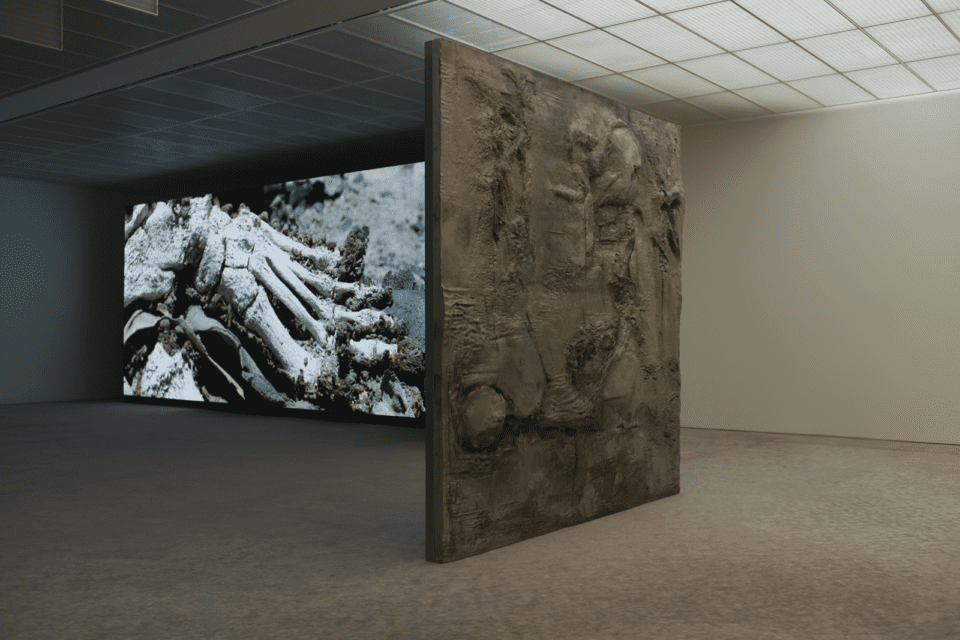
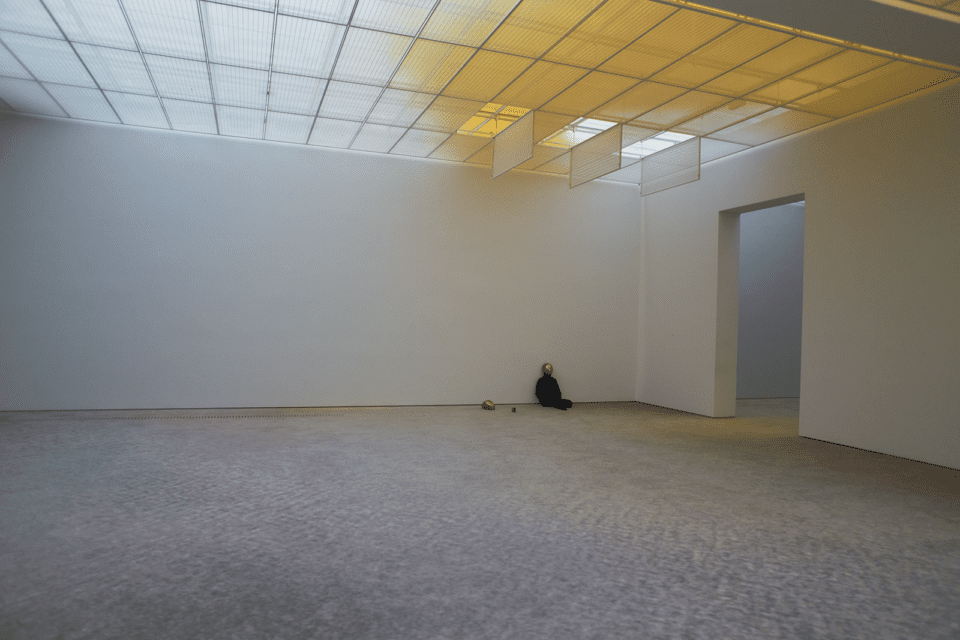
That suspended logic becomes more explicit in Camata, where machinic systems engage in an ongoing ritual-like interaction with an unburied skeleton recovered from the Atacama Desert. The work unfolds continuously, reconfigured in real time through sensors embedded within the exhibition environment, preventing any fixed version from fully emerging. What is seen is always slightly out of phase with itself, as though the piece were revising its own memory while simultaneously generating new perceptual conditions. No narrative arc develops, and repetition replaces resolution as the structuring logic of the work. Meaning is distributed across machines, spatial conditions, and material residue.
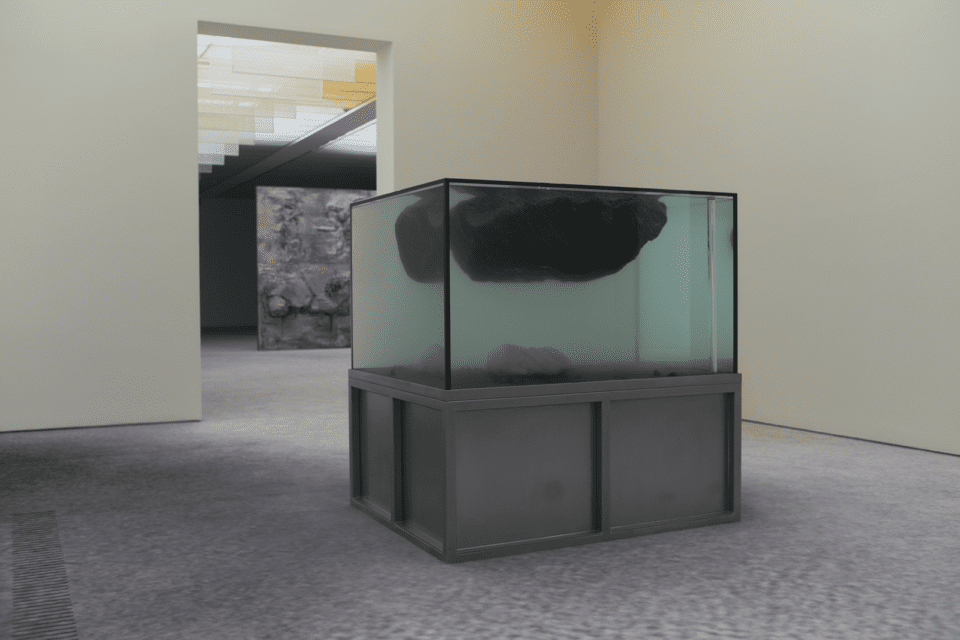
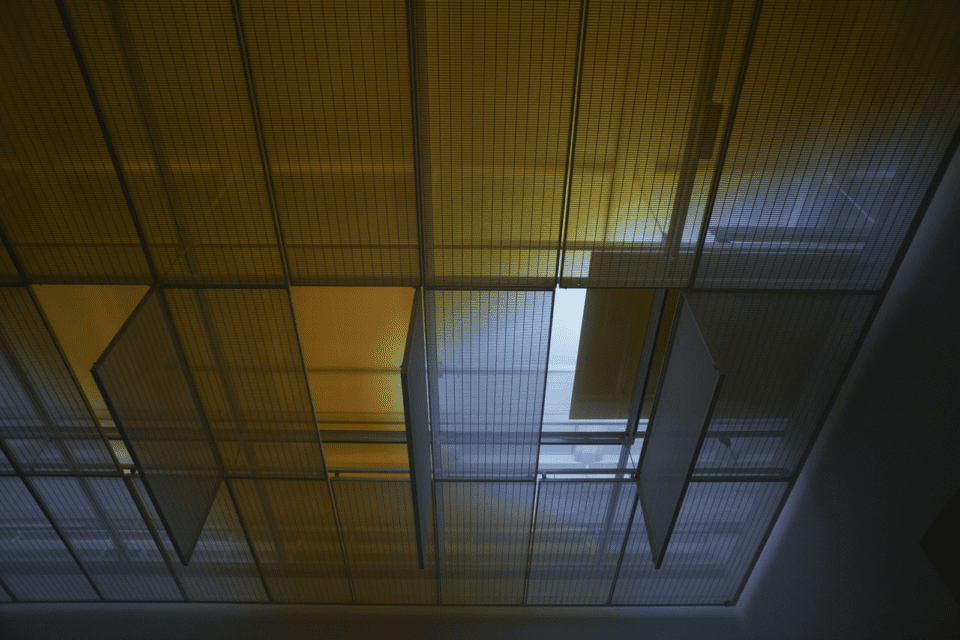
Time becomes materially legible in Timekeeper and Light Dust, where duration gathers across surfaces and alters the behaviour of light within the galleries. Walls retain sedimented traces of time, while dust and illumination shift slowly through space, producing changes that unfold almost below perception. Nothing announces transformation directly, yet gradual accumulation produces a subtle reconfiguration of the environment over time. The museum begins to operate less as a container than as a surface upon which time deposits itself and becomes visible. What is experienced is not sequence but the slow thickening of duration into matter that can be sensed rather than measured.
Individual works do not remain separate for long, instead operating as overlapping conditions that continually influence one another as the exhibition unfolds. Sound, movement, organisms and material processes circulate between rooms, producing effects that exceed any single work’s boundary or definition. Earlier pieces remain active within the system, not as historical references but as ongoing presences that continue to shape the field in which newer works appear. The exhibition takes on the character of a continuously adjusting environment, where relations matter more than objects. Attention moves with these shifts, never fully settling into a single position or interpretive frame.
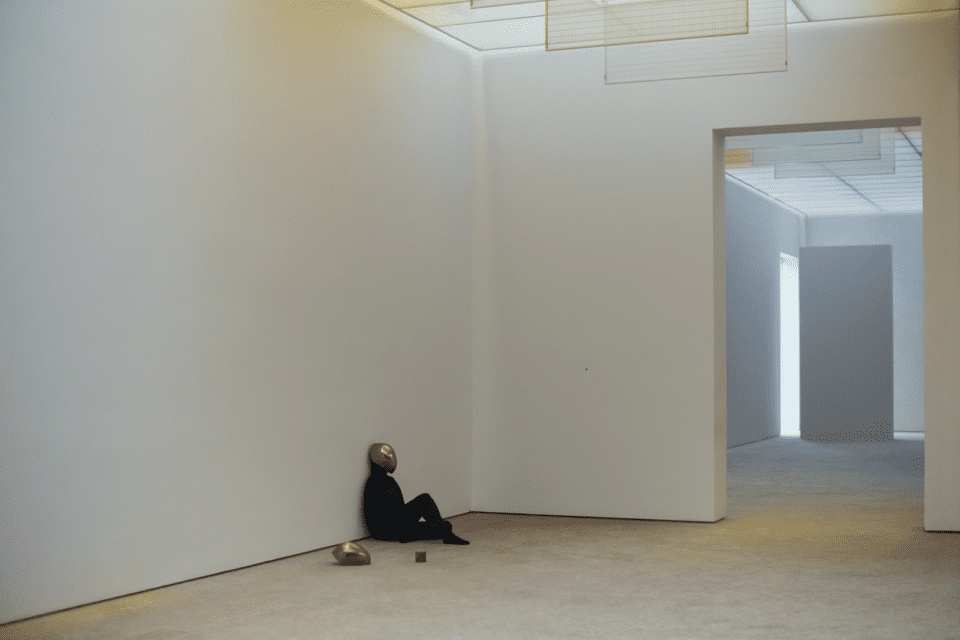
What persists is a condition in which stability is never fully achieved within the exhibition space. Perception is continuously adjusted by shifting relations between bodies, materials, and systems that remain in flux throughout the encounter. Rather than forming a single coherent image, the works remain in states of continual modulation, where meaning appears only briefly before dissolving back into environment. There is no fixed moment in which the exhibition resolves into a whole or unified structure. Instead, it unfolds through overlapping durations that keep reconfiguring what is being experienced. Attention follows these shifts as they occur, shaped by rhythm, proximity, and atmospheric variation.
Pierre Huyghe is at Fondation Beyeler, Riehen until 13 September: fondationbeyeler.ch
Words: Anna Müller
Image Credits:
1.Pierre Huyghe, Camata, 2024. Robotics driven by machine learning, self-directed film edited in real time, sound, sensors Collection Maja Hoffmann / Luma Foundation, Sammlung Maja Hoffmann / Luma Stiftung, Courtesy the artist © Pierre Huyghe, represented by ProLitteris (CH) / ADAGP (FR).
2. Pierre Huyghe, Camata, 2024. Robotics driven by machine learning, self-directed film edited in real time, sound, sensors Collection Maja Hoffmann / Luma Foundation, Sammlung Maja Hoffmann / Luma Stiftung, Courtesy the artist © Pierre Huyghe, represented by ProLitteris (CH) / ADAGP (FR).
3. Installation view, Pierre Huyghe, Foundation Beyeler, Riehen/Basel, 2026. © Pierre Huyghe, represented by ProLitteris (CH) / ADAGP (FR). Photo: Ola Rindal.
4. Installation view, Pierre Huyghe, Foundation Beyeler, Riehen/Basel, 2026. © Pierre Huyghe, represented by ProLitteris (CH) / ADAGP (FR). Photo: Ola Rindal.
5. Installation view, Pierre Huyghe, Foundation Beyeler, Riehen/Basel, 2026. © Pierre Huyghe, represented by ProLitteris (CH) / ADAGP (FR). Photo: Ola Rindal.
6. Installation view, Pierre Huyghe, Foundation Beyeler, Riehen/Basel, 2026. © Pierre Huyghe, represented by ProLitteris (CH) / ADAGP (FR). Photo: Ola Rindal.