Moment Suspended

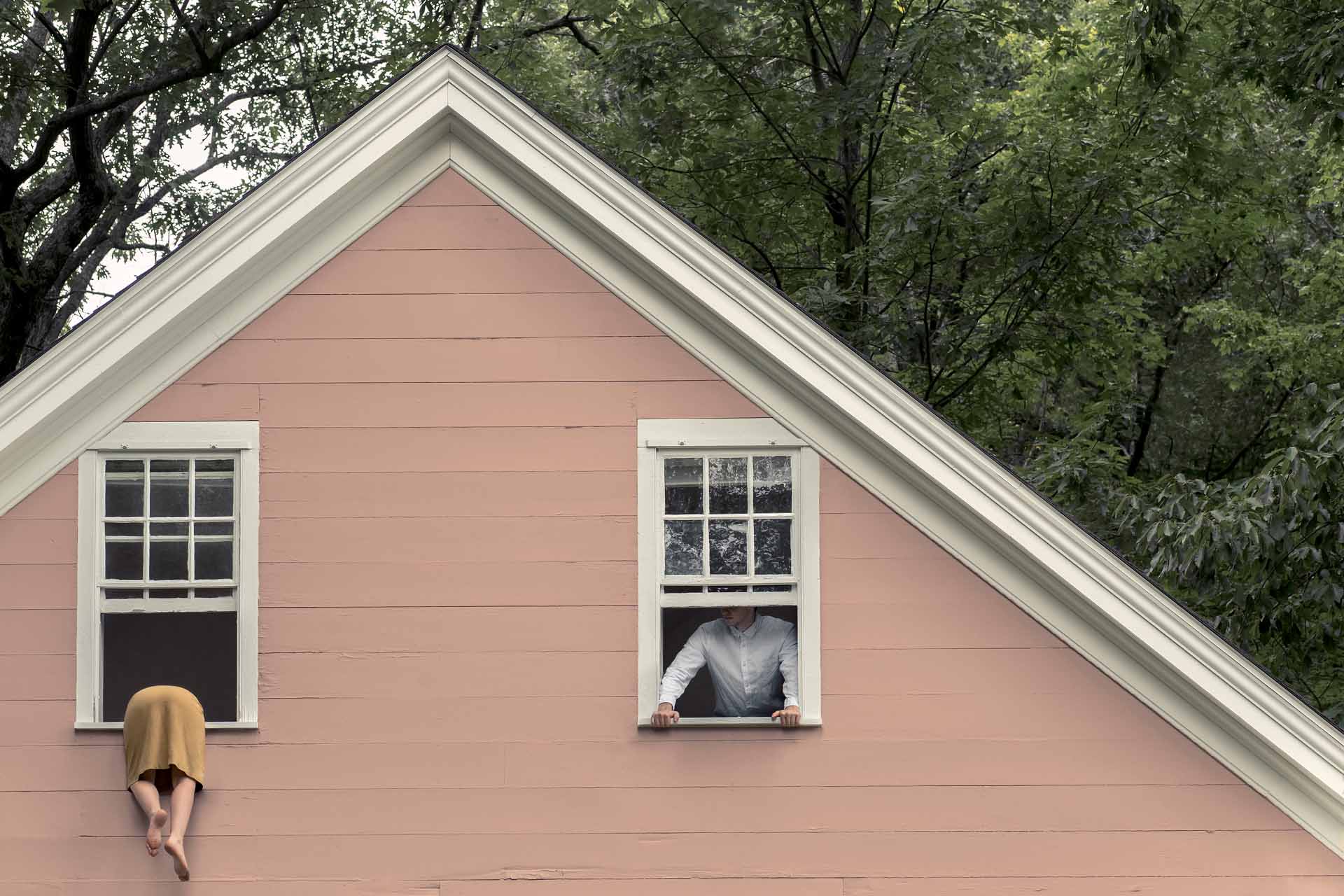
Uncanny. Surreal. Nostalgic. Disorientating. Fantastical. All these words and more can be used to describe the world of Brooke DiDonato (b. 1990). The inimitable visual artist, originally from Ohio and now based in New York City, has established a singular photographic vision over the past decade – one rooted in a playful imagination and the desire to inspire a double take. Her scenes, constructed using real locations, objects and people, teeter on the edge of possibility, occupying a place that is familiar yet off-kilter. But their popularity also comes from their relatability: tapping into contemporary anxieties and universal experiences of love and loss. Family homes and domestic settings offer DiDonato endless inspiration. Cosily decorated rooms and pristine gardens are imbued with danger, humour and intrigue, encouraging us to look again. In one shot, legs kick from an open window. Elsewhere, garage doors and white picket fences close in around characters, whilst curtains, footstools and sofas engulf bodies whole. Meanwhile, attics, cupboards, fireplaces and kitchen cabinets are locations to be occupied and explored. The outdoors offers a similar playground for ideas, where figures are subsumed by cacti, arch backwards into shrubbery or fold forwards into iron railings. One thing is made clear: DiDonato looks at a setting and asks, “what if?”

Take a Picture, It Will Last Longer, from Thames & Hudson, is DiDonato’s debut monograph. It brings together several of her most well-known bodies of work, alongside new photographs that have never been seen before. We sat down with the artist ahead of the launch, to discuss her inspirations, creative process and the experience of making this first book.

A: Do you remember the first time you picked up a camera? What drew you to start making photographs?

BDD: It was my dad’s Polaroid. He worked for Nationwide as a claims adjuster, and would take pictures of houses that had storm damage. Sometimes I would go with him, and I thought it was cool that he spent his day taking pictures. At the time, I would’ve been 10 or 11. When he wasn’t working, he’d let me use this camera. I took pictures of our cat, Tiger, posing in different areas of the house. I built sets around him – like in a bathtub surrounded by bottles – and wrote captions on the bottom of the Polaroid, such as “which shampoo should I use?” It took me a long time to realise there was a strong throughline to what I’m making today – a constructed scene with a funny caption. But it’s what I was doing aged eleven.

A: Your pictures are so distinctive and imaginative. Where do your ideas usually begin? And are there any particular artists, filmmakers or thinkers who influence you?

BDD: I love Gregory Crewdson’s work – I discovered him in my early twenties. He has spoken about wanting his stories to remain unresolved, and I like the idea of a moment suspended in time, where we don’t really know what happened before or after. I was also influenced by Francesca Woodman early on in my career: her work is eerie, somewhere between a dream and a nightmare. Other than that, I go to vintage stores a lot – sometimes I buy things, and I don’t know what I’ll do with them yet, but they’ll appear in a picture later down the line. Sometimes it’s as simple as reading a quote and then thinking of ways to visualise it. I really like idioms, too.

A: Could you walk us through the making of one of your compositions? How does an image take shape from concept to completion? Is there a process you tend to follow?

BDD: I often reshoot: maybe the picture didn’t have the mood I wanted, or the lighting could have been better. I have a background in journalism, which is a bit more “you missed the moment.” But I can be a perfectionist about the way I work. The legs hanging out the window is a good example. That’s my dad’s house, and I have unlimited access to the location. When I first shot this, it was overcast and I had no movement in my legs. I wanted it to feel more playful. So I went back out, three more times, until I got the shadow of the tree on the façade, which adds a little bit more dimension to the image. It makes it clear this is a real place, not a studio. I also kicked my legs around to make the scene feel more active. Now, the viewer is asking: is she going in? Climbing out? We don’t know, but something is happening. Those little changes can completely alter the meaning of the photo.

A: Your pictures transform domestic settings into uncanny spaces. Why use ordinary locations as your backdrops? BDD: I grew up in a rural area, where you know what’s going to happen: who your neighbour is, what time the mailman is coming. So it’s the perfect stage for something that you don’t expect. I’ve shot a lot of work at my dad’s house, and that comes from a sense of familiarity with the place. I’m always returning, and noticing it change in these subtle ways: maybe he painted the fence or replaced the carpet in the bedroom. I became especially drawn to this phenomenon when I moved to New York – a place where you walk out your door and have no idea what’s next. It gave me a different perspective.

A: These photos are often described as “surreal.” Do you identify with that term, or not? Where do you feel your photography fits within the movement’s rich lineage?

BDD: I do identify with it. I didn’t go to art school, so a lot of my background in photography was journalism. But I’ve become more interested in the movement over the years – especially discovering artists like René Magritte. Surrealism was birthed out of discontent with reality, so I can identify with the intent. Somebody once referred to my work as magical realism, and I can see both definitions. The majority of my images are possible, and they did happen. I have constructed the scenes myself. So, in a way, it’s not surreal – just unexpected. They’re almost always practical effects, and I’m not trying to trick the audience. If something is hanging, I’ve used fishing line. Oftentimes, I’ll leave that in the final image.

A: You tend to challenge expectations of how space can be occupied – sometimes defying physical logic. What fascinates you about manipulating spatial relationships?

BDD: I have a curiosity about how things should work, versus how they can work. The fun thing about shooting indoors is that the space stays the same: it’s always going to look like this. Either I have to alter it, or change how I show it to you. Some of my favourite photos are set in the same corner of my room, that I’ve revisited repeatedly, over and over again. In my bedroom in Austin, I would go to sleep every night below the attic and wonder how many ways I could get up there. Could I stand on somebody’s shoulders? That became a photo. Then: I wonder if I could stack 60 books and make it 10 feet tall? That became yet another photo. It’s all about troubleshooting, and asking: how many ways can this work?

A: What was the process of looking back and curating Take a Picture, It Will Last Longer like? Did you observe developments in your creative approach over the years?

BDD: I definitely noticed differences in my process, from then to now. I used to work a bit more spontaneously and the work was less controlled. I’ve always been interested in depicting domestic spaces – one of the earliest images in the book is from 2012 at my mom’s house – but I don’t think I nurtured that idea quite as much as I did during the pandemic. In 2020, I moved into a house in Austin, and that is when things really took off. I was living alone, and I thought: I can make anything here. I can do whatever I want. I’d put up wallpapers, hang stuff from the ceiling and just leave it there for a week and think about it. I had my friend spray herself in the face with a hose, in my bed. I used my living space as a studio. The work became more unhinged during that time.

A: What element of making the book did you enjoy most? BDD: It was fun to figure out how all my work would live together. When I was living in New York, in my early 20s, I would collaborate with dancers or models who I met on Instagram. So those photos are quite different to the work in Austin. When we started the book, I thought: how are these things going to match? It was a pleasant surprise for me that they did. We’ve used wallpapers as a signifier that you’re moving into a different thematic section – it feels like you’re travelling through rooms in a house. It shifts from work that is, for example, an expression of pillows, to a section about limbs, bodies and wacky contortions. Even though I don’t really shoot with a series in mind, there are different threads within the book. It was very satisfying to see it fit as a whole.

A: Was there a part of the process that stood out to you?

BDD: Raquel Rei, who is the designer of the book, had an uncannily good sense for the work. I was shocked by the way she put things together. She understood the timeline of things and matched up the images well. For example, she placed a photograph I made when I was deep in grief next to a lighter expression of loss. She somehow managed to sense that just by looking at the pictures. It’s interesting when you think a piece is so personal to you, but someone else gets it.

BROOKE DIDONATO CLOSURE

A: The publication includes an interview between your father and Emmy Award-winning filmmaker and writer Eve Van Dyke. What did you take away from those conversations? Did they prompt you to see your work anew?

BDD: It made me see things in a fresh light. There’s a funny passage where my dad speaks about how his neighbours never say anything when I’m out in the yard doing odd things – like lying face down on a white picket fence. They’ll just say: “I see Brooke’s home.” I won’t spoil it, but it was fun for me to hear his point of view by reading those conversations. A: Finally, what are you working on now? Are there new ideas, formats or directions you’re excited to explore? BDD: Making Take a Picture has meant looking constantly at completed work. That’s made it harder to sit with anything unfinished, as it doesn’t yet have a home in the way the images in the book do. I’m going to do other things and see what comes of it: read more, go on runs and engage in activities that aren’t photography for a while so I can renew. I definitely want to explore video in future: a short film would be a good challenge. But I don’t have any concrete plans just yet.


Take a Picture, It Will Last Longer | Thames & Hudson

thamesandhudson.com

Words: Eleanor Sutherland


Image credits:

1.

2.

3.

4.

5.

6.

7.

8.