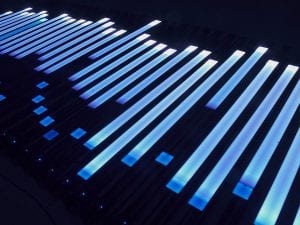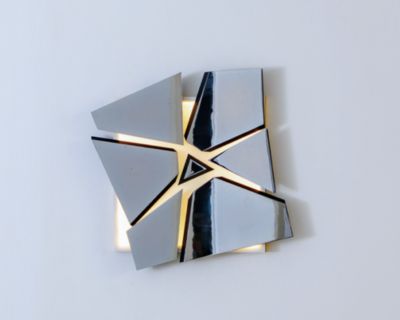
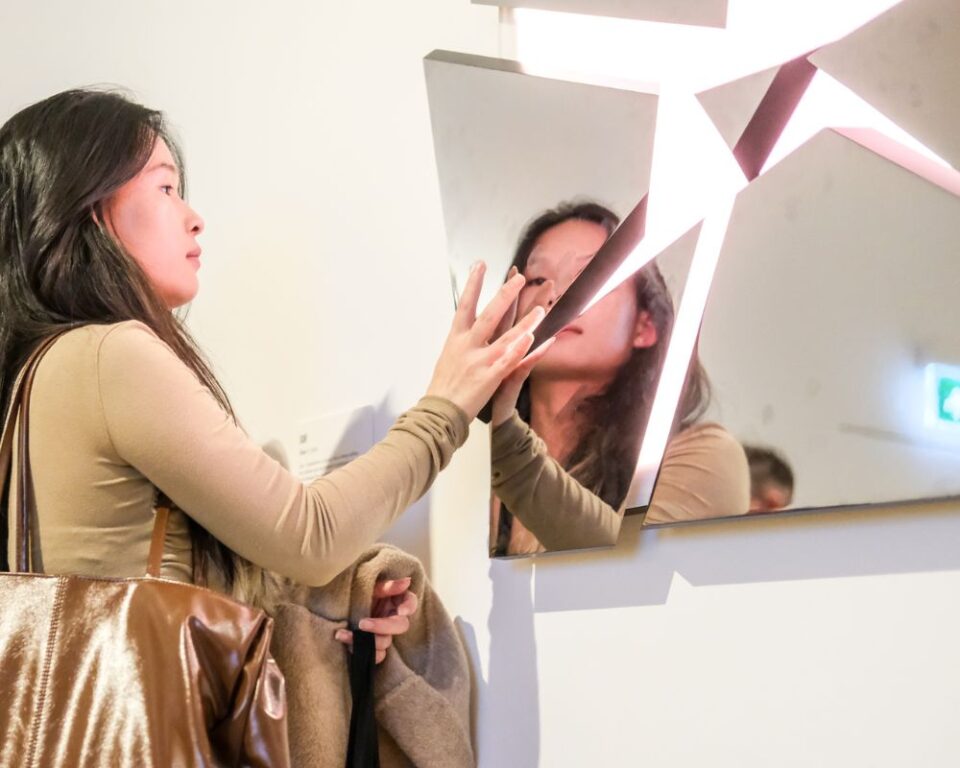
Italian artist Sof creates works that invite audience participation. His latest work, Geo 1 is an artwork that comes alive through touch. Instead of simply looking at it, viewers are invited to interact with the surface, moving pieces of the mosaic to reveal shifting patterns of light underneath. Shards of mirrored material come together to form a single sculpture, with light shining through the cracks. The work changes with every touch, made up of magnetic fields, materials and light that respond in real time, meaning no two experiences are the same. The piece, which was nominated for the 2025 Aesthetica Art Prize, was built around the idea of anagrams, encouraging people to discover new meanings as they explore. Each movement uncovers another layer, highlighting themes of transformation, motion and presence. In this piece, the audience isn’t just observing; they become part of the artwork itself, shaping how it looks and feels moment by moment. We caught up with Sof to chat about his creative process.
A: What inspired the idea of transforming a traditional mosaic into an interactive, living surface?
S: It was both digital and ancient. It all started from a fascination with pixels as a teenager and it developed into a broader interest in the fundamental logic of mosaics. I related the basic elements of mosaic making – substrate, tesserae and binder – to the concepts of space, matter and time. This shift turned a static craft into an evolving set-up. Viewers can move pieces and reveal or hide light. They perform the making of something that never reaches finality. I like that this started with my own experiments with immaterial pixels, and ended up inviting people to physically interact with matter and light in their purest form.
A: How do you see the role of the audience in shaping the work?
S: Firstly, allowing the audience to shape and reshape the piece is a lot of fun because it breaks a barrier that’s always been there between viewer and artwork. The temporal dimension, the concept of infinity and the fact that anyone can be part of it, feels almost divine and that’s where I wanted this project to go. I love to see the energy created when the people realise that they can modify what they see. The idea is also to hand people the brush so we recognise, consciously or not, that we can all engage with the elements around us and define the reality we want to see. So when I’m near one of the mosaics and I see two arms being lifted towards the piece, I internally think “Yes! Mission accomplished!”
A: What materials and technologies did you use to create the responsive surface of Geo 1?
S: It’s a mix of new technologies and traditional technique. Each component of the magnetic light base is the result of a long research process. The magnetism is achieved with neodymium, a crucial rare-earth element that has transformed much of the high‑tech landscape in recent years, including electric motors. However, I’m also mindful of the face that mining actually raises significant environmental concerns. Regarding the light, I use LEDs and build my own “Light Guide Panel” to produce a smooth, tinted light inspired by the horizontal sunlight. Light’s immateriality gives it a holy dimension so I didn’t want to diffuse it through a material like plastic. I ultimately found the right partner in a company that produces hand-blown flat glass, made using traditional methods. After many efforts and collaborations, we created an exclusively extra-sized, semi-tempered opal glass that fits the project perfectly.
A: Can you tell us a bit about how anagrams influence your creative practice?
S: Anagrams weren’t a key element at the start of the project, but they have become one. After producing pieces in different materials, I wanted names that would shape how viewers appreciate the piece. Because an interaction occurs between a human being and a material, the work should provoke questions about our relationship to the specific matter. I like my art to be playful, so I was seduced by the use of anagrams. I don’t really care whether they’re easy or difficult to decrypt, they should be accessible to those who can truly grasp the meaning behind the work. The consequence of that little game is that anagrams now directly play into the conception of the future mosaics, both semantically and plastically.
A: What’s next for you? Are you working on anything we can look forward to?
S: I plan to work with other materials (sometimes unexpected), aligning with new shapes, scales and, of course, more anagrams. I’ll be continuing the four existing series and in the next pieces, I want to focus on working with the roughness of the raw material, which means applying less transformation. However, my immediate next step is to develop a semi-industrial version of the magnetic light base. From this revised object I’m going to prepare, promote and launch a crowdfunding campaign based on an evolution of the CHIMNAES series. The idea is to make a part of the project accessible to a wider audience.
The Aesthetica Art Prize is Open for Applications. Win £10,000 and Exhibition. Submit Here.
The Aesthetica Art Prize Exhibition 2025 is at York Art Gallery until 25 January.
sof-art.it | yorkartgallery.org.uk
Words: Emma Jacob & Sof.
Image Credits:
All images courtesy of Sof.