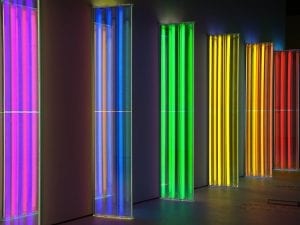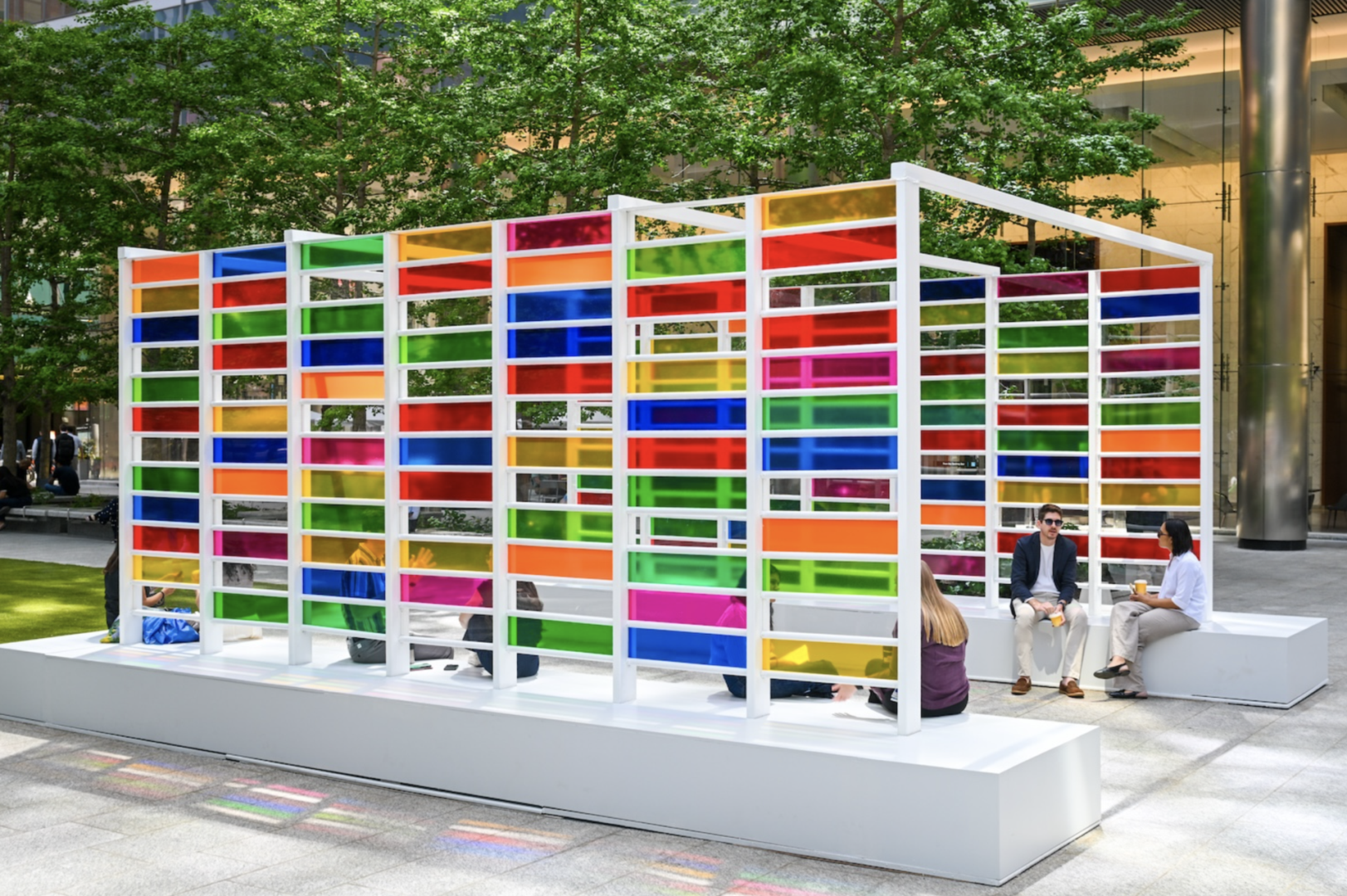
Few artists working in Britain today have developed such an immediately recognisable visual language as Liz West. Immersive installations that unite colour, light and architecture have steadily transformed public space into environments of heightened perception, inviting audiences to experience the familiar anew. Operating at the intersection of sculpture, design and sensory experience, chromatic intervention becomes a means of shifting not only physical surroundings but emotional and cognitive states. At a moment when contemporary art continues to prioritise participation and experiential encounter, this approach feels increasingly central to how audiences engage with installation. In 2026, a succession of ambitious exhibitions has consolidated West’s position within the field of immersive practice, extending international visibility while reinforcing a conceptual focus that continues to evolve through light.
Architecture in these environments rarely remains neutral. Transparent acrylic, mirrored surfaces and refracted daylight form a working vocabulary in which colour emerges as a living condition rather than applied surface. Each installation operates as a responsive system, recalibrated through the movement of sun and viewer alike. Shifts in position alter entire fields of perception, where reflection and refraction continuously reorganise spatial relationships. Engagement slows almost instinctively, as attention adjusts to subtle variations in intensity and chromatic density. Within this dynamic, colour becomes inseparable from perception itself, shaping how memory, orientation and emotion are experienced in real time.
Recent presentations have sharpened this relationship between sensation and structure across markedly different contexts. Yorkshire Sculpture Park offered a particularly resonant encounter, where the historic chapel was transformed through mirrored interventions that fractured natural light into drifting chromatic fields. Movement through the space unfolded with a quiet graduality, allowing colour to accumulate through duration rather than immediacy. At Double Fizz in Manchester, vertical bands of colour and reflective surfaces compressed visual rhythm into a dense interior environment, oscillating between architectural clarity and perceptual dissolution. Bristol Light Festival extended this language into civic space, where temporary interventions interrupted familiar urban routes with bursts of refracted illumination, briefly recalibrating the visual logic of the city. Variation in scale and setting reveals a practice increasingly attuned to how light behaves across institutional, commercial and public conditions.
Recognition of this trajectory is closely tied to an earlier milestone in 2016, when inclusion as an Aesthetica Art Prize alumnus signalled the emergence of a distinctive voice within contemporary installation practice. Since that moment, work has expanded across museums, festivals and large-scale public commissions spanning Europe, Asia and the Americas, consistently returning to questions of perception, participation and chromatic experience. Inclusion within the Aesthetica 20 anniversary exhibitions situates this development within a broader reflection on two decades of contemporary art practice, where immersive installation has moved from peripheral experimentation to a defining mode of visual culture. Rather than indicating a shift in direction, this continuity underscores how tightly focused the core enquiry has remained, even as spatial and geographical scope has widened considerably.
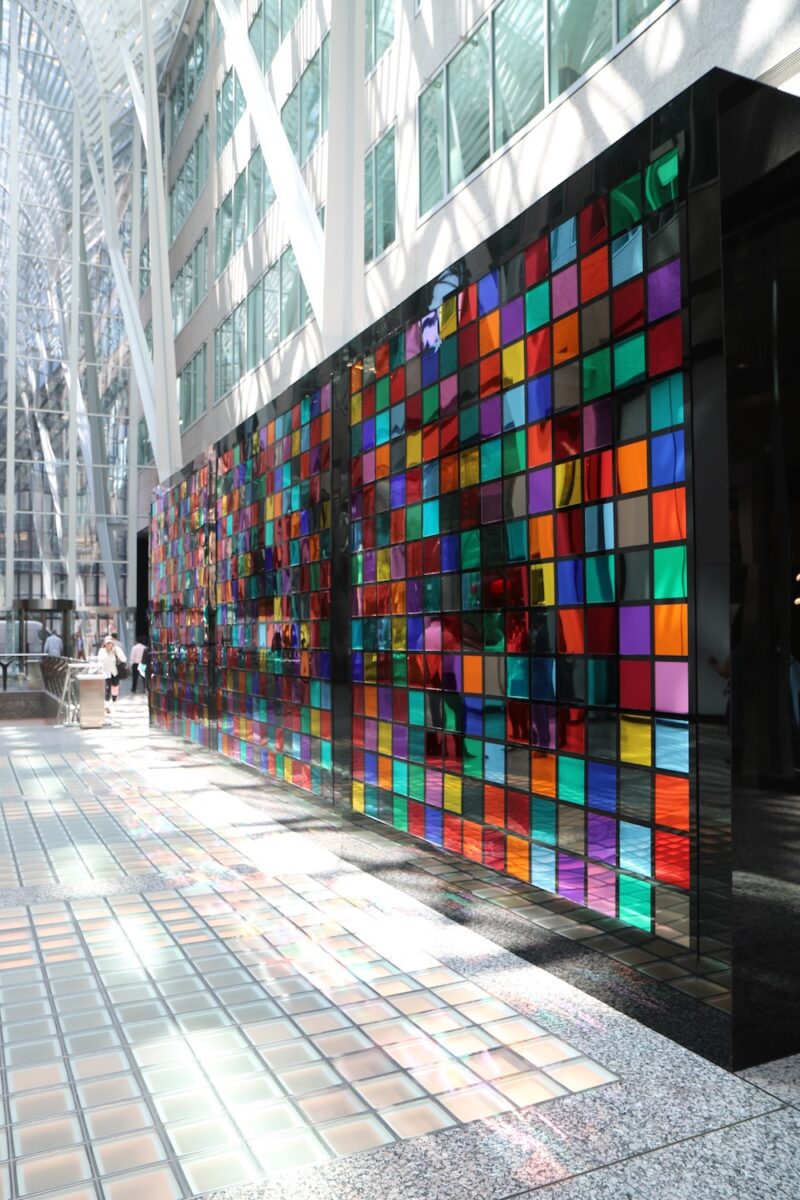
Broader critical attention around light-based installation inevitably invites comparison with figures such as Olafur Eliasson, whose atmospheric environments often foreground ecological systems and perceptual framing. Eliasson’s work tends towards environmental abstraction and calibrated phenomenology, while Carlos Cruz-Diez explored chromatic instability through systematic optical progression, and James Turrell redefined architectural perception through controlled immersion in light. Distinct from these approaches, West’s practice embraces chromatic excess and visual generosity, where saturation replaces reduction, and immediacy coexists with formal precision. Rather than withdrawing perception into minimal fields, environments expand it into active, shifting conditions of encounter.
Accessibility remains central without diluting complexity. Installations operate fluidly across galleries, cathedrals, urban infrastructure and large-scale public commissions, allowing audiences to enter without prior interpretative frameworks. Experience is activated through movement, where shifting position alters chromatic relationships and redefines spatial awareness. Participation is not supplementary but structural, embedded within the conditions of viewing itself. Encounters remain open, yet carefully composed, balancing sensory immediacy with sustained formal intelligence. Within this balance lies a distinct strength, where clarity of experience and conceptual rigour coexist without tension.
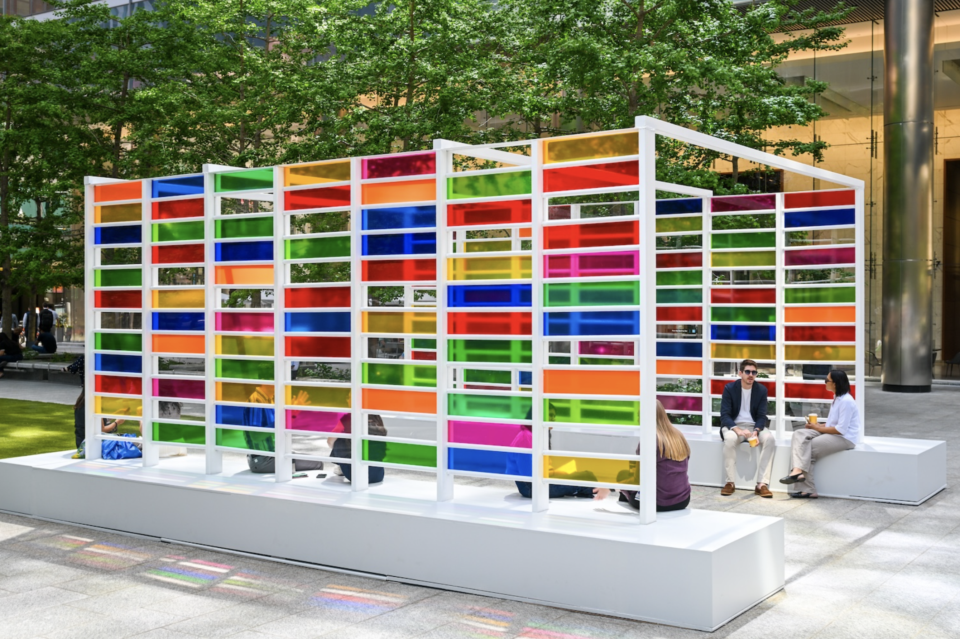
Anthems to Colour, presented as part of Luminato Festival in Toronto, extends this trajectory into a multi-site urban commission spanning Brookfield Place, First Canadian Place and Bay Adelaide Centre. Commissioned by Luminato Festival and supported by Brookfield Properties, the project embeds large scale chromatic interventions within the city’s financial core, reconfiguring commercial architecture through reflective and translucent systems. Rather than overlaying imagery onto existing structures, installations operate through them, activating glass, steel and interior atriums as dynamic surfaces for light. Movement through the city becomes a perceptual circuit, where colour emerges from infrastructure itself. Urban space temporarily shifts from functional backdrop to active chromatic field.
A conceptual undercurrent drawn from 1990s popular culture informs the series, though not through direct quotation. Emotional immediacy, collective rhythm and shared affect associated with pop music find translation into spatial form, where colour functions as a visual analogue for musical resonance. Collective experience becomes central, as installations generate shared perceptual conditions across audiences moving through the same environments. Rather than invoking nostalgia, the work channels optimism into spatial logic, structuring environments around play, connection and openness. Joy operates not as aesthetic decoration, but as organisational principle embedded within the behaviour of light and reflection.
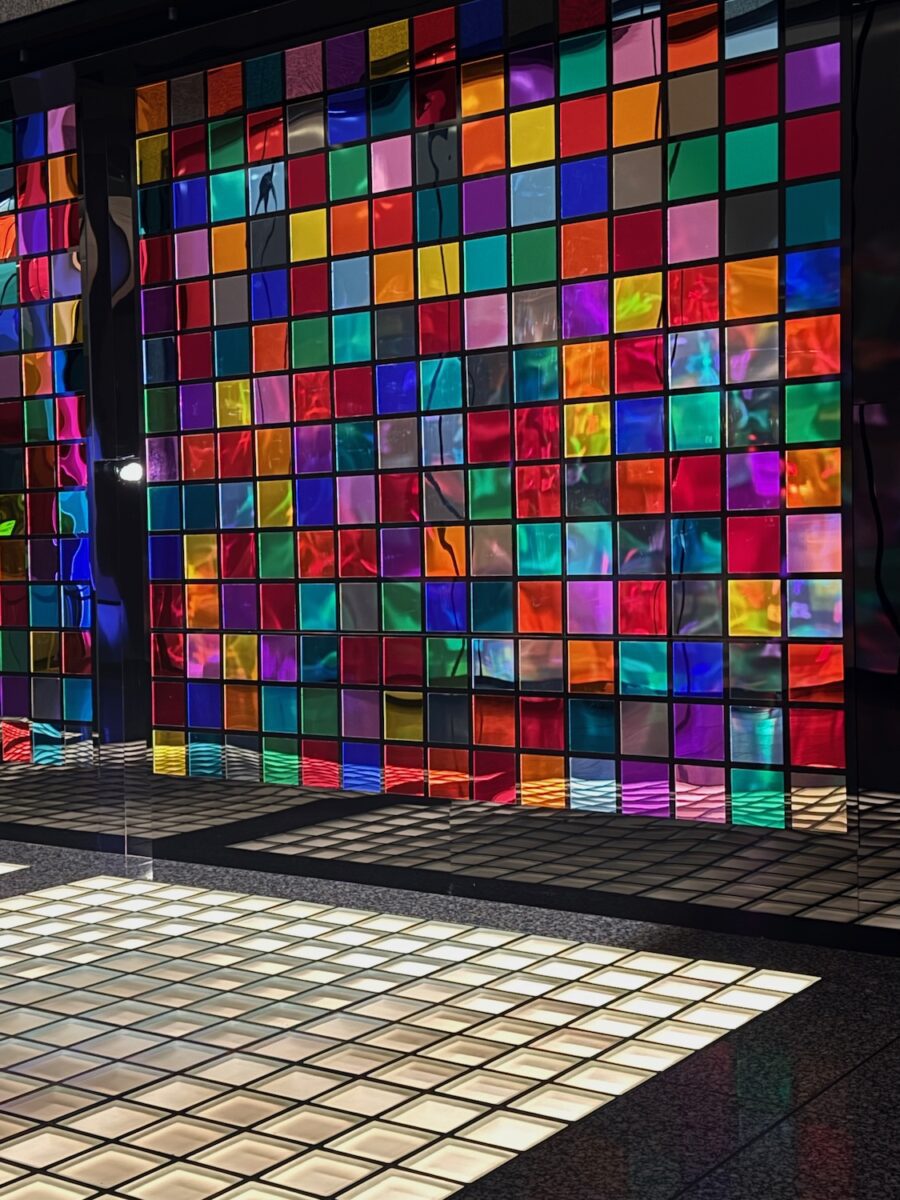
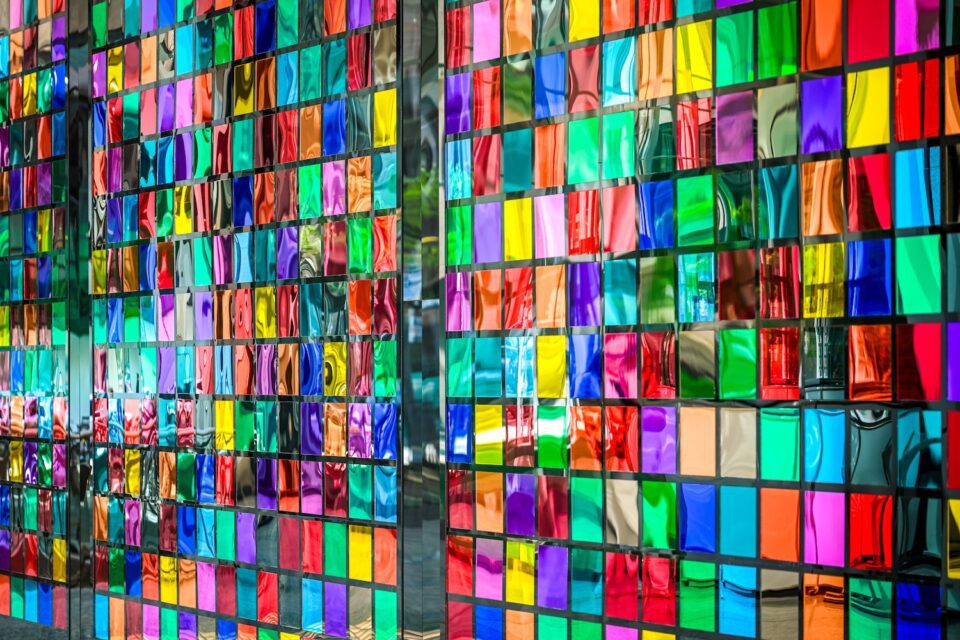
At Bay Adelaide Centre, Ascending Colour Frequency introduces vertical arrays of translucent panels that shift according to viewer position, producing gradients that rise through surrounding architecture. Brookfield Place hosts Gridded Echo, where mirrored coloured squares generate layered reflections that disperse across interior surfaces, producing effects of spatial doubling and expansion. First Canadian Place presents Diffraction Tango, an exploration of iridescent phenomena through circular apertures that fracture light into spectral fragments, recalling both natural and industrial surfaces. Across all sites, movement functions as the organising principle, ensuring that perception remains in constant recalibration.
Daylight operates as an active collaborator throughout the series, continuously reshaping each installation as it passes across Toronto’s skyline. Glass façades, polished stone and steel surfaces absorb and redistribute colour, producing shifting conditions that evolve throughout the day. Familiar commercial architecture is momentarily transformed, acquiring unexpected intensity and visual vitality within everyday circulation routes. Intervention lies not in structural alteration but in perceptual recalibration, revealing how profoundly environment is shaped by light. Familiarity gives way to heightened awareness, where attention becomes the primary site of transformation.
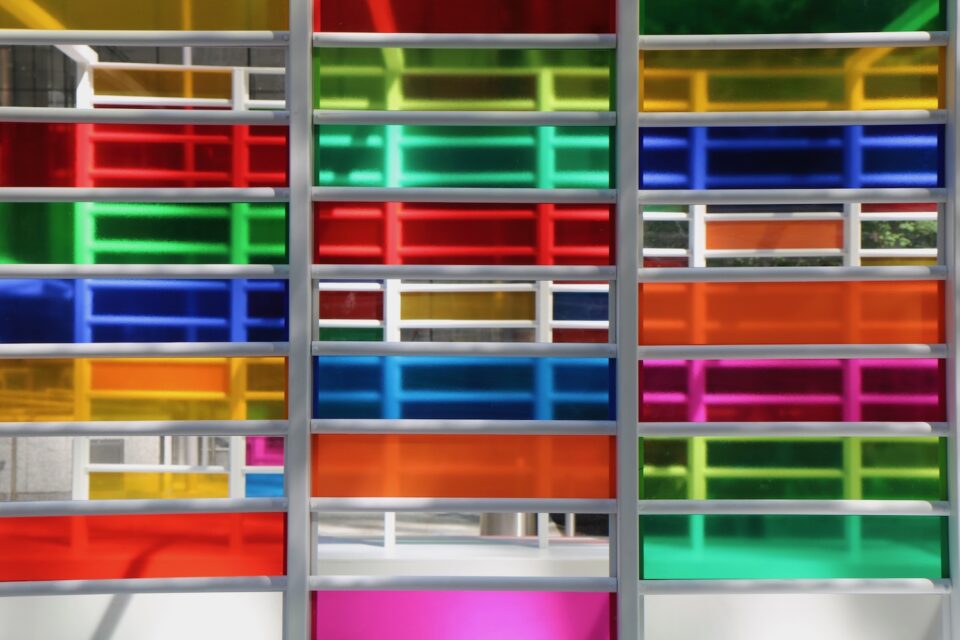
Underlying this chromatic complexity is a sustained interest in sensory psychology and embodied perception. Colour functions simultaneously as stimulus and structure, shaping emotional response while organising spatial understanding. Encounters emerge through movement and duration rather than fixed image, allowing perception to unfold gradually across changing conditions. Each installation reveals new relationships between surface, reflection and depth as light evolves. Experience accumulates over time rather than resolving instantly, embedding viewers within a continuous field of perceptual negotiation.
Across an evolving body of work, a coherent enquiry persists: how colour might operate as environment rather than image. From Yorkshire Sculpture Park through Double Fizz and Bristol Light Festival, and now within the expansive framework of Anthems to Colour, each iteration extends this investigation into new spatial and cultural contexts. Perception is never treated as passive, instead understood as something actively constructed through movement, light and attention. Within that proposition lies the enduring strength of West’s practice, which continues to expand in scale while remaining anchored in a precise and sustained exploration of how colour reorganises the experience of space itself.
Anthems to Colour is at Luminato Festival, Toronto until 28 June: luminatofestival.com
Words: Anna Müller
Image Credits:
1. Anthems to Colour (Gridded Echo) by Liz West, presented by Luminato Festival 2026 and supported by Brookfield Properties. Photo credit – Ernesto Di Stefano on behalf of Brookfield Properties.
2. Anthems to Colour (Gridded Echo) by Liz West, presented by Luminato Festival 2026 and supported by Brookfield Properties. Photo © Liz West.
3. Anthems to Colour (Ascending Colour Frequency) by Liz West, presented by Luminato Festival 2026 and supported by Brookfield Properties. Photo credit – Ernesto Di Stefano on behalf of Brookfield Properties.
4. Anthems to Colour (Gridded Echo) by Liz West, presented by Luminato Festival 2026 and supported by Brookfield Properties. Photo © Liz West.
5. Anthems to Colour (Ascending Colour Frequency) by Liz West, presented by Luminato Festival 2026 and supported by Brookfield Properties. Photo © Liz West.