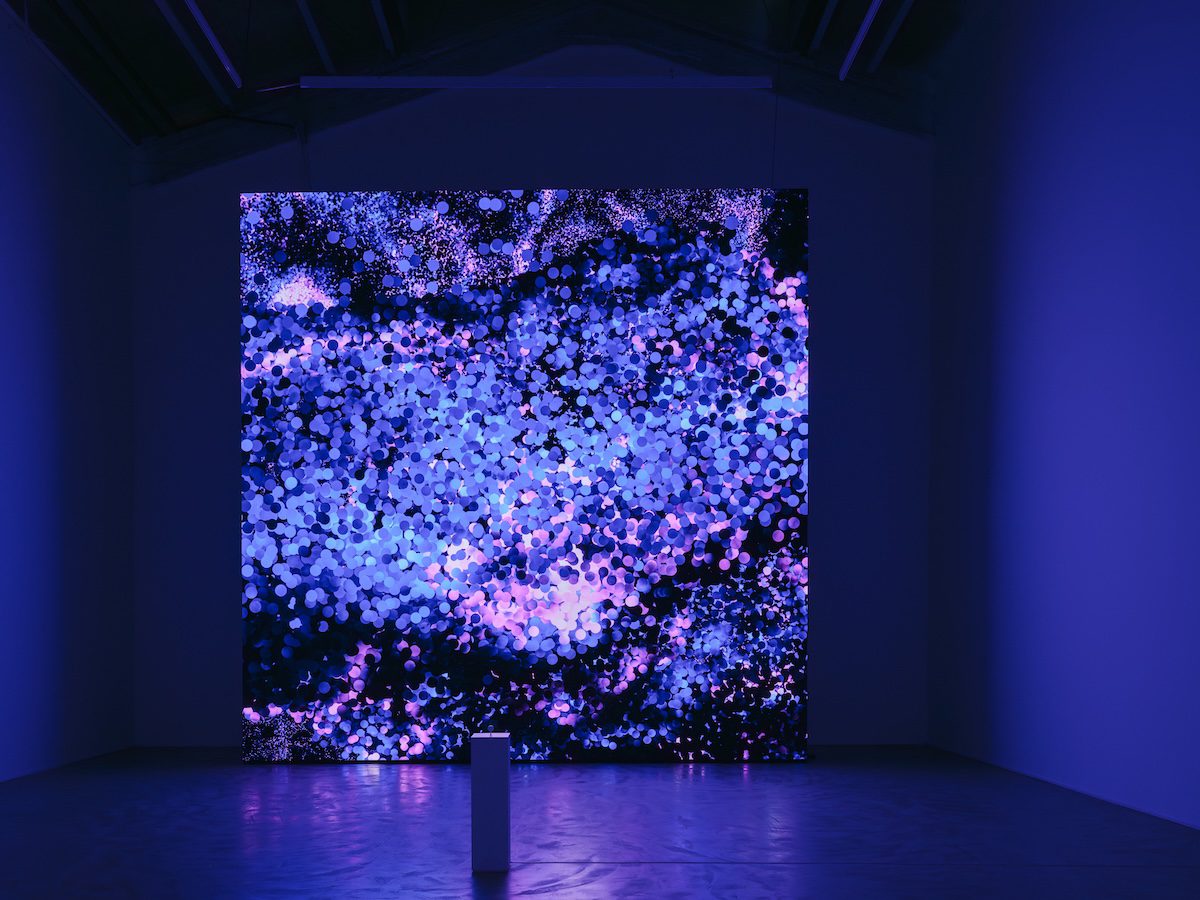
Maxim Zhestkov’s Flow: Infinite Walk at BOUNDED SPACE, Beijing, stages a familiar proposition within contemporary digital art, but does so with a clarity that exposes both its strengths and its limits. The exhibition, on view until end of June, presents itself as an environment in which the viewer is repositioned from observer to participant through the introduction of a joystick interface. This gesture is framed as a shift in authorship, yet it also reveals how easily interactivity has become a default claim within immersive installation practice. Zhestkov’s London-based studio builds systems that respond in real time, but the more pressing question is what kind of agency is actually being offered. The answer lies somewhere between navigation and constraint, where participation bounded by pre-scripted computational logic.
The centrepiece Playscapes – comprising Dark Forest, Sentient Ocean, Tectonic Shifts and Superclusters – is constructed from particle systems that simulate natural forces through algorithmic rule sets. These environments are visually compelling in their scale and responsiveness, but their structural language is already well-established within generative design and real-time simulation aesthetics. The viewer’s input via joystick introduces variation, yet it does not fundamentally alter the underlying system architecture. Instead, it modulates behaviour within a closed field of possibilities, producing a controlled sense of unpredictability. This distinction matters, because it separates true systemic openness from the aestheticisation of variability. Zhestkov’s work operates convincingly within the latter category.
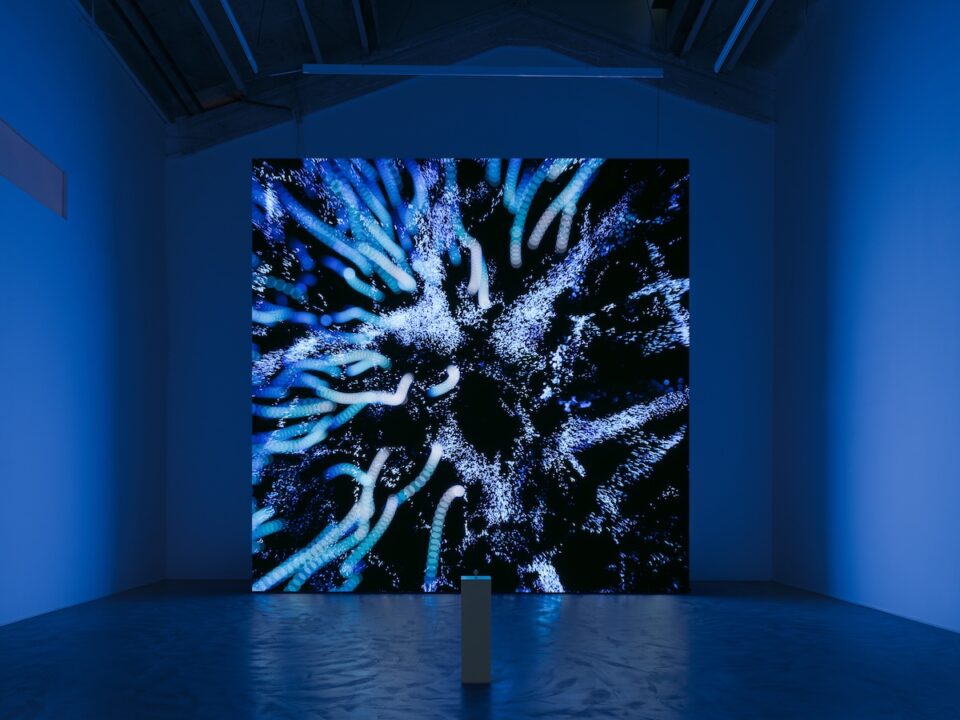
It is here that a comparison with Cory Arcangel becomes productive, though not in terms of influence so much as divergence. Arcangel’s interventions into game systems historically relied on subtraction, exposing the latent absurdity or poetry of computational constraints by stripping them down to near-zero gestures. The critical force of that approach lay in its refusal of immersion, insisting instead on distance and legibility. Zhestkov moves in the opposite direction, intensifying immersion until the system becomes atmospheric and enveloping. However, in doing so, the critical legibility of the system can become less visible, absorbed into experience rather than revealed through it. The question is whether depth of immersion correlates with depth of insight, or whether it risks flattening critique into spectacle.
A more direct comparison might be drawn with Refik Anadol, whose large-scale data-driven environments similarly convert computation into spatial experience. Both practices rely on the translation of complex systems into sensory fields, but Anadol’s work tends to foreground the rhetoric of machine perception and data sublime. Zhestkov’s framing is more restrained, focusing on interaction rather than dataset authorship, but the aesthetic outcome can still converge on familiar registers of fluid abstraction and algorithmic spectacle. In both cases, there is a tension between the stated conceptual ambition and the recognisable visual language of generative display. The risk is that these systems begin to stabilise into style rather than proposition, where “real-time” becomes an aesthetic category rather than a critical one.
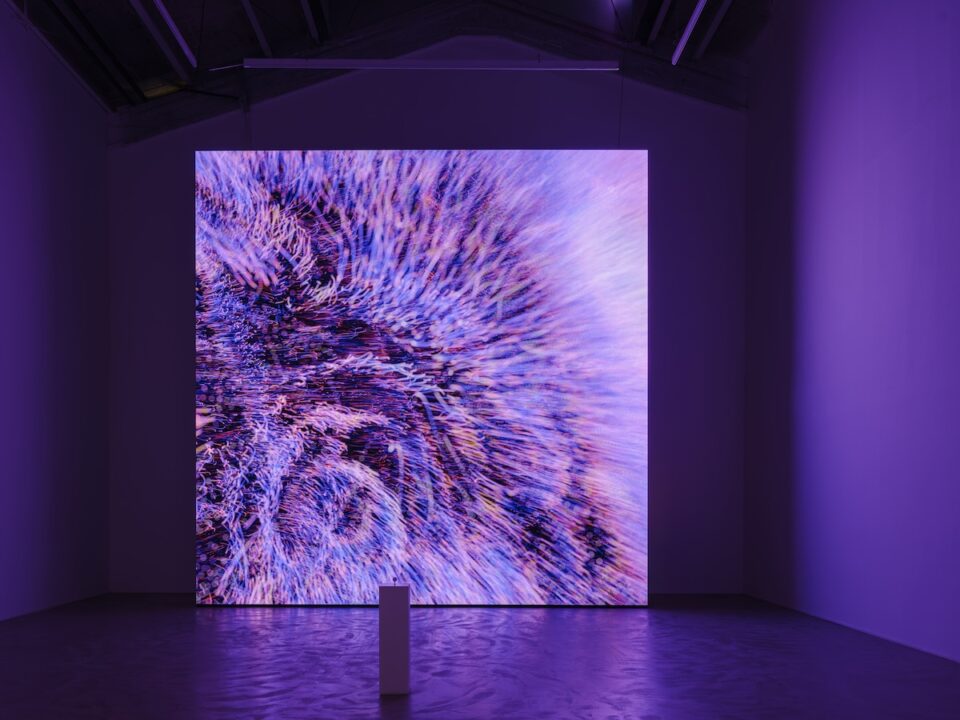
The inclusion of earlier works such as Modules (2023), alongside Elements (2017) and Volumes (2018), situates Flow: Infinite Walk within a consistent trajectory of system-building and spatial experimentation. These works demonstrate a sustained interest in translating physical phenomena into computational models, where motion, pressure and aggregation become visual grammar. However, viewed collectively, they also reveal a narrowing field of formal exploration, where variation occurs primarily at the level of environment rather than structure. The exhibition’s multi-room format reinforces this sense of controlled expansion. Each space recalibrates scale and input, but not necessarily conceptual stakes. The viewer moves through difference, yet within a stable methodological frame.
The joystick interface, positioned as a radical shift in authorship, is perhaps the most ambivalent element of the exhibition. It certainly introduces immediacy, translating gesture into visible systemic response, but it also reinforces a well-established paradigm of interactive art in which agency is simulated through bounded choice. The sensation of control is real at the level of experience, however, it operates within tightly governed parameters set by the system’s architecture. This is where Zhestkov’s work is most revealing: not in its claim to collaboration, but in its demonstration of how collaboration is engineered within digital environments. Interaction here is not openness so much as calibrated responsiveness.
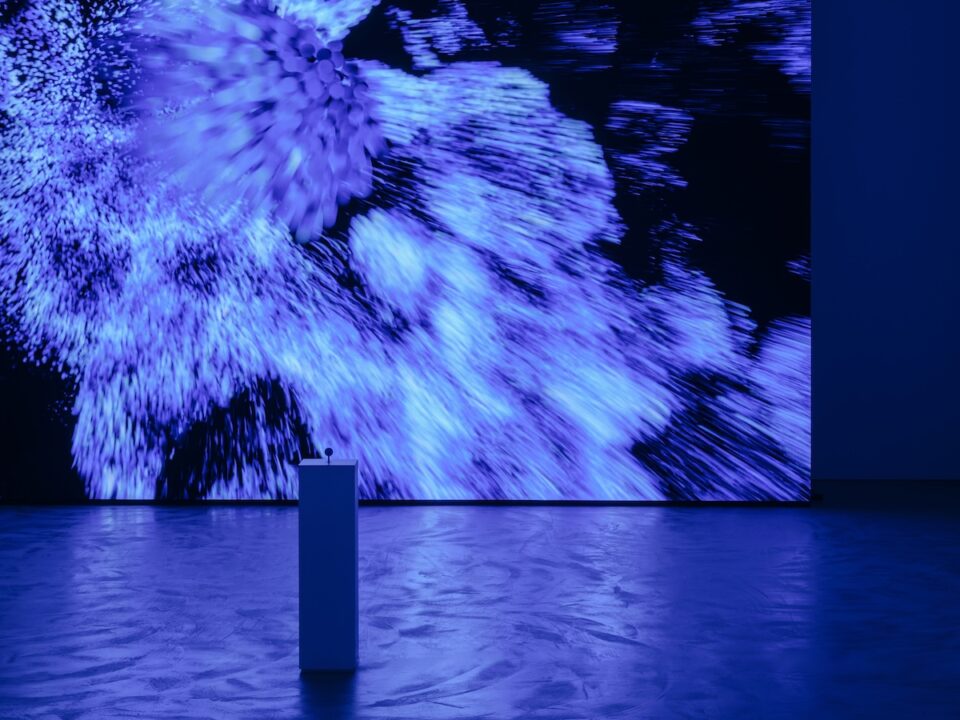
What Flow: Infinite Walk ultimately clarifies is the current condition of game-derived aesthetics within contemporary art: a field in which immersion, simulation and participation have become dominant languages, but not always critical tools. Zhestkov’s exhibition is compelling in its technical execution and spatial coherence, and it participates fluently in this broader visual economy. Yet, it also sits comfortably within it, rarely pushing against the structural assumptions that underpin generative and interactive installation practice. The result is a show that sharpens the vocabulary of systems-based art while leaving its foundational terms largely intact. In that sense, its most interesting tension is not between viewer and work, but between ambition and architecture, where the promise of openness is continually negotiated.
Playscapes is at Bounded Space Gallery, Beijing until 28 June: zhestkov.studio
Words: Simon Cartwright
Image Credits:
1. Maxim Zhestkov, Playscapes.
2. Maxim Zhestkov, Playscapes.
3. Maxim Zhestkov, Playscapes.
4. Maxim Zhestkov, Playscapes.