Contemporary art is increasingly concerned with where and how encounters take place. As artists move beyond the gallery’s traditional boundaries, landscapes, architectural structures and temporary communities have become spaces in which questions of ecology, attention and collective experience can be explored. Houghton Festival’s 2026 visual arts programme reflects this broader shift, presenting seven site-responsive commissions that consider the relationship between artwork, environment and audience. Across the grounds of Houghton Hall in Norfolk, sculpture, architecture, light and participation are used not simply to occupy space, but to alter how it is perceived. At a moment when public space is increasingly shaped by commercialisation, digital mediation and environmental uncertainty, these works examine how physical encounters can still produce moments of connection, reflection and imagination.
Over the past five decades, site-responsive practice has transformed contemporary art’s relationship with place. Since the emergence of Land Art in the late 1960s and 1970s, artists have questioned the neutrality of the gallery space, exploring how landscapes carry histories, politics and ecological narratives. More recently, artists and curators have expanded these ideas through temporary, participatory and socially engaged practices that treat audiences as active participants rather than passive observers. Houghton’s programme operates within this lineage, using the estate’s architecture, woodland and sculpture park as a framework for artistic exploration. Rather than presenting artworks as isolated objects, the festival creates a network of encounters shaped by movement, atmosphere and shared experience.
Across contemporary cultural discourse, the festival has become an increasingly complex site for artistic experimentation, positioned between exhibition, performance and social gathering. Such environments raise questions around spectacle and substance, particularly as large-scale events seek to balance entertainment with critical engagement. Yet, the most compelling interventions use their temporary nature to examine how communities form, how attention is directed and how shared experiences are produced. Developed under the direction of artist, DJ and curator Craig Richards, Houghton’s visual arts programme considers these possibilities by bringing together practices that move between contemplation and participation. Rather than functioning as an outdoor gallery, the festival becomes a shifting environment in which artworks are encountered through movement, sound, landscape and time.
Questions of imagination and uncertainty are central to Ryan Gander’s first commission for Houghton Festival, where three monumental black PVC balloon sculptures appear across the landscape. Titled Do you smile in your sleep?, How far is a head start? and Is everything necessary?, the works present large-scale questions written in bold white lettering, transforming language into a visual interruption. Gander’s practice has consistently examined the relationship between knowledge, perception and play, often using familiar objects and absurd propositions to expose the limitations of rational thinking. These sculptures operate through contradiction – they are enormous physical structures carrying questions that cannot be resolved. Within the festival environment, they create moments of curiosity and pause, encouraging audiences to consider uncertainty not as a problem to overcome but as a space for creativity.
Gander’s interrogation of everyday assumptions connects to wider contemporary concerns around information, automation and pressure to constantly interpret the world. In an era shaped by algorithms, measurable outcomes and accelerated communication, his deliberately unproductive questions offer a different mode of engagement. They return attention to speculation, humour and the possibility of not knowing. Throughout Houghton’s grounds, the sculptures interrupt habitual patterns of movement and introduce moments of reflection within a highly active environment. Their presence suggests that imagination can become resistance – a way of preserving ambiguity in a culture driven by certainty.
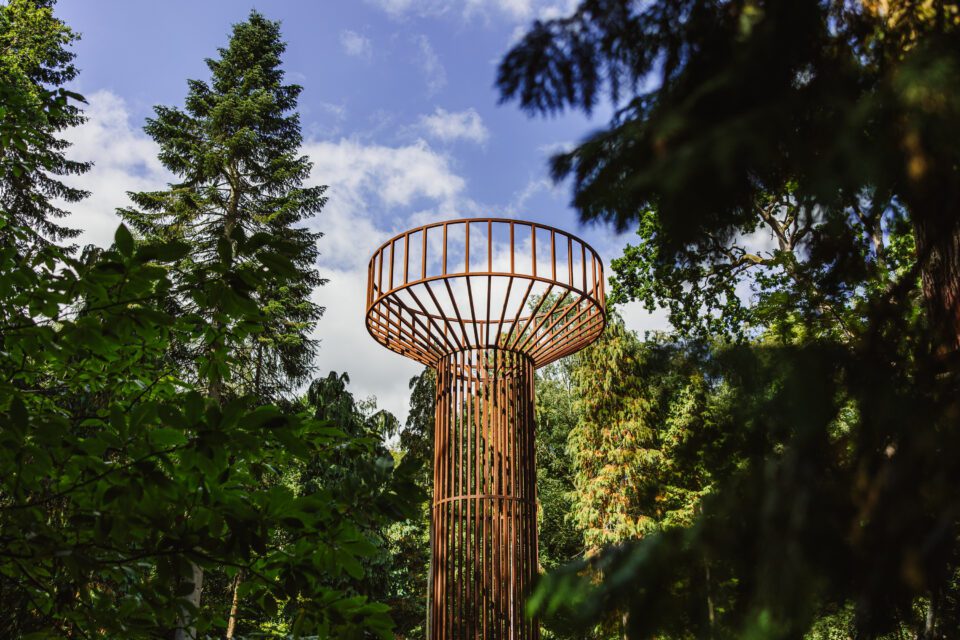 Ecological awareness and material responsibility shape another major strand of the 2026 programme through Water Tower, a new architectural pavilion created by Cella Collective and Mitre & Mondays. Drawing inspiration from Norfolk’s waterways, reedbeds and historic building traditions, the structure reinterprets Houghton Hall’s 1772 water tower through contemporary sustainable design. Using reed harvested from Scottish RSPB, the pavilion explores the relationship with architecture, biodiversity and craft knowledge. Rather than treating sustainability as a technological solution alone, the project considers how inherited building practices and local materials might inform future approaches to construction.
Regenerative approaches to architecture and design have become increasingly significant within contemporary practice, reflecting a broader shift away from extraction towards reciprocity between human and natural systems. Water Tower contributes to this conversation by considering materials not simply as resources, but as carriers of ecological and cultural memory. Its ongoing presence at Houghton complicates the temporary nature often associated with festivals, becoming a structure that evolves alongside the landscape rather than appearing as a short-lived intervention. Architecture here becomes a form of dialogue – between past and future, craft and innovation, permanence and change – demonstrating how artistic practice can engage environmental concerns without reducing them to simplified narratives.
Human connection becomes the central concern of Henry Krokatsis’ participatory work in the Pedilavium, which crucially centres on the intimate act of washing another individual’s feet. Performed by 40 volunteers throughout the festival weekend, the work draws on the historical rituals of humility and care while placing them within a wider contemporary social context. Its simplicity creates an encounter that feels both unfamiliar and deeply recognisable, asking participants to reconsider forms of interaction that have largely disappeared from everyday life. Krokatsis’ approach sits within a broader history of participatory art, from relational practices that examine social exchange to current artistic investigations into care, vulnerability and collective responsibility. Rather than creating an image for consumption, the work produces a situation dependent upon trust, presence and human involvement.
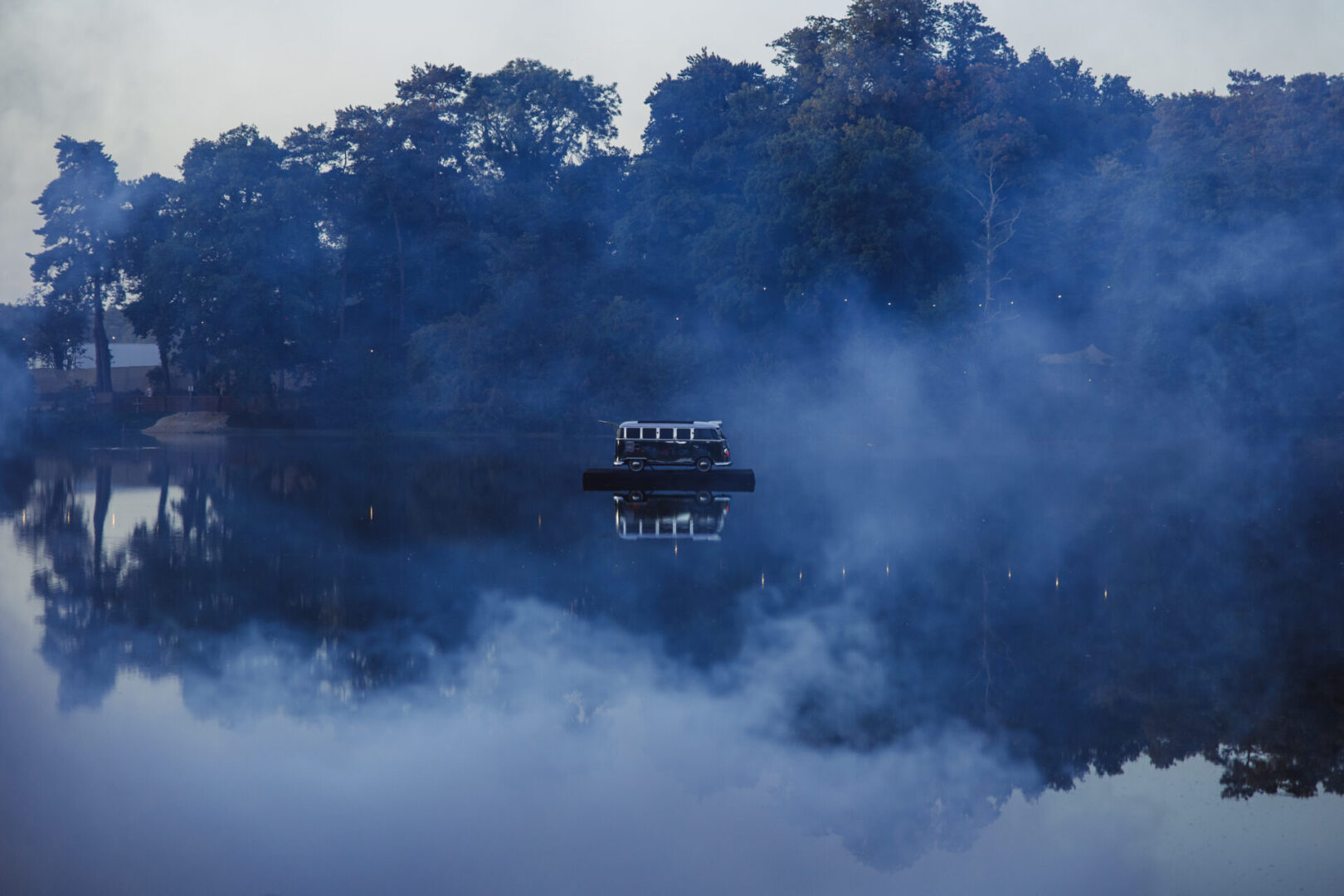
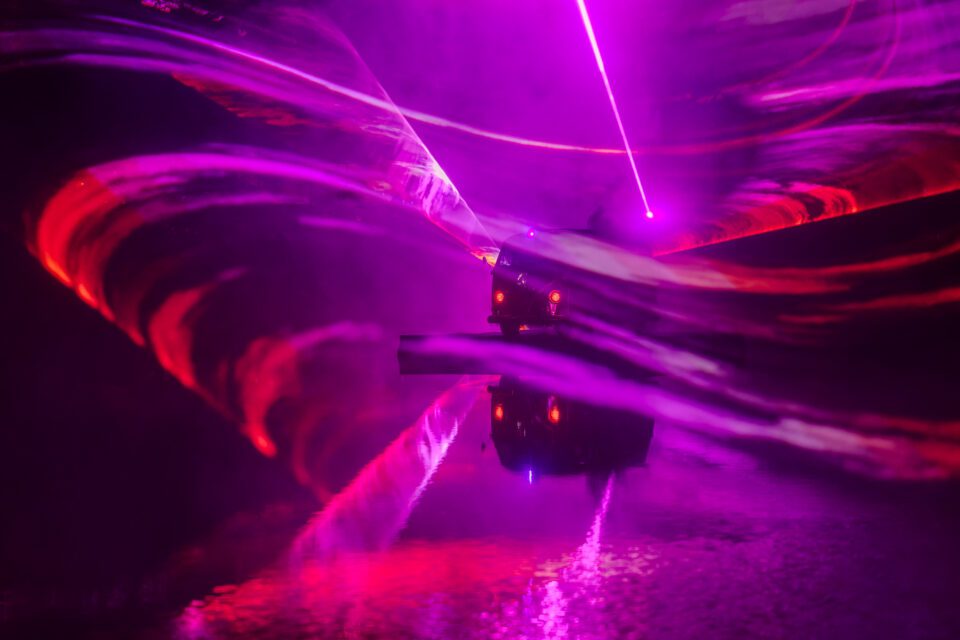
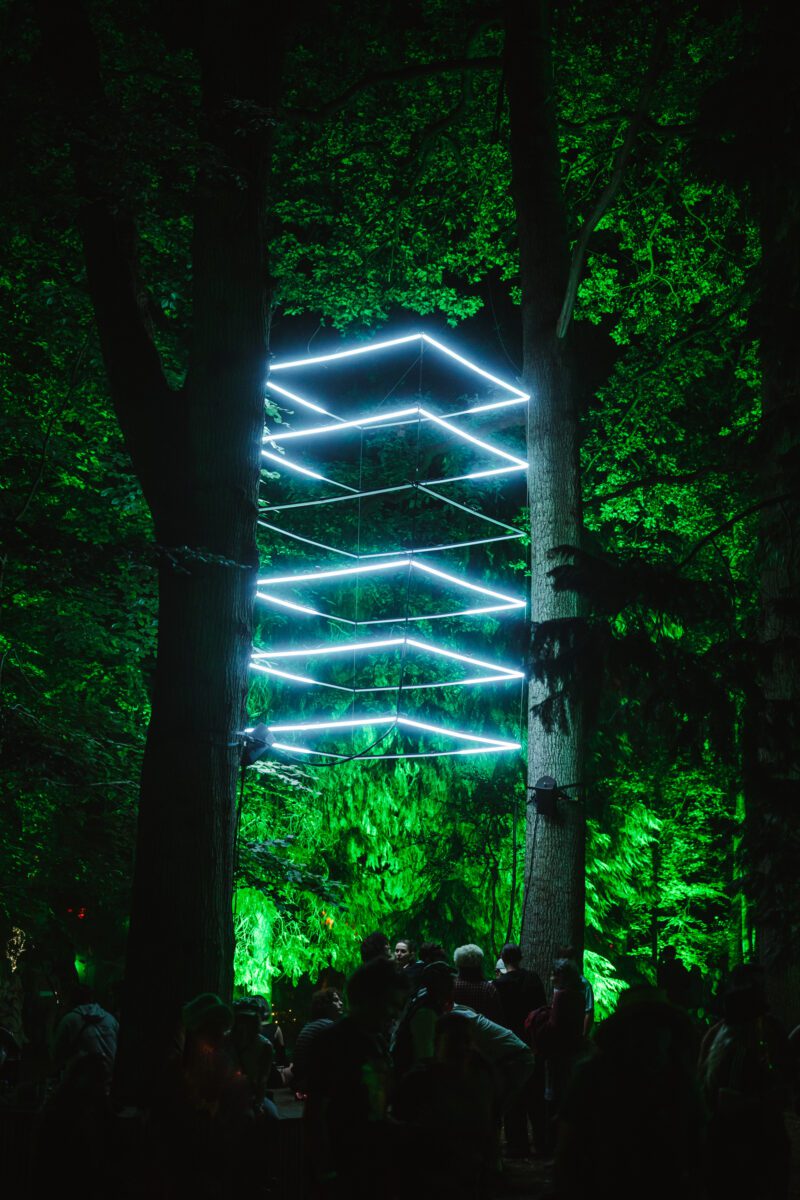 Light and perception remain central concerns within Chris Levine’s expanded presentation of Full Beam, returning to Houghton’s grounds with a new iteration that extends across the festival site and surrounding environment. Levine’s practice has long explored the emotional qualities of illumination, using technology to create experiences that exist between physical spectacle and psychological reflection. The installation’s illuminated forms, including the chrome-plated VW camper van that remains central to the work, create an atmosphere designed to slow perception and encourage a meditative state. In contrast to the intensity of festival culture, where sound and movement dominate, Levine introduces a space concerned with stillness and interior experience. His exploration of “the space between thought” positions light not simply as an effect, but as a medium through which attention can be redirected.
A similar investigation into reflection and optical experience emerges in Nicole Gordon and Ke Peng’s Contact Field, created specifically for Houghton’s woodland setting. The installation consists of a suspended mirrored circle of rotating panels that captures and redistributes light through the surrounding trees and atmosphere. Moving between sculpture, screen and instrument, the work explores the moment where natural environment and constructed image become inseparable. Its shifting reflections transform the forest into an active participant, recalling a wider history of artists who have used light and perception to challenge the boundaries between object and viewer. Through this intervention, the landscape becomes something to be experienced differently – not merely seen, but reconsidered.
Questions of social space, community and mediated culture emerge through Craig Richards’ installation The Kardashians, A Third Place. Constructed from trees felled on the Houghton estate, the work creates an open-air living room featuring sculptural thrones and sofas positioned around an imaginary television. Referencing the decline of communal “third places” – spaces beyond home and work where social life traditionally unfolds – the piece examines changing forms of gathering in an era dominated by digital networks and celebrity culture. Its playful title masks a more serious reflection on consumption, identity and the spaces where communities are formed. Richards’ background across music, visual art and curation informs a work that considers not only what audiences encounter, but how they come together.
Taken collectively, these commissions reveal a programme concerned with the conditions that allow the emergence of artistic experiences. Their significance lies not simply in placing contemporary works within an unusual setting, but rather in examining how art can respond to urgent questions around ecology, social connection and the politics of attention. Site-responsive practice remains vital because it challenges the idea that artworks exist separately from the environments and communities that they find themselves in. In a culture increasingly experienced through screens and mediated platforms, these projects return emphasis to physical presence – to the act of gathering, looking and thinking together. Houghton’s landscape becomes more than a location for display; it transforms into an active participant in a continuing conversation about how we inhabit, understand and imagine the world.
Houghton Festival is at Houghton Hall, Norfolk from 6 – 9 August: houghtonfestival.co.uk
Words: Shirley Stevenson
Image Credits:
1. Chris Levine, Full Beam, Higher Power. Houghton Festival 2025. Michael Fung Photography.
2. ©️ Photography by Khali Ackford for Khroma Collective
3. © Photography by Jake Davis | Khroma Collective.
4. ©️ Photography by Khali Ackford for Khroma Collective.
5. Chris Levine, Full Beam, Higher Power. Houghton Festival 2025. Michael Fung Photography.