

Yamagata Prefecture lies in the Tōhoku region of Honshu, the largest of Japan’s four main islands. It is characterised by its hot, humid summers and long, snowy winters – replete with fir trees, ski slopes and hot springs. It is also home to Himebotaru: small, 6mm-long fireflies known for their bright, fleeting flashes of light. For just 10 days each summer, these insects illuminate the region’s forests with a brilliant display.
Kazuaki Koseki (b. 1977) is a photographer who has spent years observing the species’ ecology and habitat. He takes his camera into the night forest, immortalising their glimmer- ing flight paths in otherworldly compositions. Koseki’s ongo- ing project, Summer Fairies, has been recognised by major awards like LensCulture Critics’ Choice, Sony World Photog- raphy Awards and Wildlife Photographer of the Year. His work has also been published by National Geographic and Smith- sonian Magazine. Most recently, he was shortlisted for Earth Photo 2025, an international award established in 2018 by Forestry England, the Royal Geographical Society (with IBG) and Parker Harris. The prize champions image-makers who address pressing issues affecting our planet, aiming to stimu- late conversation about the environment and climate change.
Now and into 2026, the exhibition is travelling across the UK, with a unique curatorial premise: to experience images whilst immersed in nature. The tour includes stops at For- estry England sites including Alice Holt, Bedgebury, Dalby, Grizedale, Haldon, Moors Valley and Wendover. It presents a selection of shortlisted photographs, including those by overall winner Lorenzo Poli. In this interview, Koseki speaks to Aesthetica about how the Summer Fairies series came to life.
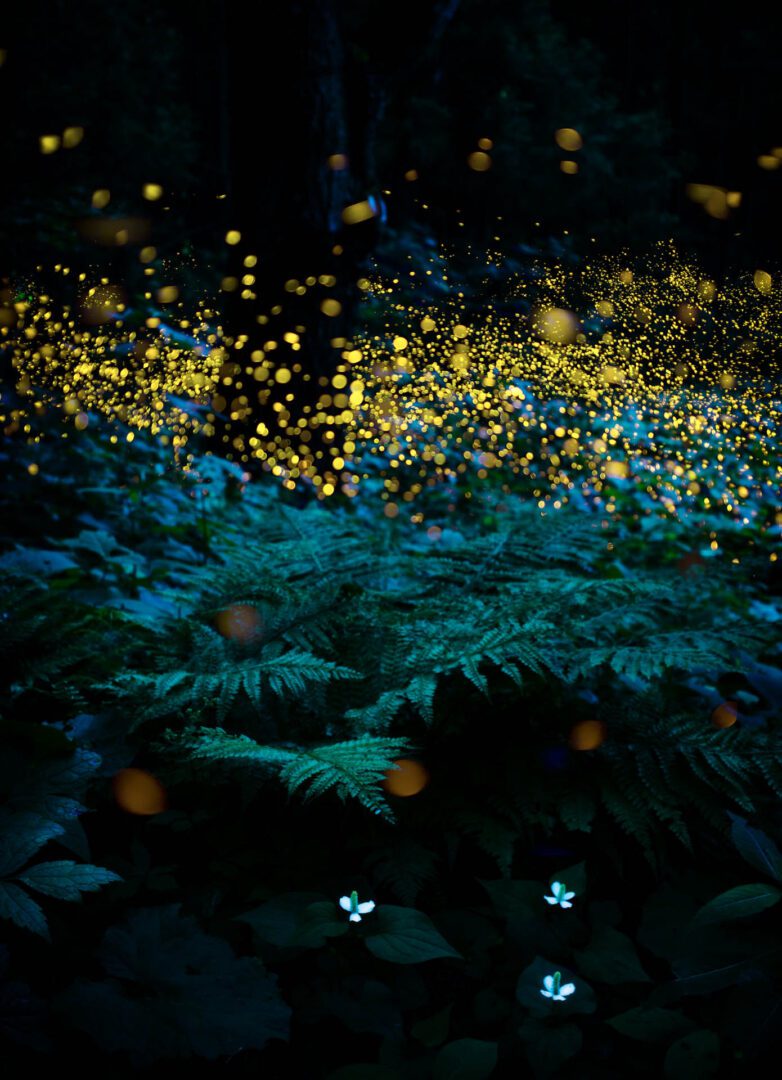
A: What was your first ever experience with photography?
KK: I was born the eldest son of a family that owned a studio, so I grew up in an environment where photography was close by. I helped to dry washed prints before I was a teenager. It wasn’t until I was an adult that I started taking portraits under my father’s tutelage. Photographing nature was just a hobby, and I did it whilst visiting the mountains, forests and rivers for fly-fishing, which I discovered at the same time. On 11 March 2011, the Great East Japan Earthquake struck the east coast of Tōhoku, including Miyagi Prefecture, where I lived when I was younger. Seeing my friends die and so many others affected, I learnt about the ferocity of nature and the fragility of life. Then, the Fukushima Daiichi nuclear power plant accident engulfed the Tōhoku region, and the river I used to travel, in an invisible terror. These experiences were a very big driving force behind my decision to start creating artwork.
A: How did you first come to learn about the Himebotaru?
KK: When I was a boy, I spent a lot of time with my grandparents, who were farmers. The fields, rice paddies and forests were our playground. The fireflies, which I saw out and about back then, still exist in my memory indelibly. I first learnt of the Himebotaru, specifically, through the news. They live all over Japan in mountainous forests – not only in the wild, but also in the cedars planted for building materials. I had no information on whether they existed in Yamagata Prefecture. But, based on my experience of walking and observing nature in the region, I assumed there must be an environment in this area for them to inhabit – so I decided to open up a map and start searching. It turns out, during early summer in Yamagata, the males fly through the forest for two hours during the night – glowing as they look to attract females.
A: You specialise in documenting the outdoors, particularly in Yamagata and Tōhoku. Where do you think your big love of wild places and exploration originates from?
KK: My earliest memories of nature are of childhood with family. In my mid-20s, I began to spend most of my holidays walking through forests, up mountains, in streams and fish- ing for trout. I learnt about seasonal changes, the aquatic in- sects that the trout feed on, the geology that forms the river, the weather and much more – both through fieldwork and from books. I continue to walk with my camera, listen, see, touch and smell the seasons. I want to understand nature by feeling it with all my senses. And by recording it with my camera, I aim to capture the “now” of living on this planet.
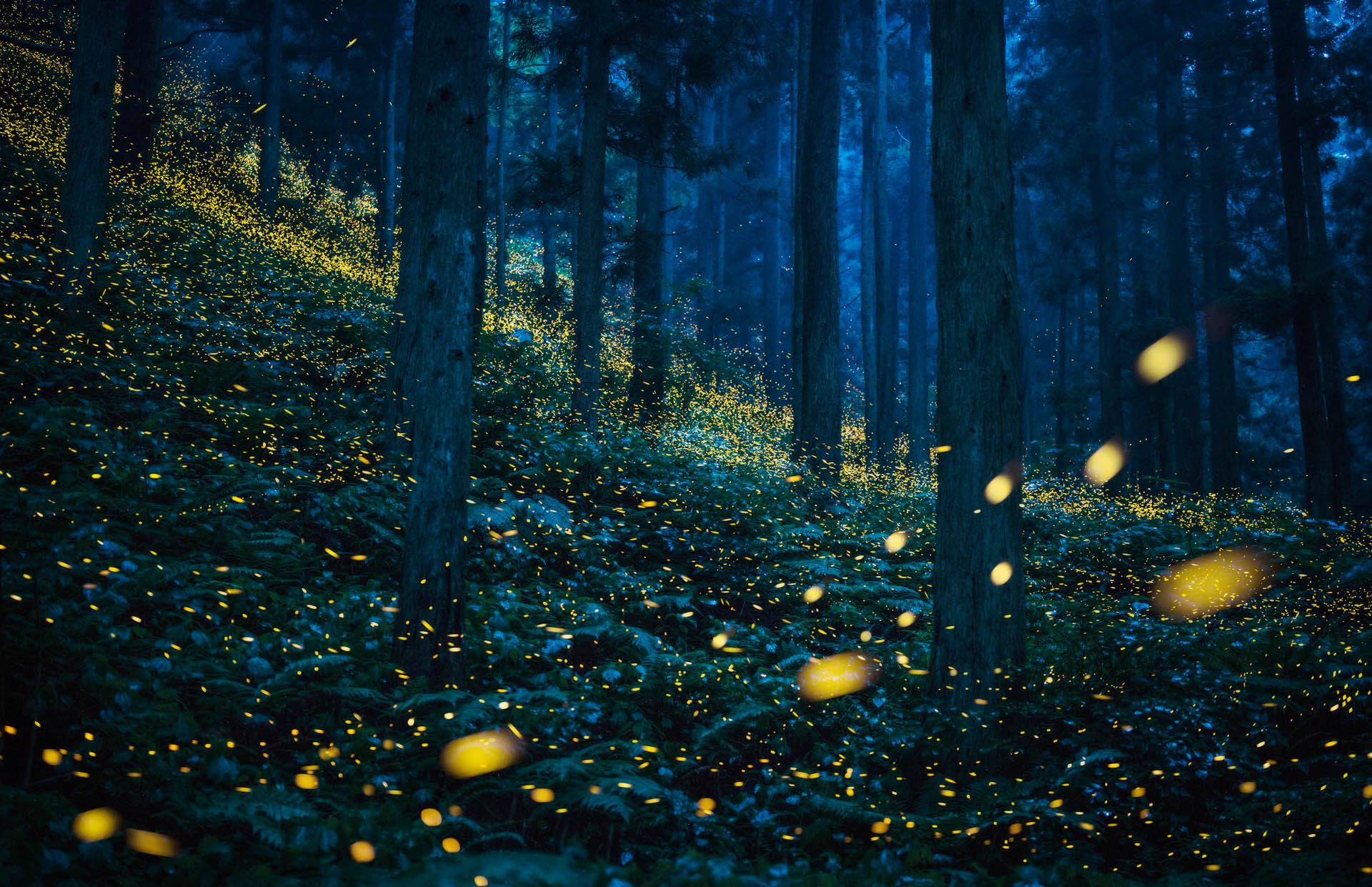
A: Do you remember the first Summer Fairies picture you took? How did you know it was going to become a series?
KK: I painstakingly researched forests that might be inhabited by Himebotaru. When I found a spot, I drove my car deep into the night and started walking – alone without moonlight. The uninhabited forest after dark is a wild territory and, although I felt fear, I walked deeper. After about 30 minutes, I saw a small yellow speck that seemed to twinkle. After a while, my eyes became accustomed to the darkness and countless lights started to glow. It was like a starry sky. The forest, which had seemed so terrifying, spread out before my eyes and became the most beautiful I had ever seen – thanks to the Himebotaru. When I returned home, even after some time had passed, the sight did not disappear from my mind. It was an emotional experience. And so the project began: to explore nature, ecology and various phenomena, including the forests where Himebotaru live, and to document the fireflies over a long period. It’s a series that may last a whole lifetime.
A: What are the specific environmental conditions and photographic techniques needed to produce an image?
KK: Yamagata is a land of four distinct seasons, with hot sum- mers and deep snow in winter. Fireflies fly around the forest for about 10 days in early to mid-July. This is Japan’s rainy, hot and humid season. They are active every night unless there is a heavy downpour, but the ideal day is when the wind has stopped. Fireflies start to move shortly after sunset – the blue hour. In ancient Japan, this was called the “twilight hour” and was regarded as the time between life and death. That blueness is difficult to see with the naked eye but becomes more pronounced when photographed. Another important factor is to predict which altitude and route fireflies will take, and to capture the parabolic lines they draw. Their unpredictable light trails are determined by a variety of things, includ- ing the density of darkness, the terrain and vegetation. I photograph with long exposures, and the final image is obtained by the light drawn by the fireflies. I consider Himebotaru to also be artists, who are painting with light. The images are made in a dialogue between me, them and the environment.
A: Your pictures are startlingly beautiful, but there’s a darker side, too. How do these works connect to conversations around climate crisis, deforestation and tourism?
KK: Himebotaru have lived in uninhabited deep forests for a long time. But in the last 100 years or so, much of this has been cut down for farmland, pasture, roads, housing and tourism developments, leaving them no place to live unnoticed. The fireflies we see today are those that have escaped these threats. There are concerns that torrential rains and wildfires caused by climate change could damage populations. And with the development of solar and wind power, which is being promoted for environmental protection, woodland is also being cut down. Asphalt roads for mountain tourism do not make it easy for females, which cannot fly, to cross and expand their habitat. However, the fact that areas have been left behind is largely due to the belief in, and respect for, the natural world. Moreover, during the last few years, the population of Himebotaru has increased – perhaps influenced by rising temperatures and lack of snow.
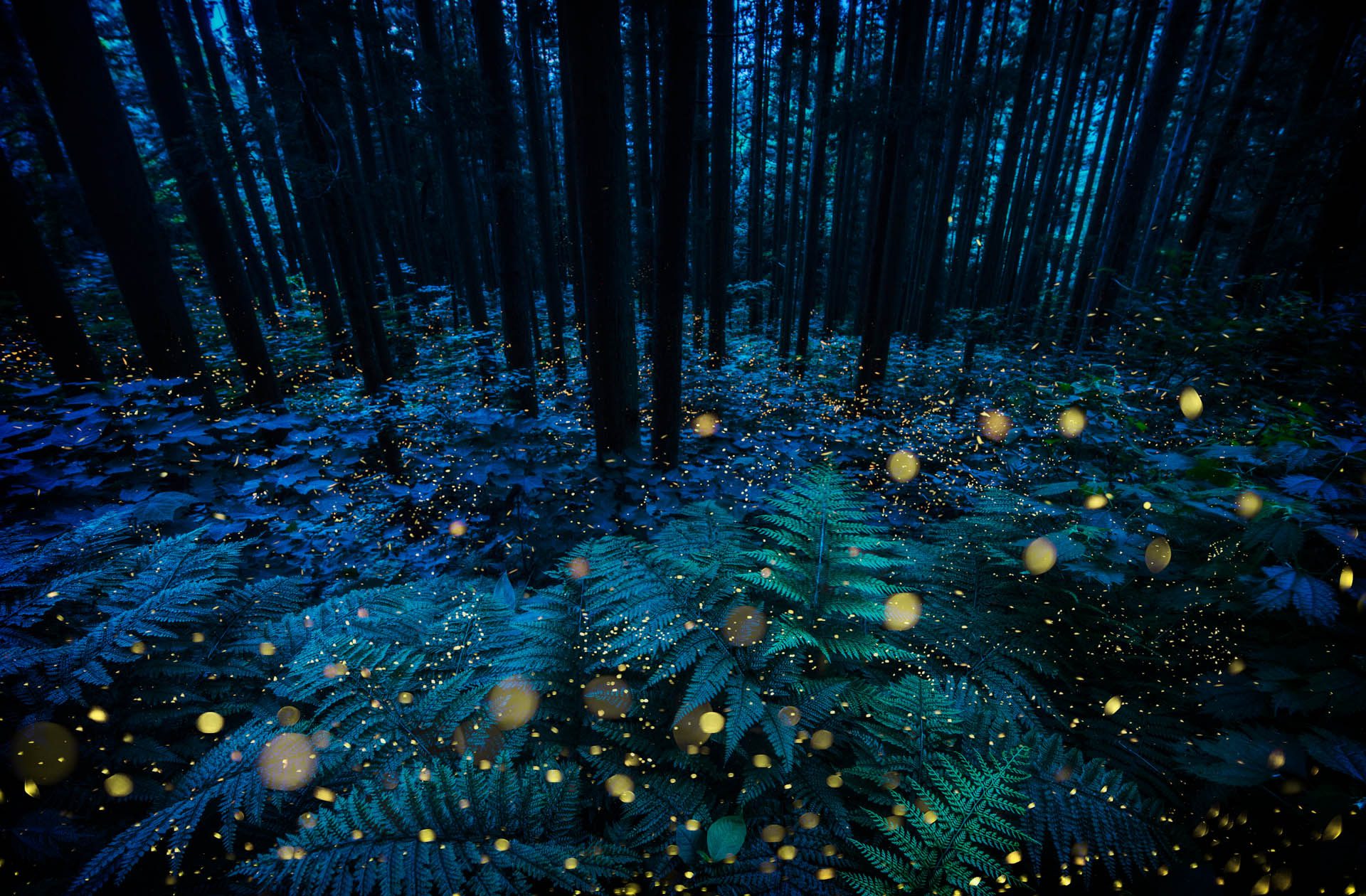
A: Fireflies have long held a special place in Japanese folklore. How much do these cultural stories, myths or rituals influence your approach to the subject matter?
KK: The word “firefly” was first mentioned in Japan 1,300 years ago in the Nihon Shoki, the oldest book in Japan. It was written there as “(螢火)Hotaru – Fire.” Since ancient times, Japanese people have also associated them with the souls of human beings and the dead. At times, watching them in the darkness feels like a kind of prayer. Even during the production stage, my mind becomes filled with thoughts of what took place in Tōhoku in the past, and other things happening around the world. Near the area where I work, there are many ruins where the Jōmon people lived 10,000 years ago. The female Hime fireflies I photograph are less mobile because their hind wings have degenerated, leading me to believe that they have lived in the region for generations. I wonder: how did our ancestors feel, when the night was darker than now? Were fireflies considered beautiful? Sublime? Or were they seen as terrifying? These questions always inspire me.
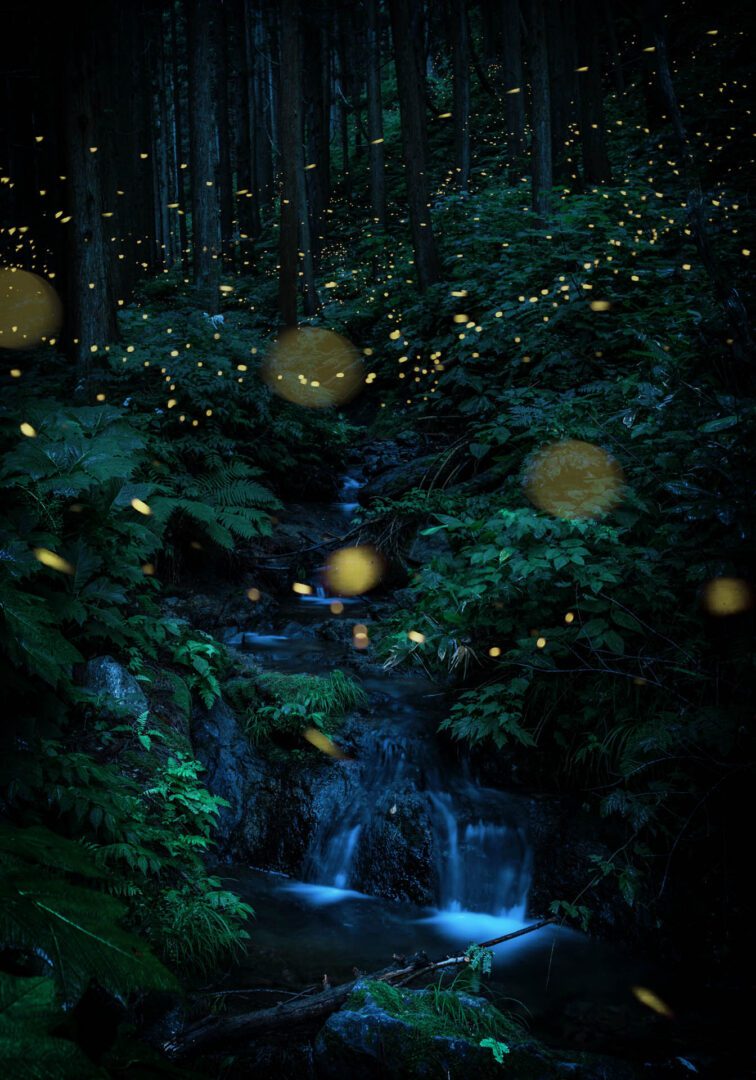
A: Who have been the most influential figures in your creative journey? What motivates their work, and how does it resonate with the message you’re sharing today?
KK: When I started out in photography, I read Ansel Adams’ black-and-white printing technique books. His expression of tonality is still an important element in my work now. I also respect Hiroshi Sugimoto’s approach to history and time, as well as Gerhard Richter’s ideas on coincidence. I sympathise with the ways in which they think about and see the world. Nature is sometimes beautiful, majestic, threatening and fragile. It is a living organism, of which we are a part. I hope these pictures are a reminder that we have many neighbours living around us, all the time, and that we coexist on Earth.
A: The Summer Fairies series has been recognised by several renowned awards and events, such as Earth Photo 2025, and Belfast Photo Festival. What is next for you?
KK: I feel very honoured that my work, which I create in the countryside of a small island country, is appreciated and shared all over the world. I see it as my duty to continue living and exploring in the Tōhoku region of Japan. I spend my days in its nature, climate and spirituality. The changing seasons here give me a lot of inspiration. It is a place where the ancient Jōmon people lived and where nature wor- ship, especially mountain worship, flourished. As such, I am working on several new projects in and around this region.
Earth Photo 2025, Various Locations, UK
Until 19 March 2026
Words: Eleanor Sutherland
Image credits:
1. Kazuaki Koseki, Cross the Valley, (2019). From Hotarubi – Summer Fairies. Archival pigment print, Handmade Japanese traditional Ise-washi paper. Courtesy the artist.
2. Kazuaki Koseki, Layers of Lights, (2018). From Hotarubi – Summer Fairies. Archival pigment print,
Handmade Japanese traditional Ise-washi paper. Courtesy the artist.
3. Kazuaki Koseki, Golden Forest , (2020). From Hotarubi – Summer Fairies. Archival pigment print, Handmade Japanese traditional Ise-washi paper. Image courtesy the artist.
4. Kazuaki Koseki, Rich Deep Forest , (2018). From Hotarubi – Summer Fairies.
Archival pigment print, Handmade Japanese traditional Ise-washi paper. Image courtesy the artist.
5. Kazuaki Koseki, Inside the Water Flowing Forest, (2018). From Hotarubi – Summer Fairies. Archival pigment print, Handmade Japanese traditional Isewashi paper. Image courtesy the artist.


