In 1954, Vietnam gained independence from France and split into two territories: communist North Vietnam and anti-communist South Vietnam. The Cold War was reaching its height, and the USA was concerned that the communist regime could spread across Asia. President John F. Kennedy sent “military advisers” to the country, but by 1961, US intervention had descended into full conflict. The Vietnam War would last until April 1975, when the last few Americans were airlifted out of Saigon. It cost 58,000 American lives, and as many as two million Vietnamese soldiers and civilians were killed. British photographer Don McCullin (b. 1935) visited the country throughout the conflict, documenting Marines, domestic life caught among the battlefields and the casualties of war. The images have become some of the most infamous in 20thcentury photojournalism. Now, in what McCullin describes as his “last ever book,” GOST publishes Vietnam. The volume includes 100 black-and-white images and more than 20 colour photographs, nearly half of which have never been seen before. The shots are accompanied by McCullin’s own personal notes, commentary and ephemeral matierals, including boots, spreads from the famous 1968 Sunday Times feature and his ID cards. The result is a uniquely intimate look at the historic episode, and at the toll that war takes on both those that live through it and for those who document it.
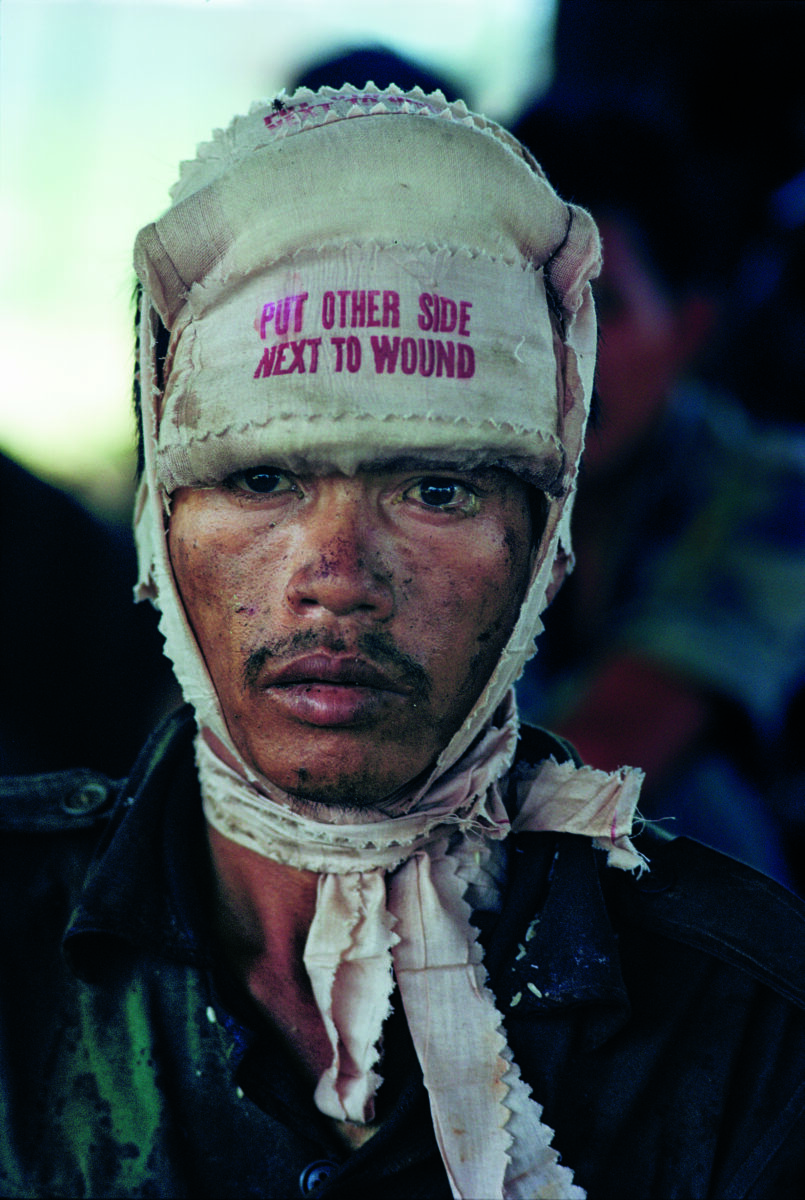
McCullin’s work has always spoken to the humanity amongst the barbarity. Harold Evans – one of his editors at the Sunday Times – once said that the photographer had a “cold eye informed by the warmth of his empathy.” This dichotomy shines through in this book. Each image is accompanied by a small description, some are as short as “a local villager, with understandable resentment in his eyes,” whereas others give more of a backstory to a single snapshot. One image shows two US troops huddled over a young Vietnamese man, grievously injured and wrapped in a blanket. McCullin explains how: “what these two men were doing was showing the better part of humanity. They were there to kill, but then they suddenly were concerned with this North Vietnamese solider who looks like a child. And yet these North Vietnamese soldiers were highly regarded as great fighters and the greatest challenge the American soldiers would come up against. Everything you photograph has another story attached to it, another psychological story to analyse.” This sentiment sums up Vietnam , as throughout the whole book, one perspective on the war gives way to another, and another, until the complex reality comes into full view.
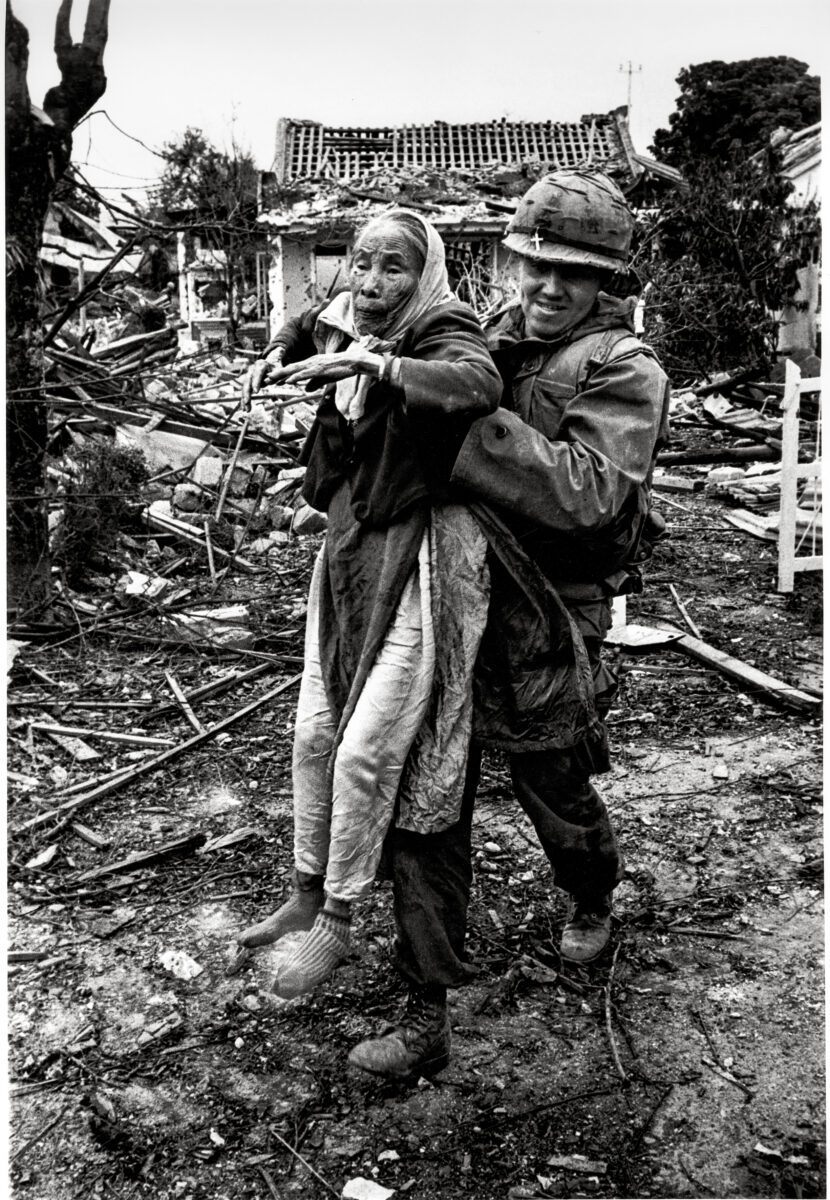
There’s the pervading sense that none of what McCullin documented or saw was taken lightly, or without intense thought. Readers are constantly confronted with his musing on the concept of “glamourising” war – a contentious topic in the media’s depictions of conflict. Think of French filmmaker François Truffaut’s declaration that “there’s no such thing as an anti-war film,” a statement that claims that all movies inevitably portray the thrill of combat. McCullin questions the same thing: “I always think when I look at this picture, am I glorifying war? You know, because I’m making it look exciting, adventurous. Am I not turning this into a “Hollywood” still, glamourising war? Mind you, it was happening.” As we move through the book, there’s a sense of give and take between the glimmers of compassion McCullin so clearly experienced, and the desire to portray the worst of humanity. Nowhere is this dichotomy more evident than in a double page spread, where two images are paired together. One shows a US solider carrying an elderly Vietnamese woman to safety, the other shows a different man with a detained US civilian, who has been blindfolded in an attempt to make him feel unsafe and disorientated.
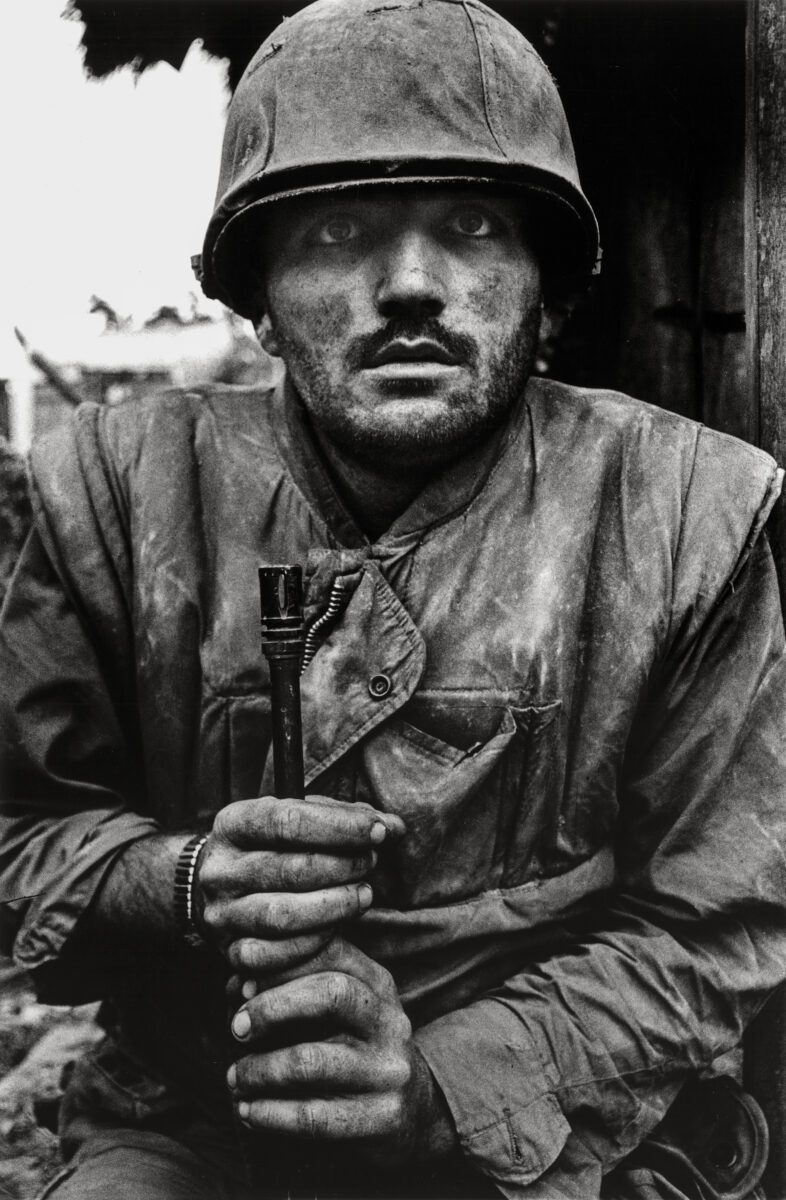
Several featured images have had almost unparalleled political ramifications. Shell-shocked US Marine, The Battle of Hue (1968) depicts an infantryman in a state of disassociation. He stares at the camera, uncomprehending, as he clutches his rifle. The image became a symbol for psychological trauma, and alongside more graphic battlefield reporting, deeply influenced anti-war sentiment and helped turn the tide of public opinion. It was one of a handful on pictures from the war that sent shockwaves around the world. Perhaps the other most famous is Eddie Adams’ Saigon Execution, which shows the exact moment Brigadier General Nguyen Ngoc Loan shoots a Viet Cong prisoner in the head. The single image galvanised a movement, and was emblematic of the perceived futility of the war.
Beyond the political legacy of this work, there’s also the personal ramifications. It’s not something McCullin shies away from, and his vulnerability makes the book all the more impactful. The photographer returns to one key message: there is empathy and humanity to be found in war, but there is no glory. Time and again, he highlights the lifelong psychological impacts on those involved, himself included. In one passage, he describes his involvement in a twelve-day operation in the city of Hue, where he witnessed death viscerally, only narrowly escaping the explosion of a hand grenade. He writes: “this battle comes to me every night of my life when I go to bed. Every night and it was sixty-eight years ago.” Elsewhere, he movingly concludes that “The Vietnam War was one of America’s greatest political misadventures, paid for with the lives of 58,000 Americans…on a personal level, it changed me forever. I witnessed unbelievable destruction and loss that would stay with me for the rest of my life.”
Then there’s the personal consequences for those in his images. One page of the book shows a group of Marines carrying the body of a fallen solider – the troop prided themselves on not leaving their dead out overnight – despite being under open fire. The chaos is palpable, as is the men’s exhaustion. McCullin explains how: “The man on the right here is the same solider from one of my better-known images of this war, the shell-shocked US Marine. Once I took that picture of him, he was never respected by anybody else, but you can see this man is not shrinking in his duties.” In one sentence, McCullin encapsulates everything that is so nebulous about war photography. He’s candid about the Marines’ reluctance to have him as part of their movements – “these people that don’t want you there in the first place” – and even in an image that placed a huge role in turning the tide of public opinion on the Vietnam War, he makes no illusions that it was an entirely positive endeavour. To capture an image of someone in the worst moments, whether that be conflict, famine or disaster, and share it with the world is to ask something of them that cannot be given back. McCullin’s enduring legacy as a war photographer is partly because he has constantly reckoned with this pay off – giving each shot the gravitas and respect it deserves.
This nuance has given McCullin’s career its impact. He is one of the greats of 20th century photojournalism precisely because he does not hand his audiences an answer or a neat narrative. This is not a story wrapped up in a bow. It is upsetting, confusing, messy. Much like war. Much like life. The reader’s experience is richer for having followed McCullin, seeing a major historic event, and the people who lived it, through his lens.
Don McCullin: Vietnam is published by GOST Books: gostbooks.com
Words: Emma Jacob
Image Credits:
All images © Don McCullin.