Chiharu Shiota’s (b. 1972) work is immediately recognisable. Entire rooms are overtaken by red thread, forming dense networks that obscure personal belongings, architectural structures and, at times, sleeping figures. The evocative installations, rendered primarily in red, black and white, give form to the intangible connections we make throughout life. They’re often rooted in the artist’s own experiences, taking the personal and expanding it outwards to comment on universal human concerns like life, death and relationships. Threads of Life is the Berlin-based Japanese artist’s first major solo exhibition in a London public gallery. The intricate takeover responds directly to Hayward Gallery’s Brutalist architecture, resulting in a truly atmospheric presentation that invites audiences into Shiota’s unique world.
Shiota was born and raised in Osaka, Japan, though her artistic career quickly became international in scope. She studied at Kyoto Seika University before continuing her education in Australia and Germany. It was during her time in Canberra that she created her first installation work, Becoming Painting (1994), which was created with red enamel paint used on her body. The artist described the piece as formative to her practice: “Taking part in Becoming Painting was indeed an act of liberation. It was my first physical piece of work, using my whole body, rather than a skillful artwork.” Threads of Life takes viewers back to these early pieces, allowing them to trace the entire trajectory of Shiota’s illustrious career.
The show also features new iterations of early, monumental installations, including During Sleep (2002). Hospital-style beds are entirely surrounded by dense, black string. Each one is often filled with sleeping occupants, creating an uneasy sense of voyeurism between audience and performer, even as the surrounding structure enforces distance. Here, the artist reminds us that sleep and dreams are, as she often describes, “a kind of death.” No matter how intimate the connection between the waking observer and sleeping figure feels, we cannot know what is happening behind their closed eyes. Shiota trained under Marina Abramović, and echoes of the performance artists are never more evident than in During Sleep.
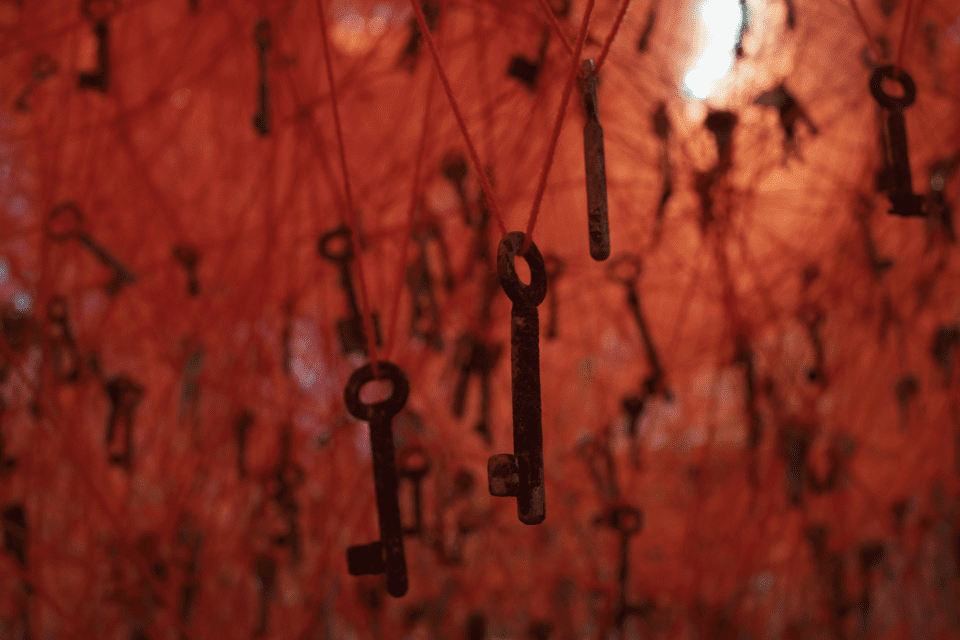
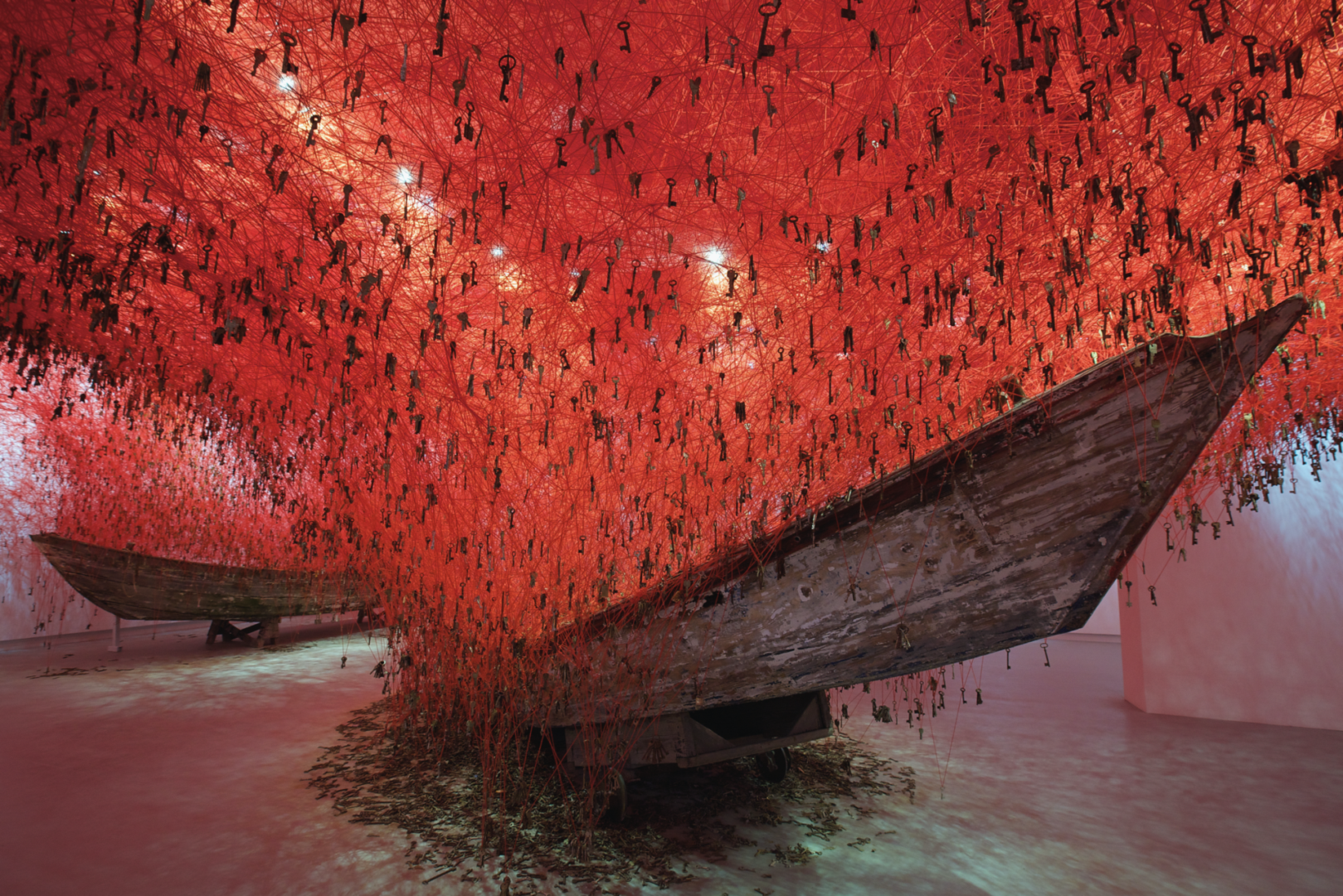
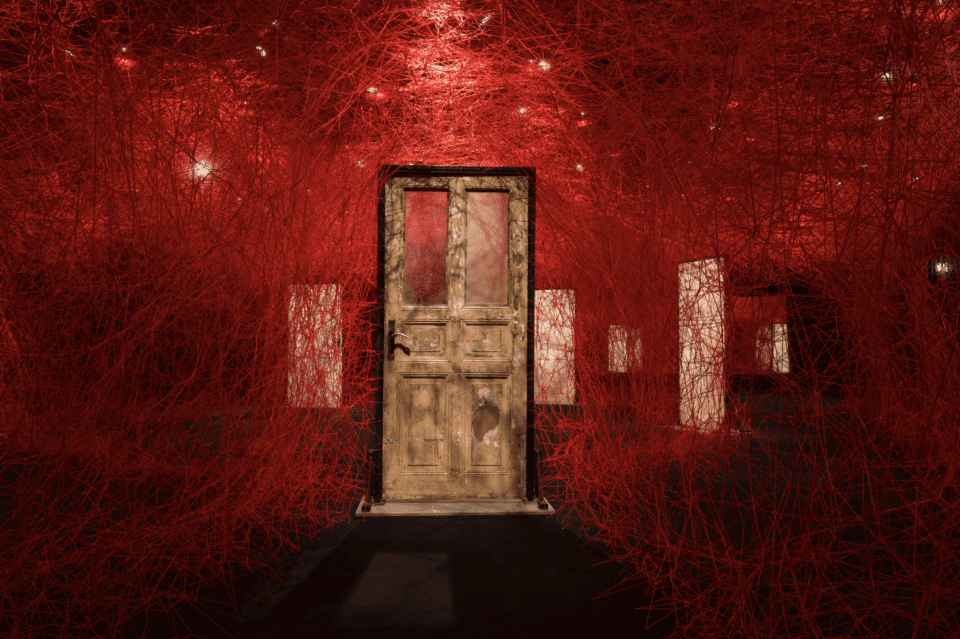
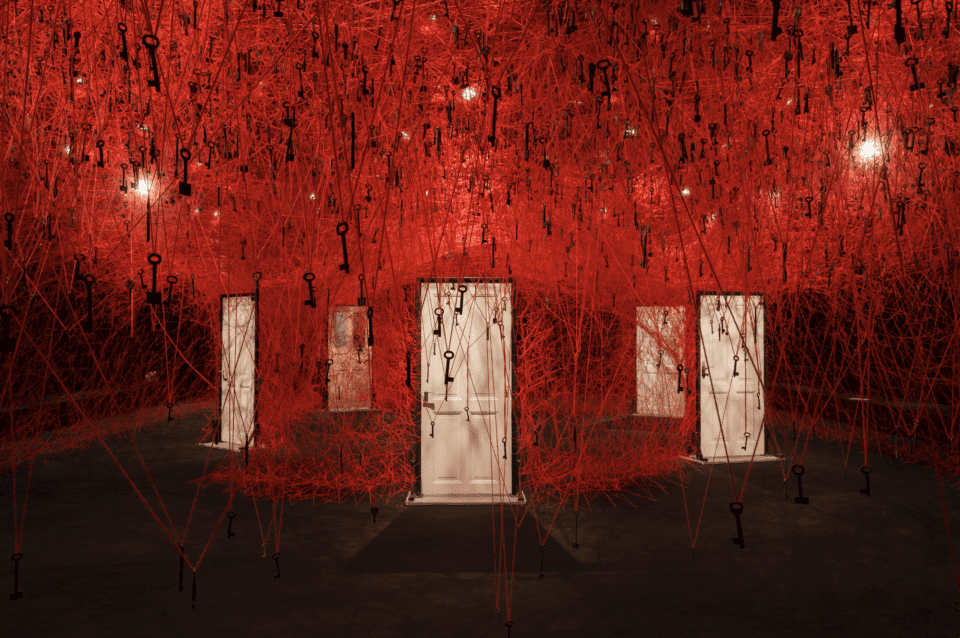
As audiences progress through the show, her familiar red creations come to the fore. One particular highlight is The Locked Room (2016), which sees thousands of metal keys suspended from tightly woven wool, surrounding five, upright wooden doors. The installation recalls Shiota’s Japanese Pavilion commission for the 56th Venice Biennale, The Key in the Hand (2015), in which similar elements cascaded over a wooden boat. The Locked Room appears as though Shiota has painted three dimensionally with string. The delicately woven structures create a cocoon-like area that encloses visitors, allowing them to walk through the piece in seeming isolation. The artist says: “This exhibition reflects the often-hidden connections between us, with each thread becoming a trace of our shared existence, weaving visible forms from the invisible threads of life. Through my work, I try to make sense of life and its uncertainties; each installation has grown from personal experiences, such as losing my father, facing death and questioning what it means to be human. While we live our lives separately, we are, at the same time, deeply connected.”
Almost 20 years after Shiota first exhibited at the gallery as part of the 2009 group show, Walking in My Mind, the artist’s return is a triumph. The works holds space for the biggest questions, encouraging discussions of life, death and shared human existence. Shiota invites audiences to step into her labyrinthine space, let go of the outside space and recognise that even in isolation, we are never truly alone.
Chiharu Shiota: Threads of Life is at Hayward Gallery, London from 17 February – 3 May: southbankcentre.co.uk
Words: Emma Jacob
Image Credits:
1. Chiharu Shiota, The Key in the Hand, 2015 Installation_ old keys, wooden boats, red wool Japan Pavilion at 56th Venice Biennale, Venice, Italy Photo by Sunhi Mang © DACS, London, 2025 and Chiharu Shiota.
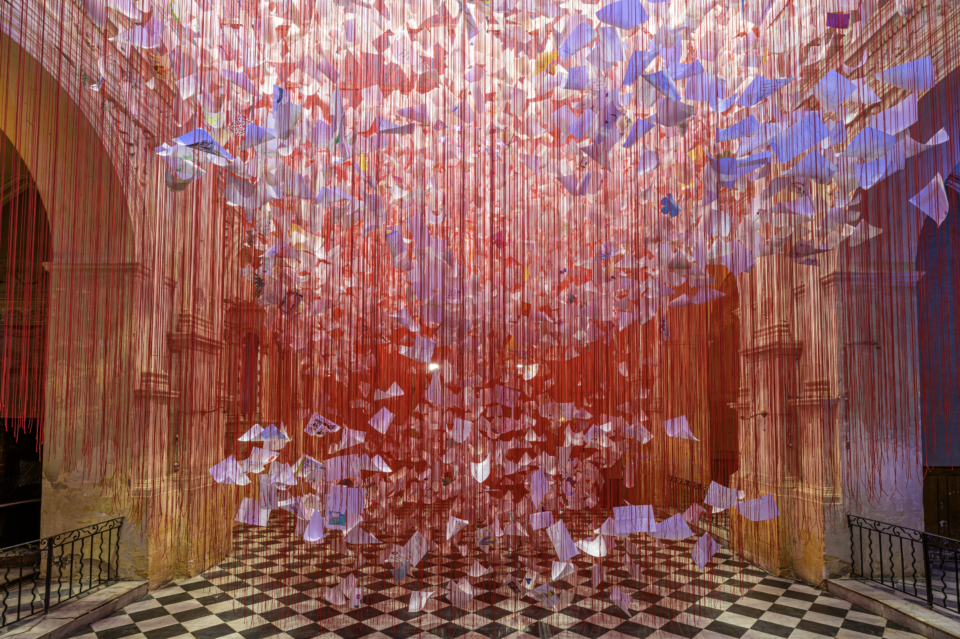
2. Chiharu Shiota, Collecting Feelings, 2024. Installation_ rope, paper. Musée du Pavillon de Vendôme; Musée des Tapisseries and Chapelle de la Visitation, Aix-en-Provence, France. Photo_ Philippe Biolatto, Ville d’Aix-en- Provence ©
3. Chiharu Shiota, The Locked Room, 2016, Installation_ old keys, wooden doors, red wool KAAT Kanagawa Arts Theatre, Yokohama, Japan Photo by Masanobu Nishino and courtesy of the artist © DACS, London, 2025 and Chiharu Shiota.
4. Chiharu Shiota, The Key in the Hand, 2015 Installation_ old keys, wooden boats, red wool Japan Pavilion at 56th Venice Biennale, Venice, Italy Photo by Sunhi Mang © DACS, London, 2025 and Chiharu Shiota.
5. Chiharu Shiota, The Locked Room, 2016, Installation_ old keys, wooden doors, red wool KAAT Kanagawa Arts Theatre, Yokohama, Japan Photo by Masanobu Nishino and courtesy of the artist © DACS, London, 2025 and Chiharu Shiota.