Every year, 11 million metric tons of plastic enters our oceans. That’s according to nonprofit environmental advo- cacy group Ocean Conservancy, which has picked up more than 380 million pounds of rubbish from shores over the last 35 years. Beach clean-ups have become an increasingly popular way for individuals to help combat the waste crisis. Data shows the most common items found are cigarette butts, bottles, caps, food wrappers, grocery bags and straws.
Over the past 10 years, campaigns, images, statistics and videos have shifted perceptions of single use plastics. There are plenty of shocking facts: The Great Pacific Garbage Patch, for example, covers an estimated surface area of 1.6 million square kilometres – an area twice the size of Texas or three times the size of France. No one can forget the distressing video of the turtle with a straw stuck up its nose, which went viral in 2015. Then there’s Justin Hofman’s heartbreaking image of a seahorse clutching an old, discarded cotton swab.
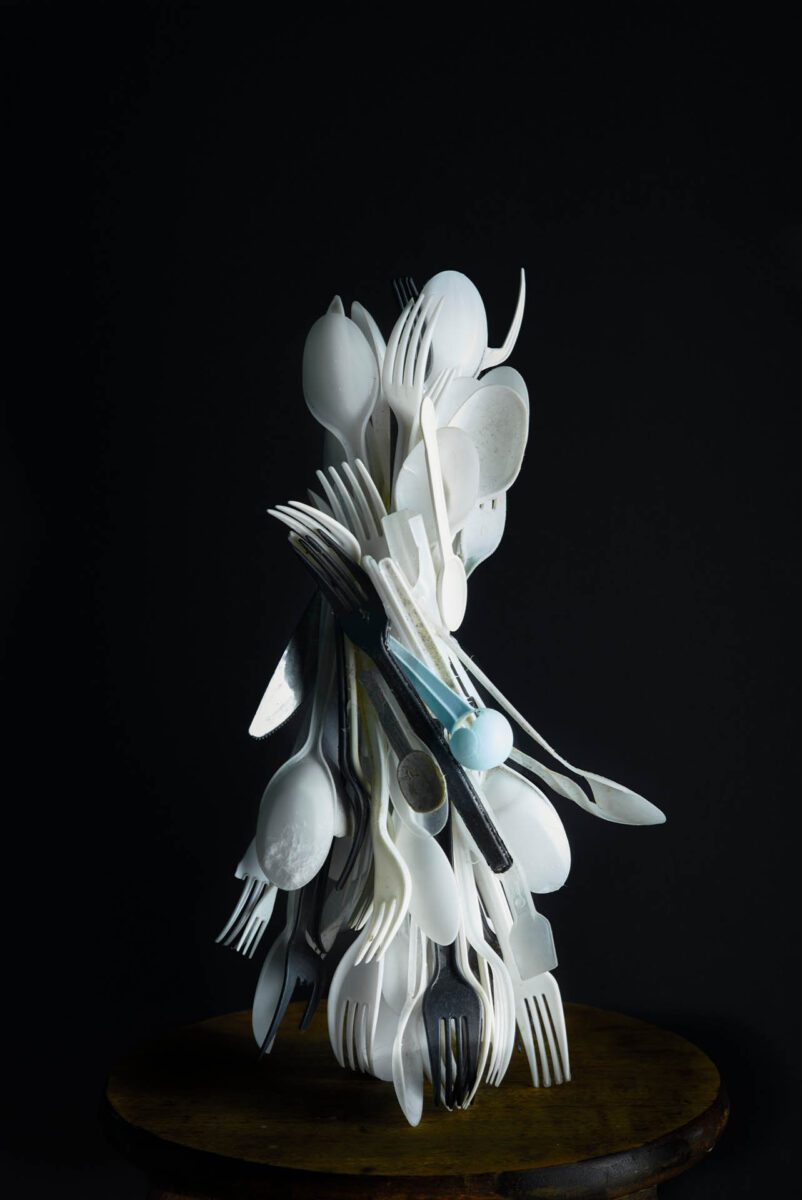
Thirza Schaap (b. 1971) takes a different, yet equally pow- erful, approach to picturing the plastic problem. In 2016, she began transforming debris collected from shorelines into sculptures, sharing them on social media. A daily morning ritual – picking up items on the beach and turning them into arrangements – became a far longer-term project that was published by i-D and Vice. The idea was to create a contradic- tion: a clash between the initial aesthetic appeal of a beautiful artwork, and the creeping repulsion of its subject matter.
Schaap’s sculptures feature everyday items: bags, bottles, cartons, combs, cutlery, lids and nets, as well as smaller, less-easily identifiable pieces, which have broken apart due to sun, wave and wind exposure. Schaap builds compositions against brightly coloured, pastel or black backdrops. The re- sults are intentionally jarring: a dandelion made from plas- tic straws; a coffee-lid crow; and a candy shop stocked with discarded footballs. It’s chilling, and makes you double take.
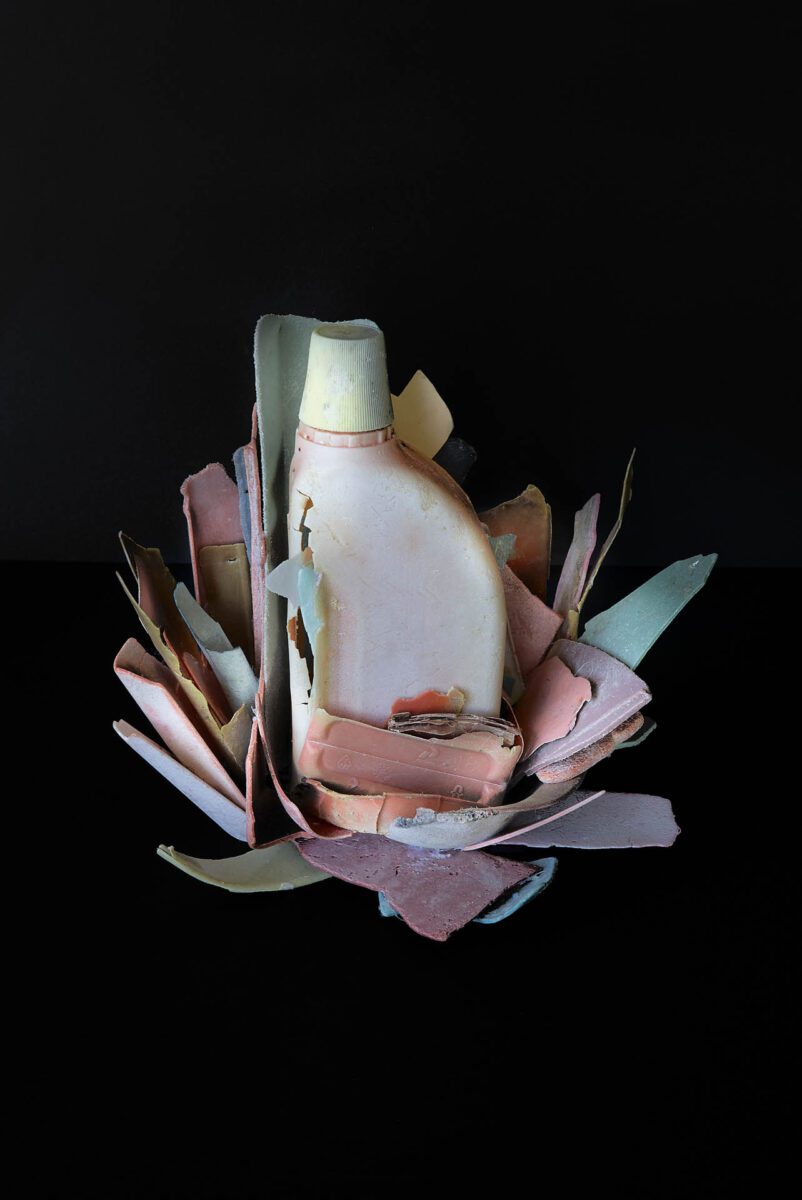
The artist, based between Cape Town and Amsterdam, pub- lished the series – titled Plastic Ocean – as a book in 2021. Other significant accolades include collaborating with the likes of Greenpeace Africa and WWF, for whom she reinvent- ed Pantone’s 2019 Color of the Year: Living Coral. Schaap’s image – of bags and bottles splayed out underneath Pan- tone’s iconic logo – communicated a powerful message: 75% of the world’s coral reefs are threatened. She is repre- sented by contemporary photography gallery Bildhalle, Zurich and Amsterdam, and has exhibited at Christie’s, Het Nieuwe Instituut and Unseen Amsterdam, amongst others.
Schaap is amongst a growing number of advocates using visual art to raise awareness about the consequences of over- consumption. Mandy Barker (b. 1964) is perhaps the most well-known; her visually captivating, yet disturbing, scenes are also assembled from ubiquitous items found on beaches. Now, Schaap joins Barker as part of the line-up for Flowers – Flora in Contemporary Art & Culture, a hugely popular show at London’s Saatchi Gallery. It is a giant exhibition that com- prises over 500 artworks and speaks to the different ways flowers have inspired, and been depicted by, creatives. It’s a who’s who of the contemporary art world, featuring installa- tion and photography from Rebecca Louise Law, Tim Walker and Viviane Sassen, plus much more, spanning nine galleries.
A: Do you remember the moment you decided to begin the Plastic Ocean project? Was there a particular trip, en- counter, or piece of waste, that sparked the idea in you?
TS: In 2008, we went on a trip with our 10-year-old son to Bali. We enjoyed the tropical islands and wanted to learn to dive and get our PADI certification. Strangely, it was not in the water where we first noticed the plastic. We were amazed by the dazzling amount of waste we could see in the rice fields – bits and pieces sparkling like fairy lights in the bright sunlight. After that, we couldn’t fully enjoy our stay on the island. I started Plastic Ocean to create awareness around this type of pollution, to try and prevent – or at least reduce – the use of plastic. As a child I would walk over beaches and through fields and forests to collect beautiful shells, shim- mering stones, feathers and funnily shaped branches. Much later, when spending more time on beaches all over the world, I found myself doing the same thing. Only to discover that I started filling my pockets with trash instead of treasure.
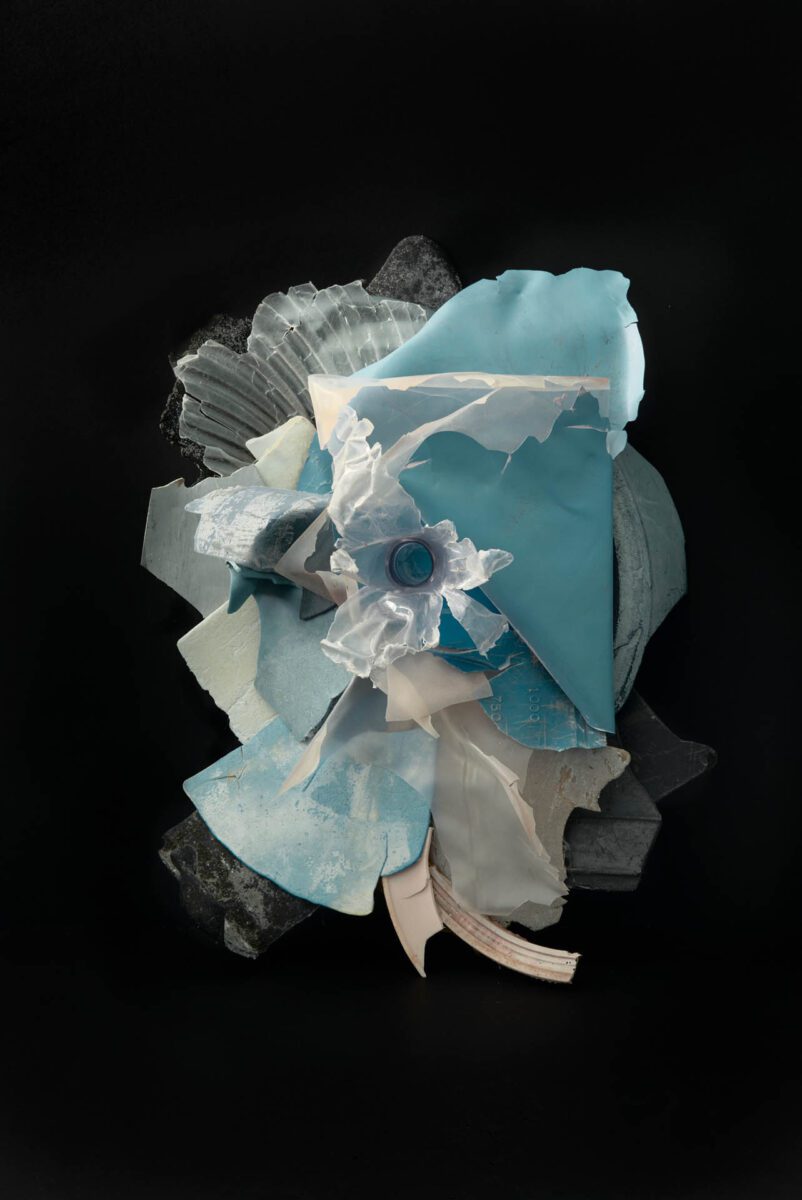
A: Can you walk us through the process of putting one of your sculptures together, from beach to studio? How do you decide on what to include, which colours to use, and how to stage, combine and light the different elements?
TS: My storage space is a small garden shed, where the former owner used to repot her plants. Once I’m in there, I just follow what appeals to me at a certain moment. It’s about what pieces fit together – like a puzzle. Simply documenting the washed up, eroded plastic findings wasn’t doing justice to the beauty of their colours and textures. I decided to sepa- rate them from any reference to their original environment, so that they became stand-alone objects – the basis of my compositions. One hundred years ago, the Surrealists coined the concept of “écriture automatique” – automatic writing – in which the hand does its own thing, unconsciously. When working on Plastic Ocean, I practice “sculpture automatique.”
A: You’ve described the series as “a kind of vanitas for the 21st century.” Can you explain what you mean by that?
TS: Vanitas is the 17th century style of painting we know from our art classes, which contains collections of objects – de- caying flowers, rotting fruit and snuffed candles – that are symbolic of the inevitability of death. These works on canvas are about transience, and the vanity of earthly achievements and pleasures. Vanitas exhorts the viewer to consider mortal- ity and to repent. The objects I find on the shores, affected by the current, salt water and light, also emphasise the shortness of life, just like the paintings did several hundreds of years ago. In my works, the traditional iconography of mortality, ephemerality and wealth has been traded out for bottles, baskets and bowls: single-use items that are used and then discarded, now only existing as empty vessels of destruction.
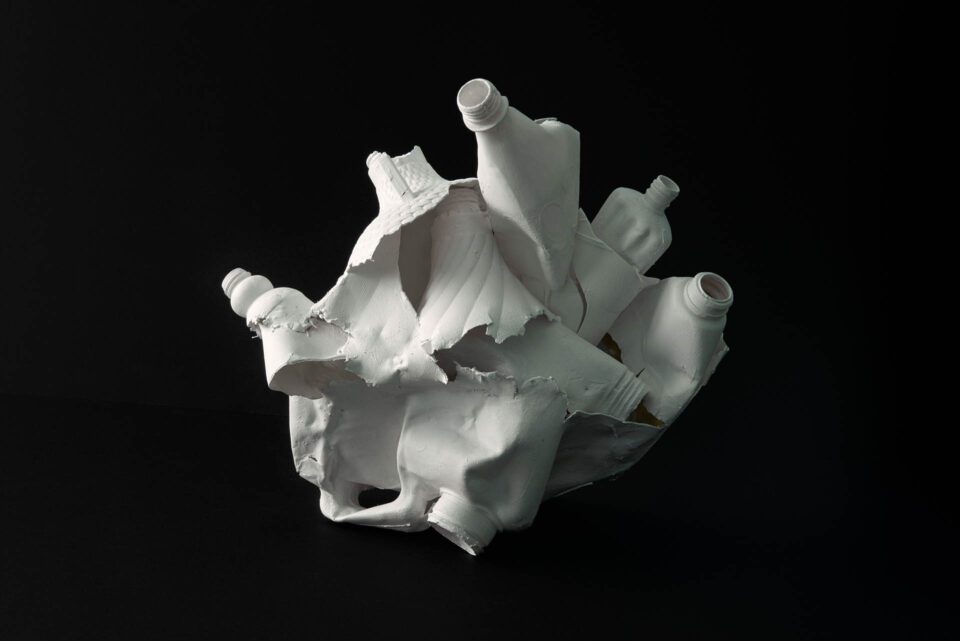
A: Are there any other contemporary artists – or environ- mental activists – whom particularly inspired the project?
TS: The idea really came out of a place where, due to my health, I could not work in advertising anymore and I was so bored. I had already been collecting these bittersweet, beau- tiful pieces of plastic from the beaches. One day, I was look- ing around my shed and I started to rearrange them. Sud- denly, I was forming my first still lives. I hadn’t made a still life composition since graduating from the Royal Academy of Art in The Hague in 1996, but it felt like being back there.Since then, I have become familiar with the work of Mandy Barker – she is a brilliant contemporary artist who collabo- rates closely with scientists to make art from waste plastics.
A: What are some of the most surprising, or worrying, finds you’ve made on beaches? What have you learned during the time you’ve been working on these images?
TS: The tide brings in the same sized objects at the same time, due to their weight and shape. So, plastic bags become tan- gled up with the seaweed, and tiny pieces settle like confetti on the white sand. There really is nothing to celebrate here.
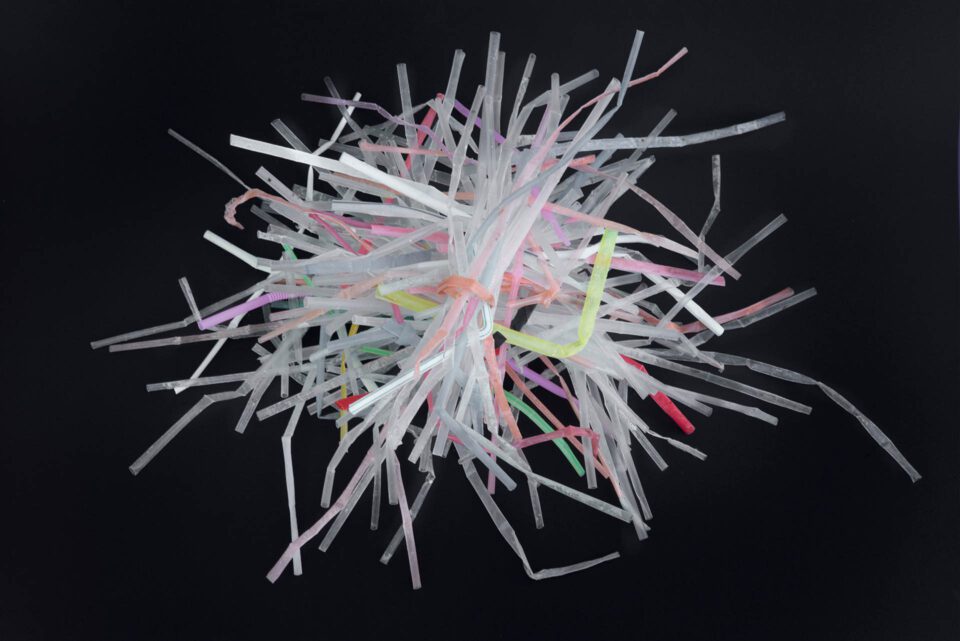
A: Plastic Ocean presents discarded waste in a way that is surprisingly beautiful. How do you achieve the balance between aesthetics and activism in your practice?
TS: When you disguise ugliness with beauty, it enters the mind through another door. Instead of disgusting people with, for example, the view of a cut open seabird’s belly
– which shows the pieces of plastic he ate accidentally – I decided to show the problem in a different way. Personally, I would rather not think about the seabird example, and would hide it in my brain. My images, by contrast, offer minimal and aesthetically pleasing compositions which, on closer inspec- tion, instil the same sense of ecological grief. Plastic Ocean questions consumption, idolatry and what it is we value in our lives today. The effect is a quirky, playful and pop art paradox: the pictures show a clash between worlds. At a first glance, the debris does not repulse us. On the contrary, its dainty appearance almost seems to gloss over the ugliness of the plastic pollution on beaches. But only for an instant. Our initial attraction soon fades, but the message remains.
A: Awareness of plastic pollution has grown since you first started working on the series. What has the public response to the collection been like, and has it affected your own life in any way? Do you see the project as a form of protest, education, or something else entirely?
TS: All the above. At the same time, it is a journey of personal growth. There is no consistent way of consuming and dispos- ing of our goods anymore. Of course, there never was, but now we are aware we cannot turn away. In my own life, I am trying to buy only what I need and, when I do feel tempted to purchase something, I will wait a day, and the urge is gone. The project has been published in Aperture, Dazed, Elle, i-D, Ignant , Kinfolk, The Guardian, The Sunday Times, Vice, Vogue and many others. Moreover, I’ve talked to so many other concerned people who are experiencing the same feelings as me, which has given me the sense that I am not alone in this.
A: You’re featured in Saatchi’s major new display Flowers – Flora in Contemporary Art & Culture. Can you tell us about the pieces you are showing as part of the line-up? Beyond the exhibition, what’s next for you? Are there any new materials, ideas, or techniques you’d like to try out?
TS: I am showing an early sculpture originally made for Vogue China. It is a buoy set on its side, to which I have at- tached a small bottle and a top, as well as cut-out paper flow- ers. The other is one of the first works I did in the garden: a still life of fallen hibiscus flowers and pieces of plastic bottle. In terms of the future for me and my practice: I have been making paintings, in which I include figures that represent myself and the people around me. They translate the per- sonal and ecological grief that I am going through right now.
Flowers | Saatchi Gallery, London | Until 5 May
Words: Eleanor Sutherland
Image credits:
1. Thirza Schaap, Le Déjeuner sur l’Herbe Too, from Plastic Ocean. © Thirza Schaap.
2. Thirza Schaap, Le Déjeuner sur l’Herbe Too, from Plastic Ocean. © Thirza Schaap.
3. Thirza Schaap, Lotus, from Plastic Ocean. © Thirza Schaap.
4. Thirza Schaap, Bluebird, from Plastic Ocean. © Thirza Schaap.
5. Thirza Schaap, Crumple, from Plastic Ocean. © Thirza Schaap.