

Images do not just preserve history; they shape what survives of it. In Parallax, a major exhibition at Jeu de Paume, Stan Douglas examines how cinema, photography and sound construct collective memory, exposing the omissions and ideological assumptions embedded in familiar accounts of the past. Across four decades of work, the Vancouver-based artist returns to a central question: what becomes visible when history is viewed from another position? Bringing roughly 40 works, the exhibition challenges the authority of the image, revealing how historical narratives are revised through technology, representation and cultural exchange. Instead of offering definitive answers, Douglas creates space for other perspectives, unsettling the distinction between what is remembered, what is recorded and what has been erased.
Running until 10 January 2027, Parallax traces the evolution of this practice from the late 1980s to the present-day. Its title refers to the apparent displacement of an object when viewed from other positions, establishing perception as both a subject and a critical method. Every historical account is shaped by the conditions through which it becomes visible, whether institutional, political or technological. Douglas makes these conditions central to his work, examining how images acquire authority and how certain outlooks come to dominate public consciousness. Curated by Gloria Moure and Marta, the exhibition brings film, video installations and photography to explore these concerns across different historical moments, showing the consistency of an artistic practice refusing to treat the past as a closed narrative.
Cinema is fundamental to this investigation. In Overture (1986), one of Douglas’s earliest fully realised experiments with editing, railway technology intersects with involuntary memory and the conventions of early filmmaking. The work establishes an enduring interest in the relationship between technological change and the ways experience is organised, suggesting that new media do not merely represent reality but alter its perception. Subsequent installations, including Der Sandmann (1995), Suspiria (2003) and The Secret Agent (2015), extend this enquiry through layered narratives and carefully constructed temporal dislocations. Rather than using cinema as a transparent window onto events, Douglas exposes its capacity to manipulate sequence, perspective and expectation. His images reveal the medium’s artifice while demonstrating how readily its constructions become accepted as truth.
This attention to representation places Douglas within a wider critical discourse concerned with the politics of the archive. Historical records are often understood as repositories of evidence, yet the process of collecting, preserving and interpreting material is never entirely neutral. Institutional priorities determine what is retained, while dominant cultural narratives influence which experiences receive recognition. Douglas works within the gap between historical documentation and its omissions, creating images that appear authoritative while exposing the limits of their own claims. His reconstructions do not simply restore missing information; they question the assumption that the archive can ever provide a complete account. In this sense, the artist’s practice resonates with postcolonial and critical historiographic approaches that examine how power shapes collective memory, asking not only what history records, but whose experiences its records are permitted to represent.
Music offers a particularly revealing way into these questions. In Hors-champs (1992), a group of American musicians performs in a French recording studio, transforming collective improvisation into a meditation on diaspora, political identity and creative exchange. The performance unfolds through the interaction of individual voices, with no single gesture able to determine the direction of the whole. Its structure becomes a model for understanding culture as an evolving process rather than a stable expression of national identity. Douglas also draws attention to the circumstances surrounding artistic production, where migration, racial inequality and political histories shape the possibilities of collaboration. Music is not incidental to the work’s meaning; it becomes the means through which social relationships are negotiated, revealing how cultural forms develop across borders and generations.
A fictional recording session provides the setting for Luanda-Kinshasa (2013), which evokes the transatlantic musical exchanges associated with the 1970s. Musicians perform within a meticulously reconstructed studio environment, generating a scene that feels historically plausible without claiming to document an actual event. The distinction is important. Douglas uses fiction not to obscure history, but to illuminate the cultural conditions that conventional documentation may leave incomplete. The work evokes the movement of musical ideas between Africa and the Americas, drawing attention to the interconnected histories that underpin modern popular music. Its extended, improvisational structure resists a conventional beginning, climax and conclusion, allowing the viewer to encounter cultural production as an ongoing process. History, therefore, begins to emerge through various relationships and repetitions, rather than through a singular event that can be isolated and explained.
The political urgency of this approach becomes particularly apparent in ISDN (2022), which stages imagined exchanges between rappers in London and Cairo against the backdrop of the Arab Spring and the unrest that followed the police killing of Mark Duggan in the UK. These geographically distinct contexts meet through music, creating a dialogue shaped by political resistance, racialised experience and the circulation of cultural expression. Multiple permutations prevent the installation from settling into a single interpretation, while its structure reflects the fragmented ways contemporary events are experienced through media. Images, sounds and narratives travel across borders at extraordinary speed, yet their circulation does not guarantee understanding. By refusing a definitive resolution, Douglas resists the simplification of political experience into easily digestible narratives. Instead, he allows competing perspectives to remain in tension, making uncertainty a productive condition for critical thought.
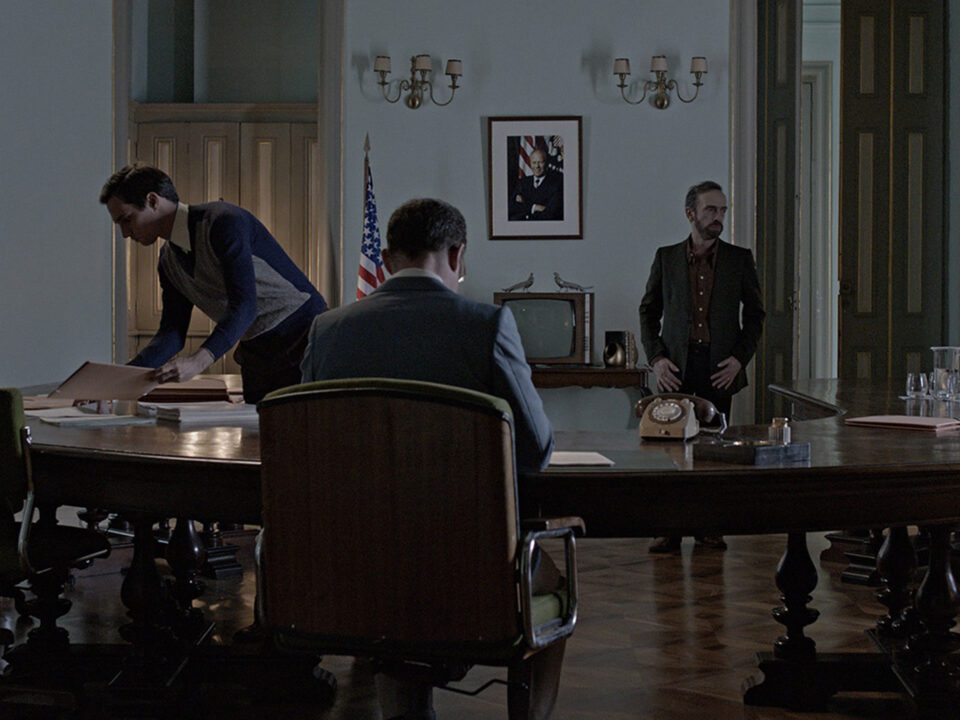
Repetition also governs Douglas’s narrative installations, where familiar events are continually rearranged to expose the contingency of their outcomes. In Inconsolable Memories (2005) and The Secret Agent (2015), stories unfold through combinations of fragments, unsettling the expectation that narrative should move towards a single resolution. Each variation alters the relationship between actions and consequences, suggesting that what appears inevitable in retrospect may once have been uncertain.
This strategy challenges deterministic accounts of history, in which events are arranged into coherent sequences that obscure the alternatives available at the time. Here, the formal complexity is inseparable from the political implications. By making different versions of a story perceptible, Douglas creates a space in which the past can be reconsidered without pretending that it can be definitively rewritten.
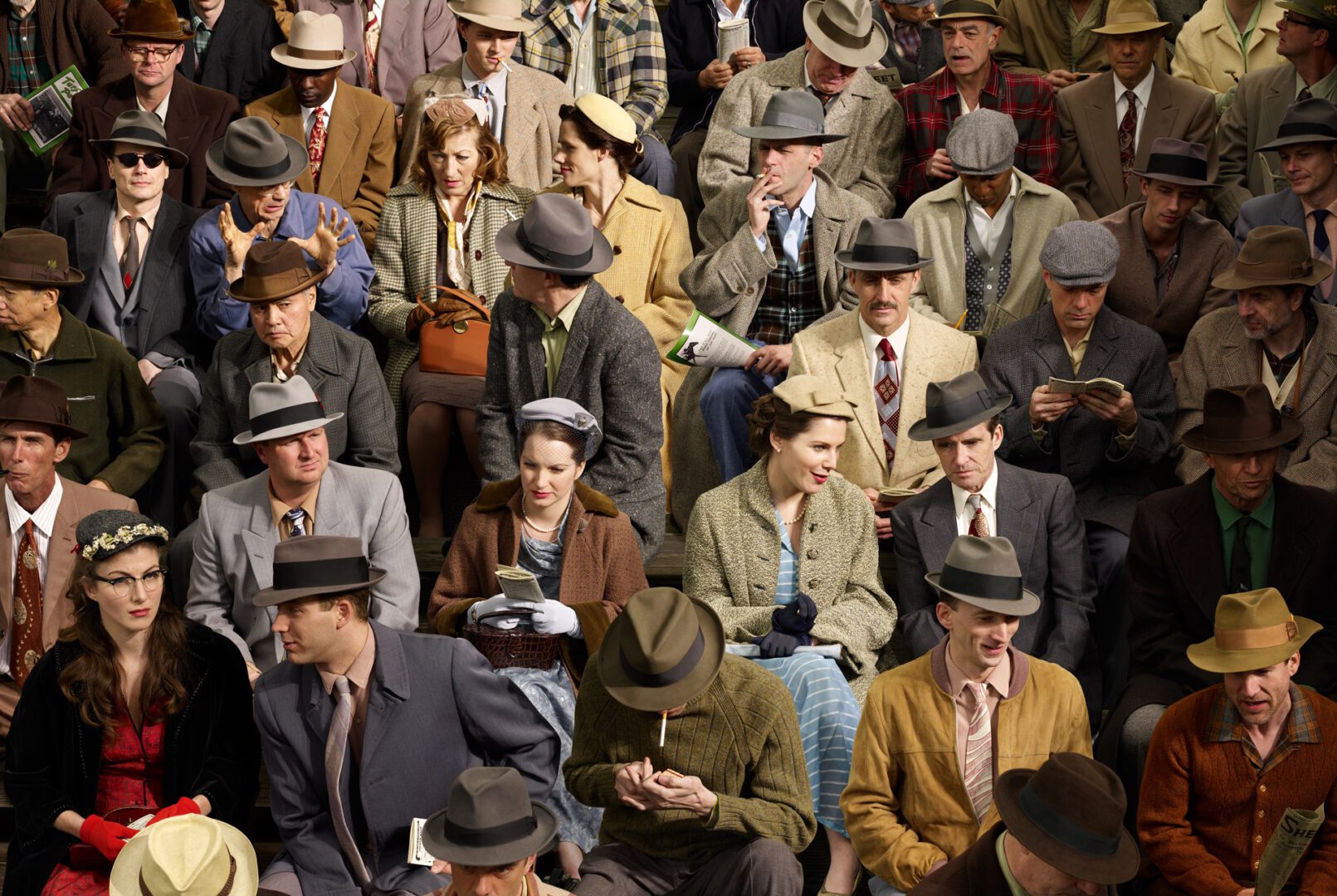
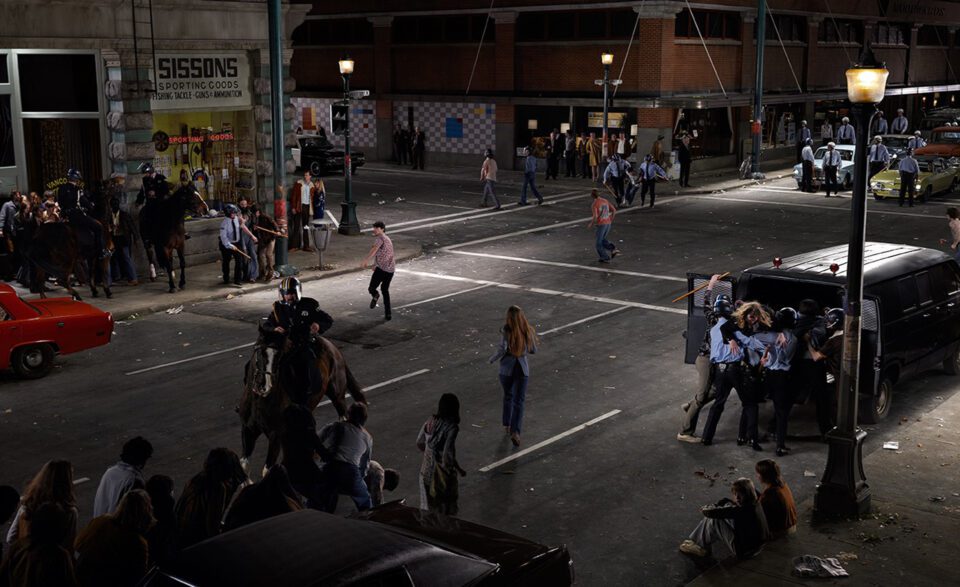
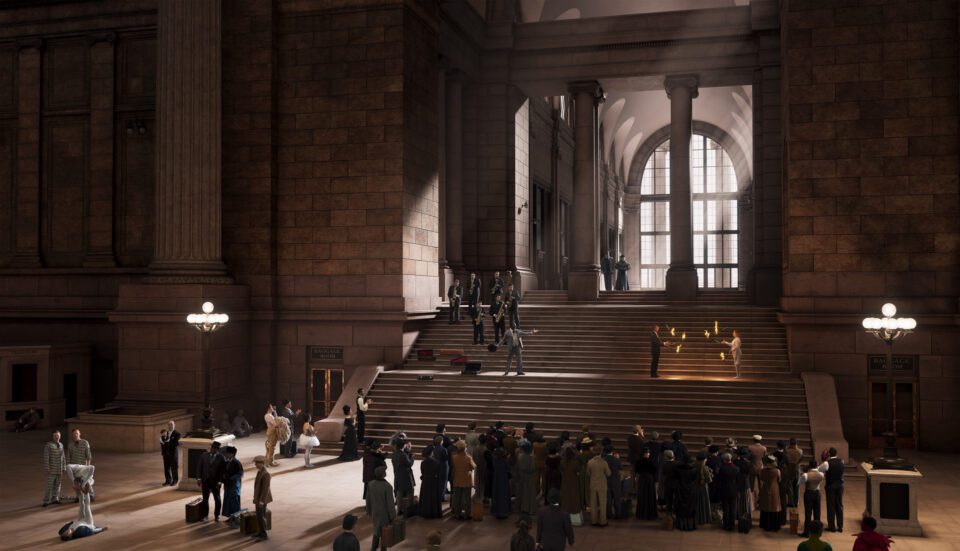
Photography brings these concerns into sharper focus by confronting the apparent authority of the still image. Across series including Crowds and Riots (2008), Midcentury Studio (2010–2011), Nocturnes (2014–2015), DCTs (2016–2017) and 2011 ≠ 1848 (2017–2021), Douglas constructs scenes that possess the precision of documentary photography while resisting its conventional claims to evidence. Some depict places that have disappeared; others recreate historical moments that were never recorded in the form presented. Their detail encourages belief, even as their constructed nature unsettles it. In an image culture increasingly shaped by digital manipulation and synthetic media, this tension carries particular significance. Douglas does not simply ask whether an image is authentic. Instead, he questions how it is that authenticity goes about being produced, recognised and used to establish authority.
These questions converge in Birth of a Nation (2025), presented in France for the first time at Jeu de Paume. Reworking D. W. Griffith’s 1915 film, Douglas confronts a foundational work of American cinema whose technical innovations are inseparable from its racist depiction of Black Americans and its glorification of the Ku Klux Klan. Griffith’s film demonstrates how cinematic form can reinforce ideological power, transforming racist mythology into an influential cultural narrative. Douglas’s intervention returns attention to the relationship between representation and exclusion, questioning the historical authority that cinema has helped establish. Revisiting such material also raises difficult questions about the afterlife of images: how can a work be understood critically when its formal achievements have become embedded in a history of racial violence? Rather than resolving this contradiction, Douglas makes it central to the viewing experience, exposing the persistence of ideology within cultural memory.
The exhibition’s curatorial framework brings these different strands into dialogue, tracing the development of Douglas’s methods without reducing them to a single medium or argument. The movement between film, photography and sound reveals how questions of historical construction change according to the technologies through which they are explored. Although the works emerge from distinct cultural and political contexts, their shared attention to repetition, reconstruction and perspective creates a coherent critical framework. The inclusion of Birth of a Nation is especially significant within this broader trajectory, bringing the politics of representation into direct confrontation with the history of cinema itself. Rather than presenting a retrospective as a straightforward chronology, Parallax encourages connections across time, allowing earlier experiments to acquire new meanings alongside more recent works. Its scope demonstrates that Douglas’s interest in historical possibility is not simply a recurring theme, but a method through which the conditions of seeing and remembering are continually examined.
Parallax asks viewers to take under reconsideration their own relationship with images and the histories they appear to confirm. Douglas’s work reveals that looking is never an entirely passive act: every image carries assumptions about what deserves attention, whose experiences matter and which narratives are allowed to endure. These questions become increasingly urgent in a media landscape where visual evidence can be manipulated, historical claims contested, and collective memory shaped by competing forms of authority. Yet Douglas offers neither a simple rejection of images nor the promise of an objective alternative. His work instead insists on the necessity of sustained scrutiny, acknowledging that the past cannot be recovered in its entirety while refusing to accept its established representations as final. History remains open to reinterpretation, not because every account is equally as valid, but because understanding depends on recognising what any single perspective has the potential of leaving out.
Stan Douglas: Parallax is at Jeu de Paume, Paris, until 10 January.
Words: Simon Cartwright
Image Credits:
1. Stan Douglas, Hastings Park, 16 July 1955, 2008. From the Crowds and Riots series, 2008. Digital chromogenic print mounted on Dibond aluminium.
2. Stan Douglas, Abbott & Cordova, 7 August 1971, 2008. From the Crowds and Riots series, 2008. Digital chromogenic print mounted on Dibond aluminium.
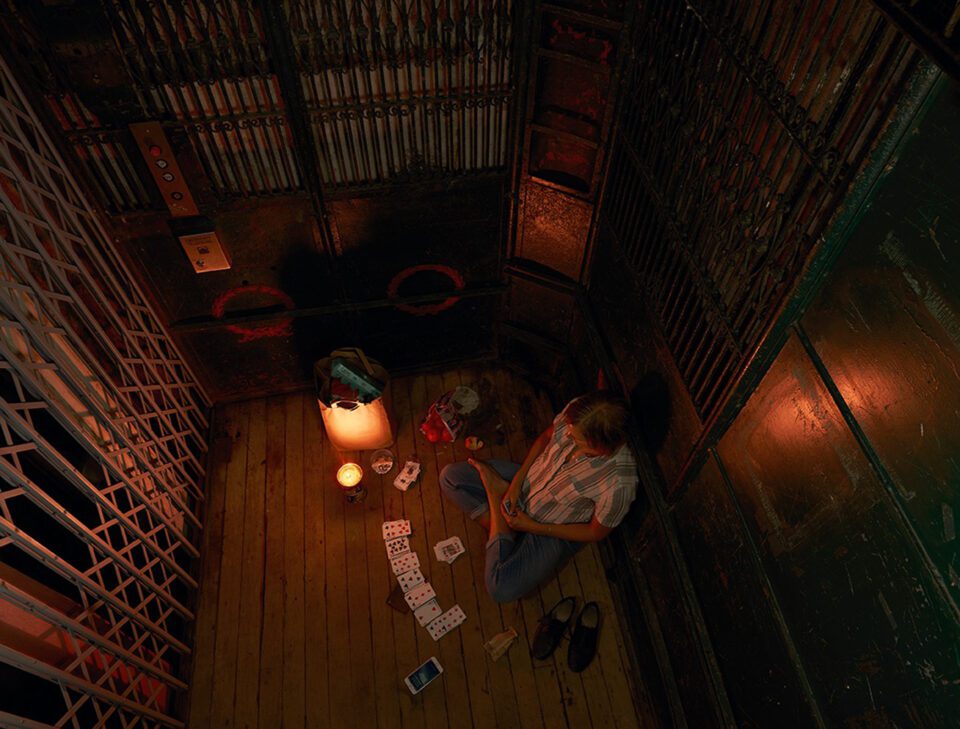
3. Stan Douglas, Solitaire 2017, 2017. From the Scenes from the Blackout series. Digital chromogenic print mounted on Dibond aluminium.
4. Stan Douglas, Video Still, The Secret Agent, 2015. Six-channel video installation with eight audio channels or two-channel video installation with four audio channels Colour, sound, 6 musical variations, 53 min 35 sec, loop.
5. Stan Douglas, 2 March, 1914, 2021. From the Penn Station’s Half Century series, 2021. Digital chromogenic print mounted on Dibond aluminium.


