

Can technology recover what modernity has taught us to overlook? Mariko Mori’s art returns to this question through digital fantasy, Buddhist cosmology and encounters with the natural world, testing the boundaries between scientific knowledge and spiritual belief. Her retrospective, All That Shines, opening at Tokyo’s Mori Art Museum on 31 October 2026, brings over three decades of work into a dialogue about consciousness, mortality and humanity’s place in the universe. Yet its most compelling offer is not that art can reconcile these seemingly disparate worlds, but that their relationship remains unresolved. Mori’s pursuit of interconnectedness offers a vision of existence beyond the isolated individual, while raising a difficult question about what might be lost when difference is absorbed into a universal whole.
Emerging internationally during the 1990s, Mori developed a visual language attuned to a culture increasingly shaped by digital images, consumer spectacle and technological fantasy. In works such as Play with Me (1994) and Birth of a Star (1995), she transformed herself into an uncanny presence within familiar urban environments, drawing on animé, video games, fashion and cosplay. These constructed identities anticipate a world in which the body is continually mediated through screens, images and commercial ideals. Rather than simply celebrating the possibilities of technological transformation, however, Mori exposes its contradictions: the promise of self-invention remains entangled with the visual codes through which femininity is produced and consumed. Her early work consequently offers more than a futuristic aesthetic; it questions who controls the images through which identity becomes legible.
That tension becomes particularly apparent in the Cyborg series (1994-1995), where Mori inhabits the space between human subject and manufactured spectacle. Her futuristic personas disrupt ordinary urban life, appearing at once alluring, artificial and estranged from their surroundings. The body becomes a site upon which competing ideas of femininity, technological progress and cultural belonging are projected. Such imagery complicates any straightforward distinction between liberation and objectification, since the power to reinvent oneself does not necessarily mean escaping the structures that shape representation. Read today, these works resonate with debates about post-humanism and digital identity, but they also retain a distinctly critical relationship to consumer culture. Their questions do not disappear when Mori turns towards spirituality; they establish a tension that her later pursuit of transcendence must negotiate.
Buddhist cosmology offered another framework through which Mori could reconsider the boundaries of the self. In the Esoteric Cosmos series (1996-1998), digitally manipulated images position the artist in deified forms against remote landscapes, drawing on religious iconography to imagine states of consciousness beyond the everyday human experience. The technology that previously enabled the construction of a futuristic persona now becomes a means of visualising spiritual transformation. This shift unsettles familiar oppositions between a technologically advanced present and supposedly less modern systems of belief. Digital imaging does not simply reproduce an ancient worldview; it mediates that worldview through contemporary visual culture. The resulting images therefore invite a question that runs throughout Mori’s practice: can new technologies open meaningful encounters with inherited traditions, or do they inevitably reshape those traditions according to the desires of the present?
Mortality provides an intimate point of entry into this enquiry. In Link (2000), Mori appears in a transparent Plexiglas capsule, her motionless body set against views of 13 locations associated with different periods of human history. Antiquity, the present and the imagined future coexist in an installation that resists the usual separation of past, present and future. Drawing on Buddhist ideas of transmigration, the work suggests that existence might be understood through cycles of transformation not a succession of beginnings and endings. Its restrained imagery also complicates the spectacle of Mori’s earlier work, introducing a contemplative dimension to her interest in technologically constructed spaces. Here, the apparatus does not merely manufacture an alternative identity; it becomes a vehicle for questioning whether the individual can be understood in isolation from the histories and systems that surround them.
The relationship between individual consciousness and collective existence takes a more literal form in Wave UFO (1999-2002). Developed using brainwave biofeedback, the large-scale installation translates participants’ brain activity into projected imagery, placing the experience of consciousness in an immersive, shared environment. Its biomorphic architecture evokes a vessel from speculative fiction, yet its ambition extends beyond the visual language of technological futurism. Mori uses scientific instrumentation to approach a philosophical premise: that apparently separate minds might participate in a wider network of existence. The work reveals the dependancy its conceptual ambition has upon a technological system that cannot establish the metaphysical claims surrounding it. Its value lies in making the relationship between private experience and collective imagination available for consideration.
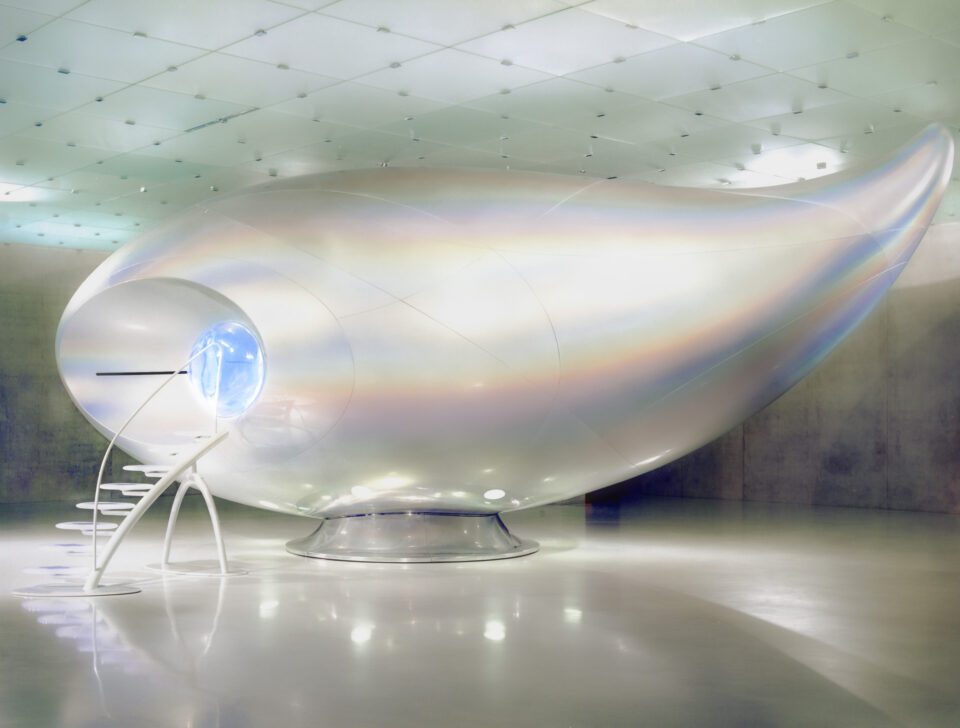
Such distinctions matter in a contemporary art world increasingly drawn to immersive environments, interactive technologies and experiences designed to exceed ordinary perception. Participation can encourage reflection, but it can also become a spectacle, with technical complexity mistaken for conceptual depth. Wave UFO occupies this uncertain territory, asking audiences to consider whether a sensory encounter might alter their understanding of consciousness without promising a definitive answer. Mori’s investment in scientific collaboration gives the work a material grounding, while its spiritual aspirations remain interpretative. This productive friction is more interesting than any suggestion that science and Buddhism ultimately describe the same reality. Their coexistence instead reveals the different ways human beings seek to comprehend phenomena that resist immediate understanding.
A further shift occurs when Mori moves beyond the body towards geological time, archaeological sites and the cosmologies of prehistoric cultures. The exhibition’s Ancient Future section connects her research into Jōmon and Celtic traditions with contemporary investigations of the universe, challenging the assumption that the ancient belongs to a superseded past. In Tom Na H-iu (2006), real-time neutrino data from Japan’s Super-Kamiokande observatory generates luminous flashes within a sculptural structure, making otherwise imperceptible cosmic events available to human perception. The work does not illustrate the universe so much as establish a point of contact with processes that exceed ordinary sensory experience. Light becomes both a material phenomenon and a means of thinking about the limits of knowledge. Yet the encounter also raises a cultural question: how can ancient traditions engage with scientific research without reducing their distinct histories to interchangeable expressions of universal wisdom?
This question becomes increasingly important as museums reconsider the cultural assumptions underpinning the presentation of global art. Indigenous knowledge systems and non-Western philosophies have often been marginalised by narratives that privilege Western scientific rationality as the primary measure of intellectual progress. Mori’s work offers a challenge to that hierarchy, proposing that different traditions might contribute to a more expansive understanding of existence. Nevertheless, the language of interconnectedness carries its own risks when cultural distinctions become subordinate to a single metaphysical vision. Jōmon and Celtic histories cannot be treated simply as evidence of an underlying human desire for cosmic harmony. Their meanings emerge from specific material, social and ceremonial contexts, which resist easy translation into universal principles. Mori’s practice is most critically engaging when these differences remain visible rather than dissolving entirely into the promise of Oneness.
The retrospective’s curatorial framework will shape how these tensions are understood. Co-curated by Alexandra Munroe, Senior Curator at Large, Global Arts, at the Solomon R. Guggenheim Museum and Foundation, and Kataoka Mami, Director of the Mori Art Museum, the exhibition brings about 40 works together across five sections. Its progression from post-human identity towards spiritual inquiry and ecological connection offers a clear account of Mori’s evolving concerns. However, chronology cannot fully explain the relationship between her early critique of constructed identities and later investment in universal consciousness. Archival material, research notebooks, drawings and studio documentation promises a more complex view of the practice, showing how ideas develop through sustained investigation. Instead of presenting the later works as the inevitable culmination of the earlier ones, this material could encourage viewers to recognise the contradictions and continuities across Mori’s career.
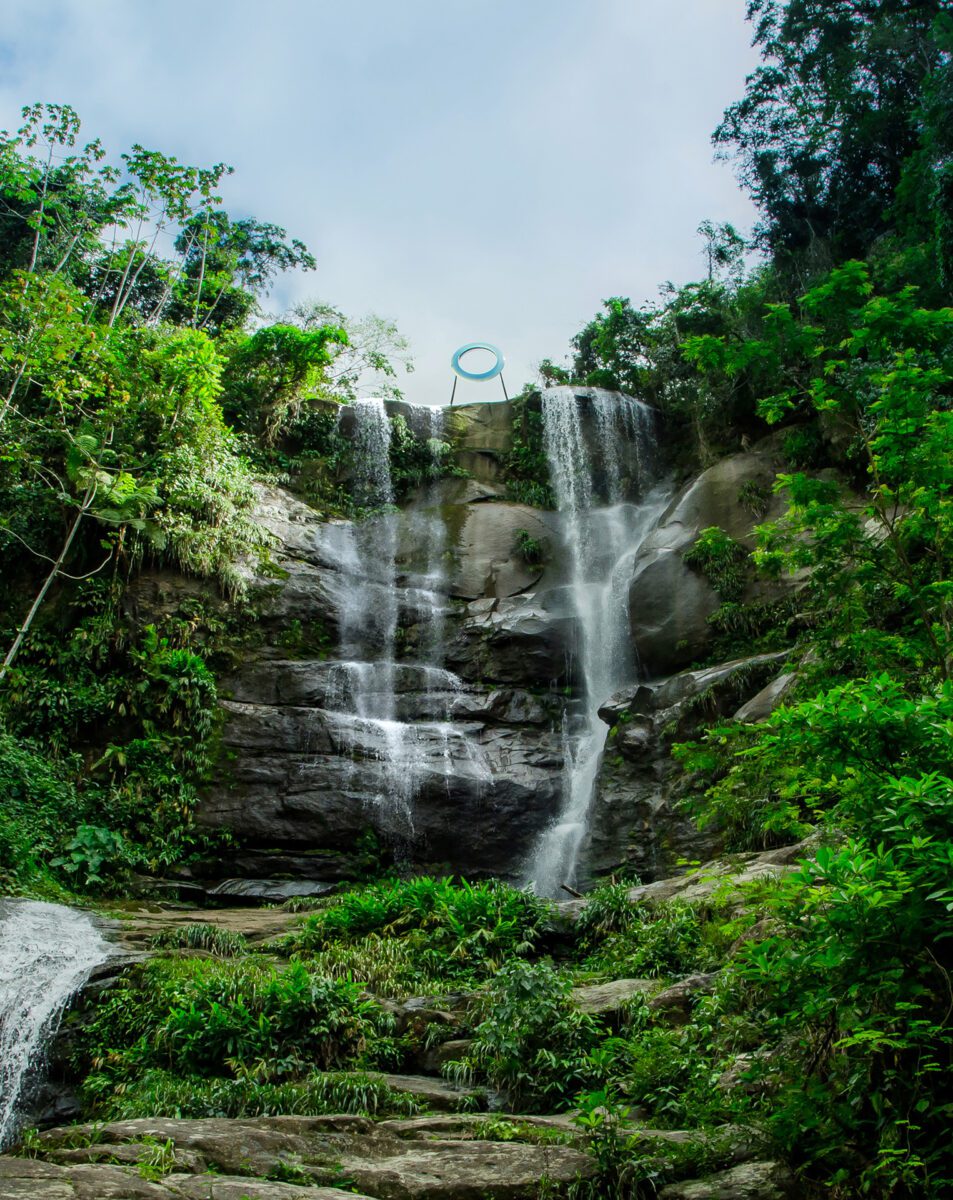
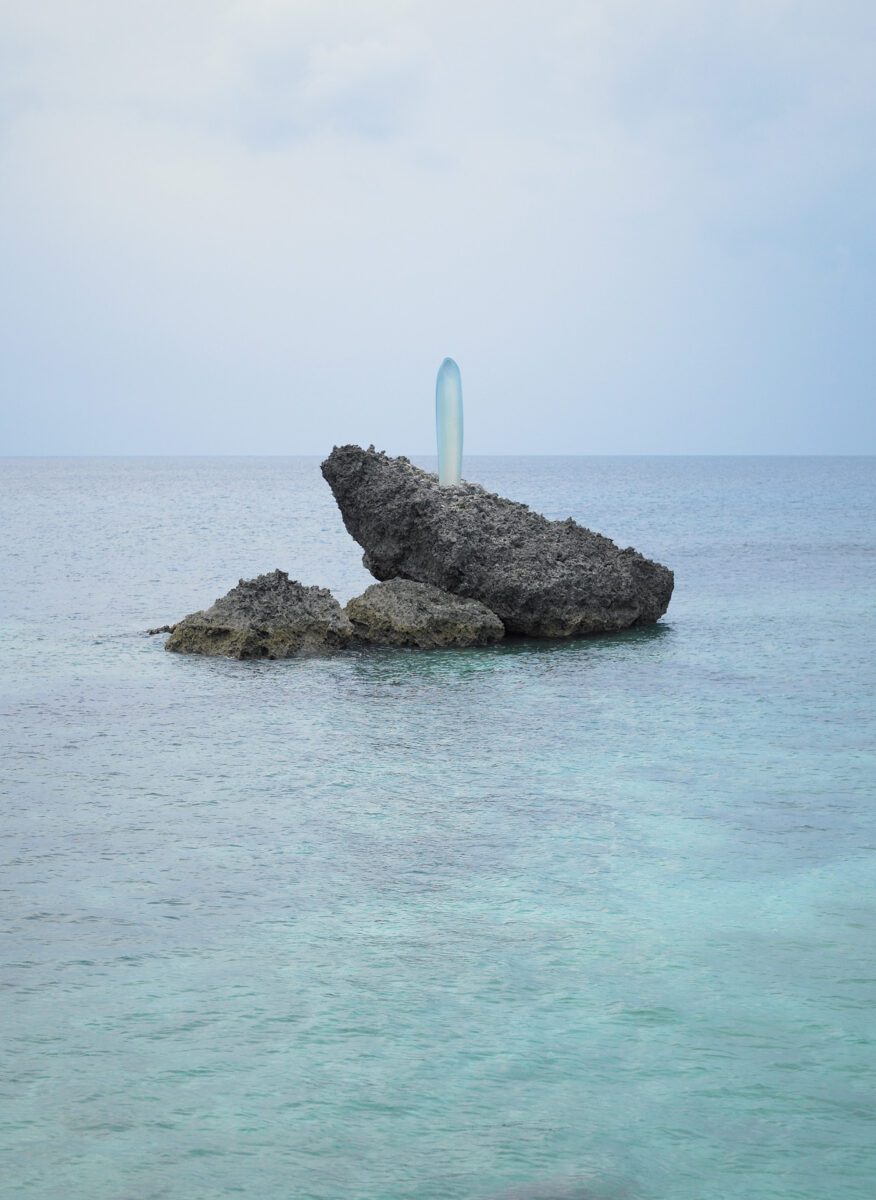
Outside the museum, these ideas acquire a different implications through the Faou Foundation, established by Mori in 2010 to develop public artworks connecting humanity with nature. Primal Rhythm: Sun Pillar (2011), installed on Miyako Island, and Ring: One with Nature (2016), created in Rio de Janeiro, relate sculptural form to celestial movements and landscapes. Their placement shifts attention from the autonomous artwork towards the environmental and communal conditions of its encounter. The ambition is significant as ecological crisis demands alternatives to models of human mastery over nature. Mori proposes attentiveness to planetary cycles as a counterpoint to technological acceleration. Yet a sense of harmony cannot, on its own, address the political and economic structures responsible for environmental destruction; ecological interdependence is a starting point for criticism, not a substitute for it.
The exhibition’s final emphasis on these projects consequently brings Mori’s metaphysical concerns into contact with contemporary ecological discourse. Its presentation of Peace Crystal, shown at the 60th Venice Biennale in 2024 and planned for installation in Ethiopia, extends the geographical scope of this ambition. Alongside footage of the foundation’s projects and the ocean surrounding Mori’s Miyako Island studio, the works establish connections between the museum and environments beyond its walls. This movement outward is central to the exhibition’s argument, suggesting that art might encourage a different relationship with the world rather than merely offer an image of it. At the same time, the distinction between proposing connection and producing meaningful change remains important. The most valuable question is not whether art can symbolise ecological unity, but how such symbolism might influence the different ways in which people perceive their responsibilities to the places they inhabit.
All That Shines presents a practice shaped by the conviction that existence exceeds the boundaries of the individual body, historical period and disciplinary framework. Mori’s movement between digital fantasy, Buddhist thought, scientific research and environmental sculpture challenges the assumption that technological innovation must be separated from spiritual reflection. However, her pursuit of universality also exposes the difficulties of reconciling different systems of knowledge without diminishing their specificity. The retrospective’s critical potential lies in allowing these tensions to remain active, rather than resolving them into a reassuring narrative of transcendence. In an era defined by technological acceleration and ecological uncertainty, Mori offers no simple escape from the contradictions of modern life. Instead, her work asks whether imagining a more interconnected world might begin with recognising not only what binds us together, but also what remains irreducibly different.
Mariko Mori: All That Shines is at Mori Art Museum, Tokyo, from 31 October – 28 March.
Words: Simon Cartwright
Image Credits:
1. Mariko Mori, Ring: One with Nature, 2016. Layered acrylic, stainless steel, and concrete 618 x φ300 cm. Courtesy: Faou Foundation, New York. Installation view: Cunhambebe State Park, Rio de Janeiro, Brazil. Photo: Stephanie Leal.2. Mariko Mori, Primal Rhythm: Sun Pillar, 2011. Layered acrylic, stainless steel, and concrete 420 x φ76 cm. Courtesy: Faou Foundation, New York. Installation view: Nanako Bay, Miyako Island, Japan. Photo: Richard Learoyd.
3. Mariko Mori, Wave UFO, 1999-2002. Brainwave interface, vision dome, projector, computer system, fiberglass, Technogel, acrylic, carbon fiber, aluminum, and magnesium 528 x 1134 x 493 cm. Installation view: Mariko Mori: Wave UFO, Kunsthaus Bregenz, Austria, 2003 Photo: Richard Learoyd.
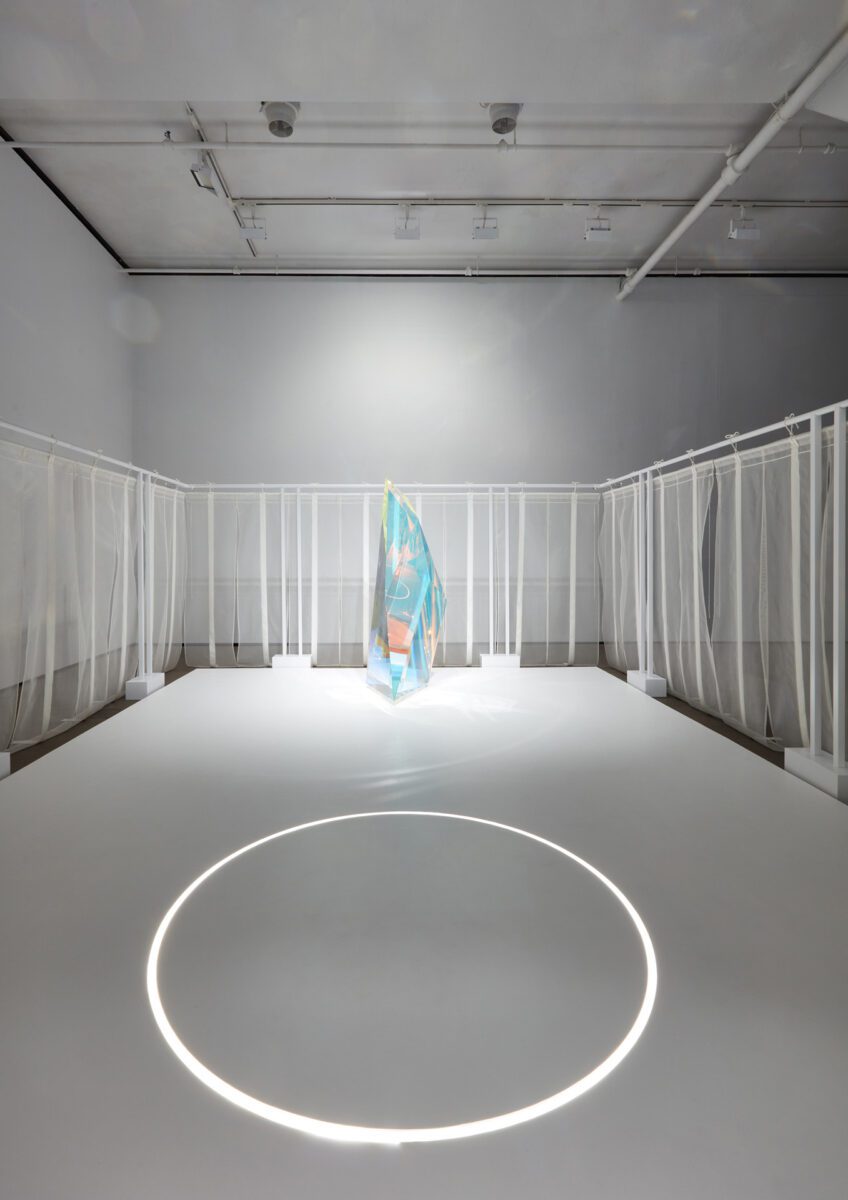
4. Mariko Mori, Shrine (detail), 2025. Silk, aluminum, wood, two dichroic coated acrylic sculptures, and Corian base 190 x 920 x 480 cm. Installation view: Mariko Mori: Radiance, Sean Kelly, New York, 2025. Photo: Jason Wyche Photo courtesy: Sean Kel


